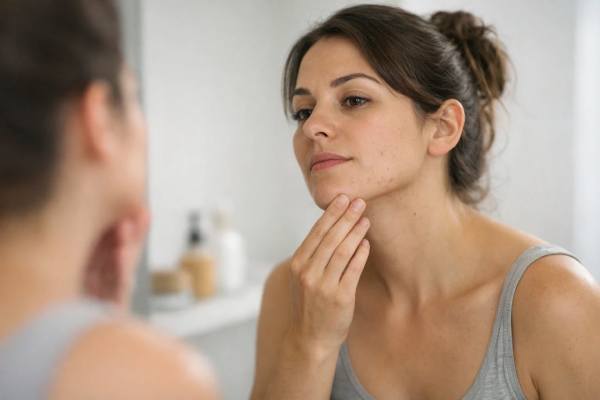
Androgen excess can be frustrating because it often shows up first in the mirror, not on a lab report. A few new coarse chin hairs, acne that lingers well past the teen years, thinning hair at the crown, or periods that grow unpredictable may seem unrelated at first. Yet together, they can point to a pattern worth taking seriously. In women, androgen excess usually means that hormones such as testosterone are higher than expected for that person, or that the skin and hair follicles are responding more strongly to normal levels.
The most common cause is polycystic ovary syndrome, but it is not the only one. Some cases are mild and gradual. Others need faster evaluation, especially if symptoms appear suddenly or become severe. The goal is not simply to “lower testosterone.” It is to identify the cause, rule out rare but important red flags, and choose treatments that improve skin, hair, cycles, and long-term health in a way that fits your life.
Quick Facts
- Gradual acne, facial hair growth, and scalp thinning often improve when the underlying hormone pattern is identified and treated early.
- Treatment usually works best in layers, with skin or hair care, hormone-targeted therapy, and metabolic support used together when needed.
- Rapid symptom onset, deepening voice, or new symptoms after menopause should be assessed promptly rather than watched at home.
- Hormonal treatments for excess hair and acne often need 3 to 6 months before the full benefit is clear.
Table of Contents
- What Androgen Excess Actually Means
- Symptoms and Red Flags
- Common Causes Behind It
- How the Workup Is Done
- Treatment Options That Help
- When Specialist Care Matters
What Androgen Excess Actually Means
Androgens are often described as “male hormones,” but that shorthand is misleading. Women also make androgens, mainly in the ovaries, adrenal glands, and peripheral tissues. These hormones help regulate normal biology, including libido, bone health, and hair follicle activity. Problems arise when levels are clearly elevated, when certain androgen pathways become overactive, or when hair follicles and oil glands become unusually sensitive to those signals.
In practical terms, androgen excess can be clinical, biochemical, or both. Clinical androgen excess means the body is showing signs such as hirsutism, acne, scalp hair thinning, or, in more severe cases, virilization. Biochemical androgen excess means blood testing shows elevated androgen levels. The two do not always line up neatly. Someone may have bothersome symptoms with labs in the normal range, especially if the issue is heightened tissue sensitivity or if testing methods are not precise enough. Another person may have elevated lab values with only mild visible symptoms.
It also helps to separate similar-sounding terms. Hirsutism means coarse, pigmented terminal hair in a male-pattern distribution, such as the chin, upper lip, chest, abdomen, or inner thighs. That is different from hypertrichosis, which is more generalized excess hair growth not driven by androgens. Acne related to androgen excess often appears along the jawline, chin, chest, or back and may persist into adulthood. Hair loss tends to show up as widening of the part or thinning at the crown rather than the sharply receding hairline more typical in men.
Androgen excess is not a diagnosis by itself. It is a signal to ask why it is happening. In most reproductive-age women, the answer is a common condition such as polycystic ovary syndrome, but that should never be assumed automatically. The pattern of symptoms, how fast they appeared, menstrual history, age, and lab results all matter.
A useful way to think about it is that androgen excess sits at the intersection of skin, hair, reproductive health, and metabolism. Many people first seek help for acne or facial hair, then realize the same hormone pattern may also be linked to irregular periods, ovulation problems, insulin resistance, or weight changes. When cycles have also become unpredictable, it can help to look at the broader picture of why periods go off schedule rather than treating each symptom as a separate problem.
Symptoms and Red Flags
The classic symptoms of androgen excess are acne, increased facial or body hair, and scalp hair thinning, but the full picture is often broader. Some women notice oily skin, more frequent breakouts around the jawline, or stubborn acne that resists standard topical treatment. Others focus more on chin hairs, sideburn growth, darker abdominal hair, or a widening part line that was not there a year ago. Menstrual changes are common too, especially if the underlying cause affects ovulation.
Typical symptoms can include:
- coarse hair growth on the upper lip, chin, chest, lower abdomen, or thighs
- adult acne, especially on the lower face, chest, or back
- scalp hair thinning at the crown or along the part
- irregular, infrequent, or absent periods
- trouble ovulating or difficulty becoming pregnant
- oily skin and faster regrowth of unwanted hair after removal
Gradual symptoms are more common than dramatic ones. A slow rise in chin hairs over several years, persistent acne since the twenties, or a long history of irregular cycles often points toward a chronic endocrine pattern rather than an emergency. Even then, the symptoms can be emotionally heavy. Facial hair and acne may affect confidence, work life, intimacy, and mental health in ways that are easy for others to underestimate.
Red flags matter because they suggest the cause may not be routine. Rapid onset over months rather than years deserves attention. So does virilization, which is stronger androgen effect than ordinary hirsutism. This may include a deepening voice, increased muscle bulk without training, loss of breast tissue, clitoral enlargement, or rapidly progressive scalp hair loss. New androgen excess after menopause is also more concerning than a stable pattern that began years earlier.
Signs that should prompt quicker medical review include:
- symptoms that appear suddenly or worsen fast
- voice deepening or clitoral enlargement
- new severe symptoms after menopause
- very irregular periods combined with rapidly changing hair or acne
- marked hair growth with unexpected weight loss, easy bruising, or severe weakness
It is also worth remembering that not all acne or facial hair means a hormone disorder. Some adult acne is not androgen-driven. Some isolated upper-lip or chin hairs are familial or age-related. Some scalp thinning reflects iron deficiency, thyroid disease, or other hair disorders. That is why pattern matters more than any single symptom.
Androgen excess is easiest to miss when symptoms are dismissed as cosmetic. In reality, the visible signs can be the clue that leads to a larger diagnosis. When acne, hirsutism, hair thinning, and cycle changes cluster together, it is reasonable to investigate rather than wait for the picture to become unmistakable.
Common Causes Behind It
Polycystic ovary syndrome is the most common cause of androgen excess in reproductive-age women, but it is only one part of the differential. PCOS often combines androgen excess with irregular ovulation, menstrual changes, and a tendency toward insulin resistance. Not everyone with PCOS has the same body type or symptom mix, which is one reason it can be missed. Some women are lean, ovulate inconsistently, and mainly struggle with acne and excess hair. Others notice weight gain, acanthosis nigricans, or metabolic changes along with skin symptoms.
Idiopathic hirsutism is another possibility. This term is used when someone has excess terminal hair growth but normal androgen levels and regular ovulatory cycles. In those cases, hair follicles may simply be more sensitive to androgens. The symptoms are still real, but the treatment approach may focus more on symptom control than on uncovering a major endocrine disorder.
Other causes are less common but important:
- nonclassic congenital adrenal hyperplasia
- certain medications, including androgenic progestins, testosterone exposure, or anabolic agents
- severe insulin resistance syndromes
- Cushing syndrome
- androgen-secreting ovarian or adrenal tumors
- ovarian hyperthecosis, especially in older women
These rarer causes are more likely when symptoms are severe, rapidly progressive, or accompanied by virilization. Postmenopausal onset raises the level of concern because ordinary PCOS-related patterns usually start earlier in life, even if they were not recognized at the time.
Insulin plays a larger role than many people realize. High insulin levels can stimulate the ovaries to produce more androgens and can lower sex hormone-binding globulin, leaving more free testosterone available to act on skin and hair follicles. That is one reason acne, unwanted hair growth, irregular cycles, and metabolic symptoms often travel together. A closer look at early insulin resistance clues can be helpful when cravings, weight changes, skin darkening, or fatigue are part of the picture.
There are also situations where the cause is mixed rather than singular. A woman may have genetically sensitive hair follicles, mild PCOS, and insulin resistance at the same time. Another may have adult acne that is partly androgen-driven but also worsened by cosmetics, stress, and friction from sports gear or masks. The point is not to force every case into one box. It is to identify the major driver strongly enough to guide treatment.
Most importantly, the most common cause is common, but common is not the same as automatic. Clinicians still need to rule out the less common but more urgent causes, especially when the symptom pattern does not feel typical. That is why history, labs, and pace of symptom onset matter so much.
How the Workup Is Done
A good androgen excess evaluation starts with the story, not the lab slip. Clinicians usually want to know when the symptoms began, how fast they changed, whether periods are regular, what medications or supplements you use, whether there has been weight change, and whether there are signs of insulin resistance, thyroid disease, or cortisol excess. Family history matters too, especially for PCOS, diabetes, and similar hair-growth patterns.
The physical exam often focuses on where excess hair appears, whether acne looks mild or inflammatory, whether scalp thinning is patterned, and whether there are signs of virilization. Blood pressure, body composition, acanthosis nigricans, and features suggestive of Cushing syndrome may also be checked. None of this is about judgment. It is about narrowing the likely cause before testing becomes a scattershot process.
Lab work depends on age, symptoms, and menstrual pattern, but commonly considered tests may include total testosterone, sex hormone-binding globulin, calculated or free testosterone if available, DHEAS, androstenedione, prolactin, TSH, and 17-hydroxyprogesterone. Pregnancy testing may be needed in the right context. If periods are irregular, other tests may help assess ovulatory function or rule out competing causes. Test quality matters. Poor androgen assays can mislead, which is one reason hormone testing should be interpreted in context rather than as a single isolated number.
A few principles make the workup more useful:
- sudden or severe symptoms lower the threshold for urgent evaluation
- postmenopausal onset is taken more seriously than a lifelong stable pattern
- a normal single lab does not erase obvious clinical symptoms
- imaging is usually guided by red flags, not ordered for every mild case
- lab timing and assay method matter more than many people realize
Pelvic ultrasound may be used if PCOS is suspected, though diagnosis is not based on ultrasound alone. Imaging of the ovaries or adrenal glands becomes more relevant when testosterone or DHEAS levels are markedly elevated, symptoms are rapidly progressive, or virilization is present. In other words, imaging is not routine for every case of chin hair and acne, but it is important when the pattern suggests something more serious.
The workup can feel overwhelming because hair and skin changes are visible every day, while endocrine diagnosis can take time. Still, an orderly evaluation often prevents months of trial and error. It can also help to understand the basics of how hormone labs are chosen and interpreted so that results feel less mysterious.
A helpful expectation is that diagnosis is sometimes layered. The first visit may establish that androgen excess is likely. The next step is distinguishing the common causes from the rare ones and then deciding whether the main treatment target is the hormone source, the skin and hair response, or both.
Treatment Options That Help
Treatment depends on three questions: what is causing the androgen excess, which symptom bothers you most, and are you trying to conceive. Those questions shape nearly every decision. Someone focused on facial hair with no pregnancy plans may choose very differently from someone with irregular ovulation who wants to become pregnant soon.
For many women, treatment is layered rather than single-drug. Acne may need topical therapy, unwanted hair may need cosmetic removal plus hormonal treatment, and the underlying endocrine driver may need separate attention. This is why it is common to use dermatology tools and endocrine tools at the same time.
Hormonal approaches often include combined oral contraceptives when pregnancy is not desired. These can reduce ovarian androgen production and increase sex hormone-binding globulin, which lowers free testosterone. Spironolactone is another common option, especially for hirsutism and hormonal acne, but it is generally used with reliable contraception because it is not a pregnancy-safe drug. Improvement takes time. Hair growth cycles are slow, so hirsutism treatment usually needs at least 6 months before it can be judged fairly.
For acne, treatment may include:
- topical retinoids
- benzoyl peroxide
- topical or oral antibiotics when appropriate
- combined oral contraceptives
- spironolactone
- isotretinoin for severe, scarring, or resistant acne
For excess hair, options may include shaving, threading, waxing, depilatories, laser hair reduction, electrolysis, and hormone-directed medications. Direct hair removal matters because even when hormones improve, existing terminal hairs do not vanish overnight. Laser works best on darker hairs against lighter skin but technology and settings can be adapted more broadly with skilled providers. Electrolysis may be better for smaller areas or lighter hairs.
For scalp thinning, treatment often centers on topical minoxidil, with other options considered case by case depending on the cause and pregnancy plans. Androgen-related scalp hair loss usually improves more slowly than acne and often needs ongoing management rather than a short course.
Lifestyle treatment matters most when PCOS or insulin resistance is part of the picture. That does not mean every case is caused by weight. It means sleep, physical activity, food quality, insulin control, and stress regulation can meaningfully change the hormonal environment in some women. The most sustainable plans usually work better than aggressive short-term resets.
Treat the timeline as part of the treatment. Acne may begin improving over weeks to months, but hirsutism and scalp hair changes often need longer. A reasonable plan is not one that promises instant reversal. It is one that explains what should improve first, what should be monitored, and what to do if the first-line choice is not enough.
When Specialist Care Matters
Many women start with a primary care clinician, gynecologist, or dermatologist, and that is often appropriate. But specialist care becomes more useful when the diagnosis is unclear, symptoms are progressing, fertility is part of the picture, or first-line treatments are not helping enough. An endocrinologist is especially helpful when labs are significantly abnormal, periods are very irregular, virilization is present, or a less common cause needs to be ruled out.
Dermatology can also be central, not secondary. For some patients, the skin and hair symptoms are what most affect quality of life, even after the endocrine evaluation is complete. A dermatologist can help distinguish androgen-related acne from other acne patterns, guide scar prevention, and build a more effective plan for scalp hair thinning or difficult hirsutism-related skin irritation.
Specialist review becomes more important when:
- symptoms are severe or appeared quickly
- testosterone or DHEAS levels are clearly elevated
- acne is scarring or failing standard therapy
- excess hair growth is distressing despite cosmetic measures
- pregnancy is desired and treatment choices need to be tailored
- postmenopausal symptoms or virilization raise concern for a tumor
What many people underestimate is the emotional cost of waiting. Hormone-driven skin and hair changes are visible, repetitive, and hard to ignore. They can affect self-esteem, relationships, clothing choices, and willingness to be photographed or seen without makeup. That impact deserves acknowledgment. Treatment is not shallow just because the symptoms show up on the skin.
Follow-up matters because the plan often needs adjustment. A combined pill may improve acne but not hair growth enough. Spironolactone may help, but dosing and monitoring may need fine-tuning. Laser may reduce hair burden, while hormone therapy prevents new stimulation. If PCOS is the driver, long-term care may also include attention to metabolic health, blood pressure, and future diabetes risk. When the picture gets complicated, it helps to know which symptoms and lab patterns warrant endocrine referral.
The most helpful mindset is steady rather than urgent. Most androgen excess is manageable, but it often improves in stages. First, the cause becomes clearer. Then new breakouts slow. Then hair growth softens or becomes less frequent. Then cycles or metabolic markers improve. Real progress often looks incremental before it looks dramatic, and setting that expectation early makes treatment easier to stick with.
References
- Society for Endocrinology Clinical Practice Guideline for the Evaluation of Androgen Excess in Women 2025 (Guideline)
- Recommendations From the 2023 International Evidence-based Guideline for the Assessment and Management of Polycystic Ovary Syndrome 2023 (Guideline)
- Female Adult Acne and Androgen Excess: A Report From the Multidisciplinary Androgen Excess and PCOS Committee 2022 (Consensus Report)
- Guidelines of care for the management of acne vulgaris 2024 (Guideline)
- Evaluation and Treatment of Hirsutism in Premenopausal Women: An Endocrine Society Clinical Practice Guideline 2018 (Guideline)
Disclaimer
This article is for educational purposes only and is not a substitute for personal medical advice, diagnosis, or treatment. Acne, excess hair growth, scalp thinning, and irregular periods can reflect common hormonal conditions such as PCOS, but they can also be caused by medications, thyroid disease, adrenal disorders, or rarely androgen-secreting tumors. Seek prompt medical care for rapidly worsening symptoms, deepening voice, clitoral enlargement, new symptoms after menopause, or major menstrual changes.
If this article helped you understand androgen excess more clearly, please consider sharing it on Facebook, X, or another platform where it may help someone else recognize the signs sooner.