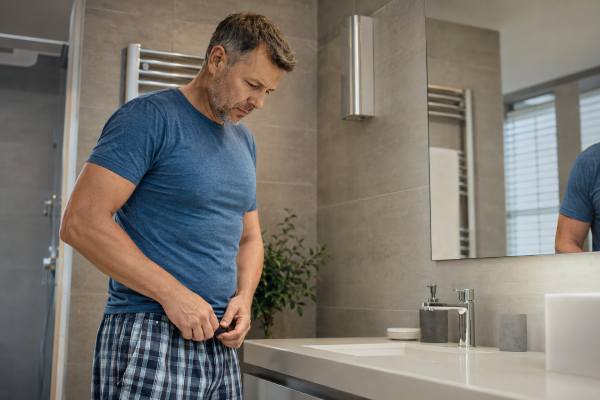
Post-void dribbling is the leak that shows up after you think you are done peeing. You finish, zip up, walk away, and a few drops wet your underwear. It is common in men because the male urethra is long and has a curved section where urine gets trapped.
Most post-void dribbling is not dangerous. It often comes from urine sitting in the bulbar urethra, the part of the tube that runs under the scrotum, instead of a bladder that is still leaking. The practical fix is usually mechanical: empty calmly, wait a moment, press out the trapped urine, and strengthen the pelvic floor muscles that help clear the urethra.
The important part is knowing when simple after-dribble is just a nuisance and when it is a clue to something else, such as an enlarged prostate, urethral narrowing, infection, prostatitis, bladder emptying trouble, or a medication side effect.
Table of Contents
- What post-void dribbling is
- Why it happens
- Quick fixes you can try
- Pelvic floor exercises for after-dribble
- When dribbling points to another problem
- How doctors check it
- Treatment options beyond home care
- When to get checked
What post-void dribbling is
Post-void dribbling, also called post-micturition dribble, is urine leakage that happens right after urination has finished. It is usually a small leak: a few drops, a damp spot, or enough to make underwear feel wet. It often appears after leaving the toilet, bending, sitting down, or walking.
This is different from a weak stream that slowly tapers off while you are still peeing. That is called terminal dribbling. Post-void dribbling happens after the stream has stopped and you believe the bladder is empty.
The usual problem is not that the bladder keeps squeezing. Instead, a little urine remains in the urethra. In men, the urethra runs from the bladder, through the prostate, through the pelvic floor, and along the penis. The section below the scrotum forms a low point where urine can pool. When you move afterward, those trapped drops come out.
| Symptom pattern | What it usually feels like | Common clue |
|---|---|---|
| Post-void dribbling | Drops leak after urination is finished | Wet spot appears after leaving the toilet |
| Terminal dribbling | The final part of the stream slows into a trickle | Peeing feels prolonged or weak |
| Urgency leakage | Leak happens with a sudden need to pee | You rush to the toilet and leak before getting there |
| Stress leakage | Leak happens with cough, sneeze, lifting, or exercise | Often seen after prostate surgery or pelvic floor weakness |
| Overflow leakage | Frequent dribbling with poor emptying | Bladder feels full, stream is weak, or urination is hard to start |
The amount matters less than the pattern. A small, predictable leak after peeing points toward trapped urethral urine. Dribbling throughout the day, trouble getting urine out, pain, blood, fever, or repeated infections needs medical attention because those signs point beyond simple after-dribble.
Why it happens
Post-void dribbling usually comes from poor clearing of the urethra after the bladder has emptied. The key muscle is the bulbocavernosus muscle, part of the pelvic floor. After urination, this muscle helps squeeze urine forward through the urethra. When it does not contract well, drops remain behind.
The issue becomes more common with age, but younger men get it too. Sitting for long periods, pelvic floor tension, constipation, lower urinary tract symptoms, and voiding before the bladder has a strong urge all contribute in some men.
Weak urethral clearing
The simplest cause is mechanical. A few drops sit in the bulbar urethra. Shaking the penis only clears the front part of the urethra, not the deeper pocket under the scrotum. That is why the leak often appears after you have already adjusted your clothes.
This is also why “milking” the urethra works better than repeated shaking. You are not forcing more urine from the bladder. You are moving urine that is already sitting in the tube.
Pelvic floor weakness or poor coordination
The pelvic floor is a group of muscles at the base of the pelvis. These muscles support bladder control, help with erections and ejaculation, and help finish urination. Weakness makes it harder to squeeze out the last urine in the urethra.
Poor coordination also matters. Some men tighten the wrong muscles, such as the buttocks or abdomen, instead of the pelvic floor. Others strain at the end of urination, which raises pressure but does not clear the urethra well. Straining also irritates the pelvic floor over time.
A structured routine of Kegel exercises is useful when the problem is muscle weakness, but the exercises need to be done correctly. Random squeezing a few times a day rarely changes symptoms.
Incomplete emptying or obstruction
Sometimes after-dribble comes with a broader emptying problem. A man with bladder outlet obstruction often notices a weak stream, hesitancy, stop-start flow, straining, frequent urination, night urination, or a feeling that urine is still left in the bladder.
An enlarged prostate is a common cause in men over 40, but it is not the only one. Urethral stricture, a narrowed scarred section of the urethra, also causes weak flow and dribbling. Strictures are more likely after catheter use, pelvic injury, prior urethral surgery, some sexually transmitted infections, or repeated urethral irritation.
Pelvic floor overactivity gives a similar pattern. The muscles tighten instead of relaxing during urination, so the stream feels interrupted or incomplete. This often overlaps with pelvic pain, pain after ejaculation, constipation, or a feeling of pressure in the perineum.
Medication, constipation, and daily habits
Some medicines make urination harder. Decongestants, some antihistamines, certain antidepressants, muscle relaxers, opioids, and medications with anticholinergic effects tighten the bladder outlet or reduce bladder contraction in susceptible men. The result is a weaker stream, incomplete emptying, and more leakage afterward.
Constipation also affects urination. A full rectum presses near the bladder and urethra, disrupts pelvic floor relaxation, and makes emptying less efficient. Men who strain to pass stool often strain to pee as well, which teaches the pelvic floor the wrong pattern.
Caffeine and alcohol do not usually cause true post-void dribbling by themselves. They increase urine production and urgency, so they make all urinary symptoms more noticeable. If dribbling is worse after coffee, beer, or energy drinks, the trigger is often higher urine volume, urgency, or bladder irritation rather than a new structural problem.
Quick fixes you can try
The fastest improvement usually comes from changing the last 30 seconds at the toilet. The goal is to let the bladder finish, then clear the urethra before you zip up.
Use this routine for two weeks:
- Relax while peeing. Stand or sit comfortably. Do not push hard at the end. Let the stream stop naturally.
- Wait 10 to 20 seconds. Take one slow breath. Many men get a small second release without forcing.
- Gently tighten the pelvic floor once. Think of lifting the muscles you would use to stop passing gas. Avoid clenching the buttocks.
- Milk the urethra. Place two or three fingers behind the scrotum, press gently upward, and move the pressure forward toward the base of the penis. Then move along the underside of the penis toward the tip.
- Blot or shake once. A small piece of toilet paper at the tip prevents the final drop from reaching underwear.
Pressure should be gentle. Hard pressing is not better. Pain, burning, or tenderness means stop and get checked.
Men who feel incompletely empty often benefit from double voiding. After the first urination, wait 20 to 60 seconds, relax the belly and pelvic floor, and try again. This is most useful when you feel urine remains in the bladder, not just in the urethra.
Avoid the “just in case” habit if it makes symptoms worse. Peeing with only a weak urge often produces a small bladder volume and a weaker finish. If you are constantly going before meetings, car rides, or sleep, your bladder may never fill enough for a strong, efficient empty. A better pattern is to go when you have a normal urge, not at the first vague sensation.
A simple tracking note helps. For one week, write down when dribbling happens, how much leaks, whether your stream was weak, and what you drank beforehand. This separates predictable after-dribble from urgency, prostate symptoms, or bladder irritation.
Pelvic floor exercises for after-dribble
Pelvic floor exercises work best when they train two skills: a stronger daily pelvic floor contraction and a well-timed squeeze after urination. The daily work builds muscle control. The post-void squeeze helps clear the urethra at the moment you need it.
Find the right muscle
The easiest cue is “stop gas,” not “tighten your abs.” You should feel a lift inside the pelvis. The penis may move slightly inward or upward. The testicles may lift a little. Your buttocks, thighs, and stomach should stay mostly relaxed.
Do not practice by stopping your urine stream every time you pee. Doing that repeatedly teaches interrupted voiding and irritates the bladder. It is fine as a one-time check to identify the muscle, then practice away from the toilet.
A practical 8-week routine
Start lying down if the muscles are hard to find. Move to sitting and standing once the contraction feels clear.
| Exercise | How to do it | Target |
|---|---|---|
| Slow holds | Tighten and lift the pelvic floor, hold, then fully relax | 10 holds of 5 seconds, once or twice daily |
| Quick squeezes | Tighten firmly for 1 second, then relax | 10 quick squeezes daily |
| Post-void squeeze | After the stream stops, wait, then give one firm pelvic floor squeeze | Every time you urinate |
| Urethral clearing | Use gentle perineal pressure from behind the scrotum forward | After urination, especially before leaving home |
Progress slowly. A good contraction followed by a full relaxation is better than a long, tense hold. Overdoing Kegels causes soreness, pelvic tightness, weaker flow, or pain after ejaculation in some men.
Expect gradual results. Some men notice less wetness within a few weeks because the after-void squeeze and urethral milking work immediately. Muscle training usually needs 6 to 12 weeks.
When exercises are not enough
Pelvic floor exercises are less likely to solve the problem alone when dribbling comes with a very weak stream, difficulty starting, repeated urinary infections, blood in urine, or pain. Those symptoms need a different plan because the issue is not only urethral clearing.
Pelvic floor physical therapy is worth considering when you cannot find the right muscle, Kegels worsen symptoms, or dribbling comes with pelvic pain, constipation, painful ejaculation, or a sense of tightness. A trained therapist checks whether the pelvic floor is weak, overactive, poorly coordinated, or a mix of both.
When dribbling points to another problem
Post-void dribbling by itself is often a quality-of-life issue. The concern rises when it arrives with other urinary changes. The pattern of symptoms tells you what to look for next.
Weak stream, hesitancy, and stop-start urination suggest obstruction or poor bladder contraction. Men often describe standing at the toilet waiting for the stream to begin, pushing to keep it going, or returning minutes later to pee again. New or worsening trouble starting to pee deserves evaluation, especially after age 50.
Burning, cloudy urine, urgency, fever, or pelvic discomfort points toward infection or inflammation. A UTI in men is not treated as casually as a simple bladder infection in many women because doctors look for an underlying reason, such as prostate infection, stones, retention, or urinary tract narrowing.
Pain between the scrotum and anus, pain with ejaculation, urinary frequency, and flares after sitting suggest prostatitis or chronic pelvic pain syndrome. The prostate is not always infected in this situation. Muscle tension and nerve sensitivity often play a role, which is why repeated antibiotics do not solve every case.
Blood in urine is never something to explain away as “just dribbling.” It needs testing even if it appears once, clears quickly, or happens without pain.
| What you notice | Possible explanation | Best next step |
|---|---|---|
| Small leak only after peeing, normal stream, no pain | Trapped urine in the urethra | Try urethral milking and pelvic floor training |
| Weak stream, hesitancy, night urination | Prostate enlargement, urethral narrowing, or poor bladder emptying | Book a medical visit for urine testing and emptying check |
| Burning, urgency, fever, cloudy urine | UTI or prostatitis | Get prompt testing, especially with fever or back pain |
| Pelvic pain, painful ejaculation, symptoms worse after sitting | Prostatitis or pelvic floor dysfunction | Ask about pelvic floor assessment and prostate evaluation |
| Ongoing leakage, bladder fullness, very poor stream | Urinary retention or overflow leakage | Seek urgent care if you cannot empty well |
Dribbling after prostate surgery has a different context. Leakage after prostate removal often includes stress incontinence, where urine leaks with movement, coughing, or lifting. After procedures for BPH, temporary urgency, dribbling, and irritation are common during healing, but persistent or worsening symptoms should be reviewed.
How doctors check it
A doctor usually starts with the story because the timing of leakage is the main clue. Be ready to describe when the leak happens, how much comes out, how long it has been going on, whether your stream changed, and whether there is pain, blood, urgency, fever, sexual pain, or new medication use.
A basic evaluation often includes a urine test. A urinalysis checks for blood, infection clues, protein, glucose, and other findings. If infection is suspected, a urine culture identifies the bacteria and guides antibiotic choice. Men with burning or discharge may also need STI testing.
The next useful test is a post-void residual measurement. This checks how much urine remains in the bladder after you pee, usually with a quick bladder ultrasound. A low residual supports simple urethral after-dribble. A high residual means the bladder is not emptying well and the cause needs attention.
Doctors may also check urine flow rate with a uroflow test. You urinate into a special device that measures speed and volume. A slow curve suggests obstruction, weak bladder contraction, or poor pelvic floor relaxation.
A prostate exam is sometimes appropriate, especially for men with weak stream, pelvic pain, fever, or age-related prostate concerns. PSA blood testing is a separate decision based on age, risk, prostate size, exam findings, and shared decision-making.
Cystoscopy is not needed for every man with post-void dribbling. It becomes more useful when there is blood in urine, suspected urethral stricture, prior urethral surgery, repeated infections, significant obstruction, or unexplained symptoms. During cystoscopy, a urologist passes a thin camera through the urethra to look for narrowing, stones, tumors, prostate blockage, or other structural problems.
If symptoms are persistent, complex, or tied to prostate issues, a visit with a urologist is reasonable. A guide on when to see a urologist helps separate routine urinary concerns from signs that deserve specialist care.
Treatment options beyond home care
Treatment depends on what is causing the dribble. The best plan for trapped urethral urine is not the same as the plan for prostate obstruction, infection, urethral stricture, or pelvic floor pain.
For straightforward post-void dribbling, the core treatment is urethral milking plus pelvic floor training. This is low risk, practical, and directly targets the mechanism. Absorbent guards or dark underwear help during the training period, but they should not replace evaluation when symptoms suggest a medical problem.
Pelvic floor physical therapy helps men who cannot activate the right muscles or who have pelvic floor overactivity. Therapy may include muscle coordination training, relaxation, breathing work, bladder habits, bowel management, and a home exercise plan. The goal is not endless squeezing. The goal is better timing: relax to pee, then contract to clear the urethra.
If BPH is causing weak stream or incomplete emptying, treatment may include lifestyle changes, prescription medicines, or procedures. Alpha-blockers relax the prostate and bladder neck. 5-alpha reductase inhibitors shrink the prostate over time in men with larger glands. Tadalafil is used in some men with urinary symptoms, especially when erectile dysfunction is also present. Procedures are considered when medicine is not enough, side effects are unacceptable, or complications such as retention, recurrent infections, bladder stones, or kidney strain appear.
If a urethral stricture is found, treatment depends on length, location, and severity. Options include dilation, internal incision, or urethroplasty. Repeated dilation sometimes gives only short relief, so recurrent strictures need a detailed urology discussion.
If infection is present, treatment should be guided by testing. Men with bacterial prostatitis often need a longer antibiotic course than a simple bladder infection. Fever, chills, flank pain, vomiting, or inability to pee needs urgent care.
If medication is contributing, do not stop prescriptions on your own. Bring a list of medicines and supplements to the visit. The clinician may adjust timing, lower a dose, switch a drug, or treat the urinary obstruction that made the side effect show up.
The biggest mistake is treating every dribble as a prostate problem. A man with normal stream and a few drops after peeing often needs technique and pelvic floor work, not prostate medication. A man with worsening weak flow and rising residual urine needs evaluation, not only Kegels.
When to get checked
Make a routine appointment if post-void dribbling lasts more than a few weeks, bothers you, causes enough wetness to change clothing, or is new and unexplained. You do not need to wait until it becomes severe. A simple urine test and bladder emptying check often give a clear direction.
Get checked sooner if dribbling comes with:
- Weak or thinning stream
- Trouble starting urination
- Straining to pee
- A feeling that the bladder does not empty
- Frequent urination or waking often at night
- Burning, cloudy urine, or strong urinary urgency
- Pelvic, testicular, penile, or lower belly pain
- Painful ejaculation
- Recurrent UTIs
- Blood in urine
- New leakage after catheter use, pelvic injury, or urinary surgery
Seek urgent care the same day if you cannot pee, have severe lower belly pain with bladder fullness, fever with urinary symptoms, flank pain, vomiting, new leg weakness or numbness, or visible blood clots in the urine. These signs are not typical simple after-dribble. They raise concern for retention, kidney infection, stone blockage, neurologic problems, or bleeding that needs prompt evaluation.
Urinary retention is especially important. A full bladder that will not empty can damage the urinary tract and become extremely painful. Symptoms such as very low output, constant dribbling with a full bladder, and worsening pressure should be treated as possible urinary retention, not routine leakage.
For mild dribbling with a normal stream and no red flags, start with the practical routine: relax, wait, pelvic floor squeeze, urethral milking, and daily pelvic floor training. If that does not improve things after 6 to 8 weeks, or if symptoms change at any point, get a medical check rather than guessing.
References
- Postmicturition dribble in men with no previous urogenital surgery: Systematic review and meta-analysis of treatment modalities 2024 (Systematic Review)
- A current perspective on post-micturition dribble in males 2019 (Review)
- Management of Non-Neurogenic Male Lower Urinary Tract Symptoms (LUTS) – Update April 2024 2024 (Guideline)
- Management of Lower Urinary Tract Symptoms Attributed to Benign Prostatic Hyperplasia: AUA Guideline (2026) Part I: Presentation and Evaluation 2026 (Guideline)
- Voiding With Less Strength of Desire to Void Is a Risk Factor for Post Micturition Dribble 2025 (Clinical Study)
- Fundamentals of terminology in lower urinary tract function 2018 (Terminology Review)
Disclaimer
This article is for education and does not diagnose the cause of urinary leakage. Post-void dribbling is often manageable with simple technique changes, but new, painful, worsening, or infection-related symptoms need medical evaluation. Seek urgent care if you cannot urinate, have fever with urinary symptoms, see blood clots, or develop severe pain.