A tight pelvic floor can make normal body functions feel difficult, uncomfortable, or unpredictable. Men may notice urinary urgency, trouble starting to pee, a weak stream, post-void dribbling, pain after ejaculation, erection problems, rectal pressure, or aching in the penis, testicles, groin, tailbone, or lower abdomen. Because these symptoms overlap with prostate problems, urinary tract infections, sexually transmitted infections, nerve irritation, and bowel disorders, many men assume the prostate is always the cause. Sometimes it is. But in many cases, the muscles at the bottom of the pelvis are holding too much tension, guarding after pain, or failing to relax at the right time. Treatment is usually not about “doing more Kegels.” A tight pelvic floor often needs relaxation, breathing, trigger point work, movement changes, and careful evaluation for other causes.
Table of Contents
- What a Tight Pelvic Floor Means
- Urinary Symptoms That Can Look Like Prostate Problems
- Sexual Symptoms and Ejaculation Pain
- Pain Patterns and Common Triggers
- Causes and Risk Factors
- How It Is Evaluated
- Treatment That Helps the Muscles Let Go
- What to Do at Home and What to Avoid
- When to Get Urgent or Specialist Care
What a Tight Pelvic Floor Means
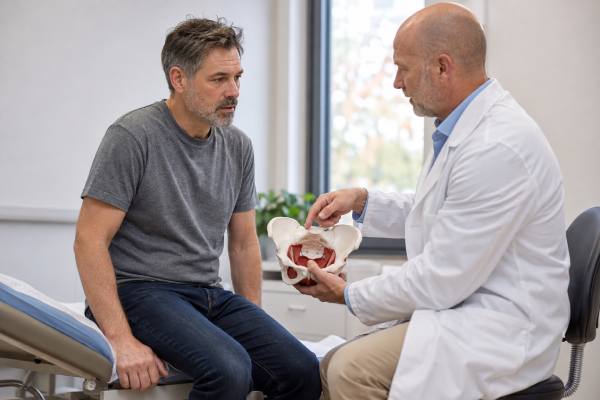
The pelvic floor is a group of muscles that sits like a sling at the base of the pelvis. These muscles help support the bladder, bowel, and prostate area. They also help control urine, bowel movements, erections, ejaculation, and core stability.
A healthy pelvic floor can contract and relax. Tightness becomes a problem when the muscles stay partly contracted, spasm easily, or do not relax when they should. This is sometimes called pelvic floor overactivity, high-tone pelvic floor dysfunction, pelvic floor muscle myalgia, pelvic floor spasm, or pelvic floor tension.
The word “tight” can be confusing. A tight muscle is not always a strong muscle. A man can have pelvic floor muscles that are tense, painful, poorly coordinated, and weak under load. That is why doing repeated Kegels without an exam can backfire. Kegels train contraction. A tight pelvic floor usually needs relaxation, coordination, and controlled lengthening before strengthening makes sense.
The pelvic floor must relax during urination and bowel movements. It also needs coordinated movement during sexual arousal and ejaculation. When it stays guarded, the bladder may feel irritated, the urine stream may feel blocked, and ejaculation may become painful or less satisfying.
A tight pelvic floor is also not a diagnosis that rules out everything else. It is a pattern that can exist alone or alongside chronic prostatitis/chronic pelvic pain syndrome, overactive bladder, constipation, pudendal nerve irritation, lower back or hip problems, stress-related muscle guarding, or recovery from infection or injury. Men with ongoing pelvic pain may benefit from a broader look at chronic pelvic pain syndrome symptoms and triggers, especially when pain, urinary changes, and sexual symptoms occur together.
Urinary Symptoms That Can Look Like Prostate Problems
Pelvic floor tightness can make urination feel obstructed even when the prostate is not the main problem. The bladder may contract, but the pelvic floor and urinary sphincter may not relax smoothly. The result can feel like trying to pee while the outlet is still partly closed.
Common urinary symptoms include:
- Trouble starting the stream
- A weak or thin stream
- Stop-and-start urination
- Urgency to pee
- Frequent urination, especially during stressful periods
- Feeling like the bladder is not empty
- Burning or discomfort when urine tests are normal
- Dribbling after peeing
- Spraying or changes in stream direction
- Pressure in the urethra, perineum, or rectum after urination
These symptoms can overlap with benign prostatic hyperplasia, prostatitis, urethral stricture, bladder irritation, medication effects, diabetes, and infection. Age matters, but it does not settle the question. A 28-year-old with urgency, hesitancy, and pelvic pain is less likely to have prostate enlargement than a 68-year-old with a gradually worsening weak stream, but both men still need proper evaluation if symptoms persist.
A tight pelvic floor often causes symptoms that shift during the day. A man may pee normally in the morning but struggle after sitting at work, cycling, lifting, stress, sex, constipation, or a long drive. Prostate enlargement tends to produce a steadier pattern, such as slowly worsening nighttime urination, weak stream, and incomplete emptying. Even then, patterns can overlap.
| Symptom pattern | Possible explanation | Why evaluation matters |
|---|---|---|
| Urgency, hesitancy, pelvic aching, symptoms worse after sitting | Pelvic floor overactivity or chronic pelvic pain pattern | Pelvic floor therapy may help, but infection and urinary retention should be ruled out. |
| Gradually weaker stream, frequent nighttime urination, older age | Possible enlarged prostate | Bladder emptying, prostate size, medications, and PSA context may need review. |
| Burning, fever, cloudy urine, new urinary pain | Possible UTI or prostatitis | Urine testing and sometimes antibiotics may be needed. |
| Sudden inability to pee | Urinary retention | This is urgent because the bladder can become overstretched. |
If starting the stream is the main issue, the cause may be muscular, prostate-related, medication-related, neurologic, or structural. A closer look at trouble starting to pee can help separate common patterns, but persistent or worsening symptoms still deserve a clinician’s exam.
Post-void dribbling can also happen when urine gets trapped in the urethra after the bladder empties. Tight or poorly coordinated pelvic floor muscles may contribute. Some men improve with pelvic floor relaxation, urethral milking, constipation treatment, and better voiding posture. For a deeper breakdown, see post-void dribbling causes and fixes.
Sexual Symptoms and Ejaculation Pain
Painful ejaculation is one of the symptoms most strongly associated with pelvic floor overactivity in men. Ejaculation requires coordinated contractions around the prostate, seminal vesicles, urethra, and pelvic floor. If the muscles are already tense or tender, those contractions can trigger aching, burning, cramping, or sharp pain.
Pain may occur:
- During ejaculation
- Immediately afterward
- Several hours later
- The next day, especially after repeated sexual activity
- In the penis, testicles, perineum, rectum, lower abdomen, or lower back
Some men describe a “deep prostate ache,” even when infection tests are negative. Others feel urethral burning after orgasm and worry about an STI, especially if the symptom is new. Testing is important when there is new discharge, burning after exposure, sores, fever, testicular swelling, or partner risk. But when tests are repeatedly negative and pain tracks with sitting, stress, bowel strain, or muscle tenderness, the pelvic floor becomes a more likely part of the problem.
Pelvic floor tightness can also affect erections. The connection is not always direct. Pain can reduce arousal, create performance anxiety, and make sex feel risky. Muscle tension may also change blood flow, nerve sensitivity, and the way the body responds during arousal. Some men report erectile dysfunction, loss of morning erections during flares, early ejaculation, delayed ejaculation, or reduced orgasm intensity.
This does not mean every erection problem is muscular. Blood vessel disease, diabetes, low testosterone, medication effects, depression, anxiety, sleep apnea, and pornography-related arousal patterns can all contribute. Sudden or persistent erection changes should be taken seriously, especially in men with heart risk factors. For broader causes, see erectile dysfunction causes and treatments.
A common mistake is trying to fix sexual symptoms with aggressive Kegels. In men with weak pelvic floor muscles after prostate surgery, targeted strengthening may be useful. In men with pelvic pain, painful ejaculation, and tightness, repeated squeezing can increase symptoms. The better first step is usually learning to feel the difference between contraction, relaxation, and gentle lengthening. A pelvic floor physical therapist can teach this in a way that matches the exam findings.
Painful ejaculation should be checked sooner if it is new, severe, associated with blood in semen, linked to fever, or accompanied by testicular swelling. Men with recurring pain after orgasm may also want to review painful ejaculation and prostate-related causes, because the symptom can come from more than one source.
Pain Patterns and Common Triggers
Pelvic floor pain rarely stays in one neat spot. The muscles, nerves, joints, bladder, bowel, and sexual organs share close pathways. Pain from one area can be felt somewhere else. A tight pelvic floor may feel like testicular pain, penile pain, rectal pressure, tailbone pain, groin pulling, lower belly cramping, or a golf-ball sensation in the perineum.
Men often describe one or more of these patterns:
- Aching between the scrotum and anus
- Burning at the tip of the penis
- Rectal fullness without needing a bowel movement
- Pain with sitting that improves when standing or lying down
- Testicular ache without a clear testicular problem
- Lower abdominal tightness
- Tailbone pain
- Hip, inner thigh, or groin tightness
- Pain after sex, urination, or bowel movements
Sitting is a major trigger for many men. Long periods of sitting can compress the perineum, reduce movement through the hips and spine, and keep the pelvic floor in a guarded position. Cycling can add direct pressure through the saddle. Heavy lifting can also flare symptoms if the man braces hard, holds his breath, and clenches the pelvic floor during each lift.
Stress is another common trigger. The pelvic floor often behaves like the jaw, neck, and shoulders. Some men clench it without noticing. They may tighten their abdomen, glutes, and pelvic floor during emails, driving, workouts, conflict, or anxiety. Over time, that guarding can become the body’s default setting.
Bowel habits matter too. Constipation, straining, diarrhea, irritable bowel symptoms, and hemorrhoid pain can keep the pelvic floor on alert. A man who strains every morning may later feel urinary urgency, rectal pressure, or penile burning and not connect the two.
Flares can feel alarming because they often move around. A man may have testicular ache one week, urinary urgency the next, and painful ejaculation after that. Shifting symptoms do not prove the problem is harmless, but they can fit a neuromuscular pain pattern. Fixed, worsening, one-sided swelling or severe acute pain needs a different level of concern.
Causes and Risk Factors
A tight pelvic floor often develops from repeated guarding. The body protects an area after pain, irritation, injury, or stress. That protection can be useful for a short time. It becomes a problem when the muscles never fully relax.
Common contributors include:
- Previous urinary tract infection, prostatitis, or STI
- Chronic prostatitis/chronic pelvic pain syndrome
- Constipation or frequent straining
- Long sitting hours
- Cycling or saddle pressure
- Heavy lifting with breath-holding
- Hip, lower back, or tailbone problems
- Anxiety, chronic stress, or trauma
- Pain after sex or fear of pain with sex
- Abdominal surgery, pelvic surgery, or injury
- Repeated “just in case” urination
- Habitual clenching of the abs, glutes, or pelvic floor
Sometimes the first trigger is clear. A man develops pelvic pain after a bad UTI, then keeps tightening around the area long after the infection clears. Another man begins symptoms after months of intense cycling. Another notices urinary urgency during a stressful year, then starts going to the bathroom often to avoid accidents. The bladder becomes more sensitive, the pelvic floor tightens, and the cycle feeds itself.
In other cases, there is no single starting point. The problem builds slowly from sitting, constipation, high stress, hard workouts, poor sleep, and fear of symptoms. These factors can increase nervous system sensitivity. When the nervous system becomes more protective, normal sensations from the bladder, bowel, prostate area, or genitals can feel stronger than they should.
Prostate conditions can still be involved. Chronic prostatitis is not always a simple infection. Many men with chronic pelvic pain have no active bacteria found, and symptoms may involve muscles, nerves, immune changes, bladder sensitivity, and stress physiology. If prostate pain, urinary symptoms, and pelvic floor tenderness overlap, treatment often needs more than antibiotics. Men comparing prostatitis-type symptoms may find it useful to review chronic prostatitis symptoms and triggers.
It is also possible to have more than one problem. A man with an enlarged prostate can develop pelvic floor tension from straining to pee. A man with an STI can develop muscle guarding after the infection is treated. A man with low back pain can develop pelvic floor symptoms through nerve irritation, posture changes, or protective bracing. Good care looks for the full pattern instead of forcing every symptom into one box.
How It Is Evaluated
The evaluation starts by ruling out conditions that need different treatment. A clinician may ask about urinary symptoms, pain location, sexual symptoms, bowel habits, fever, STI risk, medications, surgeries, cycling, workouts, stress, and how symptoms change with sitting or movement.
Testing depends on the situation. It may include:
- Urinalysis and urine culture
- STI testing when exposure or symptoms suggest risk
- Prostate exam when appropriate
- Genital and testicular exam
- Post-void residual test to see how much urine remains after peeing
- PSA testing based on age, risk, and prostate findings
- Uroflow testing to measure stream strength
- Imaging or cystoscopy if structural problems are suspected
- Screening for bowel, back, hip, or nerve contributors
A pelvic floor physical therapist may assess posture, breathing, hip motion, abdominal tension, scar mobility, and muscle tenderness around the pelvis. In some cases, an internal rectal pelvic floor exam is offered to assess muscle tone, tenderness, coordination, and trigger points. This should be explained clearly, done with consent, and stopped if the patient is uncomfortable.
The exam is not about proving the pain is “in your head.” Muscle tenderness, poor relaxation, and nervous system sensitivity are real physical findings. At the same time, stress, fear, sleep loss, and anxiety can amplify pain signals. That does not make the symptoms fake. It means the treatment plan may need to address both the muscles and the nervous system.
Men should be careful with self-diagnosis. A tight pelvic floor can mimic many conditions, but it cannot be confirmed by symptoms alone. Blood in urine, fever, unexplained weight loss, new neurologic symptoms, severe testicular pain, and true urinary retention require medical evaluation. Men with persistent urinary symptoms may also need to consider prostate, bladder, urethral, and neurologic causes. For a broader list of symptoms that deserve urology care, see when men should see a urologist.
Treatment That Helps the Muscles Let Go
Treatment works best when it matches the main drivers. A man with muscle tenderness, constipation, sitting pain, and stress-related flares needs a different plan from a man with bacterial prostatitis or severe prostate enlargement. For tight pelvic floor symptoms, care often combines pelvic floor physical therapy, behavior changes, pain education, bladder retraining, bowel management, and treatment of related medical conditions.
Pelvic floor physical therapy may include:
- Down-training to reduce resting muscle tension
- Diaphragmatic breathing
- Manual therapy for tender muscles and connective tissue
- Hip, spine, and abdominal mobility work
- Biofeedback to show when muscles are contracting or relaxing
- Relaxation-based pelvic floor exercises
- Gradual strengthening only when appropriate
- Guidance on sitting, lifting, cycling, and sexual activity
- Flare plans for symptom spikes
Manual therapy is not the same as a massage for general soreness. The goal is to reduce protective guarding, improve tissue mobility, and teach the nervous system that the area can move without threat. Some treatment is external. Some may be internal if the patient agrees and the therapist is trained in male pelvic health.
Biofeedback can be helpful because many men cannot tell whether their pelvic floor is relaxed. A screen or sensor may show that the muscles stay active even when the man thinks he is letting go. Seeing this in real time can make training more accurate.
Medications may be used when symptoms suggest bladder irritation, nerve pain, prostate inflammation, infection, or severe pain flares. Alpha-blockers may help some men with urinary symptoms. Anti-inflammatory medications, neuropathic pain medicines, or muscle-relaxing strategies may be considered in selected cases. Antibiotics should not be repeated again and again without evidence of infection, because pelvic floor pain can continue even when bacteria are not the cause.
Treatment is usually gradual. Some men feel better after a few sessions once they stop clenching and learn how to relax the muscles. Others need several months, especially if symptoms have lasted years, involve central pain sensitivity, or overlap with bowel, back, bladder, sexual, and stress factors.
Progress often looks uneven. A man may first notice shorter flares, less fear, easier urination, or less pain after sitting before symptoms fully settle. It helps to track function, not just pain scores. Can he sit longer? Pee with less strain? Have sex without a two-day flare? Exercise without guarding? Those changes matter.
What to Do at Home and What to Avoid
The safest at-home starting point is to reduce clenching, pressure, and straining. Gentle changes can calm the system while a man arranges medical or physical therapy care.
A useful routine may include:
- Sit or lie in a comfortable position with the hips supported.
- Breathe slowly into the lower ribs and belly without forcing the abdomen outward.
- On each inhale, imagine the pelvic floor dropping or widening.
- Keep the jaw, glutes, and belly relaxed.
- Practice for 3 to 5 minutes, one to three times daily.
This should feel like letting go, not pushing down hard. Bearing down can worsen hemorrhoids, prolapse-like pressure, or pelvic irritation. The goal is softening and lengthening, not straining.
Heat can help some men. A warm bath, heating pad over the lower abdomen, or warm pack near the hips may reduce guarding. Avoid burning the skin, and do not use heat as a substitute for medical care if there are infection signs or severe pain.
Movement usually helps more than bed rest. Walking, gentle hip mobility, relaxed stretching, and light strength work can reduce guarding. Long static stretches can irritate symptoms if forced. The best stretch is one that allows calm breathing and does not cause a flare later.
During urination, avoid pushing. Try sitting to pee, relaxing the belly, breathing out slowly, and giving the stream time to start. Double voiding can help some men: pee, stand or move for a moment, then try again gently. If you routinely strain to empty, get evaluated rather than forcing it.
Bowel care is often central. Aim for soft, easy stools. Hydration, fiber from food, regular meals, walking, and treating constipation can reduce pelvic floor load. If fiber worsens bloating or constipation, the plan may need adjustment.
Avoid these common mistakes:
- Starting intense Kegels without knowing whether the muscles are tight
- Testing the urine stream repeatedly during the day
- Going to the bathroom “just in case” every hour
- Straining to pee or poop
- Sitting for hours without movement breaks
- Pushing through painful cycling or heavy lifting flares
- Repeatedly checking the genitals for pain signals
- Assuming negative infection tests mean nothing is wrong
If strengthening is appropriate, it should come after relaxation and coordination improve. Men using pelvic floor work for erection support need the right type of training. The approach described in pelvic floor exercises for ED may not fit men whose main problem is pelvic pain and muscle overactivity unless it is modified.
Sexual activity does not always need to stop, but it may need pacing. During flares, some men do better with a short break from ejaculation, then gradual return. Others do better by reducing frequency, avoiding edging, using relaxation before and after sex, and treating the fear-pain cycle. Pain that is severe, new, or associated with blood, fever, swelling, or discharge should be checked.
When to Get Urgent or Specialist Care
Some symptoms should not be watched at home. Go for urgent care if you cannot urinate, have severe testicular pain, develop fever with pelvic or urinary symptoms, have new weakness or numbness in the groin or legs, lose bowel or bladder control, or have severe back pain with neurologic symptoms.
Sudden inability to pee is especially important. It can happen from prostate enlargement, medications, infection, nerve problems, or severe pelvic floor spasm, but the immediate issue is bladder overfilling. More detail is covered in urinary retention warning signs.
Make a non-urgent medical appointment if symptoms last more than a few weeks, keep returning, interfere with sex or work, or cause you to avoid sitting, exercise, travel, or relationships. Also get checked if you have blood in urine, blood in semen that persists, unexplained weight loss, a testicular lump, new penile discharge, STI exposure, or worsening urinary symptoms.
A urologist may be the right starting point when urinary symptoms, prostate concerns, genital pain, blood, recurrent infections, or sexual symptoms are prominent. A pelvic floor physical therapist with male pelvic health training can be very helpful when symptoms point toward muscle overactivity, especially pain with sitting, painful ejaculation, pelvic muscle tenderness, constipation-related flares, or symptoms that worsen with stress and clenching.
Care may also involve a primary care clinician, gastroenterologist, pain specialist, psychologist, sex therapist, or orthopedic physical therapist. This does not mean the condition is vague. It means the pelvis is a crossroads for muscles, nerves, bladder, bowel, sex, movement, and stress physiology.
Recovery is usually possible, but it often requires patience and the right target. If the muscles are tight, the first goal is not to force them into better performance. It is to help them stop guarding, coordinate with breathing and movement, and relax when urination, bowel movements, and sex require it.
References
- EAU Guidelines on Chronic Pelvic Pain 2025 (Guideline)
- Male Chronic Pelvic Pain: AUA Guideline: Part I Evaluation and Management Approach 2025 (Guideline)
- Male Chronic Pelvic Pain: AUA Guideline: Part II Treatment of Chronic Prostatitis/Chronic Pelvic Pain Syndrome 2025 (Guideline)
- Chronic Primary Pelvic Pain Syndrome in Men 2023 (Review)
- Physiotherapy for chronic prostatitis/chronic pelvic pain syndrome in men: a systematic review 2025 (Systematic Review)
- Pelvic physical therapy for male sexual disorders: a narrative review 2025 (Review)
Disclaimer
This information is educational and is not a substitute for care from a qualified health professional. Pelvic pain, urinary changes, painful ejaculation, and erection changes can have several causes, including infections, prostate conditions, nerve problems, and urgent urinary obstruction. Seek medical care promptly for severe pain, fever, blood in urine, testicular swelling, new neurologic symptoms, or inability to urinate.