Fordyce spots are small pale, yellowish, or skin-colored bumps caused by visible oil glands in places where hair follicles are absent or hard to see. On men, they often show up on the shaft of the penis, foreskin, glans, scrotum, lips, or inside the cheeks. They are common, harmless, and not a sexually transmitted infection.
The trouble is that genital bumps are easy to misread. A man may notice them during an erection, after shaving, or while checking for an STI and worry that something has suddenly appeared. Fordyce spots usually have a steady, smooth, clustered pattern and do not blister, ulcerate, or spread like an infection. Still, new genital bumps deserve attention when the pattern is unclear, painful, changing, bleeding, or linked with discharge, burning urination, ulcers, or a recent STI exposure.
This guide explains what Fordyce spots look like, how they differ from more concerning causes, and when a doctor should check them.
Table of Contents
- What Fordyce Spots Look Like
- Why Fordyce Spots Happen
- Where Men Notice Them Most
- How to Tell Fordyce Spots Apart From Other Genital Bumps
- When to Get Checked
- What Not to Do at Home
- Treatment Options and What to Expect
- Talking With a Partner and Moving Forward
What Fordyce Spots Look Like
Fordyce spots usually look like tiny raised dots or bumps. They are often white, cream, yellowish, pale red, or the same color as the surrounding skin. Most are about 1 to 5 millimeters across, which is roughly the size of a pinhead to a sesame seed.
On the penis or scrotum, they often appear in small groups rather than as one isolated bump. They tend to look smooth, evenly shaped, and shallow under the skin. They often become easier to see when the skin is stretched, which is why men may notice them more during an erection or when pulling the skin tight during self-exam.
A typical pattern looks like this:
- Many small dots close together
- Pale yellow, white, or skin-colored bumps
- Smooth surface rather than rough or crusted skin
- No open sore, blister, or scab
- No pus, discharge, or strong odor
- Little to no pain
- A similar look over weeks, months, or years
They are not pimples, even though they involve oil glands. A pimple usually becomes red, tender, swollen, or filled with pus. Fordyce spots generally stay quiet. They do not “come to a head,” and squeezing them only irritates the skin.
They also do not behave like an STI. They do not spread to a partner, and they do not appear because of sexual activity. A man in a long-term relationship can notice them for the first time simply because he looked more closely, had brighter bathroom lighting, shaved, lost weight around the groin, or saw them during an erection.
Fordyce spots can occasionally feel more noticeable during sex or masturbation because friction stretches and rubs the skin. That does not mean they are dangerous. But irritation, bleeding, or soreness after friction is a reason to ease up, avoid picking, and get checked if the skin does not settle.
Why Fordyce Spots Happen
Fordyce spots are visible sebaceous glands. Sebaceous glands produce sebum, the oily substance that helps protect skin. In most areas of the body, these glands sit beside hair follicles. Fordyce spots are different because the oil glands are visible in areas without obvious hair follicles, such as the lips, inner cheeks, penis, foreskin, glans, and scrotal skin.
They are considered a normal skin variation, not a disease. Many people have them, but not everyone notices them. They often become more visible after puberty because hormone changes enlarge oil glands and increase oil production.
Several details make them easier to spot:
- Stretching the skin
- Strong lighting
- Dry skin
- Shaving or trimming pubic hair
- Friction from sex, masturbation, cycling, or tight clothing
- Anxiety-driven checking after a sexual exposure
- Naturally thin genital or lip skin
Fordyce spots are not caused by poor hygiene. Washing more aggressively will not remove them. In fact, harsh scrubbing often makes the area redder and draws more attention to the bumps.
They are also not caused by HPV, herpes, chlamydia, gonorrhea, yeast, or HIV. Those infections have different causes, symptoms, testing needs, and treatment paths. If the concern is a possible STI exposure rather than the bumps themselves, timing matters. Testing too early gives false reassurance for some infections, so a guide to STI testing after exposure is more useful than trying to judge risk by appearance alone.
Fordyce spots are not usually a sign of a hormone problem. They become more visible around puberty and adulthood because sebaceous glands respond to normal androgen activity, but their presence alone does not mean testosterone is too high, estrogen is abnormal, or fertility is affected.
Where Men Notice Them Most
Men usually notice Fordyce spots in places where the skin is thin, stretched, or closely inspected.
On the penis, they may appear on the shaft, foreskin, or glans. On the scrotum, they often look like small pale or yellowish dots scattered across the surface. Around the mouth, they may show along the edge of the lips or inside the cheeks. The same basic process is involved in each location: visible oil glands near the surface.
The location affects how worried a person feels. Spots around the lips are often mistaken for cold sores or clogged pores. Spots on the penis are often mistaken for genital warts, herpes, molluscum, folliculitis, or pearly penile papules. That is why pattern matters.
Fordyce spots on the shaft or scrotum often look more scattered than pearly penile papules. Pearly penile papules usually form a neat row or ring around the corona, the ridge just behind the head of the penis. They are also harmless, but they have a different layout. A fuller comparison of pearly penile papules and genital warts helps when the bumps sit near the head of the penis.
On the scrotum, Fordyce spots can be confused with cysts, angiokeratomas, inflamed follicles, or irritation from shaving. Scrotal skin has texture, folds, hair follicles, and oil glands, so not every bump has the same meaning. A single enlarging lump, a painful swelling, or a deeper mass inside the testicle is not a Fordyce spot and needs a different evaluation.
Fordyce spots can also be more visible in men with darker skin when the bumps look lighter than the surrounding skin. In lighter skin, they may look yellow, cream, or pale red. Color alone is not enough to identify them. Shape, surface, symptoms, location, and change over time matter more.
How to Tell Fordyce Spots Apart From Other Genital Bumps
A useful first question is whether the bumps are stable and quiet or active and changing. Fordyce spots tend to stay stable. Infections and inflammatory problems often change over days or weeks.
| Condition | Typical look or feel | Clues that it is not Fordyce spots |
|---|---|---|
| Fordyce spots | Small, smooth, pale or yellowish dots in clusters | Usually painless, stable, not contagious, no ulcer or blister |
| Genital herpes | Painful blisters, open sores, burning, crusting | Comes in outbreaks, often tender, may include swollen glands or flu-like symptoms |
| Genital warts | Raised, rough, flat, or cauliflower-like growths | Often grow, spread, or develop an uneven surface |
| Molluscum contagiosum | Small dome-shaped bumps, often with a central dimple | Can spread by skin contact and often has a distinct central pit |
| Folliculitis or ingrown hair | Red tender bump around a hair follicle | Often sore, pus-filled, or linked with shaving and hair-bearing skin |
| Balanitis | Redness, soreness, swelling, itching, or irritation of the glans or foreskin | More of a rash or inflamed area than many stable pale dots |
| Angiokeratomas | Dark red, blue, purple, or black tiny bumps, often on scrotum | Can bleed if scratched and look vascular rather than yellow-white |
Herpes is one of the most common fears. Fordyce spots do not usually blister, break open, crust, or heal in cycles. Herpes often starts with burning, tingling, tenderness, or small blisters that become ulcers. If the problem is a painful outbreak rather than stable pale bumps, compare the pattern with herpes versus pimples and get medical advice promptly, especially during the first episode.
Genital warts are another common concern. Warts from HPV can be flat, raised, rough, or cauliflower-like. They often have a surface texture that looks different from the smooth, oil-gland look of Fordyce spots. A man who sees new spreading growths, rough bumps, or lesions around the anus, groin, or pubic area should consider an exam rather than guessing. Information on HPV-related genital warts is more relevant when bumps look rough, grow over time, or appear after a known exposure.
Folliculitis and ingrown hairs usually happen in hair-bearing areas, especially after shaving, sweating, tight clothing, or friction. These bumps are often red, sore, or centered around a hair. Fordyce spots are not usually centered on hair follicles.
Balanitis is different again. It often causes redness, itching, soreness, odor, cracking, or swelling around the glans or foreskin. A man with redness and irritation needs to think about hygiene products, yeast, friction, dermatitis, diabetes risk, or foreskin tightness rather than assuming the issue is Fordyce spots. A focused guide to balanitis symptoms and treatment fits better when inflammation is the main problem.
The safest rule is simple: if the bumps are new, painful, spreading, ulcerated, bleeding, or linked with urinary or sexual symptoms, do not rely on appearance alone.
When to Get Checked
A routine check is reasonable when you are not sure what you are seeing. Genital skin conditions overlap, and even doctors sometimes use magnification, swabs, STI tests, or rarely a biopsy when the appearance is not classic.
Book a non-urgent appointment with a dermatologist, urologist, sexual health clinic, or primary care clinician if:
- The bumps are new and you have never been diagnosed with Fordyce spots before
- They changed color, size, number, or surface texture
- They are painful, itchy, inflamed, or bleeding
- There are ulcers, blisters, crusts, or open sores
- You have penile discharge or burning when urinating
- You had a recent partner with an STI or symptoms
- The bumps are rough, cauliflower-like, or spreading
- There is a single lump that keeps enlarging
- You are immunosuppressed or have poorly controlled diabetes
- Anxiety about the spots is affecting sex, relationships, or daily life
Seek urgent care if there is severe genital pain, rapidly worsening swelling, fever with genital ulcers, trouble urinating, black or dying-looking skin, or a painful testicular lump. Those are not typical Fordyce spot features.
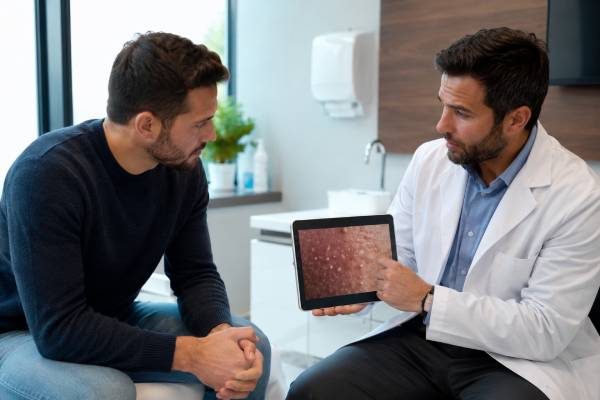
A clinician usually starts with a visual exam. Many Fordyce spots are diagnosed by appearance alone. Dermoscopy, a handheld magnifying tool with light, helps when the pattern is subtle. STI testing is used when history or symptoms point toward infection. A biopsy is uncommon but useful when a lesion is unusual, persistent, pigmented, ulcerated, or suspicious.
Do not feel embarrassed about asking for an exam. Men often delay care because the bumps are in a private area or because they fear being judged. Clinicians who handle men’s sexual and genital health see these concerns constantly. A visit can prevent weeks of checking, searching images online, and worrying about a harmless normal variant.
For men who have several possible symptoms at once, a broader guide to common genital bumps in men helps organize the possibilities before the appointment.
What Not to Do at Home
The biggest mistake is trying to pop or squeeze Fordyce spots. They are oil glands, not blocked pimples. Squeezing can force out a small amount of oily material, but it does not remove the gland. It often leaves redness, swelling, broken skin, infection risk, or a darker mark that lasts longer than the original spot.
Avoid these common home treatments:
- Wart remover
- Apple cider vinegar
- Toothpaste
- Lemon juice
- Tea tree oil or undiluted essential oils
- Harsh exfoliating acids
- Acne spot treatments on genital skin
- Needles, razors, or attempts to “drain” the bumps
- Steroid creams unless prescribed
- Retinoids on the penis or scrotum unless a clinician specifically recommends them
Genital skin is thinner and more sensitive than skin on the face or back. Products that seem mild elsewhere can burn, peel, or inflame the penis or scrotum. Chemical irritation also makes diagnosis harder because the original bumps become surrounded by redness and swelling.
A safer approach is boring but effective: wash with warm water and a mild, fragrance-free cleanser, rinse well, dry gently, and avoid heavy friction for a few days if the skin feels irritated. Wear breathable underwear and avoid shaving directly over bumps that are already inflamed.
If itching is the main symptom, Fordyce spots may not be the whole explanation. Irritation, yeast, jock itch, allergic reactions, and pubic hair grooming all cause itching. A guide to itchy genitals in men is more useful when the problem is itch rather than visible bumps alone.
Do not use someone else’s prescription cream. Antiviral, antibiotic, antifungal, steroid, and wart treatments all have specific uses. The wrong treatment wastes time and may worsen irritation.
Treatment Options and What to Expect
Fordyce spots do not need treatment for health reasons. The main reasons men ask about treatment are appearance, anxiety, friction irritation, or embarrassment with a partner. A clinician should confirm the diagnosis before any cosmetic procedure, especially in the genital area.
Treatment aims to reduce the appearance of the spots, not cure an infection. Results vary, and recurrence is possible because sebaceous glands are part of the skin.
Laser treatment
Carbon dioxide laser treatment is one of the better-known procedural options. It removes or vaporizes superficial tissue containing the visible glands. It is usually done by a dermatologist or a clinician trained in laser procedures.
The possible benefits are faster visible improvement and targeted removal. The tradeoffs are cost, discomfort, healing time, temporary redness, pigment changes, scarring risk, and recurrence. Genital skin needs extra caution because scarring or sensitivity changes in that area are more meaningful than a small mark on less sensitive skin.
Electrosurgery, micro-punch, and other procedures
Electrosurgery uses controlled heat to destroy selected spots. Micro-punch removal uses a tiny instrument to remove individual lesions. These approaches are more practical when there are a limited number of bothersome bumps rather than widespread clusters.
Cryotherapy is sometimes discussed, but freezing delicate genital skin can cause blistering, pigment changes, and scarring. It is not something to attempt with over-the-counter freezing kits.
Any procedure should come after a clear discussion of:
- Whether the diagnosis is certain
- Whether treatment is medically necessary or cosmetic
- How many spots will be treated
- Expected healing time
- Pain control
- Scarring and pigment-change risk
- Sexual activity restrictions during healing
- Whether recurrence is likely
- Total cost and number of sessions
Topical treatment
Topical retinoids and other prescription creams are sometimes used for visible spots, especially around the lips. They irritate easily and are not a casual choice for the penis, foreskin, glans, or scrotum. Do not apply facial acne medication to genital skin unless a clinician tells you exactly how to use it.
Creams also tend to give slower, less predictable results than procedures. They may reduce visibility for some people, but they often cause dryness, peeling, burning, or redness before any cosmetic improvement appears.
Choosing no treatment
No treatment is often the best decision. That does not mean ignoring your health. It means confirming the diagnosis when needed, avoiding injury from home remedies, and understanding that the spots are a normal skin finding.
Treatment makes more sense when the diagnosis is certain, the spots cause repeated irritation, or the cosmetic concern is strong enough that the benefits outweigh the risks. It makes less sense when anxiety is the main driver and the person keeps checking for new flaws. In that situation, reassurance, STI testing when appropriate, and reducing repeated inspection often help more than removing normal glands.
Talking With a Partner and Moving Forward
Fordyce spots are not contagious, so a partner does not need treatment because of them. You do not need to avoid sex solely because you have confirmed Fordyce spots. The more important issue is confidence in the diagnosis. If there is any doubt, or if the bumps are new after a recent exposure, pause sexual contact until you are checked or tested.
A simple explanation is enough: “These are Fordyce spots. They’re visible oil glands, not an infection, and they aren’t sexually transmitted.” Most partners respond better to a calm explanation than to secrecy or nervous over-explaining.
Condoms still matter for STI prevention, but they are not needed specifically because of Fordyce spots. They also may not cover every area where STI-related lesions appear, such as the groin, pubic region, scrotum, or nearby skin. Use protection based on sexual health risk, not because of harmless oil glands.
If you feel stuck in a cycle of checking, photographing, stretching the skin, comparing images online, and seeking repeated reassurance, the bumps may be harmless but the worry is real. In that case, set a practical limit: get one proper exam, follow the clinician’s plan, avoid daily inspection, and return only if the spots change or symptoms develop.
Fordyce spots are common. The goal is not to make every tiny bump disappear. The goal is to know what is normal for your body, recognize warning signs, avoid damaging the skin, and get checked when the pattern does not fit.
References
- Fordyce spots: Quick and Informative guidance 2021 (Patient Guidance)
- Fordyce spots (syn. Fordyce’s granules) 2021 (Clinical Guidance)
- Differentiating Fordyce Spots from Their Common Simulators Using Ultraviolet-Induced Fluorescence Dermatoscopy—Retrospective Study 2023 (Observational Study)
- Treatment of Fordyce Spots with CO2 Laser 2024 (Case Series)
- Sexually Transmitted Infections Treatment Guidelines, 2021 2021 (Guideline)
- Fordyce Spots 2022 (Patient Guidance)
Disclaimer
This article is for education and cannot diagnose genital bumps from description alone. Fordyce spots are usually harmless, but new, painful, changing, ulcerated, bleeding, or STI-associated genital lesions should be checked by a qualified clinician. Do not use wart removers, acids, needles, or prescription creams on genital skin unless a healthcare professional has confirmed the diagnosis and recommended that treatment.