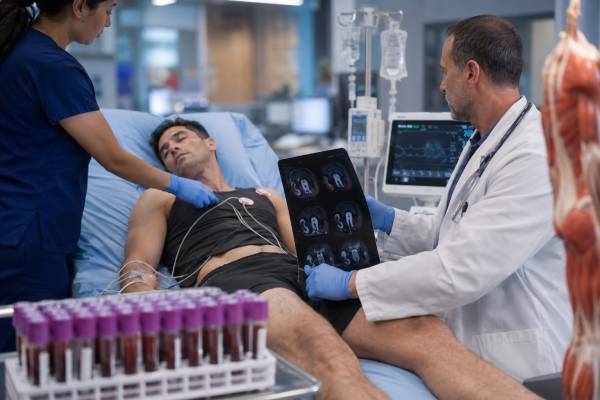
Rhabdomyolysis is a serious muscle-breakdown condition that can release large amounts of creatine kinase, myoglobin, potassium, phosphorus, and other cell contents into the blood. The blood test panel is used to confirm muscle injury, estimate kidney risk, detect dangerous electrolyte changes, and follow whether the injury is improving. CK is usually the main marker because it stays elevated longer than myoglobin, while myoglobin can rise early and contribute to kidney stress. A single result rarely tells the whole story. The pattern over time, kidney markers, urine findings, symptoms, medications, recent exercise, trauma, heat exposure, seizures, infection, and hydration status all matter. Some cases are mild and resolve with monitoring and rest, but severe rhabdomyolysis can cause acute kidney injury, abnormal heart rhythms from high potassium, compartment syndrome, or the need for hospital treatment.
- CK is the main blood marker for rhabdomyolysis: many clinicians consider CK above 5 times the lab’s upper limit, often around 1,000 U/L or higher, concerning in the right clinical setting.
- Myoglobin rises earlier than CK but clears faster: blood or urine myoglobin may be missed if testing happens late after the muscle injury.
- Kidney risk depends on more than CK: creatinine, urine output, potassium, phosphorus, calcium, bicarbonate, dehydration, and the cause of injury help determine risk.
- CK above 5,000 U/L often raises concern for significant muscle injury: higher values need closer monitoring, especially with abnormal creatinine or dark urine.
- Urgent care is important for dark cola-colored urine, reduced urination, severe muscle swelling, weakness, confusion, heat illness, crush injury, or high potassium.
Table of Contents
- What the Rhabdomyolysis Blood Test Panel Measures
- When Rhabdomyolysis Testing Is Ordered
- How CK, Myoglobin, and Muscle Breakdown Results Are Interpreted
- Kidney Risk, Electrolytes, and Urine Findings
- Common Causes and Result Patterns
- Monitoring Recovery and Follow-Up Testing
- Urgent Results and Next Steps
What the Rhabdomyolysis Blood Test Panel Measures
A rhabdomyolysis blood test panel checks for muscle-cell leakage and the complications that follow it. The central test is creatine kinase, usually reported as CK or CPK. CK is an enzyme found in high amounts inside skeletal muscle. When muscle fibers are damaged, CK leaks into the bloodstream.
Most panels also look beyond muscle injury. That is important because the danger in rhabdomyolysis is not only the muscle damage itself. The released contents can stress the kidneys, disturb electrolytes, and affect heart rhythm. A practical panel often includes CK, creatinine, BUN, eGFR, potassium, calcium, phosphorus, bicarbonate or CO2, urinalysis, and sometimes myoglobin, AST, ALT, LDH, uric acid, and blood counts.
| Test | Why it is checked | Typical concern in rhabdomyolysis |
|---|---|---|
| CK or CPK | Main marker of skeletal muscle injury | Often markedly elevated; serial trend is important |
| Blood myoglobin | Early muscle-breakdown protein | May rise early and clear quickly through the kidneys |
| Urine myoglobin or urinalysis | Checks pigment in urine | Positive “blood” on dipstick with few or no red blood cells suggests myoglobin |
| Creatinine, BUN, eGFR | Kidney function markers | Rising creatinine or falling urine output suggests acute kidney injury |
| Potassium | Heart rhythm and cell-release marker | High potassium can be dangerous and needs urgent attention |
| Calcium and phosphorus | Mineral shifts after muscle breakdown | Low calcium early and high phosphorus can occur |
| Bicarbonate or CO2 | Acid-base balance | Low bicarbonate can suggest metabolic acidosis |
| AST, ALT, LDH | Additional tissue and muscle enzymes | May rise from muscle injury and be mistaken for liver injury |
CK is usually more useful than myoglobin for confirming and following rhabdomyolysis because it remains abnormal longer. Myoglobin is smaller and appears earlier, but the kidneys clear it quickly. This means a person may have had myoglobinuria and dark urine earlier in the course, yet test negative for myoglobin later.
A broader muscle-marker workup may overlap with a skeletal muscle enzyme panel, especially when symptoms are not clearly due to trauma, exercise, heat, or medication. If the main concern is kidney stress, clinicians often follow a kidney function blood test panel closely during the first days of illness.
When Rhabdomyolysis Testing Is Ordered
Rhabdomyolysis testing is ordered when symptoms, history, or risk factors suggest significant skeletal muscle injury. The classic symptom combination is muscle pain, weakness, and dark red-brown urine, but many people do not have all three. Some have only severe soreness after unusual exertion. Others are tested because they had a seizure, prolonged immobilization, heat stroke, a crush injury, intoxication, infection, or a medication exposure known to injure muscle.
Common reasons to order the panel include:
- Severe muscle pain, tenderness, swelling, or weakness
- Cola-colored, tea-colored, or red-brown urine
- Reduced urination after heavy exercise, illness, intoxication, or trauma
- Heat illness, especially with confusion, collapse, or very high body temperature
- Crush injury, prolonged pressure on a limb, or being unable to get up for hours
- Recent seizure, extreme agitation, or severe shaking chills
- Suspected drug, alcohol, toxin, or medication-related muscle injury
- Very high AST or LDH when liver disease does not fully explain the pattern
- High potassium or unexplained kidney function worsening after a muscle-stress event
Exercise-related testing needs context. A hard workout can raise CK, sometimes substantially, without true medical emergency. Unaccustomed eccentric exercise, such as downhill running, heavy squats, or intense interval training after a long break, can cause large CK increases. The result becomes more concerning when the person has severe pain, swelling, weakness, dark urine, dehydration, abnormal kidney markers, heat illness, or symptoms that are far beyond normal delayed-onset muscle soreness.
Medication history also matters. Statins, fibrates, colchicine, antipsychotics, some antivirals, daptomycin, stimulants, cocaine, alcohol, and drug interactions can contribute. The risk is higher when several triggers overlap, such as a statin plus dehydration, infection, kidney disease, or intense exercise.
A clinician may add heart tests when chest pain, shortness of breath, abnormal ECG findings, or high-risk symptoms are present. CK and myoglobin are not specific enough to rule in or rule out a heart attack in modern care. Troponin is the preferred heart-injury marker, and patterns are interpreted differently from skeletal muscle breakdown. For heart-related testing, a cardiac biomarker panel has a different purpose than a rhabdomyolysis panel.
How CK, Myoglobin, and Muscle Breakdown Results Are Interpreted
CK is the anchor marker, but the number must be interpreted with timing and symptoms. Many laboratories list a CK reference range roughly around 20–200 U/L, but normal values vary by lab method, sex, muscle mass, ancestry, recent activity, and age. A CK result that is mildly above the reference range can occur after exercise, injections, muscle cramps, or minor injury. Rhabdomyolysis usually involves a larger rise.
Many clinicians use CK above 5 times the upper limit of normal as a working diagnostic threshold. In practical terms, this often means a CK around 1,000 U/L or higher, though the exact cutoff depends on the lab. Values above 5,000 U/L often raise concern for significant muscle injury and kidney-risk monitoring. In exertional cases, some experts use higher thresholds, especially when trying to separate expected post-exercise CK elevation from clinically important rhabdomyolysis.
| CK result pattern | Possible meaning | How it is usually handled |
|---|---|---|
| Normal or mildly elevated | No major muscle breakdown, very early testing, or resolving injury | Repeat testing may be needed if symptoms or timing are concerning |
| About 5 times upper limit of normal or higher | Consistent with rhabdomyolysis in the right clinical setting | Check kidney markers, electrolytes, urine, symptoms, and cause |
| Above 5,000 U/L | More significant muscle injury; kidney risk becomes more important | Often needs close follow-up or hospital-based monitoring depending on the full picture |
| Very high or still rising | Ongoing muscle injury, delayed peak, or severe exposure | Serial CK, kidney tests, fluids, and complication monitoring become more urgent |
CK usually begins to rise within several hours after muscle injury. It commonly peaks about 1 to 3 days later, though the timing can vary. It then falls gradually if the injury has stopped. A falling CK is reassuring, but it does not automatically mean the kidneys are safe. Creatinine, urine output, potassium, bicarbonate, calcium, and phosphorus still need attention.
Myoglobin behaves differently. It rises earlier and often returns toward normal sooner, sometimes within the first 24 hours. This makes myoglobin useful when the injury is recent, but less reliable when testing is delayed. Urine may appear dark because myoglobin is filtered by the kidneys. A urine dipstick may read positive for “blood” because it reacts to heme pigment, even when microscopy shows few or no red blood cells. That pattern supports myoglobinuria, although it is not the only possible explanation.
AST and LDH can also rise because they exist in muscle cells. This can confuse interpretation when someone appears to have “high liver enzymes.” ALT is more liver-weighted than AST, but AST can come from muscle. A pattern of very high CK with elevated AST and LDH often points toward muscle injury rather than isolated liver disease. For this overlap, CK, AST, and LDH patterns can help clarify whether the main signal is muscle, liver, or mixed tissue injury.
Kidney Risk, Electrolytes, and Urine Findings
Kidney risk is estimated from the whole panel, not CK alone. Myoglobin can injure kidney tubules, especially when dehydration, low blood pressure, acidosis, sepsis, heat illness, or trauma reduce kidney blood flow. The kidneys may also face high uric acid, pigment casts, oxidative stress, and electrolyte shifts after muscle cells break down.
Creatinine is one of the most important follow-up markers. A rising creatinine suggests kidney filtration is worsening. BUN and eGFR add context, but eGFR can be less reliable during rapidly changing acute kidney injury because it is calculated from creatinine. Urine output is just as important as the blood result. Passing very little urine, especially with dark urine, is a concerning sign.
Potassium deserves special attention. Muscle cells contain a large amount of potassium, and when they break apart, potassium can enter the bloodstream. High potassium can trigger dangerous heart rhythm problems. The risk is higher when kidney function is impaired because the kidneys cannot remove potassium efficiently. A separate high potassium blood test result may need urgent treatment even before CK has peaked.
Other electrolyte and acid-base changes can include high phosphorus, early low calcium, low bicarbonate, and metabolic acidosis. Calcium can be tricky: it may fall early as calcium shifts into injured muscle, then rebound later during recovery. This is one reason calcium should not be interpreted casually in severe cases.
A useful kidney-risk review includes:
- Creatinine: rising values suggest acute kidney injury.
- Urine output: low output can be an early warning sign even before labs fully change.
- Potassium: high levels can affect heart rhythm and may require urgent care.
- Bicarbonate or CO2: low values suggest acidosis, which can worsen pigment-related kidney stress.
- Phosphorus: high values can reflect cell breakdown and kidney strain.
- Calcium: low early values may occur, while later high calcium can appear during recovery.
- Urinalysis: dipstick blood with few red blood cells suggests myoglobin or hemoglobin pigment.
The electrolyte panel is therefore not an optional side note in suspected rhabdomyolysis. It helps identify complications that may be more immediately dangerous than the CK value itself. When low bicarbonate and a high anion gap appear, an anion gap and bicarbonate pattern can help show whether acidosis is part of the illness.
Common Causes and Result Patterns
Rhabdomyolysis usually develops when muscle energy supply fails, muscle cells are crushed or overheated, or muscle membranes are injured by toxins, drugs, inflammation, or metabolic stress. Many cases have more than one cause. A person may exercise hard, become dehydrated, take a medication that increases susceptibility, and then develop infection or heat stress.
Exercise and heat
Exertional rhabdomyolysis often follows activity that is intense, unfamiliar, prolonged, or performed in heat. Examples include high-repetition squats, military training, long endurance events, CrossFit-style workouts, spin classes after a long break, and outdoor labor during hot weather. Soreness alone is common after exercise, but severe pain, weakness, swelling, dark urine, fainting, confusion, or reduced urination is not normal recovery.
In exercise-related cases, CK may continue to rise after the person has stopped exercising. Testing too early can underestimate the peak. Repeat CK and kidney markers are often needed when symptoms are significant.
Trauma, compression, and immobility
Crush injuries, motor vehicle accidents, falls, building-collapse injuries, and prolonged limb compression can cause large muscle breakdown. A person who lies on the floor for many hours after intoxication, stroke, fainting, or surgery can develop pressure-related muscle injury even without obvious external trauma. These cases can be high-risk because dehydration, low blood pressure, and delayed discovery often occur together.
Medications, drugs, and toxins
Drug-related rhabdomyolysis may come from direct muscle toxicity, agitation, seizures, overheating, immobilization, or interactions. Statins are a well-known medication association, but severe rhabdomyolysis from statins is rare compared with ordinary muscle aches. Risk rises with interacting drugs, high doses, older age, kidney disease, untreated hypothyroidism, heavy alcohol use, and acute illness.
Cocaine, amphetamines, alcohol intoxication, opioids with prolonged immobility, antipsychotic-related neuroleptic malignant syndrome, malignant hyperthermia, and some antibiotics or antivirals are also possible triggers. The medication list matters because stopping or changing the cause can be as important as following CK.
Infection, seizures, and metabolic triggers
Influenza, COVID-19, bacterial sepsis, severe vomiting, diabetic ketoacidosis, very low phosphate, low potassium, and seizures can all cause or worsen rhabdomyolysis. In these cases, the CK result may be only one part of a broader acute illness. Lactate, glucose, ketones, infection markers, blood pressure, and kidney function may guide urgency. If lactate is elevated, a lactate blood test may help assess shock, sepsis, or tissue hypoxia alongside the rhabdomyolysis workup.
Monitoring Recovery and Follow-Up Testing
Recovery monitoring follows the direction of CK, kidney markers, electrolytes, symptoms, and urine output. A CK result that is falling generally suggests muscle breakdown has slowed or stopped. A CK result that is still rising may simply reflect normal delayed timing after the injury, but it can also mean ongoing muscle damage, untreated heat illness, persistent compression, medication toxicity, or compartment syndrome.
In moderate or severe cases, clinicians may repeat labs every several hours to daily, depending on severity. The most closely followed tests are usually CK, creatinine, potassium, calcium, phosphorus, bicarbonate, and urinalysis. In mild exertional cases with normal kidney function, normal electrolytes, good urine output, and improving symptoms, outpatient follow-up may be enough when a clinician considers it safe.
A typical monitoring plan may ask:
- Is CK rising, peaking, or falling?
- Is creatinine stable or increasing?
- Is potassium normal and staying normal?
- Is the person urinating normally?
- Is pain, weakness, or swelling improving?
- Is the trigger removed or controlled?
- Are there signs of compartment syndrome, heat injury, infection, or ongoing toxicity?
The time to normalization varies. CK may take several days to weeks to return to the reference range after a large injury. Athletes and physically active people may have higher baseline CK than sedentary people. The goal is not always to force CK to a perfect number before every normal activity resumes. The safer approach is to confirm that symptoms are improving, kidney function is stable, electrolytes are safe, urine is normalizing, and the cause is understood.
Return to exercise should be gradual after exertional rhabdomyolysis. Restarting too soon can trigger recurrence. Severe episodes, repeated episodes, episodes after ordinary activity, family history of similar problems, persistent CK elevation after recovery, or symptoms since childhood may prompt evaluation for inherited muscle conditions. These may include glycogen storage disorders, fatty acid oxidation disorders, mitochondrial disease, channel-related disorders, sickle cell trait, or other metabolic myopathies.
If CK stays elevated without a clear recent trigger, the next step may involve thyroid testing, medication review, autoimmune muscle tests, aldolase, inflammatory markers, myositis antibodies, or neuromuscular referral. A myositis blood marker panel is more relevant when weakness, rash, autoimmune features, or persistent muscle enzyme elevation suggests inflammatory muscle disease rather than a single exertional or traumatic episode.
Urgent Results and Next Steps
Some rhabdomyolysis results call for urgent medical care because complications can develop quickly. A high CK by itself may not tell the whole severity, but high CK with abnormal kidney function, high potassium, low urine output, severe swelling, or systemic illness is more concerning.
Seek urgent care or emergency evaluation when any of the following occur:
- Dark cola-colored urine, especially with muscle pain or weakness
- Little or no urination
- Severe muscle swelling, tightness, numbness, or worsening pain
- Weakness that affects walking, standing, breathing, or lifting the arms
- Confusion, fainting, heat stroke symptoms, or very high fever
- Recent crush injury, prolonged immobilization, seizure, or overdose
- High potassium, rising creatinine, or metabolic acidosis on lab results
- CK that is very high, still rising, or paired with worsening symptoms
- Chest pain, palpitations, severe shortness of breath, or abnormal ECG findings
Treatment depends on severity and cause. Hospital care often focuses on stopping the muscle injury, giving carefully monitored IV fluids, tracking urine output, correcting potassium and acid-base problems, and watching for compartment syndrome. Dialysis is not used simply because CK is high. It may be needed when acute kidney injury leads to dangerous fluid overload, severe high potassium, severe acidosis, uremic complications, or other standard dialysis indications.
People sometimes focus only on “flushing out CK,” but CK itself is not the main toxin. CK is a marker of muscle injury. Myoglobin, kidney blood flow, dehydration, acidosis, and electrolyte disturbances are more directly tied to acute complications. This is why drinking large amounts of water without medical guidance is not always the safest response, especially for someone with kidney disease, heart failure, low sodium, vomiting, confusion, or worsening symptoms.
A mild abnormal result after exercise should still be treated respectfully. Rest from intense training, avoid alcohol and heat exposure, review medications with a clinician, hydrate appropriately, and repeat testing when advised. Do not restart strenuous exercise just because pain improves on day two; CK may peak after symptoms begin. A planned return is safer than guessing.
References
- Rhabdomyolysis – StatPearls – NCBI Bookshelf 2025 (Review)
- Rhabdomyolysis: an American Association for the Surgery of Trauma Critical Care Committee Clinical Consensus Document 2022 (Guideline)
- A Clinical Approach to Rhabdomyolysis 2025 (Review)
- Molecular Mechanisms of Rhabdomyolysis-Induced Kidney Injury: From Bench to Bedside 2022 (Review)
- Rhabdomyolysis-Induced AKI (RIAKI) Including the Role of COVID-19 2022 (Review)
- Exertional rhabdomyolysis: clinical features, management and outcomes 2026 (Clinical Study)
Disclaimer
Rhabdomyolysis can become a medical emergency, especially when kidney function, potassium, urine output, or mental status is abnormal. This information is for general education and cannot determine whether a specific CK or myoglobin result is safe. Always review abnormal results with a qualified clinician, and seek urgent care for dark urine, reduced urination, severe weakness, severe swelling, heat illness, chest symptoms, or rapidly worsening symptoms.