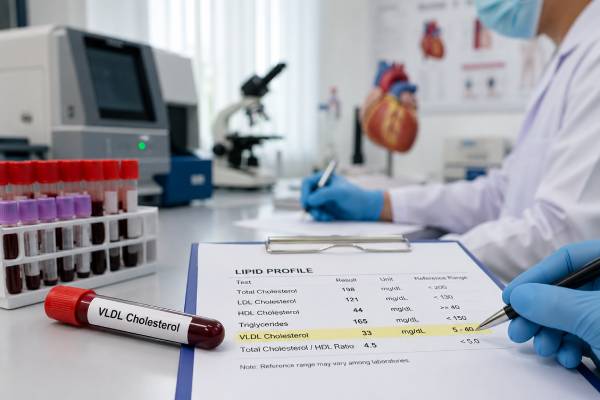
VLDL cholesterol is the cholesterol carried inside very low-density lipoproteins, the particles your liver uses to move triglycerides through the bloodstream. A VLDL cholesterol result is usually reported as part of a cholesterol or lipid panel, although many labs estimate it from your triglyceride level instead of measuring it directly. A healthy VLDL cholesterol level is usually less than 30 mg/dL, or about 0.78 mmol/L, but the result only makes sense when it is read with triglycerides, LDL cholesterol, HDL cholesterol, non-HDL cholesterol, and your overall cardiovascular risk.
A high VLDL cholesterol result often points to high triglyceride-rich lipoproteins, insulin resistance, excess liver fat, diabetes, alcohol intake, certain medications, or inherited lipid disorders. A low result is usually not concerning by itself. The main reason to pay attention to VLDL cholesterol is that triglyceride-rich particles and their remnants can contribute to artery plaque.
- Normal VLDL cholesterol is usually below 30 mg/dL; some labs list a broader reference interval, often around 5–40 mg/dL.
- VLDL cholesterol is commonly estimated as triglycerides divided by 5 when triglycerides are reported in mg/dL.
- High VLDL usually tracks with high triglycerides, especially when triglycerides are above 150 mg/dL.
- VLDL is most useful with the full lipid panel, including LDL, HDL, triglycerides, and non-HDL cholesterol.
- Very high triglycerides need prompt follow-up, especially at 500 mg/dL or higher because pancreatitis risk can rise.
- Fasting may improve interpretation when triglycerides are high, although many routine lipid panels can be done nonfasting.
Table of Contents
- What VLDL Cholesterol Measures
- Normal Range and Reference Values
- How VLDL Is Calculated or Measured
- What High VLDL Means
- What Low VLDL Means
- How to Prepare and Read Your Result
- Ways to Improve VLDL and Triglycerides
- When to Follow Up
What VLDL Cholesterol Measures
VLDL cholesterol measures the amount of cholesterol carried inside very low-density lipoprotein particles. These particles are made mostly by the liver. Their main job is to carry triglycerides, a type of fat used for energy storage, from the liver to muscle, fat tissue, and other parts of the body.
VLDL is different from LDL cholesterol. LDL particles carry more cholesterol and less triglyceride, while VLDL particles carry much more triglyceride. As VLDL particles release triglycerides into tissues, they become smaller and denser. Some become intermediate-density lipoproteins, or IDL, and later LDL. Others become remnant particles that can remain in the blood.
The VLDL cholesterol number does not count every VLDL particle. It estimates or measures the cholesterol inside those particles. That distinction matters because a person can have a modest VLDL cholesterol value but still have many triglyceride-rich particles, especially when particles are small, cholesterol-poor, or metabolically abnormal.
In everyday testing, VLDL cholesterol is most often used as a companion marker to triglycerides. If triglycerides are high, VLDL cholesterol is usually high too. If triglycerides are low, VLDL cholesterol is usually low. This is why VLDL cholesterol often adds less new information than triglycerides, non-HDL cholesterol, ApoB, or remnant cholesterol, but it can still help show whether triglyceride-rich particles are contributing to cardiovascular risk.
A standard lipid panel usually includes total cholesterol, LDL cholesterol, HDL cholesterol, and triglycerides. VLDL cholesterol may appear as a separate calculated line on the report, or it may be absent even though the lab used triglycerides to estimate LDL cholesterol.
Why VLDL is linked to artery plaque
VLDL particles and their remnants are considered atherogenic, meaning they can contribute to plaque buildup in arteries. The risk is not only from the triglyceride content. As VLDL particles are broken down, the remaining cholesterol-rich remnants can enter the artery wall, trigger inflammation, and add cholesterol to developing plaque.
This helps explain why high triglycerides can remain a risk marker even when LDL cholesterol is treated. LDL cholesterol remains the main treatment target in most cardiovascular prevention plans, but high triglyceride-rich particles can leave residual risk. That is especially true in people with insulin resistance, type 2 diabetes, metabolic syndrome, fatty liver disease, chronic kidney disease, or obesity.
Normal Range and Reference Values
A typical desirable VLDL cholesterol result is less than 30 mg/dL. In SI units, that is about less than 0.78 mmol/L. Some laboratories list a reference range such as 5–40 mg/dL, but many clinicians use below 30 mg/dL as the more useful target because higher levels are often linked with higher triglycerides and greater cardiovascular risk.
VLDL reference values are not as standardized as LDL cholesterol or triglyceride categories. The “normal” line on a lab report depends on the method the lab uses, whether the value is calculated or directly measured, and how the lab defines its reference population.
| VLDL cholesterol result | Approximate mmol/L | Usual meaning |
|---|---|---|
| Less than 30 mg/dL | Less than 0.78 mmol/L | Desirable for most adults |
| 30–40 mg/dL | 0.78–1.04 mmol/L | Often borderline or mildly high, usually reflecting higher triglycerides |
| More than 40 mg/dL | More than 1.04 mmol/L | High; commonly seen with triglycerides above 200 mg/dL |
| Very low, such as below 5 mg/dL | Below 0.13 mmol/L | Usually not a problem unless linked with malnutrition, severe illness, or another abnormal pattern |
For many people, the triglyceride result gives the clearest clue. When VLDL cholesterol is estimated by the common formula, the relationship looks like this:
| Triglycerides | Estimated VLDL cholesterol | Typical interpretation |
|---|---|---|
| 100 mg/dL | 20 mg/dL | Usually desirable |
| 150 mg/dL | 30 mg/dL | Near the upper desirable limit |
| 200 mg/dL | 40 mg/dL | Often high |
| 300 mg/dL | 60 mg/dL | High, with greater concern for triglyceride-rich particles |
| 500 mg/dL | 100 mg/dL | Very high triglycerides; pancreatitis prevention becomes a major concern |
These estimates work best when triglycerides are not very high. Once triglycerides rise sharply, the simple formula becomes less reliable because the triglyceride-to-VLDL cholesterol relationship varies from person to person.
A VLDL result should not be used as a stand-alone diagnosis. For example, VLDL cholesterol of 32 mg/dL may be a mild finding in someone with otherwise low risk, normal blood pressure, no diabetes, and healthy LDL cholesterol. The same result deserves more attention in someone with type 2 diabetes, high blood pressure, low HDL cholesterol, and a strong family history of early heart disease.
How VLDL Is Calculated or Measured
Most routine VLDL cholesterol values are calculated, not directly measured. The common estimate is:
VLDL cholesterol = triglycerides ÷ 5
This formula applies when triglycerides are reported in mg/dL. If triglycerides are reported in mmol/L, the rough estimate is:
VLDL cholesterol = triglycerides ÷ 2.2
This calculation comes from the assumption that the triglyceride-to-cholesterol ratio in VLDL particles is about 5 to 1 by mass. It is simple, inexpensive, and convenient because triglycerides are already measured in a routine lipid panel.
The limitation is that human VLDL particles do not always follow that fixed ratio. VLDL composition changes with insulin resistance, diabetes, obesity, high triglycerides, alcohol intake, liver fat, genetic lipid disorders, and recent food intake. In these settings, two people with the same triglyceride level may not have the same true VLDL cholesterol level.
When the calculation is less reliable
Estimated VLDL cholesterol is less dependable when triglycerides are very high, especially at 400 mg/dL or higher. It may also be less accurate when triglycerides are changing quickly, after a heavy meal, during uncontrolled diabetes, during acute illness, or in people with unusual lipid disorders.
The same issue affects calculated LDL cholesterol. Many LDL formulas subtract an estimated VLDL cholesterol value from total cholesterol. When the VLDL estimate is off, calculated LDL cholesterol can also be off. That is one reason labs may use newer LDL calculation methods, direct LDL measurement, or advanced lipoprotein testing when triglycerides are high or LDL cholesterol is very low.
For people with complex lipid patterns, an advanced lipid panel may include markers such as ApoB, LDL particle number, LDL size, Lp(a), remnant cholesterol, or lipoprotein fractionation. These tests do not replace routine cholesterol testing for everyone, but they can clarify risk when standard results do not tell the full story.
Direct VLDL and lipoprotein fractionation
Some specialized labs can separate lipoprotein fractions and report VLDL, IDL, LDL, and HDL cholesterol more directly. This may be done by ultracentrifugation, electrophoresis, nuclear magnetic resonance methods, or other advanced techniques. These methods can show whether cholesterol is concentrated in triglyceride-rich particles, LDL particles, or other fractions.
Direct or fractionated VLDL testing may be considered when triglycerides are persistently high, when a genetic lipid disorder is suspected, when remnant cholesterol is elevated, or when cardiovascular risk seems higher than routine lipid numbers suggest. For most routine checkups, though, calculated VLDL is enough to show the general pattern.
What High VLDL Means
High VLDL cholesterol usually means the bloodstream contains more triglyceride-rich lipoproteins than expected. Because VLDL particles carry most fasting blood triglycerides, a high VLDL value often travels with high triglycerides. It may also suggest that VLDL particles are being overproduced by the liver, cleared too slowly, or both.
A high value is not just a laboratory detail. VLDL and remnant particles can contribute to atherosclerosis, the process that creates plaque inside arteries. They are especially relevant when LDL cholesterol is not the only abnormal marker. A person with high VLDL may also have high triglycerides, low HDL cholesterol, high non-HDL cholesterol, high ApoB, high fasting insulin, or high blood glucose.
Common causes of high VLDL cholesterol include:
- Insulin resistance or type 2 diabetes
- Metabolic syndrome
- Excess body weight, especially abdominal weight gain
- Diets high in refined carbohydrates, added sugars, or excess calories
- Frequent alcohol intake
- Fatty liver disease
- Hypothyroidism
- Chronic kidney disease or nephrotic syndrome
- Pregnancy, especially later pregnancy
- Certain medications, including some beta-blockers, diuretics, steroids, estrogens, retinoids, antipsychotics, and HIV medicines
- Inherited lipid disorders, including familial combined hyperlipidemia and familial hypertriglyceridemia
A high VLDL result should lead to a closer look at triglycerides. The article on high triglycerides is closely related because VLDL cholesterol is usually a calculated reflection of triglyceride-rich particles.
High VLDL and insulin resistance
Insulin resistance is one of the most common reasons VLDL cholesterol rises. When the body does not respond well to insulin, the liver often receives more free fatty acids from fat tissue and turns them into triglycerides. The liver packages these triglycerides into VLDL particles and releases them into the blood.
This pattern often appears with:
- Triglycerides above 150 mg/dL
- HDL cholesterol below ideal levels
- Waist size above a healthy range
- Higher fasting glucose or A1c
- Higher fasting insulin
- Blood pressure above goal
- Fatty liver on imaging or abnormal liver enzymes
This cluster is common in metabolic syndrome blood testing. VLDL is not always the central marker used to diagnose metabolic syndrome, but it reflects the same triglyceride-rich, insulin-resistant pattern.
High VLDL and cardiovascular risk
VLDL cholesterol can add risk information because it belongs to the group of ApoB-containing lipoproteins. ApoB is the main structural protein on VLDL, IDL, LDL, and lipoprotein(a) particles. Each atherogenic particle generally carries one ApoB molecule, so ApoB can reflect the number of artery-entering particles more directly than cholesterol mass alone.
This is why high VLDL is often interpreted together with non-HDL cholesterol and ApoB testing. Non-HDL cholesterol includes the cholesterol inside LDL, VLDL, IDL, remnants, and Lp(a). ApoB estimates particle burden. When VLDL is high and ApoB or non-HDL cholesterol is also high, the result suggests a larger pool of atherogenic particles.
High VLDL is also closely related to remnant cholesterol. Remnant cholesterol estimates the cholesterol left in triglyceride-rich particles after they have released some triglyceride. These remnants may be particularly important because they can enter the artery wall and carry cholesterol into plaque.
High VLDL and pancreatitis risk
VLDL itself is usually discussed in relation to heart and artery risk. When triglycerides are very high, another concern becomes urgent: pancreatitis. Pancreatitis is inflammation of the pancreas and can become serious.
Triglyceride levels of 500 mg/dL or higher need medical attention, and levels near or above 1,000 mg/dL carry a much higher pancreatitis risk. In this range, the focus often shifts from long-term heart risk to lowering triglycerides quickly and safely. Treatment may include strict alcohol avoidance, a very low-fat diet for a period of time, better diabetes control, medication, and evaluation for genetic or secondary causes.
What Low VLDL Means
Low VLDL cholesterol is usually not harmful. Since VLDL is estimated from triglycerides, a low VLDL result often means triglycerides are low. For many people, this reflects a healthy pattern: regular physical activity, less refined carbohydrate intake, weight loss when needed, lower alcohol intake, and better insulin sensitivity.
A low VLDL value may appear with triglycerides below 50 mg/dL. This can be normal in lean, active people or in those eating a balanced diet with fewer added sugars and fewer excess calories. It can also occur during lipid-lowering treatment.
Low VLDL deserves more attention when it appears with other concerning signs, such as unintended weight loss, chronic diarrhea, poor appetite, malnutrition, severe hyperthyroidism, advanced liver disease, or very low total cholesterol. In those cases, the VLDL result is not usually the main problem. It is one clue in a larger clinical picture.
Low VLDL can also be seen in rare inherited lipid conditions that reduce production or transport of triglyceride-rich particles. These conditions are uncommon and usually show other clues, such as very low LDL cholesterol, fat-soluble vitamin problems, neurological symptoms, or digestive symptoms beginning earlier in life.
A low VLDL result should not be treated just to raise the number. The more useful step is to review the full lipid panel, diet pattern, symptoms, medications, and medical history. If LDL cholesterol, HDL cholesterol, triglycerides, blood count, liver enzymes, thyroid tests, and nutritional markers are otherwise reassuring, low VLDL alone is rarely a concern.
How to Prepare and Read Your Result
Many routine lipid panels can be done without fasting. Nonfasting testing is convenient and often reflects the way lipids circulate during a normal day. However, fasting can make VLDL and triglyceride interpretation cleaner, especially when triglycerides are high or when a previous nonfasting result was unexpected.
A typical fasting period is 9–12 hours, with water allowed. During that time, avoid food, caloric drinks, and alcohol. Continue medications unless your clinician gives different instructions. Heavy exercise, a very large meal, or alcohol in the day before testing can raise triglycerides in some people and may affect estimated VLDL.
Fasting is often helpful when:
- Triglycerides were high on a prior test
- VLDL cholesterol was unexpectedly high
- The clinician is checking response to triglyceride-lowering treatment
- A genetic lipid disorder is being considered
- LDL cholesterol needs a more accurate calculation
- The result will guide medication decisions
To read the result, start with the full pattern rather than one number. A VLDL cholesterol of 28 mg/dL may look normal, but if HDL cholesterol is low, glucose is high, blood pressure is elevated, and waist size is increasing, the pattern may still suggest insulin resistance. A VLDL cholesterol of 34 mg/dL may be only mildly high, but if ApoB, non-HDL cholesterol, and LDL cholesterol are also high, the overall atherogenic burden may be more important.
A practical way to review your report is:
- Check whether the VLDL result is calculated or directly measured.
- Compare VLDL with triglycerides.
- Review LDL cholesterol and non-HDL cholesterol.
- Look at HDL cholesterol for the metabolic pattern.
- Check glucose, A1c, liver enzymes, thyroid results, kidney markers, and medications when VLDL is high.
- Interpret the result with personal risk factors, not just the lab flag.
The usual triglyceride reference values can help place VLDL in context because estimated VLDL is often just one-fifth of triglycerides. LDL cholesterol should also be reviewed carefully, especially when triglycerides are high, because calculated LDL can become less reliable in some situations. The page on LDL cholesterol targets explains why goals vary by cardiovascular risk level.
Example result patterns
A person with total cholesterol 180 mg/dL, LDL cholesterol 105 mg/dL, HDL cholesterol 55 mg/dL, triglycerides 90 mg/dL, and VLDL cholesterol 18 mg/dL usually has a fairly balanced lipid pattern. The VLDL result does not suggest excess triglyceride-rich particles.
A person with total cholesterol 210 mg/dL, LDL cholesterol 120 mg/dL, HDL cholesterol 38 mg/dL, triglycerides 250 mg/dL, and VLDL cholesterol 50 mg/dL has a different pattern. The high VLDL and high triglycerides suggest triglyceride-rich lipoprotein excess, often related to insulin resistance, diet, weight, alcohol, diabetes, or medications.
A person with LDL cholesterol 65 mg/dL on statin therapy but triglycerides 260 mg/dL and VLDL cholesterol 52 mg/dL may have well-treated LDL cholesterol but persistent triglyceride-rich particle risk. In this setting, non-HDL cholesterol, ApoB, diabetes status, kidney function, and overall cardiovascular history help guide next steps.
Ways to Improve VLDL and Triglycerides
VLDL cholesterol usually improves when triglycerides improve. The most effective approach depends on why VLDL is high. For many people, the strongest drivers are insulin resistance, excess calories, refined carbohydrates, alcohol, and weight gain. For others, medication effects, thyroid disease, kidney disease, diabetes, pregnancy, or inherited lipid disorders play a larger role.
Lifestyle changes can lower triglycerides and estimated VLDL within weeks, although the full effect may take several months. The response is often strongest when a person reduces added sugars, cuts back on alcohol, loses 5–10% of body weight if overweight, and increases regular physical activity.
Helpful changes include:
- Replacing sugary drinks, sweets, and refined starches with higher-fiber foods
- Choosing unsaturated fats from fish, olive oil, nuts, seeds, and avocado instead of trans fats and excess saturated fat
- Eating enough protein at meals to reduce large carbohydrate swings
- Increasing soluble fiber from oats, beans, lentils, vegetables, fruit, and psyllium
- Limiting alcohol, or avoiding it completely when triglycerides are high
- Building toward at least 150 minutes per week of moderate aerobic activity
- Adding resistance training two or more days per week
- Treating sleep apnea when present
- Improving blood glucose control in diabetes or prediabetes
Carbohydrate quality matters. VLDL can rise when the liver converts excess sugar and refined carbohydrates into triglycerides. This does not mean every person with high VLDL needs an extremely low-carbohydrate diet. It means the first targets are usually added sugar, sweet drinks, desserts, white bread, white rice, large portions of refined grains, and frequent snacking on processed foods.
Alcohol can have a large effect on triglycerides and VLDL, even when total calories do not seem extreme. Beer, wine, and spirits can all raise triglycerides in susceptible people. If triglycerides are above 500 mg/dL, avoiding alcohol is often recommended until levels are controlled.
Medications may be needed when lifestyle changes are not enough or when risk is high. The choice depends on the full lipid pattern and medical history. Statins are often used when LDL cholesterol, non-HDL cholesterol, ApoB, or overall cardiovascular risk is high. Prescription omega-3 fatty acids, fibrates, or other treatments may be considered for high triglycerides, especially when levels are very high. Medication decisions should be individualized because some drugs improve lab values without always producing the same outcome benefits in every risk group.
Secondary causes should not be missed. If VLDL cholesterol rises suddenly, the explanation may be a new medication, reduced thyroid function, worsening diabetes, kidney disease, major weight change, heavy alcohol intake, or a recent change in diet. Finding and correcting the cause can be more effective than treating the number alone.
When to Follow Up
Follow-up depends on how high the VLDL and triglyceride results are, whether the test was fasting, and whether other risk markers are abnormal. A mildly high calculated VLDL result after a nonfasting test may simply need a repeat fasting lipid panel. A very high triglyceride result needs faster evaluation.
Contact a clinician promptly if triglycerides are 500 mg/dL or higher, especially if the result is new, fasting, or rising. Seek urgent care for severe upper abdominal pain, vomiting, fever, or pain that spreads to the back, because those symptoms can occur with pancreatitis.
Follow-up is also important when high VLDL appears with:
- Diabetes, prediabetes, or high fasting glucose
- High LDL cholesterol or high non-HDL cholesterol
- Low HDL cholesterol
- High blood pressure
- Fatty liver disease
- Chronic kidney disease
- A personal history of heart attack, stroke, stent, bypass surgery, or peripheral artery disease
- A strong family history of early heart disease
- Triglycerides that stay high despite lifestyle changes
- Very high levels in childhood, adolescence, or young adulthood
A common next step is to repeat a fasting lipid panel and review other markers. Depending on the situation, a clinician may order A1c, fasting glucose, liver enzymes, thyroid-stimulating hormone, kidney function tests, urine protein, ApoB, non-HDL cholesterol calculation, Lp(a), or lipoprotein fractionation. If diabetes or insulin resistance is suspected, fasting blood glucose testing and A1c can help explain why triglyceride-rich particles are elevated.
The follow-up timeline is usually shorter when triglycerides are very high or when medication is started. Many clinicians recheck lipids after about 4–12 weeks after a major treatment change, then less often once results are stable. When results are only mildly abnormal and risk is low, follow-up may be less urgent.
VLDL cholesterol is most helpful when it starts a better conversation about triglyceride-rich lipoproteins, metabolic health, and total atherogenic particle burden. A single value below or above the lab range rarely tells the whole story. The full lipid pattern, cardiovascular risk level, and repeatable trends over time are more useful than one isolated number.
References
- VLDL Cholesterol 2025 (Official Page)
- 2021 ESC Guidelines on cardiovascular disease prevention in clinical practice 2021 (Guideline)
- Triglyceride-rich lipoproteins and their remnants: metabolic insights, role in atherosclerotic cardiovascular disease, and emerging therapeutic strategies-a consensus statement from the European Atherosclerosis Society 2021 (Position Statement)
- Triglyceride-Rich Lipoproteins and Remnant Cholesterol in Cardiovascular Disease 2023 (Review)
- New Methods for Calculating LDL-Cholesterol and Related Biomarkers of Atherosclerotic Cardiovascular Disease Risk 2026 (Review)
Disclaimer
VLDL cholesterol results should be interpreted with the full lipid panel, medical history, medications, and cardiovascular risk factors. A high or low VLDL result does not diagnose a condition by itself. Speak with a qualified healthcare professional before changing medication, starting supplements, or using a lipid result to make treatment decisions.