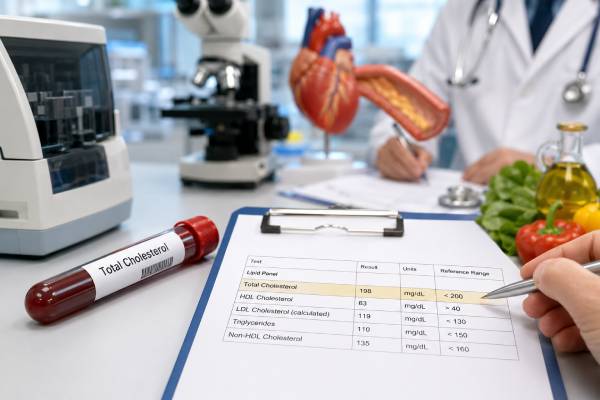
Total cholesterol is one of the first numbers many people notice on a lipid panel, but it is only the starting point for understanding cardiovascular risk. A total cholesterol test measures the overall amount of cholesterol carried in the blood by different lipoproteins, including LDL, HDL, VLDL, remnant particles, and lipoprotein(a). A result below 200 mg/dL is commonly considered desirable for adults, while values of 200–239 mg/dL are borderline high and 240 mg/dL or higher are high.
A healthier target is more personal. A total cholesterol around 150 mg/dL is often described as optimal for population-level heart health, but treatment decisions rarely use total cholesterol alone. LDL cholesterol, non-HDL cholesterol, ApoB, triglycerides, blood pressure, diabetes, smoking, age, kidney disease, family history, and previous heart or stroke events usually matter more than the total cholesterol number by itself.
- Desirable adult total cholesterol is below 200 mg/dL; 200–239 mg/dL is borderline high, and 240 mg/dL or higher is high.
- An often-cited optimal total cholesterol level is about 150 mg/dL, especially when LDL and non-HDL cholesterol are also low.
- Total cholesterol is not the main treatment target; LDL cholesterol and non-HDL cholesterol usually guide risk reduction more directly.
- Fasting is often not required, but an 8–12 hour fast may be requested when triglycerides are high or a precise lipid panel is needed.
- High total cholesterol usually reflects high LDL, high non-HDL cholesterol, high triglyceride-rich particles, or genetics, but very high HDL can also raise the total.
- Low total cholesterol is often harmless when due to low LDL, but unexpectedly low results may need review for thyroid, liver, nutrition, or chronic illness causes.
Table of Contents
- What Total Cholesterol Measures
- Normal and Optimal Total Cholesterol Ranges
- How to Interpret Your Result
- Why Total Cholesterol Is Not Enough
- High Total Cholesterol Causes
- Low Total Cholesterol Causes
- Testing, Preparation, and Repeat Results
- Targets and Next Steps
What Total Cholesterol Measures
Total cholesterol measures the cholesterol carried in all major lipoprotein particles in your blood. Cholesterol itself is a waxy substance your body needs for cell membranes, bile acids, vitamin D production, and steroid hormones. The problem is not cholesterol existing in the body. The problem is too many cholesterol-carrying particles entering the artery wall over time.
A total cholesterol result includes cholesterol carried by:
- LDL particles, often called “bad cholesterol,” because high levels strongly relate to plaque buildup in arteries
- HDL particles, often called “good cholesterol,” because HDL is involved in reverse cholesterol transport
- VLDL particles, which carry triglycerides and cholesterol from the liver
- IDL and remnant particles, which can be especially atherogenic when triglycerides are elevated
- Lipoprotein(a), or Lp(a), a genetically influenced LDL-like particle that can raise risk even when standard cholesterol numbers look acceptable
Total cholesterol is usually part of a standard lipid panel, which commonly reports total cholesterol, LDL cholesterol, HDL cholesterol, triglycerides, and often non-HDL cholesterol. The total cholesterol number is useful, but it blends helpful and harmful fractions into one value.
A simple way to think about it: total cholesterol tells you how much cholesterol is present overall, but it does not tell you how many artery-entering particles you have or how much of the result comes from LDL versus HDL. Two people can both have total cholesterol of 220 mg/dL and have very different risk profiles.
In many lab reports, total cholesterol is measured directly. LDL cholesterol may be calculated from the rest of the lipid panel or measured directly in certain cases. A traditional relationship is:
Total cholesterol ≈ LDL cholesterol + HDL cholesterol + VLDL cholesterol
In older calculations, VLDL cholesterol is often estimated as triglycerides divided by 5 when values are reported in mg/dL, but newer LDL equations are often preferred, especially when triglycerides are higher or LDL cholesterol is low.
Normal and Optimal Total Cholesterol Ranges
For adults, total cholesterol below 200 mg/dL is generally considered desirable. A result from 200 to 239 mg/dL is usually called borderline high, and a result of 240 mg/dL or higher is high. Many public health references also describe about 150 mg/dL as an optimal total cholesterol level.
| Total cholesterol | Category | Approximate mmol/L | Usual meaning |
|---|---|---|---|
| About 150 mg/dL | Optimal | About 3.9 mmol/L | Often associated with a lower population-level risk pattern, especially when LDL and non-HDL cholesterol are also low |
| Less than 200 mg/dL | Desirable | Less than 5.2 mmol/L | Generally acceptable for many adults, but still needs context from LDL, HDL, triglycerides, and risk factors |
| 200–239 mg/dL | Borderline high | 5.2–6.2 mmol/L | Often prompts closer review of LDL, non-HDL cholesterol, lifestyle, and overall cardiovascular risk |
| 240 mg/dL or higher | High | 6.2 mmol/L or higher | More likely to reflect a cholesterol pattern that increases long-term heart and stroke risk |
To convert total cholesterol from mg/dL to mmol/L, multiply by 0.02586. To convert mmol/L to mg/dL, multiply by 38.67. For example, 200 mg/dL is about 5.2 mmol/L, and 240 mg/dL is about 6.2 mmol/L.
Children and teenagers use lower cutoffs than adults. In pediatric screening, total cholesterol below 170 mg/dL is often considered acceptable, 170–199 mg/dL is borderline, and 200 mg/dL or higher is high. A high result in a child deserves careful review when there is a family history of early heart disease, very high LDL cholesterol, or possible familial hypercholesterolemia.
“Normal” and “optimal” are not always the same. Normal means a value falls into a common reference category. Optimal means the value fits a lower-risk pattern for that person. Someone with total cholesterol of 190 mg/dL may still need treatment if LDL cholesterol is high, ApoB is high, diabetes is present, or a previous heart attack has occurred. Someone else with total cholesterol of 215 mg/dL may have a high HDL cholesterol level and an otherwise reassuring profile.
How to Interpret Your Result
Total cholesterol makes the most sense when you read it with the rest of the lipid panel. A single number can mislead if it is separated from LDL cholesterol, HDL cholesterol, triglycerides, and non-HDL cholesterol.
Here is a practical way to read common results:
| Example result | Possible interpretation | What to check next |
|---|---|---|
| Total cholesterol 185 mg/dL, HDL 35 mg/dL | Total cholesterol looks desirable, but low HDL may point to insulin resistance, smoking, inactivity, or high triglyceride risk patterns | LDL, triglycerides, non-HDL cholesterol, waist size, blood pressure, glucose or A1c |
| Total cholesterol 220 mg/dL, HDL 85 mg/dL | Total cholesterol is borderline high, but a large part may come from HDL; risk depends heavily on LDL and non-HDL cholesterol | LDL, non-HDL cholesterol, ApoB if uncertainty remains |
| Total cholesterol 260 mg/dL, LDL 175 mg/dL | High total cholesterol is mainly driven by high LDL cholesterol, which usually needs active risk reduction | Family history, secondary causes, ASCVD risk estimate, treatment discussion |
| Total cholesterol 210 mg/dL, triglycerides 350 mg/dL | Borderline total cholesterol may hide a high burden of triglyceride-rich particles | Non-HDL cholesterol, ApoB, fasting repeat panel, diabetes and liver fat assessment |
A desirable total cholesterol result is reassuring only when the rest of the risk picture is also favorable. A result below 200 mg/dL does not cancel the risk from smoking, high blood pressure, diabetes, chronic kidney disease, obesity, strong family history, inflammatory disease, or a prior cardiovascular event.
A borderline high result does not automatically mean medication is needed. It means the lipid fractions and overall risk deserve closer review. Lifestyle changes may be enough for some people, while others may need medication because their LDL cholesterol, non-HDL cholesterol, ApoB, or risk score is high.
A high result of 240 mg/dL or above deserves follow-up. Many people in this range have high LDL cholesterol, high non-HDL cholesterol, or genetic cholesterol patterns. The result is more concerning when LDL cholesterol is 190 mg/dL or higher, when close relatives had early heart attack or stroke, or when physical signs such as tendon xanthomas are present.
Why Total Cholesterol Is Not Enough
Total cholesterol is useful for screening, but it is not precise enough to guide most treatment decisions by itself. The reason is simple: total cholesterol combines cholesterol carried in particles with different meanings.
LDL and related ApoB-containing particles can enter artery walls and contribute to atherosclerosis. HDL cholesterol is different. Higher HDL cholesterol often travels with healthier metabolic patterns, but HDL cholesterol is not a treatment target in the same way LDL cholesterol is. Raising HDL cholesterol with medication has not reliably reduced heart attacks in the way lowering LDL cholesterol has.
For this reason, a high total cholesterol result can be less concerning when HDL cholesterol is very high and LDL and non-HDL cholesterol are favorable. On the other hand, a “normal” total cholesterol result can still be concerning when HDL is low, triglycerides are high, or LDL particle burden is high.
LDL cholesterol usually receives the most attention because it is directly linked to plaque formation and is the main target of cholesterol-lowering therapy. For a deeper look at treatment thresholds, LDL cholesterol targets give more useful risk information than total cholesterol alone.
Non-HDL cholesterol is also valuable because it includes all cholesterol carried by atherogenic particles: LDL, VLDL, IDL, remnants, and Lp(a). You calculate it by subtracting HDL cholesterol from total cholesterol:
Non-HDL cholesterol = total cholesterol − HDL cholesterol
For example, if total cholesterol is 220 mg/dL and HDL cholesterol is 60 mg/dL, non-HDL cholesterol is 160 mg/dL. That number may better reflect artery-related cholesterol burden than total cholesterol alone, especially when triglycerides are elevated. A detailed non-HDL cholesterol result can be especially useful in people with diabetes, metabolic syndrome, obesity, fatty liver, or high triglycerides.
Total cholesterol also does not measure particle number. Some people have many small cholesterol-carrying particles without a dramatic rise in LDL cholesterol. ApoB can help because one ApoB molecule sits on each major atherogenic particle. When ApoB is high, particle burden is high.
High Total Cholesterol Causes
High total cholesterol usually comes from high LDL cholesterol, high triglyceride-rich lipoproteins, high HDL cholesterol, or a combination of these. The cause matters because the next step differs depending on the pattern.
Common causes include:
- High saturated fat intake, especially from fatty meats, butter, full-fat dairy, coconut oil, palm oil, and many baked or fried foods
- Trans fat exposure, which can raise LDL cholesterol and lower HDL cholesterol
- Weight gain and insulin resistance, often linked with high triglycerides, low HDL, and higher non-HDL cholesterol
- Type 2 diabetes or prediabetes, which can create a more atherogenic lipid pattern even when LDL cholesterol is not extremely high
- Hypothyroidism, because low thyroid hormone can raise LDL cholesterol
- Chronic kidney disease or nephrotic syndrome, which can raise LDL and triglycerides
- Cholestatic liver or bile duct disease, which can raise cholesterol in unusual patterns
- Pregnancy, which naturally raises cholesterol and triglycerides, especially later in pregnancy
- Certain medicines, including some steroids, retinoids, antiretroviral drugs, cyclosporine, and some diuretics or beta-blockers
- Genetic lipid disorders, including familial hypercholesterolemia and familial combined hyperlipidemia
When total cholesterol is high because LDL cholesterol is high, artery risk usually rises. This is especially true when LDL cholesterol is 160–189 mg/dL with other risk factors or 190 mg/dL or higher. A separate review of high LDL cholesterol causes is often more useful than focusing only on the total cholesterol number.
High triglycerides can also raise total cholesterol by increasing VLDL and remnant cholesterol. This pattern often travels with abdominal weight gain, insulin resistance, high blood sugar, alcohol intake, fatty liver, kidney disease, and some medications. When triglycerides are very high, the immediate safety issue may shift toward pancreatitis prevention, not just long-term heart risk. For that pattern, high triglyceride results need separate attention.
Very high HDL cholesterol can raise total cholesterol, too. HDL cholesterol of 80, 90, or 100 mg/dL may make the total look high even when LDL is not severe. This does not always mean risk is high, but very high HDL is not automatically protective in every person. Genetics, alcohol intake, liver conditions, and certain medications can influence HDL levels.
Low Total Cholesterol Causes
Low total cholesterol is not always a problem. Many people have low total cholesterol because their LDL cholesterol is low, their lifestyle is heart-healthy, or they take effective cholesterol-lowering medication. In a person at high cardiovascular risk, lower LDL cholesterol is usually beneficial when achieved safely and monitored properly.
An unexpectedly low total cholesterol result deserves context. Possible causes include:
- Very low LDL cholesterol, whether genetic, lifestyle-related, or medication-related
- Hyperthyroidism, which can lower cholesterol by speeding up cholesterol metabolism
- Malabsorption or undernutrition, where the body is not absorbing or receiving enough nutrients
- Chronic liver disease, because the liver makes and clears lipoproteins
- Chronic inflammation, infection, or serious illness, which can temporarily lower cholesterol
- Some cancers or advanced illness, where low cholesterol may reflect the illness rather than protect against disease
- Very low-fat intake or major weight loss, especially if intake is not nutritionally balanced
A low total cholesterol result is more concerning when it is new, unexplained, or paired with symptoms such as unintended weight loss, diarrhea, tremor, heat intolerance, rapid heart rate, fatigue, poor appetite, or signs of liver disease. In those cases, the result should be reviewed with other tests rather than interpreted as “excellent” automatically.
The lipid fractions matter here, too. Total cholesterol of 125 mg/dL with healthy HDL and low LDL on treatment may be appropriate for someone with prior heart disease. Total cholesterol of 125 mg/dL with low HDL, weight loss, abnormal liver enzymes, or symptoms of hyperthyroidism has a different meaning. A focused review of low total cholesterol causes can help separate a favorable lipid pattern from a possible health issue.
Testing, Preparation, and Repeat Results
Total cholesterol is measured with a blood sample, usually as part of a lipid panel. Many lipid panels can be done without fasting. Nonfasting testing is convenient and often reflects everyday metabolism. However, your clinician may request an 8–12 hour fast if triglycerides are high, if the previous result was unclear, if inherited lipid disease is suspected, or if treatment decisions require the most precise lipid calculation.
Before the test, follow the instructions from the lab or clinician. For the most useful result:
- Avoid unusually heavy alcohol intake for several days before testing, especially if triglycerides are being checked.
- Do not change your diet dramatically right before the test unless instructed.
- Tell your clinician about prescription medicines, supplements, pregnancy, recent illness, and recent major weight changes.
- Ask whether the test should be fasting if your triglycerides were previously high.
- Try to use the same lab when comparing small changes over time.
Lipid results can shift. A single test may reflect recent diet, alcohol intake, illness, weight change, medication changes, pregnancy, or lab variation. Mildly abnormal results are often repeated before major decisions are made, especially in lower-risk people.
A repeat lipid panel is commonly considered after lifestyle changes or medication adjustments. Many clinicians recheck lipids about 4–12 weeks after starting or changing cholesterol-lowering medication, then periodically after that. For stable, lower-risk adults, screening may occur every few years. People with known cardiovascular disease, diabetes, chronic kidney disease, familial hypercholesterolemia, or active treatment usually need more frequent monitoring.
Children are often screened once between ages 9 and 11 and again later in adolescence. Earlier testing may be appropriate when a parent has familial hypercholesterolemia, very high cholesterol, or early heart disease.
Total cholesterol does not usually cause symptoms. Chest pain, shortness of breath, one-sided weakness, facial drooping, trouble speaking, sudden severe headache, fainting, or crushing pressure in the chest should be treated as urgent symptoms, not as “cholesterol symptoms.” In those situations, emergency care matters more than waiting for a lipid test.
Targets and Next Steps
A total cholesterol target is best viewed as a screening guide, not the final treatment goal. For many adults, below 200 mg/dL is desirable, and about 150 mg/dL is often described as optimal. But the treatment plan depends on the full lipid pattern and the person’s cardiovascular risk.
The most important next step is to identify which part of the total cholesterol is elevated. A useful review includes:
- LDL cholesterol
- HDL cholesterol
- Triglycerides
- Non-HDL cholesterol
- ApoB when particle burden is uncertain or triglycerides are high
- Lp(a), at least once in adulthood or earlier when family history suggests inherited risk
- Blood pressure, blood glucose or A1c, kidney function, smoking status, age, and family history
A more advanced lipid review may help when standard results do not match the clinical picture. For example, a person with normal LDL cholesterol but high triglycerides, diabetes, fatty liver, or a strong family history may benefit from ApoB testing. Someone with early heart disease in the family may need an Lp(a) blood test, because Lp(a) is mostly genetic and may be high even when total cholesterol is not dramatic.
Lifestyle changes can improve many cholesterol patterns. The strongest foundations include replacing saturated fats with unsaturated fats, eating more soluble fiber, choosing minimally processed foods, improving weight when needed, exercising regularly, avoiding tobacco, limiting alcohol when triglycerides are high, and treating related conditions such as hypothyroidism, diabetes, kidney disease, and high blood pressure.
Food changes do not need to be extreme to work. Oats, beans, lentils, barley, vegetables, fruit, nuts, seeds, olive oil, fish, and high-fiber meals can support healthier LDL and non-HDL cholesterol. Reducing butter, processed meats, high-fat dairy, deep-fried foods, refined carbohydrates, and sugary drinks can help many people, especially when triglycerides or insulin resistance are part of the pattern.
Medication may be appropriate when risk is high enough. Statins remain the foundation for many people who need LDL cholesterol reduction. Other options may include ezetimibe, PCSK9 inhibitors, inclisiran, bempedoic acid, bile acid sequestrants, or triglyceride-focused therapy in selected cases. The reason for treatment is not to make the total cholesterol number look better; it is to reduce the number of atherogenic particles and lower the chance of heart attack, stroke, and related events.
More urgent follow-up is reasonable when total cholesterol is very high, LDL cholesterol is 190 mg/dL or higher, triglycerides are 500 mg/dL or higher, xanthomas are present, or there is a strong family history of early heart disease. In those cases, inherited lipid disorders or high-risk metabolic patterns may be present.
A good cholesterol plan answers four questions: Which lipid fraction is abnormal? Is the pattern temporary or persistent? What is the person’s overall cardiovascular risk? What target makes sense for that risk level? Total cholesterol starts the conversation, but the full lipid profile and risk history decide the next move.
References
- About Cholesterol 2024 (Official Page)
- Blood Cholesterol – Diagnosis | NHLBI, NIH 2024 (Official Page)
- Guidelines for the Management of Dyslipidemia 2026 (Review)
- 2025 Focused Update of the 2019 ESC/EAS Guidelines for the management of dyslipidaemias 2025 (Guideline)
- Statin Use for the Primary Prevention of Cardiovascular Disease in Adults: US Preventive Services Task Force Recommendation Statement 2022 (Recommendation Statement)
Disclaimer
Total cholesterol results should be interpreted with the full lipid panel, medical history, medications, and cardiovascular risk factors. This information is educational and does not replace care from a qualified clinician. Seek urgent medical care for symptoms of heart attack or stroke, regardless of your cholesterol numbers.