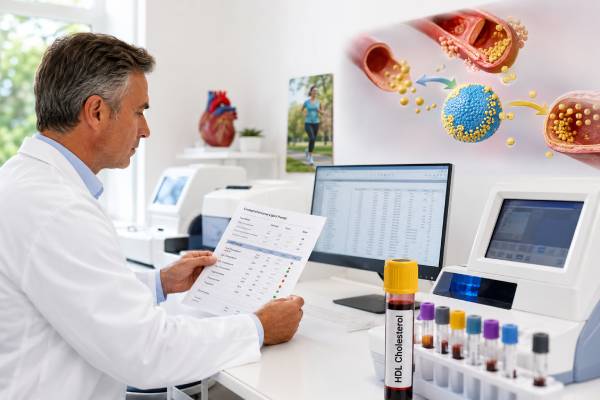
HDL cholesterol is often called “good cholesterol,” but a low HDL result is more than a simple good-or-bad number. HDL is part of a standard lipid panel, and it helps show how well your overall lipid pattern supports heart and metabolic health. A low result can appear by itself, but it more often travels with high triglycerides, insulin resistance, excess abdominal weight, smoking, type 2 diabetes, fatty liver, or an inactive lifestyle.
Low HDL cholesterol does not usually cause symptoms. Most people discover it during routine blood work, an annual physical, diabetes screening, or a cardiovascular risk check. The result matters because low HDL often points to a broader pattern: more triglyceride-rich particles, lower HDL particle quality, and higher long-term risk for atherosclerosis. Raising the HDL number alone is not the main treatment target. The better approach is to find the cause, improve metabolic health, and reduce the particles that actually build artery plaque.
- Low HDL is commonly defined as below 40 mg/dL in men and below 50 mg/dL in women.
- HDL of 60 mg/dL or higher is often considered favorable, but very high HDL is not always automatically protective.
- Low HDL usually does not cause symptoms; it is found on a cholesterol or lipid panel.
- Common causes include insulin resistance, high triglycerides, excess belly fat, smoking, inactivity, type 2 diabetes, and some medications.
- Low HDL is most concerning when LDL cholesterol, non-HDL cholesterol, ApoB, triglycerides, blood pressure, glucose, or inflammatory markers are also abnormal.
- Follow-up usually focuses on lifestyle, weight, smoking cessation, triglycerides, LDL/non-HDL cholesterol, ApoB, diabetes risk, and overall cardiovascular risk.
Table of Contents
- What a Low HDL Cholesterol Test Means
- Low HDL Ranges and Result Patterns
- Common Causes of Low HDL Cholesterol
- Low HDL, Heart Risk, and Artery Plaque
- Low HDL and Metabolic Health
- Follow-Up Tests That Put Low HDL in Context
- How to Improve a Low HDL Pattern
- When Low HDL Needs Medical Follow-Up
What a Low HDL Cholesterol Test Means
A low HDL cholesterol test means the amount of cholesterol carried inside HDL particles is below the expected range. HDL stands for high-density lipoprotein. It is a group of particles that carry cholesterol, phospholipids, proteins, and other molecules through the blood.
HDL is best known for reverse cholesterol transport, a process in which HDL particles help move cholesterol away from tissues and toward the liver for processing. HDL particles also take part in inflammation control, antioxidant activity, blood vessel signaling, and immune responses. That is why HDL biology is more complex than the nickname “good cholesterol” suggests.
A standard lipid panel usually reports HDL cholesterol along with total cholesterol, LDL cholesterol, triglycerides, and often non-HDL cholesterol. The HDL result is measured in milligrams per deciliter, written as mg/dL, in the United States. Some countries use millimoles per liter, written as mmol/L.
The HDL cholesterol number tells you how much cholesterol is inside HDL particles. It does not directly measure how many HDL particles you have, how well those particles work, or whether they are anti-inflammatory or dysfunctional. This distinction matters because two people can have the same HDL-C value but different HDL particle numbers, particle sizes, triglyceride levels, insulin sensitivity, and cardiovascular risk.
Low HDL usually matters most as part of a pattern. For example, an HDL of 36 mg/dL with triglycerides of 230 mg/dL, high fasting insulin, abdominal weight gain, and elevated blood pressure points toward insulin resistance. An HDL of 38 mg/dL with high LDL cholesterol and high ApoB points toward a high burden of atherogenic particles. An HDL of 35 mg/dL in a person who smokes may improve after quitting.
Low HDL is not usually treated by simply trying to “raise HDL” with a pill. Several medications can raise HDL cholesterol, but raising the number has not reliably reduced heart attacks or strokes when LDL-related risk is not also addressed. Modern lipid care focuses more on lowering LDL cholesterol, non-HDL cholesterol, ApoB, and triglyceride-rich remnant particles while improving the lifestyle and metabolic conditions that tend to suppress HDL.
Low HDL Ranges and Result Patterns
Low HDL cutoffs vary slightly by laboratory, age, sex, and guideline source, but adult results are commonly interpreted using these ranges.
| HDL cholesterol result | Common interpretation | Why it matters |
|---|---|---|
| Below 40 mg/dL in men | Low | Associated with higher cardiovascular and metabolic risk, especially when triglycerides, glucose, ApoB, or blood pressure are also high. |
| Below 50 mg/dL in women | Low | Often part of insulin resistance, metabolic syndrome, smoking-related lipid changes, or high triglyceride patterns. |
| 40–59 mg/dL in men | Acceptable to moderate | Risk depends strongly on LDL cholesterol, non-HDL cholesterol, ApoB, triglycerides, blood pressure, diabetes status, and smoking. |
| 50–59 mg/dL in women | Acceptable to moderate | Usually interpreted with the full lipid panel and overall risk profile. |
| 60 mg/dL or higher | Often favorable | May be linked with lower risk in many people, but HDL function and the rest of the lipid profile still matter. |
| Very high, such as above 80–90 mg/dL | Needs context | Very high HDL is not always protective and may reflect genetics, alcohol intake, liver-related changes, or altered HDL function in some people. |
The most useful interpretation comes from the pattern around HDL, not HDL alone. A low HDL result with normal triglycerides, normal ApoB, normal blood pressure, healthy glucose markers, no smoking, and no family history may be less concerning than the same HDL result in someone with several other risk factors.
The opposite is also true. A person can have normal or high HDL and still have high cardiovascular risk if LDL cholesterol, ApoB, Lp(a), blood pressure, diabetes status, kidney function, or smoking history is unfavorable. HDL can improve the risk estimate, but it does not cancel out other major risks.
For more detail on reference values, the related HDL cholesterol normal and optimal range guide can help separate low, acceptable, favorable, and unusually high results.
Fasting is not always required
Many lipid panels can be done without fasting, especially for routine screening. Nonfasting results are often enough to measure total cholesterol, HDL cholesterol, and non-HDL cholesterol. Fasting may be requested when triglycerides are high, when prior results were unclear, when diabetes or metabolic syndrome is being evaluated, or when a clinician wants the most comparable repeat result.
HDL does not usually swing sharply after a single meal. Triglycerides can rise after eating, and that can affect calculated LDL cholesterol. If your triglycerides are high on a nonfasting test, your clinician may repeat a fasting lipid panel.
One low result should be confirmed when the pattern is unexpected
HDL can vary from test to test. Recent illness, major weight change, alcohol changes, diet changes, pregnancy, intense training changes, uncontrolled diabetes, medication changes, and lab variation can all affect the result. If HDL is unexpectedly low, repeating the lipid panel after several weeks or months may give a clearer picture.
A very low HDL result, such as below 20 mg/dL, deserves more attention. It can happen with severe high triglycerides, uncontrolled diabetes, inflammation, liver disease, certain medications, or rare genetic conditions affecting HDL metabolism.
Common Causes of Low HDL Cholesterol
Low HDL often develops when the body is carrying more triglyceride-rich particles and processing lipids in a more insulin-resistant pattern. HDL particles exchange cholesterol and triglycerides with other lipoproteins. When triglycerides are high, HDL particles tend to become triglyceride-enriched and may be cleared faster from the blood. The result is a lower HDL cholesterol number.
Common causes include:
- Insulin resistance and prediabetes
- High triglycerides
- Excess abdominal fat
- Type 2 diabetes
- Smoking or nicotine exposure
- Low physical activity
- Diets high in refined carbohydrates or added sugars
- Severe calorie imbalance or rapid weight changes
- Chronic kidney disease
- Fatty liver or other metabolic liver stress
- Some medications
- Rare inherited HDL disorders
Low HDL often appears with high triglycerides. This combination is common enough that clinicians often look at the triglyceride-HDL pattern when considering insulin resistance. The triglyceride/HDL ratio is not a formal diagnosis by itself, but a high ratio can be a useful clue when paired with waist size, fasting glucose, A1c, fasting insulin, blood pressure, and liver enzymes.
Lifestyle and metabolic causes
Smoking is one of the clearest reversible causes of low HDL. Tobacco smoke affects oxidative stress, inflammation, blood vessel function, and lipid metabolism. HDL often rises after smoking cessation, although the exact change varies by person.
Physical inactivity can also suppress HDL. Regular aerobic activity and resistance training can improve HDL metabolism, triglycerides, insulin sensitivity, blood pressure, and body composition. The HDL increase may be modest, but the broader risk improvement can be meaningful.
Diet affects HDL indirectly through weight, triglycerides, insulin resistance, liver fat, and inflammation. Diets high in added sugar, sweet drinks, refined grains, and ultra-processed foods can raise triglycerides and lower HDL in susceptible people. Replacing refined carbohydrates with unsaturated fats, high-fiber carbohydrates, and protein from minimally processed foods often improves the pattern.
Excess abdominal fat is strongly linked with low HDL because visceral fat releases fatty acids and inflammatory signals into the portal circulation, which drains to the liver. The liver then produces more triglyceride-rich VLDL particles. This shifts lipid exchange in a way that often lowers HDL and raises triglycerides.
Medical conditions and medications
Medical causes may include uncontrolled diabetes, chronic kidney disease, nephrotic syndrome, inflammatory disease, liver disease, severe infections, and some endocrine disorders. Low HDL can also occur during acute illness, so results drawn during hospitalization or infection may not reflect the usual baseline.
Medications can influence HDL in some people. Examples may include certain older beta-blockers, anabolic steroids, some progestins, and some immunosuppressive or HIV-related treatments. Do not stop a medication because of HDL without medical advice. The medication may be essential, and the risk-benefit balance depends on the reason it was prescribed.
Rare genetic conditions can cause extremely low HDL. Tangier disease, familial hypoalphalipoproteinemia, and some ApoA1-related disorders are uncommon but may be considered when HDL is very low, especially if there is orange tonsil enlargement, enlarged liver or spleen, neuropathy, premature cardiovascular disease, or a strong family pattern.
Low HDL, Heart Risk, and Artery Plaque
Low HDL is associated with higher cardiovascular risk, but the reason is not as simple as “low HDL directly causes plaque.” Artery plaque forms mainly when ApoB-containing lipoproteins enter the artery wall, become retained, and trigger inflammation. These particles include LDL, VLDL remnants, IDL, and Lp(a). HDL may help with cholesterol handling and inflammation, but HDL cholesterol itself is not the main plaque-building particle.
This is why low HDL should prompt a closer look at atherogenic particle burden. LDL cholesterol is important, but ApoB and non-HDL cholesterol can reveal risk that LDL cholesterol alone may miss, especially when triglycerides are high. A person with low HDL and high triglycerides may have many remnant particles even if LDL cholesterol does not look extremely high.
If LDL cholesterol is elevated, the related high LDL cholesterol pattern usually deserves direct attention. If ApoB is high, the number of plaque-forming particles is high, even when HDL looks acceptable. The ApoB blood test can be especially useful when LDL cholesterol, triglycerides, and metabolic risk do not line up neatly.
Low HDL also affects cardiovascular risk calculators. Many risk tools include HDL because population studies show that lower HDL is linked with higher rates of heart attack and stroke. Still, HDL is only one input. Age, sex, blood pressure, diabetes, smoking, total cholesterol, LDL-related markers, kidney disease, family history, and inflammatory conditions often carry more treatment weight.
Why raising HDL with medication has not solved the problem
For years, low HDL looked like an attractive treatment target. If low HDL was linked with higher risk, raising HDL seemed as if it should reduce risk. Clinical trials did not consistently support that idea.
Niacin can raise HDL cholesterol, but when added to modern LDL-lowering therapy, it did not reliably improve cardiovascular outcomes enough to justify routine use for HDL raising. Several CETP inhibitors raised HDL dramatically, but many failed to reduce events or had safety problems. Some newer therapies in that class showed benefit mostly through lowering non-HDL cholesterol and ApoB-containing particles, not simply because HDL rose.
This history changed how clinicians interpret low HDL. The HDL number is still useful. It can point toward metabolic risk and help estimate cardiovascular risk. But treatment usually aims at proven risk reducers: lowering LDL cholesterol and ApoB when indicated, lowering very high triglycerides, treating diabetes and blood pressure, quitting smoking, improving fitness, and reducing excess visceral fat.
Low HDL and Metabolic Health
Low HDL is one of the classic features of metabolic syndrome. Metabolic syndrome is usually diagnosed when at least three risk factors occur together: increased waist circumference, triglycerides of 150 mg/dL or higher, low HDL, blood pressure of 130/85 mm Hg or higher or treatment for hypertension, and fasting glucose of 100 mg/dL or higher or treatment for high glucose.
This cluster matters because each factor amplifies the others. Abdominal fat increases fatty acid flow to the liver. The liver produces more VLDL. Triglycerides rise. HDL often falls. Blood pressure increases. Glucose and insulin levels drift upward. Over time, the pattern raises the risk of type 2 diabetes, fatty liver disease, chronic kidney disease, and cardiovascular disease.
Low HDL with high triglycerides is one of the most common blood-test clues of insulin resistance. Insulin resistance means the body needs more insulin than usual to move glucose into cells and control liver glucose production. Early in the process, fasting glucose may still look normal because the pancreas produces extra insulin. HDL and triglycerides may become abnormal before fasting glucose crosses the diabetes threshold.
That is why a low HDL result can be useful even when the rest of the cholesterol panel looks only mildly abnormal. It may encourage earlier action on waist size, fitness, sleep, diet quality, blood pressure, and glucose markers. A broader metabolic syndrome blood test panel can help connect HDL with glucose, insulin, triglycerides, liver markers, and other risk signals.
Low HDL, triglycerides, and fatty liver
Fatty liver disease often travels with low HDL and high triglycerides. When the liver receives more energy than it can safely process, it stores fat and releases more triglyceride-rich lipoproteins. This does not always cause symptoms. Mildly high ALT or GGT, abdominal weight gain, high triglycerides, low HDL, prediabetes, and high fasting insulin can all point in the same direction.
Improving liver fat often improves the lipid pattern. Weight loss, reduced alcohol when relevant, fewer sugar-sweetened drinks, higher protein quality, more fiber, and regular exercise can reduce liver fat and triglyceride production. HDL may improve as the metabolic environment improves, even if the change is gradual.
Low HDL in people with normal weight
A person does not have to be overweight to have low HDL. Some people have genetic tendencies toward lower HDL. Others have low muscle mass, low activity, high refined carbohydrate intake, smoking exposure, poor sleep, high stress, diabetes risk, or high triglycerides despite a normal body mass index.
Waist circumference, blood pressure, fasting triglycerides, fasting glucose, A1c, fasting insulin, and family history can be more informative than weight alone. A normal-weight person with low HDL and high triglycerides still deserves a metabolic risk review.
Follow-Up Tests That Put Low HDL in Context
A low HDL result is a starting point, not a full diagnosis. The most useful follow-up depends on the full lipid panel, medical history, family history, age, blood pressure, smoking status, medications, and glucose markers.
Common follow-up tests include:
| Test or marker | Why it helps |
|---|---|
| Repeat lipid panel | Confirms whether HDL is persistently low and checks LDL cholesterol, total cholesterol, triglycerides, and non-HDL cholesterol. |
| Triglycerides | High triglycerides often explain or accompany low HDL and may point toward insulin resistance or high remnant cholesterol. |
| Non-HDL cholesterol | Estimates cholesterol carried by atherogenic particles, including LDL, VLDL, IDL, and remnants. |
| ApoB | Counts the main protein on plaque-forming particles and can clarify risk when triglycerides are high or LDL cholesterol seems misleading. |
| Fasting glucose and HbA1c | Checks for prediabetes, diabetes, and longer-term glucose exposure. |
| Fasting insulin or HOMA-IR | Can show insulin resistance before fasting glucose becomes abnormal, especially when interpreted carefully. |
| ALT, AST, and GGT | May identify liver stress or fatty liver patterns that travel with high triglycerides and low HDL. |
| TSH | Checks thyroid function when the lipid pattern or symptoms suggest thyroid disease. |
| Lp(a) | Identifies inherited cardiovascular risk that HDL does not offset. |
| hs-CRP | Provides a general marker of inflammation that can refine cardiovascular risk in selected people. |
Triglycerides deserve special attention. The related high triglycerides blood test discussion is often relevant when HDL is low, because the two markers commonly move in opposite directions.
An advanced lipid panel may be useful when there is premature heart disease in the family, diabetes, metabolic syndrome, high triglycerides, normal LDL but high suspected risk, or repeated uncertainty about treatment decisions. Advanced panels can include ApoB, LDL particle number, Lp(a), HDL particle number, and particle size. These tests are not needed for everyone, but they can add clarity in selected cases.
For glucose and insulin patterns, the fasting insulin test can be useful when low HDL appears with abdominal weight gain, high triglycerides, cravings, fatigue after meals, polycystic ovary syndrome, fatty liver, or a strong family history of type 2 diabetes. Insulin testing is not a standalone diagnosis, but it can reveal strain on the metabolic system earlier than glucose alone.
How to Improve a Low HDL Pattern
The healthiest way to improve low HDL is to improve the metabolic conditions that are lowering it. The goal is not to chase a number. The goal is to reduce cardiovascular risk, lower plaque-forming particles, improve triglycerides, improve insulin sensitivity, and strengthen blood vessel health.
Regular exercise is one of the most reliable starting points. Aerobic training, brisk walking, cycling, swimming, running, rowing, and resistance training can all help. A practical target is at least 150 minutes per week of moderate-intensity aerobic activity, plus two or more days of strength training. People who are inactive can start with 10- to 15-minute walks after meals and build gradually.
Weight loss can improve HDL, but the bigger benefit often comes from lower triglycerides, lower insulin resistance, lower blood pressure, and less liver fat. Even a 5% to 10% weight reduction can improve metabolic markers in people with excess abdominal fat. Waist reduction may be more meaningful than scale weight alone.
Diet changes should focus on lowering triglyceride pressure and improving insulin sensitivity:
- Replace sugar-sweetened drinks with water, unsweetened tea, or other low-sugar options.
- Reduce refined starches such as white bread, pastries, sweet cereals, and large portions of white rice or pasta.
- Choose higher-fiber carbohydrates such as beans, lentils, vegetables, oats, barley, berries, and intact whole grains.
- Use unsaturated fats from olive oil, nuts, seeds, avocado, and fish instead of trans fats or frequent deep-fried foods.
- Eat enough protein from minimally processed sources, such as fish, poultry, eggs, Greek yogurt, legumes, tofu, or lean meats.
- Limit alcohol if triglycerides are high, HDL is unusually high, liver enzymes are elevated, sleep is poor, or weight loss has stalled.
Quitting smoking is one of the most important steps for low HDL and heart risk. Smoking damages blood vessels, raises clotting tendency, worsens inflammation, and lowers HDL. The cardiovascular benefit of quitting begins quickly, even before lipid numbers fully change.
Sleep and stress also matter. Short sleep, untreated sleep apnea, shift work, and chronic stress can worsen insulin resistance and blood pressure. If low HDL appears with morning headaches, loud snoring, daytime sleepiness, resistant hypertension, or weight gain, sleep apnea evaluation may be appropriate.
What about supplements?
No supplement reliably fixes low HDL or replaces cardiovascular risk management. Fish oil can lower triglycerides in some settings, but effects depend on dose, formulation, baseline triglycerides, and medical context. Prescription omega-3 therapy is different from over-the-counter fish oil and is used selectively.
Niacin raises HDL but is not routinely used just to raise HDL because outcome benefits have not matched the HDL increase when modern LDL-lowering therapy is already in place. It can also cause flushing, liver enzyme changes, glucose worsening, and drug interactions.
Fiber supplements such as psyllium may help LDL and glucose patterns modestly. They do not directly “treat low HDL,” but they can support a healthier lipid and metabolic profile when used with diet changes.
Medication decisions usually focus on LDL, ApoB, non-HDL, and triglycerides
If cardiovascular risk is high, medication may still be needed even if lifestyle improves HDL. Statins, ezetimibe, PCSK9 inhibitors, bempedoic acid, fibrates, and prescription omega-3 therapies are used for specific lipid patterns and risk levels. The reason for treatment is usually LDL cholesterol, ApoB, non-HDL cholesterol, very high triglycerides, diabetes, known cardiovascular disease, or high calculated risk—not low HDL alone.
For example, a person with low HDL, high ApoB, and a strong family history may need LDL/ApoB-lowering treatment. A person with low HDL and triglycerides above 500 mg/dL may need treatment to reduce pancreatitis risk. A person with low HDL, normal ApoB, normal triglycerides, and low overall risk may need lifestyle follow-up rather than medication.
When Low HDL Needs Medical Follow-Up
Low HDL should be reviewed with a healthcare professional when it is persistent, severe, or part of a broader abnormal pattern. Follow-up is especially important if HDL is below 40 mg/dL in a man or below 50 mg/dL in a woman and any of the following are present:
- LDL cholesterol, non-HDL cholesterol, or ApoB is high.
- Triglycerides are 150 mg/dL or higher.
- Triglycerides are 500 mg/dL or higher.
- Blood pressure is elevated or treated with medication.
- Fasting glucose, A1c, fasting insulin, or waist circumference suggests insulin resistance.
- There is type 2 diabetes, chronic kidney disease, fatty liver disease, or inflammatory disease.
- You smoke or recently quit smoking.
- A close relative had a heart attack, stroke, stent, bypass surgery, or sudden cardiac death at a young age.
- HDL is extremely low, especially below 20 mg/dL.
- There are symptoms that could suggest heart disease, such as chest pressure, shortness of breath with exertion, pain radiating to the arm or jaw, fainting, or new severe exercise intolerance.
Urgent care is needed for possible heart attack or stroke symptoms. These include chest pressure, severe shortness of breath, sudden weakness on one side, facial drooping, trouble speaking, sudden vision loss, or sudden severe dizziness with neurologic symptoms. Low HDL itself is not an emergency, but it can be part of the long-term risk profile that makes prevention important.
For most people, the next step is not panic. It is pattern recognition. Recheck the lipid panel if needed. Review triglycerides, LDL cholesterol, non-HDL cholesterol, ApoB, glucose markers, blood pressure, waist size, medications, smoking, alcohol, sleep, and activity. Low HDL often improves when the whole metabolic picture improves, and cardiovascular risk can fall even when HDL rises only modestly.
References
- High-density lipoprotein revisited: biological functions and clinical relevance 2023 (Review)
- 2024 Guidelines of the Polish Society of Laboratory Diagnostics and the Polish Lipid Association on laboratory diagnostics of lipid metabolism disorders 2024 (Guideline)
- HDL: Fact, fiction, or function? HDL cholesterol and cardiovascular risk 2021 (Review)
- 2022 ACC ECDP on Role of Nonstatin Therapies for LDL-C Lowering 2022 (Guideline)
- Blood Cholesterol – Diagnosis 2024 (Official Page)
- HDL: The “Good” Cholesterol 2025 (Official Page)
Disclaimer
Low HDL cholesterol should be interpreted with your full lipid panel, medical history, medications, family history, and cardiovascular risk factors. This article is educational and does not replace medical care, diagnosis, or treatment. Ask a qualified healthcare professional how your HDL result fits with LDL cholesterol, triglycerides, ApoB, glucose markers, blood pressure, and personal risk.