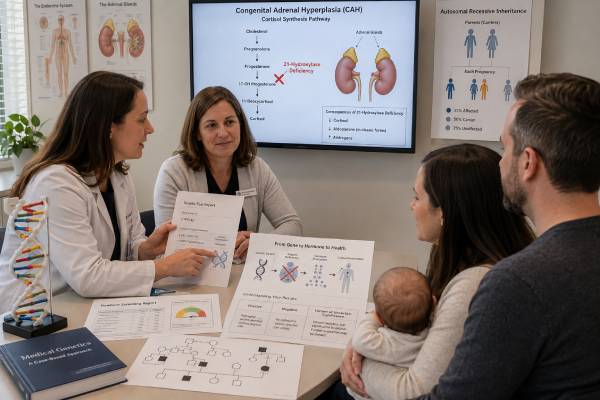
A congenital adrenal hyperplasia genetic test commonly analyzes CYP21A2, the gene responsible for 21-hydroxylase deficiency, which causes the great majority of CAH. Testing can confirm a biochemical diagnosis, distinguish classic from nonclassic genetic patterns, clarify an abnormal newborn screen, identify carriers, and define reproductive risk. CYP21A2 is technically difficult because it sits beside a highly similar pseudogene, CYP21A1P. Disease-causing sequence changes can be copied from the pseudogene into the working gene, and large deletions or gene conversions can create complex hybrid structures. A reliable assay therefore needs more than ordinary sequencing: it must distinguish gene from pseudogene and assess deletions, duplications, chimeric genes, and phase. The result is interpreted with 17-hydroxyprogesterone, cortisol, adrenal androgens, renin, electrolytes, symptoms, and treatment history. Genetics can support the expected severity, but it cannot safely replace hormone testing or urgent management of a possible salt-wasting adrenal crisis.
- Two clinically significant CYP21A2 variants usually cause autosomal recessive 21-hydroxylase deficiency.
- Classic CAH includes salt-wasting and simple-virilizing forms; nonclassic CAH is milder and often presents later.
- CYP21A2 testing must account for the nearby CYP21A1P pseudogene and complex RCCX structures.
- The milder of two alleles often predicts phenotype, but genotype–phenotype exceptions are common.
- A single pathogenic variant usually indicates carrier status, although duplications and phase can complicate that conclusion.
- Vomiting, dehydration, poor feeding, low sodium, high potassium, or shock in a suspected infant requires emergency care.
Table of Contents
- CAH and 21-Hydroxylase Deficiency
- When CYP21A2 Testing Is Helpful
- Hormone Testing Comes First
- Why CYP21A2 Is Hard to Analyze
- Test Methods and Variant Types
- Interpreting Genetic Results
- Carrier, Partner, and Prenatal Risk
- Follow-Up After Testing
CAH and 21-Hydroxylase Deficiency
Congenital adrenal hyperplasia is a group of inherited disorders that impair adrenal steroid production. CYP21A2-related 21-hydroxylase deficiency accounts for approximately 95% or more of cases. The 21-hydroxylase enzyme is needed to make cortisol and, in the aldosterone pathway, mineralocorticoids. When enzyme activity falls, the pituitary releases more ACTH, the adrenal glands enlarge, and steroid precursors are diverted toward androgen production.
The phenotype forms a continuum, traditionally divided into three categories.
Classic salt-wasting CAH has little or no effective 21-hydroxylase activity. Cortisol and aldosterone deficiency can cause dehydration, vomiting, weight loss, low sodium, high potassium, low blood pressure, and shock in the first weeks of life. Excess prenatal androgens can virilize the external genitalia of an XX fetus. An XY infant may look typical at birth and still develop a life-threatening salt-wasting crisis.
Classic simple-virilizing CAH retains enough mineralocorticoid function to avoid obvious neonatal salt loss but still causes substantial androgen excess. Children may have atypical genital development, early pubic hair, rapid growth, advanced bone age, and reduced adult height if untreated.
Nonclassic CAH retains more enzyme activity and usually appears after infancy. Features can include early pubic hair, acne, excess facial or body hair, irregular menstrual cycles, reduced fertility, or no symptoms. It can resemble polycystic ovary syndrome. Many affected males are minimally symptomatic.
The categories are useful for care but do not correspond perfectly to individual variants. Hormone production is continuous, and people with the same genotype can differ. Treatment, age, sex characteristics, stress, and modifier genes influence presentation.
Other genes cause rarer forms of CAH, including CYP11B1, HSD3B2, CYP17A1, POR, STAR, and CYP11A1. A negative CYP21A2 test does not rule out CAH as a group. If the steroid pattern is atypical for 21-hydroxylase deficiency, a broader adrenal steroidogenesis panel may be more appropriate.
When CYP21A2 Testing Is Helpful
Genetic testing is most useful when it answers a defined question. In a newborn with an abnormal CAH screen, the first priority is prompt biochemical and clinical evaluation. CYP21A2 analysis can confirm the cause, help distinguish severe from mild alleles, and provide the family’s variants, but treatment should not wait for a multiweek DNA result when adrenal insufficiency is possible.
Common indications include:
- Elevated 17-hydroxyprogesterone, or 17-OHP, on newborn screening or diagnostic testing.
- A salt-wasting crisis, atypical genital development, or early androgen excess.
- An ACTH-stimulation result consistent with nonclassic 21-hydroxylase deficiency.
- A family history of classic or nonclassic CAH.
- An affected sibling or known familial CYP21A2 variant.
- Carrier screening before or during pregnancy.
- A reproductive partner with a CYP21A2 carrier result.
- Prenatal or preimplantation genetic testing planning.
- Discordance between clinical findings and previous limited genetic testing.
Testing can be especially valuable in nonclassic CAH, where baseline 17-OHP can overlap with normal values or other endocrine conditions. A stimulated steroid profile remains important, but two appropriately classified CYP21A2 variants can strengthen the diagnosis.
In an affected person, the laboratory should aim to identify both alleles and determine whether variants are in trans. In a carrier, the goal is to establish whether one chromosome contains a disease-causing allele and whether a complex duplication changes that interpretation. In a fetus, the goal is targeted diagnosis using known parental variants and validated family-specific methods.
Testing can also clarify an old diagnosis. Earlier assays often examined a short list of common variants and may have missed rare sequence changes or complex rearrangements. Updating the molecular result can improve family testing and may resolve a mismatch between the stated phenotype and the genotype.
A broad reproductive panel may report CYP21A2, but not every panel performs the specialized analysis needed. The ordering clinician should verify gene-specific validation, copy-number detection, pseudogene discrimination, and how the laboratory handles duplications.
Hormone Testing Comes First
CYP21A2 genetic testing does not measure adrenal function. The diagnosis and immediate safety assessment rely on hormone and chemistry results. The central marker is 17-OHP, a steroid precursor that rises when 21-hydroxylase is deficient.
Newborn screening uses a dried blood spot. Prematurity, low birth weight, illness, stress, and immunoassay cross-reactivity can raise 17-OHP and create false-positive screens. Conversely, a specimen collected very early or a milder disorder may be missed. Programs often use birth-weight or gestational-age cutoffs and may add second-tier steroid profiling.
After an abnormal screen, evaluation can include serum 17-OHP, electrolytes, glucose, cortisol, plasma renin activity or direct renin, aldosterone, and adrenal androgens. A sick infant should be assessed immediately for dehydration and circulatory instability. Clinical teams may begin hydrocortisone and mineralocorticoid support before genetic confirmation.
For suspected nonclassic CAH, an early-morning 17-OHP is often the starting test. Borderline results may lead to a cosyntropin, or ACTH, stimulation test with a steroid profile before and after stimulation. Assay method matters; liquid chromatography–tandem mass spectrometry is more specific than some immunoassays.
The biochemical pattern can reveal whether CYP21A2 is the right gene. Markedly elevated 17-OHP supports 21-hydroxylase deficiency. Other precursor patterns may suggest 11β-hydroxylase deficiency, 3β-hydroxysteroid dehydrogenase deficiency, P450 oxidoreductase deficiency, or another steroidogenic defect.
Treatment alters hormone values. Glucocorticoids suppress ACTH and lower adrenal precursors, while mineralocorticoids and salt affect renin. The report request should state whether the patient is treated, when medication was taken, and whether the specimen was collected during illness.
A genetic carrier can have normal adrenal hormones. One pathogenic CYP21A2 variant generally does not cause classic or nonclassic CAH, although stimulated 17-OHP may be modestly higher in some carriers. Hormone testing alone is not a precise carrier test because values overlap.
Why CYP21A2 Is Hard to Analyze
CYP21A2 lies in the major histocompatibility complex on chromosome 6 within a structurally variable region called the RCCX module. Nearby is CYP21A1P, a pseudogene that resembles CYP21A2 but does not make functional 21-hydroxylase. The two sequences are highly homologous, including across most exons and surrounding DNA.
This arrangement creates two major mechanisms of disease. Short gene-conversion events copy harmful pseudogene sequence into CYP21A2. Larger unequal recombination events can delete about 30 kilobases and create a CYP21A1P/CYP21A2 chimeric gene. Many recurrent CAH variants originated in the pseudogene.
The same homology creates laboratory problems. Short sequencing reads can align to the wrong gene. Polymerase chain reaction primers can amplify the pseudogene instead of CYP21A2. Copy-number assays can misread a duplication or hybrid gene. Ordinary exome sequencing may therefore produce a false negative, false positive, or incomplete genotype if it is not supplemented by gene-specific methods.
The RCCX region can contain one, two, or more CYP21A2 copies on a chromosome. A duplication is not automatically disease-causing. It can carry a pathogenic variant on one duplicated copy while another copy remains functional. For example, a truncating variant may be observed on a duplicated allele that also includes a working CYP21A2 copy. Without dosage and phase analysis, an individual could be incorrectly labeled a carrier.
Conversely, a deletion may remove CYP21A2 and adjacent genes. Some large deletions are associated with contiguous-gene effects such as tenascin-X deficiency, which can contribute to a hypermobility-type connective tissue phenotype. The laboratory should characterize the extent of a deletion when possible because adjacent-gene involvement can substantially change counseling and follow-up.
Phase is unusually important. Several changes can sit on one allele as a cluster, while the other allele may be normal or separately affected. Parental testing helps determine which variants travel together. A list of three or four variants does not mean the person has three or four independent disease alleles.
These complexities make CYP21A2 a poor gene for unconfirmed raw-data interpretation. A result from a genotyping chip or general sequencing service should be confirmed in a clinical laboratory experienced with the locus before it is used for diagnosis or reproductive decisions.
Test Methods and Variant Types
A comprehensive CYP21A2 analysis generally combines gene-specific sequence analysis with deletion and duplication testing. No single method is ideal for every structure, so laboratories may use several complementary techniques.
Long-range or gene-specific PCR with sequencing separates CYP21A2 from CYP21A1P and detects single-nucleotide variants and small insertions or deletions. Sanger sequencing or next-generation sequencing can be used after specific amplification.
Multiplex ligation-dependent probe amplification, or MLPA, assesses exon dosage and recurrent large rearrangements. It can identify deletions, duplications, and some chimeric patterns, but interpretation requires knowledge of RCCX structures.
Targeted common-variant panels test recurrent pseudogene-derived changes. They may be useful when combined with copy-number analysis, but a negative panel does not exclude rare CYP21A2 variants.
Long-read sequencing can span the gene and surrounding complex region, helping resolve phase, pseudogene interference, duplications, and structural variants. It is increasingly useful but is not available in every clinical laboratory.
Family studies test parents or relatives to establish phase and confirm complex alleles. They are often necessary when multiple variants or a duplication is reported.
Important variant groups include severe null alleles that eliminate enzyme function, intermediate alleles associated with simple-virilizing disease, and mild alleles usually associated with nonclassic CAH. Commonly recognized changes include splice-altering variants, small frameshifts, nonsense variants, p.Ile173Asn, p.Val282Leu, p.Pro31Leu, and p.Arg357Trp, although nomenclature can differ by transcript and numbering convention.
The specimen is usually blood, saliva, or a cheek swab. No fasting is required. Blood may be preferable for complex diagnostic work or when multiple assays are planned. In people who have received a stem-cell transplant, blood DNA can reflect the donor, so another tissue may be required.
Turnaround time varies from roughly two to several weeks because complex copy-number findings may require confirmation or family studies. A rapid targeted test may be available when a familial allele is already known, but a targeted result cannot characterize an unknown second allele. The ordering team should ask whether reflex testing is automatic or must be requested separately after an initial negative sequence result.
A laboratory report should state whether sequencing, deletion/duplication analysis, chimeric-gene detection, and duplication phasing were performed. “CYP21A2 negative” is not interpretable without that information.
Interpreting Genetic Results
A CYP21A2 report should be interpreted as an allele map, not merely a variant list. The key questions are how many functional gene copies are present, which changes share a chromosome, and what residual enzyme activity each allele is expected to allow.
| Report pattern | Likely meaning | Needed correlation |
|---|---|---|
| Two severe pathogenic alleles in trans | Classic CAH, often salt-wasting | Newborn course, aldosterone function, electrolytes |
| Severe allele plus intermediate allele | Often classic simple-virilizing or variable classic CAH | Hormones and clinical history |
| Severe allele plus mild allele | Often nonclassic CAH | ACTH-stimulated steroid profile |
| Two mild alleles | Nonclassic or sometimes minimally symptomatic | Biochemical confirmation |
| One pathogenic allele with a normal second allele | Carrier status | Confirm copy number and phase |
| Pathogenic variant on a duplicated allele with another functional copy | May not represent carrier status | Detailed structural interpretation |
| VUS or one unexplained allele | Inconclusive | Hormones, family studies, expanded testing |
A common rule is that the milder allele determines the phenotype because it supplies the greater residual enzyme activity. This works reasonably well for many genotypes but has exceptions. Promoter effects, variant combinations on one allele, assay limitations, and biological variability can shift severity.
A pathogenic or likely pathogenic classification supports clinical use. A variant of uncertain significance does not establish CAH. Functional evidence, steroid results, family segregation, and location relative to the pseudogene can help reclassification. A genetic variant results guide explains why a VUS should not be treated like a confirmed mutation.
If only one pathogenic variant is found in a person with clear biochemical CAH, the second allele may be a deletion, regulatory variant, complex conversion, or change missed because of allele dropout. Reanalysis at an experienced laboratory is appropriate. If two variants are reported but hormone testing is normal, verify phase, copy number, and whether a functional duplicated gene is present.
A negative result reduces the likelihood of CYP21A2-related disease but does not exclude it unless the assay thoroughly covers the locus. It also does not exclude other CAH genes. The next step should be guided by the steroid profile rather than repeatedly ordering the same limited test.
Carrier, Partner, and Prenatal Risk
21-hydroxylase deficiency is autosomal recessive. When both reproductive partners carry clinically significant CYP21A2 alleles, each pregnancy generally has a 25% chance of inheriting both, a 50% chance of inheriting one, and a 25% chance of inheriting neither.
The expected phenotype depends on the allele pair. If one parent carries a severe classic allele and the other a mild nonclassic allele, an affected child is often expected to have nonclassic disease because the mild allele provides residual function. However, counseling should acknowledge genotype–phenotype uncertainty.
Partner testing should be comprehensive and gene-specific. Testing only for the first partner’s exact variant can miss a different CYP21A2 allele. The laboratory should analyze copy number and complex structures, not just sequence common variants.
A person with nonclassic CAH has two affected alleles and will pass one to every biological child. If the partner is a carrier, each pregnancy has a 50% chance of inheriting two variants. Depending on the affected parent’s alleles, a child could have classic or nonclassic CAH. This makes partner testing important even when the prospective parent’s own symptoms are mild.
If one partner is a carrier and the other has a well-validated negative result, the affected-pregnancy risk is low but not zero. Residual risk reflects variants the assay may miss and the accuracy of structural interpretation.
Prenatal diagnosis can test chorionic villus or amniotic-fluid DNA for known parental alleles. PGT-M can test embryos during IVF. Both require accurate characterization of complex CYP21A2 alleles before the procedure. A general prenatal genetic testing overview can help distinguish screening from diagnostic testing.
Prenatal dexamethasone intended to reduce virilization remains controversial and should not be considered routine care. It exposes many fetuses who would not benefit before definitive fetal diagnosis is available. Major guidelines recommend that such treatment occur only in approved research settings with appropriate oversight.
Newborn screening should still be performed after prenatal or preimplantation testing according to local policy. Rare laboratory errors, allele dropout, and unexpected findings make postnatal clinical confirmation prudent.
Follow-Up After Testing
A confirmed classic CAH result requires lifelong endocrine care. Treatment commonly includes glucocorticoid replacement, mineralocorticoid replacement for salt-wasting disease, and supplemental salt in infancy. Families need written sick-day rules, emergency hydrocortisone, medical identification, and training for injectable stress dosing.
An adrenal crisis is a medical emergency. Warning signs include repeated vomiting, severe weakness, dehydration, abdominal pain, confusion, low blood pressure, or shock. Infants may have poor feeding, weight loss, lethargy, low sodium, and high potassium. Emergency treatment should not wait for genetic results.
Nonclassic CAH management is symptom-based. Not every asymptomatic person needs glucocorticoids. Treatment may be considered for problematic androgen symptoms, early rapid growth, or fertility needs, while avoiding overtreatment. An endocrinologist should distinguish nonclassic CAH from PCOS and other causes of androgen excess.
After a carrier result, obtain the full report and confirm that the laboratory assessed duplications and phase. Arrange partner testing before pregnancy when possible. A short portal label may omit the structural detail that determines whether the person truly carries a deficient allele.
After an inconclusive result, compare genetics with hormones. If the biochemical diagnosis is strong, seek expert laboratory review or a broader method. If hormones are normal and the genetic result is complex, do not assign disease solely from a variant list.
Relatives can benefit from targeted testing once the family’s alleles are mapped. Siblings of an affected person may be affected, carriers, or unaffected; testing and hormone evaluation should reflect age and symptoms. Sharing the original report prevents nomenclature errors.
Patients should retain a durable record containing the molecular result, endocrine diagnosis, medication doses, emergency plan, and specialist contacts. The genetic test explains inherited cause, but safe outcomes depend on everyday hormone replacement, stress dosing, and rapid emergency response.
References
- 21-Hydroxylase-Deficient Congenital Adrenal Hyperplasia 2016 (GeneReviews)
- Clinical guidelines for the diagnosis and treatment of 21-hydroxylase deficiency 2022 (Clinical Guideline)
- Genetics in Congenital Adrenal Hyperplasia Due to 21-Hydroxylase Deficiency and Clinical Implications 2025 (Review)
- Improved Genetic Characterization of Congenital Adrenal Hyperplasia Using Long-Read Sequencing 2024 (Research Article)
- Accurate diagnosis of congenital adrenal hyperplasia due to 21-hydroxylase deficiency: the role of CYP21A2 promoter variants 2025 (Research Article)
- EMQN best practice guidelines for molecular genetic testing and reporting of 21-hydroxylase deficiency 2020 (Laboratory Guideline)
Disclaimer
This article is for education and does not replace emergency assessment, endocrine testing, or individualized genetic counseling. Suspected adrenal crisis requires immediate medical treatment regardless of whether CYP21A2 results are available. Genetic findings must be interpreted with hormone studies, copy-number structure, phase, symptoms, and the laboratory’s gene-specific methods.