English daisy, or Bellis perennis, is the small lawn flower many people overlook until they learn how long it has been used in European folk herbalism. Traditionally, it has been valued for bruises, sore tissues, minor wounds, and irritated skin, while the young leaves and flowers have also been used in simple spring foods and teas. What makes this plant interesting is not one dramatic “active ingredient,” but a layered mix of flavonoids, phenolic acids, and triterpene saponins that may help explain its antioxidant, soothing, and tissue-supportive effects.
That said, English daisy is best approached with realistic expectations. It is not a substitute for medical care, and the modern evidence is still much stronger in laboratory and animal research than in human clinical trials. For most readers, the practical question is not whether the herb is magical, but whether it has a sensible place in home herbal care. In the right setting, especially for topical use, it may. The key is choosing the right form, dose, and safety boundaries.
Key Insights
- English daisy is most practical as a topical herb for bruises, minor scrapes, and irritated skin.
- Its flowers contain flavonoids, phenolic acids, and triterpene saponins linked to antioxidant and tissue-support activity.
- A traditional tea range is about 2–4 g dried herb in 250–300 mL hot water, up to 2–3 times daily, but no standardized clinical dose exists.
- Avoid use if you react to daisy-family plants, and do not self-treat deep, infected, or heavily bleeding wounds with it.
- Pregnancy, breastfeeding, and routine oral use in young children call for extra caution because safety data are limited.
Table of Contents
- What is English daisy and whats in it
- What benefits is it best known for
- English daisy for skin and bruises
- How to prepare and use it
- How much English daisy per day
- Side effects interactions and who should avoid it
- What the evidence actually says
What is English daisy and whats in it
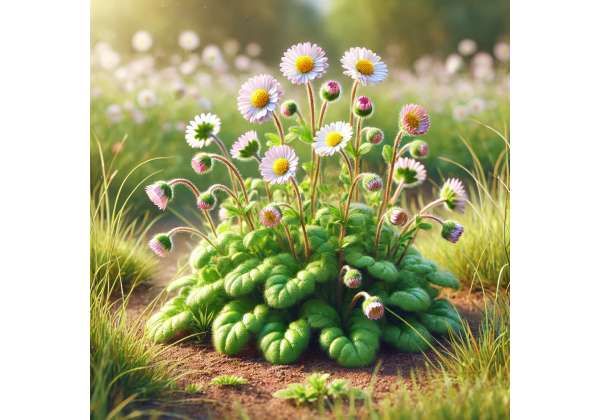
English daisy is the familiar low-growing perennial with a yellow center and white, sometimes pink-tinged, petals that appears in lawns, meadows, and path edges across Europe and many other temperate regions. It is also called common daisy or lawn daisy. In herbal use, the flower heads are the main part discussed, though some traditions also use the tender leaves and the whole aerial parts.
One useful point for readers is plant identity. English daisy is not the same as larger ornamental daisies such as Shasta daisy, marguerite daisy, or Gerbera. Those plants may belong to the same broad family, but they are not interchangeable in herbal practice. If a product does not clearly state Bellis perennis, assume you may be dealing with a different plant.
Its medicinal profile comes from several overlapping classes of compounds rather than one dominant chemical. The most relevant groups include:
- Flavonoids, including apigenin-related compounds and quercetin-type derivatives, which are often discussed for antioxidant and tissue-calming activity.
- Phenolic acids, such as chlorogenic acid, which may contribute to antioxidant effects and broader metabolic signaling in laboratory models.
- Triterpene saponins, a group that appears especially important in daisy research and may help explain interest in wound support, membrane effects, and collagen-related activity.
- Other polyphenols and minor volatile compounds, which likely shape both the plant’s scent and some of its biological behavior.
This chemistry matters because it explains why English daisy has been explored in more than one direction. Some extracts have shown anti-inflammatory, antioxidant, collagen-supportive, and glucose-handling effects in preclinical work. That does not mean every tea, oil, or capsule will do all of those things in the body. It means the plant contains plausible compounds worth studying.
Preparation changes the outcome. A hot water infusion pulls out a different mix than an alcohol extract, and both differ from an oil infusion or ointment. That is one reason readers sometimes get confused by herbal claims. Two products can both say “English daisy” and still behave very differently.
In practical terms, English daisy is best understood as a gentle, multi-compound herb with traditional skin-focused use and a growing, but still incomplete, modern research profile. That combination makes it interesting, but it also means product form and expectations matter.
What benefits is it best known for
English daisy is best known for everyday, low-drama situations rather than dramatic therapeutic claims. In traditional use, it has been applied to bruises, sore tissues, minor wounds, and irritated skin. Some traditions also used it internally for mild respiratory or digestive complaints, but the strongest historical identity of the plant is still topical.
The most realistic benefit category is supportive skin and soft-tissue care. People turn to English daisy when they want a plant that feels gentler than a strong essential oil but more targeted than a plain base cream. In that setting, the goals are usually modest:
- calming minor skin irritation
- supporting comfort after bumps and bruises
- helping clean superficial scrapes feel less raw
- adding a soothing herb to a balm or compress
Another plausible benefit is support for tissue recovery. This is one reason English daisy has often been mentioned alongside herbs used for bruised or strained areas. It is not identical to arnica for bruises and soreness, but the comparison comes up often because both are associated with post-impact care. The difference is that English daisy is usually described as milder and more appropriate for general herbal support than for aggressive “sports recovery” expectations.
A third area of interest is antioxidant and inflammation-related support. Lab work suggests the plant’s polyphenols and saponins may influence oxidative stress, inflammatory signaling, and tissue remodeling. For a reader, the key translation is simple: the herb may help create a calmer local environment, especially on the skin. It is not a replacement for wound care, infection management, or prescription treatment.
Some modern research has also explored metabolic and cosmetic angles. Extracts have shown insulin-mimetic behavior in preclinical models, and skin-cell studies suggest possible photoprotective effects. These are interesting findings, but they are not strong reasons for the average person to start taking English daisy for blood sugar or using it as a stand-alone anti-aging product. The research is promising, not settled.
It is also edible in small culinary amounts. The leaves and flowers can be added to salads, herb butters, or spring soups, where they contribute a slightly grassy, faintly bitter taste. That culinary use does not automatically make medicinal use proven, but it does show that the plant occupies a space between food and folk remedy.
The best way to think about English daisy is this: it may be genuinely useful for minor external problems and gentle traditional wellness routines, but it is not a high-confidence oral therapeutic herb on the level of better-studied plants. That distinction keeps expectations grounded and helps readers use it well.
English daisy for skin and bruises
If English daisy has a practical “home use” sweet spot, this is it. Topical use makes the most sense because it matches both the plant’s traditional reputation and the strongest direction of modern preclinical research. When people use it well, they are usually not trying to treat a major disease. They are trying to support a minor problem that is already improving.
The main situations where topical English daisy may make sense include:
- minor bruising after a bump
- tender, overworked skin
- superficial scrapes after proper cleaning
- chapped or weather-stressed areas
- mild post-friction irritation
The likely advantage of topical use is contact. Instead of hoping a swallowed tea reaches the right tissue in meaningful amounts, a compress, infused oil, or salve puts the preparation directly where the problem is. That is also why English daisy is often described as more convincing externally than internally.
A cool or lukewarm compress can be useful when the skin feels tender or mildly swollen. An infused oil or salve can be better when the area is dry, tight, or needs a protective layer. This is also where form matters. A water-based compress feels lighter. An ointment stays longer and may feel better on rough or cracked skin.
English daisy is not the best choice for every skin problem. It is not designed for:
- deep puncture wounds
- infected cuts
- rapidly spreading redness
- burns with blistering
- heavily bleeding injuries
- unexplained lumps or serious pain
That matters because herbs work best when the problem is appropriate for self-care. On a clean, superficial scrape, a daisy compress may feel calming. On a deep or contaminated wound, the same homemade preparation could delay proper care.
In real life, English daisy often fits best beside other gentle skin herbs, not above them. If your main goal is superficial skin comfort and barrier support, calendula for superficial skin support is another classic option worth comparing. Calendula is usually the better-known choice, while English daisy is the quieter relative with a long bruise-and-tissue tradition.
One more practical point: “natural” does not mean sterile. If you make your own compress or balm, cleanliness matters. Use clean jars, strained preparations, and fresh carrier oils. Do not keep homemade products indefinitely, and do not apply them to wounds that may need medical assessment.
For readers interested in a realistic herbal toolkit, English daisy earns its place mostly as a modest topical herb. It may not be flashy, but in the right context it can be useful precisely because it is simple.
How to prepare and use it
English daisy can be used in several forms, but the best method depends on what you are trying to do. The mistake many readers make is choosing a form based on convenience alone. A tea, a compress, and an infused oil are not interchangeable.
Here are the most practical ways to use it.
- Infusion as tea This is the simplest internal form. Pour hot water over the dried flowers or aerial parts, cover, steep, then strain. Oral use is usually chosen for traditional mild wellness support rather than for a specific evidence-based outcome.
- Infusion as a compress or wash A stronger tea can be cooled to lukewarm and used to soak a clean cloth. This is one of the best ways to use English daisy for minor bruised or irritated areas because it gives direct contact without leaving a heavy residue.
- Infused oil Freshly dried flowers can be infused into a carrier oil such as olive or sunflower oil. The strained oil can then be used directly or turned into a balm. This is often the most practical choice for dry, tight, or weathered skin.
- Salve or ointment An infused oil thickened with beeswax gives you a portable preparation for repeated topical use. This is especially helpful when you want a product that stays in place longer than a water compress.
- Culinary use Young leaves and flowers can be used in small amounts in salads, soups, omelets, or herb blends. The flavor is mild but slightly bitter. Culinary use should be modest, especially if you are new to the plant.
If you are foraging your own English daisy, a few rules make the difference between a good herbal habit and a risky one:
- harvest only from unsprayed, pesticide-free areas
- avoid roadsides, heavily trafficked lawns, and places frequented by dogs
- identify the plant carefully before use
- wash edible material well
- dry flowers thoroughly before oil infusion to reduce spoilage risk
For compresses and simple topical use, English daisy is sometimes grouped with other household “green first-aid” herbs. If you enjoy that style of herbal practice, plantain leaf uses in simple poultices are another classic comparison.
The most important idea is to match the preparation to the goal. Drink tea for gentle traditional internal use. Use compresses for tender superficial areas. Choose oils and salves when dryness and repeated application matter. That simple matching process makes the herb much more useful.
How much English daisy per day
English daisy does not have a well-established, clinically standardized dose in the way some mainstream herbs do. That means dosage should be approached as traditional and preparation-based, not as a fixed evidence-backed prescription. This is especially important for oral use.
For tea or infusion, a practical traditional range is about 2 to 4 g of dried herb per 250 to 300 mL of hot water, usually taken 1 to 3 times daily. If you measure by kitchen spoon instead of weight, that often works out to roughly 1 to 2 teaspoons of dried material per cup, depending on how finely cut the herb is. Steep for about 10 to 15 minutes, covered, then strain.
For topical compresses, a slightly stronger preparation is often preferred. Many people use 2 to 4 g per cup, let it cool to lukewarm, then apply a clean soaked cloth for 5 to 15 minutes, 1 to 3 times daily as needed.
For infused oils or salves, the dose is less about milligrams and more about frequency and tolerance. A thin layer can be applied 2 to 3 times daily to intact or only superficially affected skin. Stop if the area becomes itchier, redder, or more irritated.
A few variables can change the right amount:
- fresh vs dried plant: fresh material contains water, so you need more bulk for a similar infusion
- flowers vs mixed aerial parts: flower-only preparations may be somewhat more concentrated in the compounds most often discussed in research
- extract strength: commercial tinctures and extracts vary widely, so label directions matter
- goal of use: a mild culinary tea is not the same as a stronger compress
- individual sensitivity: if you have a history of reacting to daisy-family plants, start very cautiously or avoid entirely
Timing also matters. English daisy is generally better for short-term, situational use than for long-term daily supplementation. For example, a compress for several days after a minor bump is more sensible than taking oral preparations for months without a clear reason.
As a practical rule, start at the lower end, especially with oral use. If you tolerate it but notice no benefit after several days, increasing slightly may be reasonable within the traditional range. If the issue is not improving within 3 to 7 days, it is better to reassess the problem than to keep increasing the herb.
One final point: homeopathic Bellis perennis products use the same Latin name but are not dosed like teas, oils, or herbal extracts. They are a separate category and should not be treated as interchangeable with herbal preparations.
Side effects interactions and who should avoid it
English daisy is usually framed as a gentle herb, but gentle is not the same as risk-free. The most important safety issue is allergy, especially in people sensitive to plants in the daisy family. If you react to ragweed, chamomile, chrysanthemum, marigold, or related plants, English daisy deserves extra caution.
Possible side effects include:
- itching or rash after skin contact
- worsening redness or irritation from topical use
- oral or throat irritation in sensitive people
- stomach upset with internal use
- allergic reactions in people with Asteraceae sensitivity
The people most likely to want stricter caution or avoidance are:
- those with known allergy to daisy-family plants
- pregnant or breastfeeding people, because reliable safety data are limited
- young children using oral preparations routinely
- anyone trying to use it on deep, infected, or serious wounds
- anyone with severe symptoms who may need diagnosis rather than self-care
Documented drug interactions for English daisy are not well characterized. That does not prove there are no interactions. It mostly means the plant has not been studied well enough in real-world medication users. Because of that uncertainty, oral use is best kept conservative in people who:
- take multiple prescription medicines
- have complex chronic illnesses
- are using anticoagulants or antiplatelet drugs
- are already taking several herbal products
Another important practical safety point is product quality. Wild or culinary flowers may carry pesticides, dirt, animal contamination, or microbes. That matters even more because flowers are often used fresh. Homemade eye rinses or eye compresses are not a good idea; they are not sterile and may irritate delicate tissue.
If you already use other daisy-family herbs, it is also wise to think in terms of cumulative sensitivity. Someone who tolerates one member of the family may still react to another, but the family connection is a useful warning sign. Readers familiar with chamomile tea and daisy family sensitivity should apply the same allergy awareness here.
A good rule is simple: stop use if symptoms worsen, if a rash appears, or if the area becomes hotter, more swollen, or more painful. English daisy is a reasonable herb for minor issues. It is the wrong tool for severe ones.
What the evidence actually says
This is where English daisy needs the most honesty. The research is interesting, but it is not yet strong enough to support broad medical claims. Most of the evidence comes from laboratory studies, skin-cell experiments, and animal models, not large human trials.
What looks promising?
- Wound-healing support: a commonly cited animal study found that a topical fraction from Bellis perennis flowers improved wound-healing measures in rats. This is one of the stronger reasons the herb still gets attention for topical care.
- Skin protection and inflammation signaling: keratinocyte research suggests daisy extract may reduce UVA-related oxidative stress and inflammatory markers. That supports interest in cosmetic or dermal formulations.
- Metabolic signaling: preclinical work has shown insulin-mimetic activity and improved glucose handling in experimental models. This is scientifically interesting, but far too early to treat as a practical self-care indication.
- Phytochemical richness: modern reviews show the plant contains a wide range of biologically active compounds, which helps explain why it keeps reappearing in research.
What remains weak?
- Human clinical evidence
- standardized oral dosing
- clear long-term safety data
- well-defined drug interaction data
- head-to-head studies against standard topical care
That last point matters. A plant can be biologically active and still not prove clinically useful in ordinary care. Many herbs look impressive in a dish, a petri dish, or a rodent model, then deliver only modest benefits in humans.
There is also frequent confusion between herbal English daisy and homeopathic Bellis perennis. They share a name but not a method. A tea, tincture, oil, or salve contains measurable plant material. A highly diluted homeopathic pellet is a different product category entirely. Readers should not assume evidence or dosing for one applies to the other.
So where does that leave the herb? In a sensible middle ground. English daisy has enough traditional use and enough preclinical support to justify cautious interest, especially for topical applications and small-scale home herbalism. It does not have the kind of human evidence needed for strong claims about internal treatment, chronic disease support, or major therapeutic outcomes.
That is not a dismissal. It is a useful conclusion. English daisy is best approached as a traditional supportive herb with promising chemistry and limited clinical proof. Readers who keep that balance in mind are much more likely to use it safely and realistically.
References
- (Bio)active Compounds in Daisy Flower (Bellis perennis) 2023 (Review)
- Bellis perennis extract mitigates UVA-induced keratinocyte damage: Photoprotective and immunomodulatory effects 2021
- Allergic Potential of Medicinal Plants From the Asteraceae Family 2025 (Review)
- A Comprehensive Review of Edible Flowers with a Focus on Microbiological, Nutritional, and Potential Health Aspects 2025 (Review)
- The evaluation of topical administration of Bellis perennis fraction on circular excision wound healing in Wistar albino rats 2012 (Preclinical study)
Disclaimer
This article is for educational purposes only and is not medical advice. English daisy should not replace diagnosis, wound assessment, prescription treatment, or individualized guidance from a qualified clinician. Seek prompt medical care for severe pain, infection, rapidly worsening skin changes, deep wounds, allergic reactions, or symptoms that do not improve. If you are pregnant, breastfeeding, managing a chronic condition, or taking prescription medicines, check with a healthcare professional before using English daisy internally or in concentrated preparations.
If this guide helped you, please share it on Facebook, X, or your preferred platform so more readers can use English daisy with clearer expectations and safer habits.