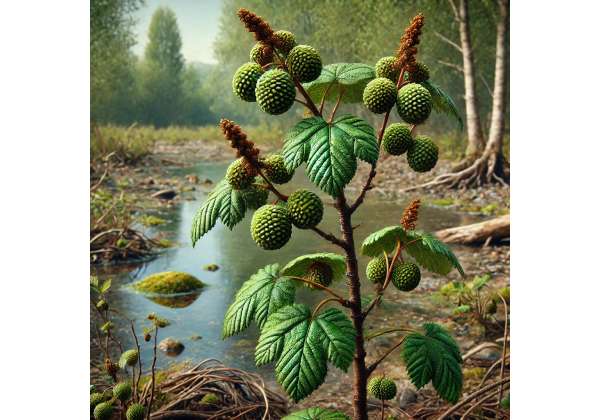
European alder, also called common alder or black alder, is a moisture-loving tree better known for riverbanks and wet woodlands than for kitchen-shelf herbal fame. Yet its bark, leaves, and female cones have a long tradition of medicinal use in parts of Europe, especially for soothing irritated tissues. In herbal practice, European alder is valued mainly as an astringent and anti-inflammatory plant: it has been used for sore throats, gum irritation, mild diarrhea, minor skin complaints, and wash-type wound care. Modern phytochemical research adds another layer of interest, showing that the plant contains tannins, flavonoids, phenolic acids, and distinctive diarylheptanoids such as oregonin.
What makes European alder worth understanding is not broad clinical proof, but a credible bridge between tradition and laboratory science. It looks most promising as a short-term, targeted herb for tissues that are inflamed, weepy, or irritated. At the same time, it is not a standardized mainstream supplement, and dosing varies widely by form. That means the smartest use of European alder is cautious, practical, and evidence-aware rather than enthusiastic or vague.
Core Points
- European alder is best known as a tannin-rich astringent herb used traditionally for sore throats, gum irritation, mild diarrhea, and minor skin inflammation.
- Bark and leaf extracts show antioxidant, anti-inflammatory, and wound-healing potential, but human clinical evidence is still limited.
- A traditional adult starting preparation is about 1 to 2 teaspoons dried bark or leaves in 250 mL water, used short term as a decoction, rinse, or gargle.
- Avoid self-directed use during pregnancy, breastfeeding, childhood, active stomach irritation, or iron-deficiency states unless a qualified clinician advises otherwise.
Table of Contents
- What is European alder
- Key ingredients and medicinal properties
- What might it help with
- How to use European alder
- How much European alder per day
- Side effects, interactions, and who should avoid it
- What the evidence really says
What is European alder
European alder, Alnus glutinosa, is a deciduous tree in the birch family, Betulaceae. It grows across much of Europe and parts of western Asia and northern Africa, with a clear preference for damp ground. You often find it near rivers, ponds, marshy edges, and flood-prone soils. In ecology it is known as a pioneer tree, but in herbal practice it has a quieter role: a traditional remedy for irritated mucous membranes, minor skin trouble, and certain short-lived digestive complaints.
Several parts of the tree have been used medicinally. The bark is the most discussed in modern phytochemical papers, while traditional practice also includes the leaves and the small woody female cones, sometimes described in older texts as “fruits” or “collective fruits.” Those different parts matter because they are not chemically identical. Bark preparations tend to be richer in certain phenolic compounds and diarylheptanoids, while leaves bring a slightly different flavonoid profile and have been used more often in topical or tinctured preparations.
The plant’s traditional reputation centers on its astringent nature. In simple terms, European alder has a tightening, drying, and toning action on irritated tissue. That is why the old uses cluster around places where secretions, swelling, or surface inflammation are a problem: sore throats, bleeding gums, mild loose stools, wet or irritated skin, and superficial wound care. Historically it has also been described as hemostatic, febrifuge, tonic, and anti-rheumatic, though those broader labels are less clinically precise than its astringent role.
One practical point deserves emphasis: European alder is not the same plant as alder buckthorn. Folk names can create confusion because “black alder” has also been used for other species in older herbal writing. Here the subject is specifically Alnus glutinosa, not Frangula alnus. That distinction matters because the medicinal uses, safety profile, and active compounds are quite different.
European alder also sits in an interesting middle ground between classic folk medicine and modern product development. It is not as standardized as widely commercialized herbs, but it is no longer just a historical curiosity. Recent work has explored alder bark and leaf extracts for skin-focused formulations, antioxidant activity, and wound support. That makes it useful to think of European alder less as a trendy supplement and more as a traditional tissue remedy with emerging formulation science behind it.
In practical terms, European alder makes the most sense when you are considering short-term support for irritated skin, the mouth and throat, or mild digestive looseness, and when you understand that it is still a relatively niche herb rather than a heavily trialed modern botanical.
Key ingredients and medicinal properties
European alder is chemically interesting because it combines old-fashioned astringency with a more modern polyphenol story. The herb’s reputation begins with tannins, but that is not where it ends. Current research on Alnus glutinosa bark and leaves points to a broader mix of bioactive compounds, especially diarylheptanoids, flavonoids, and phenolic acids.
The best-known compound family in alder bark is the diarylheptanoids. These are plant polyphenols built around two aromatic rings joined by a seven-carbon chain. In Alnus glutinosa, the standout compound is oregonin, which has drawn attention for antioxidant, anti-inflammatory, and cell-protective effects in laboratory models. Related alder diarylheptanoids include hirsutenone, hirsutanonol derivatives, platyphylloside, rubranosides, and alnuside-type compounds. These chemicals are one reason European alder has become more interesting to phytochemical researchers than its modest public profile might suggest.
Alongside them are tannins, which explain much of the herb’s traditional use. Tannins help tighten tissues and may reduce excessive secretions. That supports older uses for gargles, mouth rinses, washes, and short-term digestive astringency. If you compare European alder with another classic tannin-rich herb, its action is closer to oak bark for strongly astringent tissue support than to a fragrant essential-oil herb.
European alder also contains flavonoids and phenolic acids, including quercetin-type compounds, hyperoside in leaves, chlorogenic acid, caffeic acid, and related phenolics. These compounds add antioxidant and anti-inflammatory depth. In topical or mucosal use, they may help explain why alder has been used not just to “dry” tissue, but to calm irritated surfaces while they recover. Leaves and cones appear to contribute their own supportive polyphenol mix, which is one reason different traditions use different plant parts.
Taken together, these compounds give European alder four practical medicinal properties:
- Astringent
Useful when tissues feel swollen, damp, weepy, or overly secretory. - Anti-inflammatory
Relevant for irritated skin, inflamed oral tissues, and some short-term throat or gut complaints. - Antioxidant
Most meaningful in laboratory and formulation research, especially for skin-facing products. - Antimicrobial-supportive
Better understood as a helpfully hostile environment for some microbes rather than as a natural antibiotic.
This last distinction matters. European alder may support topical cleanliness and barrier recovery, but it should not be marketed as a replacement for evidence-based treatment of infection. Its medicinal strength seems to come from multifunctionality, not one dramatic effect. It tightens, calms, protects, and modestly discourages unwanted microbial overgrowth.
That profile helps explain why alder keeps reappearing in skin and mucosal care discussions. It is not a stimulant herb, a sedative herb, or a strongly aromatic herb. It is a polyphenol-rich surface and tissue herb. That makes it especially relevant for the sort of complaints where the goal is not to push the body harder, but to help irritated tissue settle down and recover.
What might it help with
European alder is most believable when its benefits are kept specific. It is not a cure-all, and it does not have strong modern proof for broad internal treatment claims. But within its traditional niche, it may offer useful short-term support.
The clearest traditional uses fall into three clusters: mouth and throat irritation, mild digestive looseness, and topical skin care.
For the mouth and throat, alder bark or cone decoctions have been used as gargles or rinses for sore throat, mild pharyngeal irritation, stomatitis, and gum bleeding. This makes sense from an astringent perspective. A tannin-rich rinse can tighten inflamed tissue, reduce surface ooze, and provide a cleaner-feeling oral environment. It is not the same as treating a bacterial throat infection, but it may reduce discomfort when irritation is mild and localized.
For the digestive tract, traditional use points to short-term support in loose stools, mild enteritis-like irritation, and nonspecific digestive upset where astringency is helpful. Here again, the benefit is probably local rather than systemic. Alder is not a digestive tonic in the modern sense. It is more of a temporary “settling” herb for irritated, overly active tissue. That also means it is less appropriate for constipation, chronic inflammatory bowel disease, or abdominal pain of unclear cause.
For the skin, European alder is especially interesting. Leaves, bark, and prepared extracts have been used in washes, compresses, and more recently gels for minor wounds, inflamed skin, and superficial irritation. This may be where its modern potential is strongest, because topical application fits both the traditional logic and the newer research on antioxidant, antimicrobial, and wound-related activity. In this respect, it has a family resemblance to witch hazel for topical astringent care, though alder is less standardized and less commonly commercialized.
Less central but still traditional uses include:
- mild gum tenderness or bleeding,
- inflamed oral tissues,
- wet or irritated rashes,
- minor wound cleansing support,
- soothing compresses for achy or inflamed areas.
Some folk traditions also mention rheumatic discomfort and gout-like complaints, especially with leaf applications. Those uses are plausible as surface comfort measures, but much less certain as true disease-targeted treatments.
The realistic way to read European alder’s benefits is this:
- It may help irritated surfaces feel less raw.
- It may help weeping or inflamed tissue feel drier and more controlled.
- It may support short-term local recovery in the mouth, skin, or gut.
- It is not a substitute for treating infection, persistent bleeding, or chronic inflammatory disease.
This distinction protects against the most common herbal mistake: taking a useful narrow-action plant and stretching it into a general wellness promise. European alder is likely best when used for a defined symptom and a short period of time, especially when that symptom involves irritated, inflamed, or excessively moist tissue. That is a respectable herbal role, even if it is a smaller one than marketing language usually prefers.
How to use European alder
European alder is best used in preparations that respect its strengths: decoctions, rinses, washes, compresses, and well-made topical products. Because it is not a highly standardized supplement, practical use depends more on form and purpose than on a universal dose.
The most traditional approach is a decoction. Bark, leaves, or cones are simmered rather than merely steeped, which helps draw out tannins and other water-soluble compounds. That decoction can then be used in different ways depending on the complaint.
For throat and mouth care, the cooled liquid is used as a gargle or rinse. This suits sore throat, gum irritation, or minor mouth inflammation better than swallowing large amounts. For skin use, the same liquid can be applied with a clean cloth as a compress or wash. This is often the most sensible home use, especially for mild irritation, surface inflammation, or a minor wound that is already being cleaned properly.
European alder may also appear as a tincture or as part of a gel or cream. Tinctures vary widely in solvent strength and plant-part ratio, so they should be treated as product-specific rather than interchangeable. Gels and creams make the most sense when they are professionally formulated, because that improves stability and reduces the guesswork around concentration.
A practical route-by-route guide looks like this:
- Gargle or mouth rinse
Use a cooled decoction for sore throat, mild pharyngeal irritation, gum bleeding, or stomatitis-style discomfort. - Compress or wash
Apply to intact but irritated skin, minor superficial wounds, or localized inflammation. - Short-term oral decoction
Consider only in mild, self-limited digestive upset, and keep the dose low because alder is tannin-heavy. - Prepared topical product
Choose this when you want convenience and more consistent application.
A few habits improve safety and usefulness:
- Prefer dried material over fresh bark for home use.
- Start with a mild preparation before trying a stronger one.
- Use alder for days, not months, unless a knowledgeable practitioner says otherwise.
- Keep it away from deep wounds, eyes, and heavily infected skin.
- Stop if the area becomes more irritated rather than calmer.
European alder also combines reasonably well with gentler skin-focused herbs. In topical routines, some people pair it with calendula for added skin-soothing support, especially when the goal is to calm rather than strongly dry tissue.
The larger point is that European alder is not usually a “take it daily for general wellness” herb. It is a problem-solving herb. You use it because tissue is irritated, inflamed, or overly moist, and you stop once the specific reason for using it has passed. That mindset keeps alder in its strongest lane and reduces the chance of overuse.
How much European alder per day
There is no widely accepted modern clinical dose for European alder, and that is one of the most important things to know before using it. Unlike herbs with formal monographs and standardized commercial extracts, Alnus glutinosa is still used mostly through traditional preparations and region-specific products. So dosage should be approached as traditional and cautious, not fully standardized or clinically fixed.
For a mild adult decoction, a practical starting point is:
- 1 teaspoon dried bark or leaves per 250 mL water, simmered for about 10 to 15 minutes.
For many dried cut herbs, that works out to roughly 1.5 to 2 g per cup, though density varies by material. Taken internally, that usually means 1 cup once or twice daily for a short period. Because alder is astringent, more is not automatically better. Starting low gives you a chance to see whether the plant feels settling or simply too drying.
For a gargle or mouth rinse, a somewhat stronger preparation is often more useful:
- 1 to 2 teaspoons dried bark, leaves, or cones per 250 mL water,
- simmered and then cooled,
- used 2 to 3 times daily as a rinse or gargle rather than swallowed in full.
For a compress or wash, people often prepare a stronger decoction:
- 2 to 4 teaspoons per 250 mL water,
- applied to the affected area for 10 to 15 minutes,
- once or several times daily depending on tolerance.
With tinctures or fluid extracts, there is no universal alder dose that can be transferred across brands. Extraction strength, solvent, and plant part all vary too much. In that case, the right answer is simple: follow the product label, and if the maker gives no clear adult dosing information, choose a better product.
Timing also matters. European alder is better suited to short-term use, often over a few days, rather than open-ended daily use. As a rough practical guide:
- Mouth and throat uses: a few days up to about a week.
- Digestive astringent use: often no more than a few days unless guided.
- Topical wash or compress: continue only while the area is improving.
There are two reasons for that short-term approach. First, the herb’s strongest actions are local and symptom-focused. Second, repeated heavy tannin exposure can irritate some people and may interfere with nutrient or medication absorption.
A good “stop and reassess” list includes:
- no improvement after several days,
- worsening pain or swelling,
- fever,
- persistent diarrhea,
- bleeding,
- signs of infection,
- stomach upset after taking the decoction.
So how much European alder per day is reasonable? For most adults, the conservative answer is low to moderate, in a short-term preparation matched to the complaint. In herbal terms, alder is a plant that rewards restraint. A modest decoction used well is more appropriate than a strong extract used casually.
Side effects, interactions, and who should avoid it
European alder does not have a long list of well-documented modern adverse events, but that should not be mistaken for proof of safety in every setting. More accurately, it is an herb with limited human safety data, significant tannin content, and a strong case for sensible precautions.
The most likely side effects come from its astringent and tannin-rich nature. Internally, that can mean:
- stomach irritation,
- nausea,
- a heavy or queasy feeling,
- constipation,
- worsening of reflux or ulcer discomfort in sensitive people.
Topically, side effects are usually simpler:
- dryness,
- stinging on broken or very inflamed skin,
- irritation from a preparation that is too concentrated,
- occasional contact sensitivity.
People with plant allergies, especially those who already react strongly to tree pollens or fragrant topicals, should test cautiously. Alder pollen allergy is a separate issue from bark or leaf use, but it still reminds us that this is a biologically active tree, not an inert material.
The main interaction concern is not a dramatic drug-herb clash. It is absorption interference. Tannins can bind to compounds in the gut, which may reduce absorption of certain medications, iron, or minerals if taken at the same time. That is why it makes sense to separate internal alder use from medicines or iron supplements by a few hours.
The people who should be most cautious, or avoid self-treatment, include:
- pregnant or breastfeeding adults, because safety data are too thin,
- children, especially for internal use,
- people with active ulcers, gastritis, reflux, or very sensitive stomachs,
- people with iron deficiency or those taking iron regularly,
- anyone with chronic bowel disease or unexplained digestive symptoms,
- anyone using it on a deep, infected, or non-healing wound.
Fresh material also deserves caution. Traditional sources note that fresh bark can be more irritating, and older herbal writing even describes emetic effects from fresh bark use. That makes dried material the better default for home preparations.
Alder is also not the best choice when the problem is obviously beyond self-care. Seek proper medical help rather than leaning harder on the herb if you have:
- fever,
- spreading redness,
- pus,
- severe throat pain,
- dehydration,
- blood in the stool,
- a wound that is worsening rather than closing.
For inflammation-linked aches, some people are really looking for a pain herb rather than an astringent tissue herb. In those cases, a better directional comparison may be white willow for pain-centered herbal support, because alder’s role is usually more local and surface-oriented.
The safety message is straightforward: European alder is likely best used topically or as a rinse first, internally only in modest short-term amounts, and never as a reason to ignore persistent or serious symptoms.
What the evidence really says
European alder has a meaningful medicinal tradition, but its modern evidence base is still mostly preclinical and formulation-focused. That does not make the herb unhelpful. It simply means the claims should stay proportionate.
The strongest modern support comes from studies on bark and leaf extracts, not from large human trials using home decoctions. Researchers have shown that alder bark is rich in phenolic compounds and diarylheptanoids, with oregonin standing out as a major constituent. Those extracts demonstrate antioxidant, anti-inflammatory, anti-angiogenic, and antimicrobial-related effects in laboratory systems. This gives the traditional uses a plausible biochemical foundation.
Skin-related research is especially notable. Animal and formulation studies suggest that alder leaf and bark preparations may support wound closure, local antioxidant defense, and topical antimicrobial control. More recent work has also explored alder extracts in cosmeceutical formulations, where antioxidant and photoprotective properties are attractive. That does not mean European alder is now a proven dermatology treatment. It means the herb is scientifically interesting in exactly the area where tradition already pointed: surface tissue support.
What is missing is just as important as what is present. There is very little high-quality human clinical evidence showing that European alder decoctions, tinctures, or bark extracts reliably improve sore throat, diarrhea, gum bleeding, or routine wound outcomes in ordinary care. There is also no widely accepted monograph that settles optimal dose, treatment length, or standardized product composition. That is why dosage remains traditional rather than clinical.
So where does that leave European alder?
- Best supported by tradition and laboratory science: astringent, topical, and mucosal use.
- Promising in modern research: antioxidant skin applications and wound-oriented extracts.
- Weakly supported in humans: internal use for digestive or throat complaints.
- Not established: long-term daily supplementation or broad disease treatment.
This evidence pattern actually gives a useful practical answer. European alder is probably most appropriate when used as a short-term adjunct, especially for mouth rinses, gargles, washes, compresses, and carefully chosen topical products. It is less convincing as a daily internal herb for generalized wellness.
That balanced conclusion is often more helpful than a dramatic one. European alder does not need to be overpromised to be worthwhile. It appears to be a legitimate traditional herb with genuine phytochemical interest, strongest when aimed at irritated surfaces and minor local complaints, and weakest when stretched into claims it has not yet earned. For readers who want a herb grounded in both history and restraint, that is a respectable place for European alder to stand.
References
- New Insights on Phytochemical Features and Biological Properties of Alnus glutinosa Stem Bark 2022 (Research Article)
- Antioxidative and Antimicrobial Evaluation of Bark Extracts from Common European Trees in Light of Dermal Applications 2023 (Review)
- Leveraging crude extracts from European tree bark to combat oxidative stress, enhance wound healing, and inhibit pathogenic bacterial growth 2025 (Research Article)
- From Plant to Skin: Exploring Alnus glutinosa Extracts for Cosmeceutical Applications 2025 (Research Article)
- Effect of wound healing in gels containing tinctures of Alnus glutinosa (L) leaves 2021 (Research Article)
Disclaimer
This article is for educational purposes only and is not medical advice. European alder is a traditional medicinal tree with promising laboratory and formulation research, but it does not have the level of clinical standardization seen with more established herbal medicines. Internal use, especially for children, pregnancy, breastfeeding, digestive disease, or long-term symptoms, should be discussed with a qualified healthcare professional. Seek medical care promptly for severe throat pain, persistent diarrhea, bleeding, fever, infected wounds, or symptoms that do not improve.
If this guide helped you, please share it on Facebook, X, or any platform you prefer so others can find a more careful, evidence-aware overview of European alder.