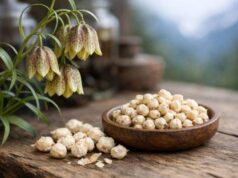
Fumitory, Fumaria officinalis, is a delicate, gray-green herb with a long history in European herbal medicine, especially for digestive discomfort, sluggish bile flow, and certain chronic skin complaints. At first glance it looks fragile, but its chemistry is more assertive than its appearance suggests. The plant contains isoquinoline alkaloids, flavonoids, phenolic acids, and other compounds that help explain why traditional systems treated it as more than a simple bitter herb.
What makes fumitory especially interesting is the way its old uses overlap with modern questions. People still ask whether it helps indigestion, bloating, gallbladder discomfort, eczema, or “liver support.” The honest answer is that some of those uses have a credible traditional and pharmacological basis, but the best modern evidence is still limited. In current practice, fumitory is most convincing as a short-term digestive herb, particularly where fullness, slow digestion, and bile-related discomfort are part of the picture. Its skin reputation is also notable, though modern clinical support is much thinner and sometimes based on combination products. Used thoughtfully, fumitory can be a valuable traditional herb, but it should be matched to the right symptom pattern and used with clear safety boundaries.
Key Takeaways
- Fumitory is most credible for mild digestive disturbances such as fullness, slow digestion, and flatulence.
- Its main active groups include isoquinoline alkaloids and polyphenols, with protopine often used as a key marker compound.
- A common herbal tea range is about 2 g in 250 mL of boiling water, with total daily use around 4.8 to 6.4 g in divided doses.
- Avoid medicinal use if you have gallstones, bile duct obstruction, cholangitis, active liver disease, or unexplained upper abdominal pain.
- Pregnancy, breastfeeding, and medicinal use in children require extra caution because safety data are limited.
Table of Contents
- What is Fumitory
- Key ingredients and medicinal properties
- What benefits are most realistic
- Does Fumitory help digestion and bile flow
- How is Fumitory used
- How much should you take
- Safety, side effects, and evidence
What is Fumitory
Fumitory is an annual flowering herb in the poppy-related family Papaveraceae. Its fine, divided leaves and dusty green color make it easy to overlook in fields, garden edges, and disturbed ground, but for centuries it held a clear place in European herbals. The medicinal part is the flowering aerial herb, collected when the plant is in bloom and dried for teas, extracts, tinctures, and powders.
Historically, fumitory was used above all for the digestive system. Older sources describe it for fullness after meals, sluggish digestion, flatulence, biliary discomfort, and “hepatic” complaints. It was also used for certain skin problems, especially chronic or recurrent eruptions that traditional medicine linked to poor bile flow or “impure blood.” Modern readers do not need to accept that older framework literally to see the pattern: fumitory was often chosen when digestion, bile movement, and skin symptoms seemed to travel together.
That traditional profile still matters because fumitory is not primarily a food herb or a tonic taken casually every day. It is a medicinal herb with a more specific personality. It fits best in short-term or targeted use rather than broad lifestyle use.
A helpful way to understand fumitory is to separate three ideas that often get blended together:
- it is a bitter digestive herb,
- it is a bile-active herb,
- and it is a traditional skin-support herb.
These overlap, but they are not identical. A person might use fumitory for slow digestion without any skin issue at all. Another may be drawn to it because of its eczema reputation. A third may be using a standardized extract sold for biliary discomfort. Those are related, but not interchangeable, use cases.
One especially useful insight is that fumitory has often been described as amphocholeretic in older European phytotherapy. This term suggests a bile-regulating effect rather than a simple one-way “bile booster.” In practice, that means the herb was traditionally valued not for forcing bile flow indiscriminately, but for helping normalize bile-related digestive function. Whether modern pharmacology fully confirms that older language is another question, but it explains why fumitory developed such a specific digestive reputation.
It is also worth noting what fumitory is not. It is not the same as pharmaceutical fumaric acid esters used in dermatology, even though people sometimes assume the plant’s name implies a direct connection. Nor is it a modern “liver detox” cure-all. Its strongest legacy is narrower and more practical.
So what is fumitory in plain terms? It is a traditional European medicinal herb most often used for bile-related digestive discomfort and secondarily for chronic skin complaints, with enough phytochemical interest to justify continued study, but not enough modern evidence to support exaggerated claims.
Key ingredients and medicinal properties
Fumitory’s medicinal character comes from a mix of isoquinoline alkaloids and polyphenolic compounds rather than from vitamins or minerals. The alkaloids are especially important because they are part of what gives fumitory its pharmacological identity. In pharmacopoeial quality standards, total alkaloids are often expressed as protopine, which serves as a key marker for the herb.
Among the better-known alkaloids reported in fumitory are:
- protopine,
- allocryptopine,
- jatrorrhizine,
- stylopine,
- and other related isoquinoline derivatives.
These compounds are thought to contribute to fumitory’s spasm-modulating, bile-related, and anti-inflammatory behavior. Protopine, in particular, comes up repeatedly in both older and newer literature as a central constituent.
Fumitory also contains a significant polyphenol fraction, including flavonoids and phenolic acids. Recent analytical work has identified compounds such as:
- rutin,
- quercetin glycosides,
- caffeoylmalic acid,
- and other phenolic acids with antioxidant potential.
These molecules help explain why the herb is discussed not only as a digestive plant, but also as one with antioxidant, anti-inflammatory, and skin-support relevance.
Another important practical point is that fumitory’s medicinal profile comes from the whole herb acting as a mixture, not from one isolated compound doing all the work. That matters because people sometimes look for a single “active ingredient” and assume the plant’s effect can be reduced to that one number. With fumitory, the interaction between alkaloids and polyphenols is likely more important than any single constituent alone.
The main medicinal properties associated with fumitory are usually described as:
- bile-modulating or cholagogue-related,
- digestive bitter and carminative,
- mild antispasmodic,
- anti-inflammatory,
- and skin-supportive in certain traditional settings.
Still, chemistry should not be mistaken for proof. A plant can contain interesting alkaloids and still have limited human evidence. That is especially true with fumitory, where much of the clinical enthusiasm was built before modern trial standards became common.
It also helps to distinguish fumitory from other bitter or alkaloid-rich herbs. For example, barberry as an alkaloid-rich digestive herb is discussed much more often for antimicrobial and glucose-related questions, while fumitory is more closely tied to digestion, bile movement, and certain chronic skin traditions.
One subtle but useful insight is that fumitory’s bitter action is not its whole story. Classic bitters mainly stimulate digestive secretions. Fumitory seems to do that while also interacting with biliary tone and flow in a more specific way. That is one reason it developed a narrower but more distinctive therapeutic reputation than many kitchen bitters.
So when readers ask about fumitory’s key ingredients, the most useful answer is this: the herb’s identity rests on isoquinoline alkaloids, especially protopine-related compounds, supported by flavonoids and phenolic acids that broaden its anti-inflammatory and antioxidant potential. That chemistry fits its traditional uses well, even if the human evidence still trails behind the phytochemistry.
What benefits are most realistic
Fumitory has a long list of claimed benefits, but the most realistic ones are more focused than many summaries suggest. It is most persuasive as a digestive herb for fullness, slow digestion, and bile-related discomfort. Its skin uses are intriguing, but they sit on a thinner evidence base and need more cautious wording.
The benefits that make the most sense today are these:
- relief of mild digestive disturbances such as heaviness, bloating, and slow post-meal digestion,
- support in traditional biliary formulas where discomfort seems linked to poor bile flow,
- and possible adjunctive value in some chronic skin complaints, especially where older herbal traditions linked skin flares with digestive dysfunction.
This does not mean fumitory treats gallbladder disease, liver disease, or eczema in a proven medical sense. It means those are the historical domains where the herb has been most consistently used and where its chemistry offers some plausibility.
A practical way to rank fumitory’s most believable benefits would be:
- Digestive comfort
- Bile-related digestive support
- Traditional skin support
- Background anti-inflammatory and antioxidant activity
That ranking matters because online herbal descriptions often jump too quickly to phrases like “liver detox,” “gallstone remedy,” or “natural psoriasis cure.” Those claims overshoot the evidence and can be misleading. Fumitory is better understood as a short-term helper for a specific digestive pattern than as a broad cleansing herb.
Its skin reputation is worth discussing because it is one of the main reasons people search for it. Historically, fumitory was used for eczema, psoriasis-like eruptions, and chronic itching. More recently, a clinical trial tested a cream containing fumitory plus silymarin in eczema and found benefit. But because that product combined two botanicals, the result cannot be cleanly credited to fumitory alone. That is an important nuance. The skin story is promising, but it is not settled.
Another useful insight is substitution value. Some people who are drawn to fumitory may actually need a gentler or more food-like herb instead. If the complaint is mild sluggish digestion without a strong biliary pattern, dandelion as a gentler digestive and liver-support herb may sometimes be the simpler choice. Fumitory makes more sense when the pattern is more specific and when bitterness alone does not seem to explain the symptom picture.
So what should readers be skeptical of?
- claims that fumitory “cleanses the liver” in a proven way,
- claims that it dissolves gallstones,
- claims that it independently treats eczema or psoriasis,
- and claims that a culinary or tea dose will reproduce effects seen with concentrated extracts.
The most grounded benefit summary is this: fumitory may help certain mild digestive complaints, particularly where feelings of fullness, flatulence, and sluggish bile-related digestion are present. It may also have a secondary role in chronic skin-support traditions, but that use remains more suggestive than proven. That narrower framing makes the herb more credible, not less.
Does Fumitory help digestion and bile flow
This is the central question for fumitory, and the answer is: probably yes, but mainly in a traditional-use sense rather than a strongly proven modern clinical one.
European herbal authorities still recognize fumitory as a traditional herbal medicinal product for relief of digestive disturbances such as fullness, slow digestion, and flatulence. That tells us something important. Even modern regulatory bodies that apply a cautious lens still see enough long-standing, coherent use to preserve this indication. But they do so on the basis of tradition and plausibility, not on the basis of a large contemporary evidence base.
Where fumitory seems most likely to help is when digestion feels:
- slow after meals,
- heavy and bloated,
- uncomfortable after fatty foods,
- or bound up with biliary tension rather than acid reflux or infection.
This is where the old amphocholeretic idea becomes useful. Fumitory has not merely been described as forcing bile secretion upward. It has been described as helping normalize bile-related digestive function. That may explain why some traditional clinicians preferred it when symptoms pointed to the gallbladder and biliary tree rather than to simple stomach weakness.
Still, it is essential to keep the limits clear. Fumitory is not a safe herb for self-treating serious biliary disease. If someone has gallstones, cholangitis, bile duct obstruction, jaundice, fever, severe right upper abdominal pain, or unexplained digestive decline, the correct response is diagnosis, not herbal experimentation.
One good way to think about fumitory is as a post-meal pattern herb rather than a general tonic. It may be helpful when the complaint is functional and recurring, such as a feeling of slow digestion and gas after food, but less appropriate when the complaint is structural, inflamed, or dangerous.
Its role is also easier to understand when compared with classic bitters. A herb like gentian as a classic digestive bitter works mostly through strong bitter stimulation. Fumitory is often chosen when that is not the whole story, especially when biliary discomfort or sluggishness seems to be part of the picture.
A few practical signs fumitory may be a better match include:
- fullness that feels under the ribs rather than high in the throat,
- slow or uncomfortable fat digestion,
- flatulence with a “stuck” rather than overactive feeling,
- and recurrent digestive sluggishness without obvious alarm symptoms.
Signs it may be a poor match include:
- burning reflux,
- active peptic ulcer symptoms,
- vomiting,
- jaundice,
- fever,
- or known gallstone complications.
So does fumitory help digestion and bile flow? In mild, functional digestive complaints, it may. That is where its tradition, regulatory recognition, and pharmacology align best. The herb’s real strength is not in bold claims, but in a very specific digestive niche. That is often where the most useful herbs live.
How is Fumitory used
Fumitory is used in several traditional and modern forms, but the best-known ones are still fairly simple. The herb is most often taken as:
- herbal tea or infusion,
- powdered herb,
- dry or liquid extract,
- tincture,
- and less often fresh plant juice in older European practice.
Tea remains the most accessible and traditional form. It suits the herb’s role as a short-term digestive support rather than a high-intensity intervention. In many cases, fumitory is taken before meals, which fits its bitter and bile-related profile.
Extracts and tinctures are common in practitioner-style formulas because they make dosing more precise and may better suit people who do not want to drink multiple cups of herbal tea per day. These products vary considerably in strength, though, which is why label clarity matters more than general rules when extracts are involved.
Fumitory is also often used in combination formulas rather than as a stand-alone herb. Historically and in modern phytotherapy, it may be paired with other digestive or bile-support herbs when the goal is broader meal tolerance, liver-gallbladder comfort, or chronic sluggish digestion. In that setting, artichoke for bile and digestive support is a natural comparison point: both are used for post-meal heaviness and biliary discomfort, though artichoke often carries a more familiar modern reputation.
For skin-oriented use, fumitory may appear in creams, washes, or mixed topical formulas. That route is harder to standardize because the best-known clinical trial involved a combination cream rather than plain fumitory alone. So while topical use has historical logic, it is not as cleanly established as the oral digestive use.
A sensible use pattern for fumitory looks like this:
- Match it to a digestive or skin-support goal, not vague “detox.”
- Prefer tea or labeled extract over improvised high-dose use.
- Use it short-term and purposefully, not indefinitely.
- Reassess after a brief course instead of automatically continuing.
There are also a few common mistakes worth avoiding:
- using fumitory for symptoms that may actually be gallstones or acute biliary disease,
- assuming every “liver herb” fits the same situation,
- taking concentrated products without checking whether they are standardized,
- or using the herb because of its skin reputation without considering whether the skin issue actually needs dermatologic care.
One useful insight is that fumitory often makes more sense in older European-style herbal logic than in modern wellness marketing. It was not traditionally a general cleanse. It was a targeted herb for a recognizable digestive pattern. That makes it more specific and more useful than many broad “detox” labels suggest.
So how is fumitory best used today? As a clear-purpose herb in tea, tincture, or extract form, usually for short-term digestive support and only secondarily for skin-related applications. That is where both tradition and modern guidance line up most convincingly.
How much should you take
Fumitory dosage depends on the form, but this is one of the few herbs in this conversation where current monograph-style guidance provides reasonably specific ranges. That said, the numbers still belong to traditional herbal medicinal use, not to modern disease treatment.
For the comminuted herbal substance used as tea, a common adult range is:
- 2 g in 250 mL of boiling water, or
- 1.6 g in 150 mL of boiling water as an infusion.
A practical daily total is about:
- 4.8 to 6.4 g daily, divided into 3 to 4 doses.
Tea is typically taken before meals, which fits the herb’s digestive role.
For other forms, typical traditional-use ranges include:
- powdered herb: around 220 mg per single dose, up to about 1100 mg daily,
- dry extract: about 250 mg per single dose, up to 1000 mg daily,
- liquid extract: roughly 0.5 to 2 mL per single dose, total 2 to 4 mL daily,
- tincture: roughly 0.5 to 1 mL per single dose, total 1 to 4 mL daily.
These ranges are helpful, but they only work if the product clearly states its type and concentration. A vague label that just says “fumitory extract” is not enough for confident dosing.
Duration matters as much as dose. A practical self-care window is usually up to 2 weeks. If symptoms persist beyond that, worsen, or come with pain, jaundice, fever, or vomiting, the issue is no longer just dosing. It is evaluation.
Age also matters. Current guidance is more restrictive for younger people:
- tea use is generally not recommended under age 12,
- and extracts, tinctures, and similar concentrated preparations are generally not recommended under age 18 because data are limited.
A few good dosing principles keep fumitory safer and more useful:
- Start at the lower end if you are new to the herb.
- Use it for a defined symptom pattern, not broadly.
- Take it before meals when using it for digestive sluggishness.
- Do not continue automatically if the effect is unclear.
It is also important not to borrow dosing logic from other herbs. A strong bitter or a food-like liver herb may tolerate more casual daily use. Fumitory is more targeted. Compared with milk thistle as a longer-term liver-support herb, fumitory is better suited to short, functional digestive use than to open-ended daily supplementation.
One last point is especially important: more is not better with fumitory. Because it is a bile-active herb, pushing the dose can turn a targeted digestive aid into a poorly matched irritant, especially if the person’s symptoms are not actually coming from functional sluggish digestion.
So the best dosing summary is simple: use form-specific ranges, take it before meals when appropriate, keep it short-term, and stop early if symptoms point to anything more serious than mild, functional indigestion.
Safety, side effects, and evidence
Fumitory has a clearer safety framework than many niche herbs, but that framework mainly comes from traditional monographs and limited clinical experience rather than from a deep pool of modern trials.
The most important safety warning is the herb’s relationship to bile flow. Because fumitory may stimulate or modulate bile secretion, it is not recommended in cases such as:
- bile duct obstruction,
- cholangitis,
- gallstones,
- liver disease,
- or any other active biliary disorder unless a qualified clinician specifically recommends it.
This is not a minor caution. It means fumitory should never be treated as a casual “gallbladder herb” for self-diagnosed right upper abdominal discomfort.
Pregnancy and breastfeeding are another clear boundary. Safety has not been established, so medicinal use is not recommended in either setting. The same caution applies to children, especially with concentrated preparations.
As for side effects, formal monographs report no known common adverse effects, but that should be interpreted carefully. It does not mean the herb is side-effect-free. It means the evidence base has not identified a robust pattern of predictable harms at traditional doses. In practice, the most plausible mild issues would include:
- digestive irritation,
- cramping if the herb is poorly matched,
- nausea,
- or sensitivity reactions in people prone to herb intolerance.
Interactions are also underdefined. Traditional monographs report none clearly established, but with a bile-active herb, it is still wise to be cautious around:
- medicines used for biliary disease,
- drugs that can affect liver function,
- or complex digestive medication regimens.
The evidence story is mixed but useful. Here is the clearest summary:
- Digestive use: supported mainly by long-standing traditional use, some older clinical observations, and regulatory recognition as a traditional herbal medicinal product.
- Skin use: supported by tradition and by a clinical trial involving a combination cream with silymarin, but not by strong fumitory-only dermatology evidence.
- Mechanisms: supported by modern phytochemical and laboratory work showing alkaloids, polyphenols, antioxidant activity, and anti-inflammatory potential.
- Limitations: human evidence remains modest, many older studies do not meet modern standards, and some newer results involve formulations rather than plain herb use.
This makes fumitory an herb with credible tradition and credible chemistry, but only moderate modern clinical proof. That is an important distinction. It is stronger than folk rumor, but weaker than a truly well-established clinical botanical.
Another helpful nuance is that some recent research looks impressive because it uses specialized extracts, delivery systems, or topical formulations. Those findings are interesting, but they do not automatically justify broad self-treatment with ordinary tea.
So the safest conclusion is this: fumitory deserves respect, not fear and not hype. It is a legitimate digestive herb with specific boundaries, useful mainly for mild functional digestive complaints, and interesting enough in skin research to merit attention. But it should not be used to self-manage serious biliary disease, persistent skin disease, or unexplained abdominal symptoms.
References
- European Union herbal monograph on Fumaria officinalis L., herba 2024 (Guideline)
- Fumaria officinalis: Phytochemical complexity and its medicinal significance 2025 (Review)
- Effect of herbal cream containing Fumaria officinalis and silymarin for treatment of eczema: A randomized double-blind controlled clinical trial 2022 (RCT)
- Anti-inflammatory potential of isoquinoline alkaloids from Fumaria officinalis: in vitro, in vivo, and in silico evaluation 2025
- Fumaria officinalis Dust as a Source of Bioactives for Potential Dermal Application: Optimization of Extraction Procedures, Phytochemical Profiling, and Effects Related to Skin Health Benefits 2025
Disclaimer
This article is for educational purposes only and is not a substitute for medical advice, diagnosis, or treatment. Fumitory is a traditional medicinal herb with specific digestive uses, but it is not appropriate for self-treating gallstones, bile duct obstruction, liver disease, jaundice, persistent abdominal pain, or chronic skin disease without professional guidance. Speak with a qualified healthcare professional before using fumitory if you are pregnant, breastfeeding, under medical care for digestive or liver conditions, or taking prescription medicines.
If this article helped you, please share it on Facebook, X, or your preferred platform.