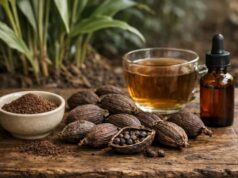
Balsam of Peru is an aromatic resin obtained from the bark of Myroxylon pereirae, a tree native to Central America. It has a long history in traditional wound care and topical preparations, and it still appears in a few modern products as a fragrance fixative, flavoring component, or skin-protective ingredient. What makes it fascinating—and tricky—is that the same chemistry that gives it a warm vanilla-cinnamon scent also makes it one of the most common causes of fragrance-related allergic contact dermatitis.
If you are looking into Balsam of Peru for “health benefits,” it helps to start with a clear distinction: most credible uses are topical (on the skin), and most important risks are also topical (allergy and irritation). Oral use is not a mainstream, well-supported practice today, and for people who are sensitized, even small exposures can trigger flares. This guide explains what it is, what it contains, what it may help with, how it is used, and how to approach dosing and safety with a realistic, evidence-aware lens.
Essential Insights
- May support minor skin protection in formulated topical products, but benefits are modest and situation-dependent.
- One of the most common fragrance allergens; avoid if you have eczema, fragrance sensitivity, or unexplained recurrent rashes.
- Typical topical product concentrations range about 1% to 5%, used as a thin layer 1 to 2 times daily for short periods.
- Do not self-patch-test or use undiluted resin; irritation and allergic reactions are common.
- Avoid during pregnancy and breastfeeding unless your clinician specifically advises it, and avoid entirely if you have a known fragrance allergy.
Table of Contents
- What is Balsam of Peru?
- Key ingredients and active compounds
- Potential benefits and medicinal properties
- Common uses and product forms
- Dosage and application tips
- Side effects and who should avoid
- What the evidence actually says
What is Balsam of Peru?
Balsam of Peru is a sticky, dark, fragrant resin collected after the bark of Myroxylon pereirae is carefully processed. You may also see it listed as Myroxylon pereirae resin, Peru balsam, or older pharmacy-style names such as balsamum peruvianum. Despite the name, it is most closely associated with El Salvador and surrounding regions; “Peru” reflects historical trade routes and naming rather than the plant’s primary growing area.
People encounter Balsam of Peru in three main ways:
- Fragrance and flavor exposure: It is valued in perfumery because it “fixes” scent—helping fragrances last longer—and it can contribute a warm, sweet aroma profile. Historically, it has also been used in flavoring contexts (or in products that share similar aromatic chemicals), which matters for people with sensitivities.
- Topical preparations: Older and some modern topical products use Peru balsam for its protective, mildly antimicrobial properties. It may appear in ointments, barrier creams, or specialty preparations intended for minor skin issues.
- Medical allergy testing: In dermatology, it is widely used as a screening allergen in patch testing because a positive reaction often signals fragrance allergy or cross-reactivity to related aromatic compounds.
Here is the key practical point: Balsam of Peru is both “traditionally medicinal” and “commonly allergenic.” Those facts are not contradictory—they reflect how complex plant mixtures behave. Many plant resins contain dozens of aromatic chemicals. Some have soothing or antimicrobial effects in the right formula; some also act as sensitizers that can train the immune system to react.
If your interest is general wellness, Balsam of Peru is rarely a first-choice option because safer, better-studied topical ingredients exist. If your interest is troubleshooting rashes, itching, or eczema, it is often more relevant as something to identify and avoid than something to apply. Understanding that framing will help you use the rest of this guide wisely and reduce the chance of worsening a skin problem you are trying to solve.
Key ingredients and active compounds
Balsam of Peru is not a single chemical—it is a complex natural mixture. That complexity explains both its appealing scent and its reputation as a frequent allergen. The resin contains a high proportion of aromatic compounds related to benzoic acid and cinnamic acid, along with additional fragrance-like constituents that can vary by source and processing.
Commonly discussed constituents include:
- Benzyl benzoate: One of the major components in many analyses. It contributes fragrance character and has a history of use in topical contexts, including antiparasitic applications in some regions (as a separate ingredient, not necessarily as crude resin).
- Benzoic acid and benzyl alcohol: Aromatic compounds that show up across many fragrance and flavor systems; they can be relevant for cross-reactivity discussions.
- Cinnamic acid derivatives and benzyl cinnamate: These contribute to the warm, sweet, “spiced” scent profile and may be part of why the resin is associated with cinnamon-like notes.
- Vanillin: Adds vanilla-like sweetness to the aroma profile and is one reason some people associate Peru balsam with “vanilla and spice” products.
- Nerolidol and related terpenoid-type compounds: These appear in fragrance chemistry broadly and may influence both scent and skin tolerability.
- Eugenol and related phenolic aroma chemicals (in some profiles): Known from clove-like scent families and relevant because they can also act as sensitizers.
From a medicinal-properties perspective, these compounds are often linked to a few broad actions:
- Mild antimicrobial effects: Some aromatic compounds can reduce microbial growth on the skin’s surface, especially when formulated correctly and paired with suitable carriers.
- Barrier support and “protective film” behavior: Resins can create a thin occlusive layer that reduces moisture loss and helps protect irritated skin from friction.
- Fragrance fixation: This is not a health benefit, but it is crucial for real-life exposure—if a resin makes scents linger, it also makes potential allergens linger.
The same chemistry can also create the main downside:
- Sensitization risk: Natural mixtures with multiple aromatic chemicals increase the odds that at least one component can act as a sensitizer for a given person.
- Cross-reactivity: People who react to Peru balsam may also react to related fragrance families, flavorings, or botanicals with overlapping aromatic profiles.
If you have eczema, recurrent dermatitis, or unexplained itching, this is why Peru balsam shows up so often in patch testing: it behaves like a “marker” for a wider fragrance-sensitivity pattern, not just a single-ingredient problem.
Potential benefits and medicinal properties
When people search for “Balsam of Peru benefits,” they often hope for something broadly healing—anti-inflammatory, antimicrobial, or restorative. A realistic view is narrower: the most defensible benefits relate to topical, short-term support in well-formulated products, and even then, it is not the best option for everyone because allergy risk is high.
1) Skin-protective and barrier-support role
Resins can form a light protective film that reduces water loss and shields irritated skin from friction. In practice, that can feel soothing for:
- Mild chapping or roughness
- Minor irritation from rubbing (for example, edges of dressings)
- Localized areas that benefit from a protective layer
However, “protective” does not mean “universally safe.” If your skin barrier is already compromised (common in eczema), a resin-based ingredient may sting, irritate, or trigger a flare.
2) Mild antimicrobial activity
Some components of Peru balsam have antimicrobial properties in laboratory settings or in traditional use. In real life, the effect depends on:
- Concentration (too low may do little; too high increases irritation risk)
- The carrier base (ointment vs. alcohol tincture vs. cream)
- The specific skin problem (minor superficial irritation vs. established infection)
For suspected infection—spreading redness, warmth, pus, fever, or rapidly worsening pain—self-treating with resin-based products is not appropriate. That situation needs clinical evaluation.
3) Traditional wound-care reputation
Historically, Peru balsam was used for minor wounds and skin complaints. Modern evidence is mixed and often indirect, but the idea likely comes from a combination of barrier effects and mild antimicrobial action.
If your goal is gentle, low-allergen support for minor skin recovery, you may want to consider alternatives with a better tolerability profile. For example, calendula-based topical support is commonly used for soothing irritated skin and is generally easier to approach cautiously (though any botanical can still cause reactions in some people).
4) Possible antiparasitic relevance (indirect)
Because benzyl benzoate is a major constituent in many Peru balsam profiles, you will sometimes see Peru balsam discussed alongside antiparasitic skin treatments. Clinically, benzyl benzoate is typically used as a standardized, separate ingredient—not as crude Peru balsam—and it can still irritate sensitive skin.
The bottom line: Peru balsam’s “medicinal” value is best viewed as situational topical support rather than a broad wellness remedy. For many people, its main relevance is not what it can do for the skin, but what it might be quietly doing to the skin as an unrecognized allergen.
Common uses and product forms
Balsam of Peru appears in everyday life more often than people realize, largely because it overlaps with fragrance and flavor chemistry. Understanding where it shows up—and how it is labeled—is one of the most practical steps you can take, especially if you are managing eczema, recurring rashes, or “mystery” dermatitis.
Common real-world exposure points
1) Fragranced personal care
You might encounter Peru balsam (or closely related fragrance ingredients) in:
- Perfumes, colognes, body sprays
- Scented lotions, creams, and deodorants
- Soaps, shampoos, conditioners, and styling products
- Aftershaves and fragranced balms
Even if the resin itself is not listed, the presence of similar aromatic chemicals can trigger the same pattern for sensitized individuals.
2) Oral care and flavored products
Some toothpastes, mouthwashes, lip balms, and flavored cosmetics contain aromatic compounds that overlap with Peru balsam chemistry. This is one reason some people with confirmed allergy notice lip irritation or perioral dermatitis.
3) Topical “traditional” preparations
Peru balsam may appear in older-style or specialty preparations intended for minor skin issues. In some settings it has also been used to improve dressing adhesion or to create a protective layer—contexts where a resin’s film-forming nature is valued.
How to read labels and ingredient lists
Depending on the product and region, it may appear as:
- Myroxylon pereirae resin
- Peru balsam / Balsam of Peru
- Balsamum peruvianum (older naming)
- Fragrance-related mixtures that contain overlapping chemicals
If you suspect Peru balsam sensitivity, label reading becomes less about finding one exact phrase and more about reducing total fragrance load. That often means shifting toward fragrance-free, simpler formulas.
If you want a plant-based topical option but are trying to minimize fragrance allergens, it can help to compare approaches. For instance, tea tree topical uses are often discussed for antimicrobial skin support—but it is still a fragrance-containing essential oil and can also cause reactions in sensitive individuals. The broader point is that “natural” does not equal “non-allergenic,” and the safest strategy for reactive skin is usually fewer botanicals, not more.
A practical troubleshooting mindset
If you are experimenting with any topical product while managing dermatitis:
- Introduce only one new product at a time.
- Use it on a small area first.
- Keep a simple log (what you used, where, and what happened over 72 hours).
- Prioritize fragrance-free basics over complex blends.
This approach prevents you from misattributing a flare to stress, weather, or food when the trigger is actually sitting in your bathroom cabinet.
Dosage and application tips
“Dosage” for Balsam of Peru is mainly a topical question, and it should be approached with more caution than many herbal ingredients because sensitization is common. The safest general rule is: do not use crude resin or DIY blends on the skin, and do not ingest it unless a qualified clinician has a very specific reason and plan (which is uncommon).
Topical products (most relevant form)
In modern use, Peru balsam is typically encountered as a minor component of a formulated product rather than a standalone remedy. When a product clearly states a concentration, a practical range you may see is:
- About 1% to 5% Peru balsam in a topical preparation, often applied 1 to 2 times daily as a thin layer.
Tips for safer topical use:
- Use the smallest amount needed to cover the area.
- Avoid use on large body surface areas.
- Avoid broken, weeping, or severely inflamed skin unless a clinician directs you.
- Stop immediately if you notice burning, spreading redness, swelling, blistering, or worsening itch.
Alcohol tinctures and resin-containing “adhesive” preparations
Some traditional-style preparations are alcohol-based, which can sting and disrupt the skin barrier—especially on eczema-prone skin. If you are sensitive, an alcohol vehicle may cause irritation even if you are not allergic to the resin.
Patch testing (diagnostic, not DIY)
Dermatology patch testing uses standardized preparations at defined concentrations to identify allergy triggers. This is not the same as “trying a little to see what happens.” Self-testing can lead to severe reactions or new sensitization.
Duration and decision points
If you are using a topical product that contains Peru balsam (or you suspect it does), keep the trial short:
- 3 to 7 days is often enough to notice whether irritation is building.
- If you are using it for a minor issue and it is not clearly helping within a week, continuing longer rarely improves the risk-benefit balance.
When you want symptom relief without fragrance load
If the main problem is itch, mild irritation, or a feeling of tightness, many people do better with simpler, low-fragrance options. For example, witch hazel topical uses are sometimes discussed for short-term soothing—though it can also irritate some people, especially if alcohol-based. The key is not which botanical is “best,” but which approach adds the least new risk to already reactive skin.
In practice, the “right dose” of Peru balsam is often zero for people with eczema, fragrance sensitivity, or chronic dermatitis. If you do choose to use it, treat it as a short, cautious experiment with clear stop rules.
Side effects and who should avoid
Safety is the most important section of any Peru balsam guide because the best-documented real-world outcome is not a benefit—it is allergy. Many clinicians consider Balsam of Peru one of the most useful screening allergens precisely because it catches a large group of fragrance-related sensitivities.
Common side effects
Even in people who are not allergic, Peru balsam can cause:
- Burning or stinging on application (especially on compromised skin)
- Irritant dermatitis (redness, dryness, scaling)
- Worsening itch in eczema-prone areas
In people who are sensitized, reactions can be stronger:
- Allergic contact dermatitis (itchy rash, redness, swelling, vesicles)
- Flare patterns on the face, neck, hands, or areas exposed to fragranced products
- Lip irritation or perioral dermatitis when oral care or lip products contain related aromatics
Systemic reactions in sensitized individuals
A smaller but important concept is systemic contact dermatitis: in some sensitized people, ingestion of certain flavorings or exposure to related aromatic compounds can contribute to widespread dermatitis or persistent flares. This is not “everyone who reacts must avoid a long list of foods,” but it can be relevant when:
- Patch testing confirms Peru balsam sensitivity
- Skin symptoms remain uncontrolled despite fragrance-free skincare
- Flares correlate with strongly flavored or spiced foods, chewing gums, or certain drinks
If a clinician suggests a trial avoidance diet, it is usually time-limited (often a few weeks) and used as a diagnostic experiment rather than a permanent lifestyle.
Who should avoid Balsam of Peru
Avoiding Peru balsam—especially as an applied ingredient—is strongly advisable for:
- People with confirmed fragrance allergy on patch testing
- People with chronic eczema, hand dermatitis, or recurrent unexplained rashes
- Individuals who react to fragranced personal care products
- Those with a history of multiple contact allergies (the risk of reacting is higher)
- Infants and young children (their skin barrier is more vulnerable)
Pregnancy and breastfeeding
Because safety data for Peru balsam as a medicinal ingredient are limited, and because allergic reactions can be intense and difficult to manage, it is generally wise to avoid intentional use during pregnancy and breastfeeding unless a clinician specifically recommends a particular product for a specific reason.
Practical safety checklist
If you suspect Peru balsam is part of your trigger pattern:
- Switch to fragrance-free basics for 2 to 4 weeks (cleanser, moisturizer, sunscreen).
- Remove perfumes and scented laundry products if possible.
- Consider professional patch testing if symptoms persist.
- Reintroduce products one at a time only after symptoms stabilize.
For many people, this stepwise approach delivers more real relief than adding another topical “remedy” into an already reactive system.
What the evidence actually says
The evidence picture for Balsam of Peru is unusually lopsided: the strongest, most consistent evidence is about allergy and exposure, while evidence for “health benefits” is narrower and less definitive.
Where the evidence is strongest
1) It is a meaningful marker for fragrance allergy.
Clinical patch test studies and dermatology practice consistently treat Peru balsam as a screening allergen that helps identify fragrance-sensitive patients. This is not a fringe idea; it is mainstream dermatology logic: a complex aromatic mixture can reveal patterns that single-chemical tests might miss.
2) Its composition explains cross-reactivity.
Analytical work shows that Peru balsam contains high proportions of a few major aromatic compounds plus smaller quantities of many others. That profile supports why sensitized individuals may react to multiple fragranced items and why “fragrance-free” routines are often recommended as a first-line management strategy.
3) Systemic contact dermatitis is real but not universal.
Case reports and clinical experience suggest that a subset of sensitized individuals can have broader reactions when exposed through non-skin routes. The key word is subset: it is not a reason for the general public to fear normal foods, but it is relevant for people with confirmed allergy and persistent symptoms.
Where evidence is limited or indirect
1) Antimicrobial and wound-healing benefits are plausible but not a slam dunk.
Traditional use and some experimental work support mild antimicrobial or protective actions. In practice, however, modern wound care and dermatitis management usually favor options with better tolerability and clearer risk-benefit profiles.
2) Oral “wellness” use is not well supported.
If you see broad claims that Peru balsam “detoxifies,” “boosts immunity,” or “heals the gut,” treat them as marketing rather than established medical fact. The best-supported clinical use cases are topical and diagnostic.
A balanced way to decide
- If you are considering Peru balsam as a topical ingredient, the decision should be based on your skin history. If you have eczema, frequent rashes, or any fragrance sensitivity, the likely downside outweighs the upside.
- If you are investigating chronic dermatitis, Peru balsam is more useful as a clue than a treatment—something to test for and potentially avoid.
- If you like the idea of resins for traditional wellness, it can help to compare with other resin-based botanicals that are discussed more for anti-inflammatory support than for fragrance allergy screening, such as frankincense health uses. Even then, the same caution applies: resins and essential oils are common sensitizers, and “natural” does not guarantee compatibility with sensitive skin.
In short, Balsam of Peru sits at the intersection of tradition, fragrance chemistry, and modern dermatology. Used thoughtfully, it can inform diagnosis and avoidance. Used casually, it can be the hidden reason a rash never fully settles.
References
- Composition of Myroxylon pereirae Resin and Colophonium for Patch Testing – PMC 2025
- Fragrance Contact Allergy – A Review Focusing on Patch Testing – PMC 2024 (Review)
- Myroxylon pereirae (balsam of Peru): Still worth testing? – PMC 2021
- Type I and type IV systemic contact dermatitis to balsam of Peru with a particular reaction to cinnamyl alcohol – PubMed 2021 (Case Report)
Disclaimer
This article is for educational purposes only and does not provide medical advice, diagnosis, or treatment. Balsam of Peru is a common cause of allergic contact dermatitis and can worsen eczema and other inflammatory skin conditions. Do not self-diagnose or self-patch-test. If you are pregnant or breastfeeding, have chronic skin disease, or use prescription medications for skin or immune conditions, consult a qualified clinician before using any product containing Peru balsam or related fragrance ingredients. Seek medical care urgently for rapidly spreading rash, facial swelling, trouble breathing, signs of infection, or severe blistering.
If this guide helped you, consider sharing it on Facebook, X (formerly Twitter), or your preferred platform so others can make safer, better-informed choices.