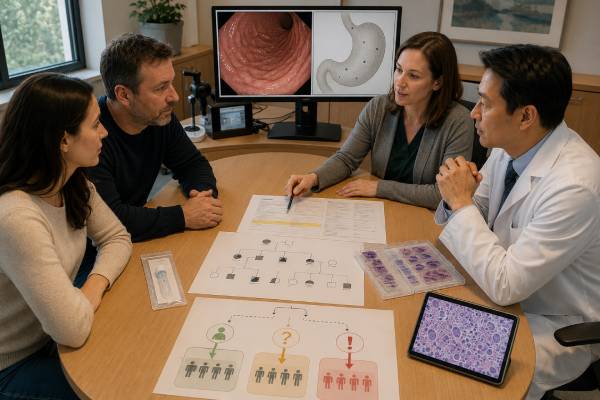
A CDH1 genetic test looks for inherited changes in the gene that makes E-cadherin, a protein that helps epithelial cells attach to one another. A germline pathogenic CDH1 variant can cause diffuse gastric and lobular breast cancer syndrome, historically called hereditary diffuse gastric cancer. The syndrome raises the risk of diffuse signet-ring cell gastric cancer in all sexes and invasive lobular breast cancer in women.
Testing usually uses blood or saliva and should include sequencing plus deletion/duplication analysis. A pathogenic or likely pathogenic result can lead to specialized stomach surveillance, discussion of risk-reducing total gastrectomy, breast MRI, and targeted testing for relatives. A variant of uncertain significance should not be used to justify stomach removal or predictive testing in family members. Cancer risks vary substantially among families, and recent studies suggest lower average gastric cancer penetrance in some broadly tested groups than older highly selected families. Management should therefore combine the exact variant, confirmed family cancers, age, expert endoscopy, and personal preferences.
- A pathogenic germline CDH1 variant raises risk for diffuse gastric cancer and lobular breast cancer but does not mean cancer is already present.
- Preventive total gastrectomy is the most reliable way to remove gastric risk, yet timing is individualized and expert surveillance is an option for selected carriers.
- Standard endoscopy can miss tiny signet-ring cell foci, so surveillance requires a specialized protocol and experienced pathology.
- Women with a pathogenic variant are usually offered annual breast MRI beginning around age 30.
- A CDH1 VUS is not managed as hereditary diffuse gastric cancer.
Table of Contents
- What CDH1 Does and How the Syndrome Develops
- Who Should Consider CDH1 Testing
- How Testing Is Performed
- How to Interpret Results
- Gastric and Breast Cancer Risks
- Stomach Surveillance and Risk-Reducing Gastrectomy
- Breast Screening and Risk Reduction
- Family Testing, Life After Diagnosis, and Limitations
What CDH1 Does and How the Syndrome Develops
CDH1 encodes E-cadherin, a cell-adhesion protein that helps organize epithelial tissues and suppress invasion. A person with an inherited pathogenic variant has one altered CDH1 copy in every cell. Cancer can develop after a stomach or breast cell loses or silences the remaining working copy. The affected cells become less cohesive and can spread individually through tissue rather than forming an obvious mass.
In the stomach, early lesions often consist of tiny clusters of signet-ring cells hidden beneath intact surface epithelium. They can be only a few millimeters or microscopic. This growth pattern explains why CT scans and routine endoscopy may look normal even when occult foci are present. Advanced diffuse gastric cancer can thicken and stiffen the stomach wall, producing linitis plastica without a discrete polyp-like tumor.
In the breast, loss of E-cadherin is characteristic of invasive lobular carcinoma and lobular carcinoma in situ. Lobular tumors can grow in single-file patterns and may be more difficult to detect on mammography than many ductal cancers. MRI therefore plays an important role in surveillance.
The condition is autosomal dominant. Each child of a carrier has a 50% chance of inheriting the familial variant, regardless of sex. A carrier can inherit it from the mother or father, and either side of the family can transmit gastric or breast risk. Reduced penetrance means some carriers remain cancer-free throughout life.
Pathogenic variants include truncating changes, splice variants, selected missense variants with strong functional evidence, and exon-level deletions. Not every CDH1 missense change is harmful. Because the gene also has associations with cleft lip or palate in some families, variant-specific interpretation and phenotype review are important.
CTNNA1 is another gene linked to a similar diffuse gastric cancer predisposition. Families meeting clinical criteria but negative for CDH1 may be offered CTNNA1 testing or a broader hereditary gastric cancer panel. A multigene panel can also evaluate Lynch syndrome, APC, STK11, TP53, and other causes of gastric or breast cancer, depending on the history.
The older name “hereditary diffuse gastric cancer” remains common, but “diffuse gastric and lobular breast cancer syndrome” better reflects both major cancer risks. The diagnosis applies to a pathogenic germline variant, not to a CDH1 change found only in a tumor.
Who Should Consider CDH1 Testing
Testing criteria focus on confirmed diffuse gastric cancer, invasive lobular breast cancer, young age, and clustering in close relatives. Pathology verification matters because intestinal-type gastric cancer and ductal breast cancer do not carry the same CDH1 signal.
Common reasons to consider testing include:
- Diffuse gastric cancer diagnosed at a young age
- Two or more gastric cancers in a family with at least one confirmed diffuse type
- Diffuse gastric cancer and lobular breast cancer in the same person or family
- Bilateral lobular breast cancer or multiple lobular breast cancers at younger ages
- Two or more close relatives with lobular breast cancer before guideline-specified ages
- Diffuse gastric cancer in a person of Māori ancestry or another family with a known founder variant
- A relative with a known pathogenic CDH1 variant
- Signet-ring cell carcinoma in situ or pagetoid spread found in gastric biopsies
- Cleft lip or palate together with diffuse gastric cancer in a family
Testing criteria have broadened as multigene panels find CDH1 variants in families dominated by lobular breast cancer and no known gastric cancer. These results require careful counseling because historical risk estimates came from families selected for multiple early gastric cancers. A variant found through broad population testing may have lower penetrance than the same broad label suggests.
The best test candidate is usually a living relative with confirmed diffuse gastric cancer or lobular breast cancer. If no affected relative is available, an unaffected person can be tested, but a negative result may be less informative. Stored tumor or normal tissue from a deceased relative can sometimes help.
Pathology should be reviewed when possible. Signet-ring cells can arise in conditions outside hereditary diffuse gastric cancer, and gastric metastasis from lobular breast cancer can mimic a primary stomach cancer. Immunohistochemistry and clinical history can distinguish them.
Testing children is usually deferred because major interventions generally begin in adulthood. Exceptions may arise in families with extremely early gastric cancer, but predictive testing before age 18 requires specialist genetics, gastroenterology, and psychosocial review. The decision should create an actionable plan rather than anxiety without medical benefit.
A genetics visit should document a three-generation history, exact cancer types and ages, ancestry, prior pathology, previous panel testing, and reproductive goals. Consent should cover uncertain results, family implications, insurance and privacy, and the life-changing nature of preventive gastrectomy.
How Testing Is Performed
Germline testing usually uses blood. Saliva or a cheek swab can be used when blood collection is difficult, although a new sample may be needed if DNA quality is poor. The laboratory should sequence all coding regions and relevant splice boundaries and perform deletion/duplication analysis because whole-exon and multiexon deletions can be pathogenic.
A targeted familial-variant test is appropriate when a pathogenic change is already known in the family. It should match the exact transcript and notation on the relative’s report. Testing only a common founder variant is insufficient unless the family context makes that strategy appropriate.
Multigene panels are often used because diffuse gastric and lobular breast cancer can overlap other hereditary syndromes. The broader test may find a different actionable gene but also increases the chance of a VUS. Pretest counseling should explain that not every listed gene has the same cancer risk or management.
Tumor sequencing may identify a somatic CDH1 mutation or loss in sporadic diffuse gastric cancer and lobular breast cancer. Such findings are common features of those tumors and do not prove an inherited syndrome. Germline confirmation requires a non-tumor sample. A variant allele fraction near 50% in tumor tissue is not enough to classify origin.
RNA analysis can clarify some splice variants, while promoter methylation and other “second hits” are usually research or tumor-level questions rather than routine germline tests. Functional assays are valuable for selected variants but should be interpreted through an expert laboratory framework.
Results often take two to four weeks. No fasting is needed. Blood from a person who has received an allogeneic stem-cell transplant may reflect donor DNA, so another tissue source can be required. Active blood cancer and clonal hematopoiesis are less common problems for CDH1 than for some blood-cancer genes but should still be disclosed.
The report should state the gene transcript, DNA and protein change, zygosity, classification, testing methods, and limitations. A genetics professional can verify that the assay included deletion/duplication analysis and that an older negative test did not use outdated methods.
How to Interpret Results
A CDH1 result is interpreted using the same five clinical categories applied to other germline genes. Management depends heavily on the distinction between pathogenic and uncertain.
| Result | Meaning | Usual next step |
|---|---|---|
| Pathogenic | The variant is established to impair CDH1 and increase syndrome risk. | Discuss expert gastric management, breast surveillance, and family testing. |
| Likely pathogenic | Evidence strongly favors a harmful effect. | Usually managed like a pathogenic result after expert review. |
| Variant of uncertain significance | Evidence is insufficient or conflicting. | Do not base gastrectomy or predictive family testing on the VUS. |
| Likely benign or benign | The variant is not considered a cause of the syndrome. | Use personal and family history for care. |
| No pathogenic variant found | No reportable causal change was identified by the assay. | Decide whether the result is a true family negative or an unexplained high-risk history. |
A true negative occurs when the family has a known pathogenic CDH1 variant and the tested relative does not carry it. That person does not need CDH1-specific gastrectomy or surveillance and cannot pass that familial variant to children. Other cancer risks based on personal history still apply.
An uninformative negative occurs when no family variant is known. A family can meet “HDGC-like” clinical criteria despite negative CDH1 and CTNNA1 testing. Selected affected relatives and first-degree relatives may receive expert endoscopic surveillance based on family history.
A VUS should not be upgraded by fear, a dramatic family history, or a tumor’s loss of E-cadherin alone. Laboratories may reclassify it as population data, segregation, RNA, and functional evidence accumulate. Most VUS findings across hereditary cancer testing are eventually downgraded.
Some variants have conflicting classifications between laboratories. A hereditary gastric cancer expert can compare ClinGen specifications, population frequency, RNA evidence, and family segregation. Before irreversible surgery, the team should confirm that the result is genuinely pathogenic or likely pathogenic in a reputable clinical laboratory.
Mosaicism is rare but possible. A low allele fraction in blood may reflect post-zygotic mosaicism, technical artifact, or another biological process. Confirmation in a second tissue and specialized counseling can clarify transmission and organ risk.
Gastric and Breast Cancer Risks
Older studies of highly selected CDH1 families estimated diffuse gastric cancer risks as high as 70% or more by age 80. Newer North American data that include people found through broader testing estimate lower average risks. A 2024 multicenter study reported cumulative gastric cancer risk ranges of roughly 7%–10% by age 80 for unselected carriers, while risks were higher in families meeting strict clinical criteria. These findings do not mean gastric risk is trivial; they show that family ascertainment strongly affects the estimate.
Microscopic signet-ring cell foci are much more common in prophylactic gastrectomy specimens than clinically apparent cancers. Many foci may remain indolent for years, while some progress unpredictably. Current tests cannot reliably identify which focus will become invasive and life-threatening.
Family history modifies counseling. A carrier from a family with several diffuse gastric cancers in the twenties or thirties faces a different practical risk from a carrier identified through a breast panel with no known gastric cancer. Variant type alone usually cannot provide a precise individual forecast.
Lobular breast cancer risk is consistently elevated in women with pathogenic CDH1 variants. Contemporary estimates often place lifetime risk around 37%–55%, though study ranges differ. Risk becomes more clinically important from the thirties onward and persists with age.
Men with pathogenic variants have diffuse gastric cancer risk but no clearly established large increase in male breast cancer. Both sexes need symptom awareness, family counseling, and stomach-risk planning. Children can inherit the variant from either parent.
Symptoms are unreliable for early gastric disease. Persistent upper-abdominal pain, early satiety, vomiting, weight loss, swallowing difficulty, anemia, or black stools need prompt evaluation but often occur after disease has advanced. Surveillance and prevention are recommended precisely because waiting for symptoms is unsafe.
Lobular breast cancer can present as subtle thickening, fullness, nipple change, asymmetry, or a mass. It may be less conspicuous on mammography, so a normal mammogram does not replace MRI in a high-risk program.
Risk estimates should be revisited over time. As population-based data and variant-specific evidence improve, recommendations may become more individualized. A one-time counseling session at diagnosis is not enough for a decision that may change with age, family events, and new evidence.
Stomach Surveillance and Risk-Reducing Gastrectomy
Risk-reducing total gastrectomy removes the stomach before invasive cancer is clinically detected. It is the most reliable way to prevent diffuse gastric cancer in a proven CDH1 carrier. Traditional guidance has advised discussing surgery in early adulthood, often between ages 20 and 30, but timing is now more individualized according to family history, age, health, variant context, and willingness to live with lifelong consequences.
The operation connects the esophagus directly to the small intestine. It requires an experienced upper gastrointestinal surgical team and specialized pathology. The entire stomach is mapped with numerous tissue sections because microscopic foci can be missed on routine sampling. Occult signet-ring carcinoma is found in many prophylactic specimens even after negative endoscopy.
Life after total gastrectomy can be active and fulfilling, but it is not medically neutral. Common issues include early fullness, weight loss, dumping syndrome, reflux-like symptoms, diarrhea, altered glucose, food intolerance, and micronutrient deficiencies. Patients need small frequent meals, dietitian support, lifelong vitamin B12, iron and bone-health monitoring, and attention to pregnancy nutrition.
Surgical complications can include leakage, infection, bleeding, stricture, and reoperation. Psychological preparation should address body image, social eating, employment, caregiving, and anxiety. Meeting another person who has undergone preventive gastrectomy can provide a realistic view.
Expert endoscopic surveillance is an accepted alternative or bridge for selected carriers who defer surgery, have lower-risk family context, are pregnant, have major comorbidity, or decline gastrectomy after informed counseling. High-definition examination includes careful inspection, targeted biopsies of visible abnormalities, and systematic biopsies from multiple stomach regions according to the center’s protocol.
Endoscopy has limited sensitivity because early foci are tiny and patchy. A negative procedure does not mean the stomach is free of signet-ring cells. A positive biopsy generally triggers renewed discussion of gastrectomy and review by an expert pathologist.
Surveillance should occur in a center familiar with hereditary diffuse gastric cancer. Pathologists must distinguish true signet-ring carcinoma from benign mimics and document the site. Newer international approaches are exploring more individualized biopsy strategies, but local expert protocols should be followed rather than ordinary community endoscopy.
Testing and treating Helicobacter pylori is appropriate because it is a separate gastric carcinogen and source of inflammation, although eradication does not remove CDH1-related risk. Smoking cessation and balanced nutrition support general health but cannot substitute for surveillance or surgery.
Breast Screening and Risk Reduction
Women with a pathogenic CDH1 variant are generally offered annual contrast-enhanced breast MRI beginning around age 30. Mammography is added according to age, breast density, local guideline, and prior findings. Some programs alternate MRI and mammography every six months so that imaging occurs twice yearly, though each modality remains annual.
MRI is sensitive for lobular cancer but can lead to false-positive biopsies. Imaging should be reviewed by a high-risk breast team familiar with subtle non-mass enhancement. Clinical breast awareness remains important because lobular cancer can cause diffuse thickening rather than a distinct lump.
Risk-reducing bilateral mastectomy is an option, not an automatic recommendation. It can reduce breast cancer risk by about 90% or more but has surgical, sensory, reconstructive, and psychological effects. Family history, prior lobular neoplasia, imaging burden, age, other health conditions, and personal priorities shape the choice.
For a woman already diagnosed with lobular breast cancer, CDH1 status can influence discussion of bilateral surgery and contralateral risk. Breast-conserving therapy may still be medically appropriate in selected situations. The inherited result does not replace tumor stage, receptor status, treatment response, and patient preference.
Lobular carcinoma in situ is a risk marker and nonobligate precursor. Management depends on subtype, extent, imaging concordance, and the inherited context. A pathogenic CDH1 variant may lower the threshold for intensified surveillance or preventive discussion, but decisions should be made in a multidisciplinary breast clinic.
Pregnancy and breastfeeding require scheduling adjustments. MRI with contrast is generally avoided during pregnancy, while ultrasound and selected mammography can be used for symptoms. Screening should resume promptly after pregnancy according to specialist advice.
Hormonal risk-reduction medication may be considered for some women, particularly because many lobular cancers are estrogen-receptor positive. Evidence specific to CDH1 carriers is limited, so potential benefit, blood-clot risk, menopausal symptoms, fertility plans, and prior cancer must be reviewed individually.
Family Testing, Life After Diagnosis, and Limitations
Cascade testing allows adult relatives to learn whether they inherited the exact family variant. Parents, siblings, and children are tested first, followed by more distant relatives on the side where the variant is found. Sharing the laboratory report prevents errors in gene or variant notation.
Reproductive options include natural conception, prenatal diagnosis, in vitro fertilization with preimplantation genetic testing, donor gametes, adoption, or no testing. The syndrome has incomplete penetrance, so embryo testing involves values as well as medical facts. A reproductive genetics consultation can explain timing, cost, success rates, and limitations.
A negative genetic test does not erase a strong family history. Families with confirmed diffuse gastric cancer but no pathogenic CDH1 or CTNNA1 variant may need expert review, updated testing, and temporary endoscopic surveillance. Tumor sequencing and pathology re-review can sometimes clarify whether cancers were truly diffuse type.
Technical limitations include deep intronic variants, complex rearrangements, mosaicism, and changes not yet recognized as pathogenic. Older tests may not have included deletion/duplication analysis. Reanalysis or updated testing can be reasonable after several years if the family remains unexplained.
Useful questions include:
- Is the variant definitively pathogenic or only uncertain?
- Does my family meet strict diffuse gastric cancer criteria?
- What risk estimate best matches how my variant was found?
- Should I choose gastrectomy now, surveillance, or a staged decision?
- How experienced is the endoscopy, surgery, dietetics, and pathology team?
- What breast imaging schedule should begin now?
- Which relatives should have targeted testing?
- How will nutrition, pregnancy, and bone health be managed after surgery?
- Who will update me when guidelines or variant interpretation change?
Seek urgent care for vomiting blood, black stools, severe dehydration, inability to swallow, persistent vomiting, or rapidly worsening abdominal pain. After gastrectomy, fever, severe chest or abdominal pain, fast heart rate, or inability to keep fluids down can signal a surgical complication and requires immediate contact with the surgical team.
Long-term care works best through a coordinated hereditary cancer program. Genetics, gastroenterology, surgery, pathology, breast imaging, nutrition, psychology, and primary care each address a different part of the risk. The test result starts that plan; it does not dictate one identical path for every carrier.
References
- Diffuse Gastric and Lobular Breast Cancer Syndrome 2024 (Review)
- Hereditary diffuse gastric cancer: updated clinical practice guidelines 2020 (Guideline)
- Hereditary Diffuse Gastric Cancer (PDQ®)–Health Professional Version 2024
- Germline CDH1 Variants and Lifetime Cancer Risk 2024
- The Changing Landscape of Hereditary Diffuse Gastric Cancer 2025 (Review)
- Hereditary diffuse gastric cancer: the evolution of a clinical syndrome 2025 (Review)
Disclaimer
This article is educational and does not replace genetic counseling or individualized advice from an expert hereditary gastric cancer team. CDH1 management depends on variant classification, verified family pathology, age, health, breast and stomach risk, reproductive plans, and the limits of endoscopic detection. Do not pursue preventive gastrectomy because of a VUS or an unconfirmed consumer result.