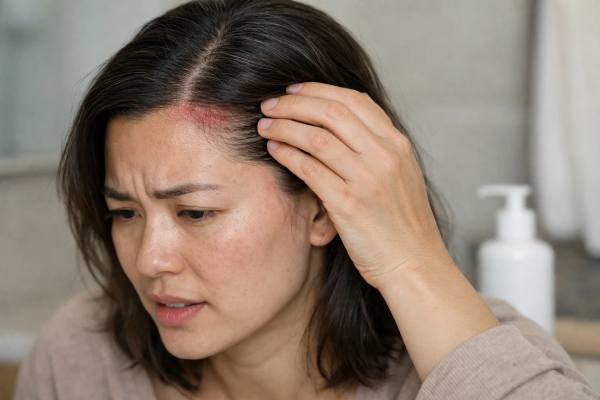
A “burning scalp” after a new hair product can mean several different things—from mild irritation that settles overnight to a true chemical burn that keeps damaging skin until it is removed. The difference matters, because the safest next step is not always the one people reach for. Chemical burns from hair products usually happen when strong alkalines, oxidizers, or acids sit on the scalp too long, are applied to already-compromised skin, or are layered with heat and occlusion. The scalp is also uniquely vulnerable: it has many follicles, rich blood flow, and is easy to overlook during rinsing.
This guide is designed for the moment when you need clarity fast. You will learn what symptoms suggest a true burn, what to do in the first minutes, which products carry the highest risk, and when medical care is urgent. You will also get a realistic healing timeline and a prevention checklist so the same mistake does not repeat.
Quick Safety Summary
- Immediate, intense burning, blistering, or raw “weeping” skin can signal a chemical burn that needs prompt decontamination.
- Thorough rinsing with cool to lukewarm running water is the most important first step, often for at least 20 minutes.
- Severe swelling (especially face or eyelids), eye exposure, trouble breathing, or expanding blisters require urgent medical care.
- Stop the process the moment pain begins and keep the product packaging so clinicians can identify the likely chemical class.
Table of Contents
- Chemical burn symptoms and severity
- What to do in the first minutes
- Hair products most likely to burn
- When to seek urgent medical care
- Healing timeline and hair loss risk
- Preventing future burns and reactions
Chemical burn symptoms and severity
A chemical burn is skin damage caused by a corrosive or reactive substance. In hair care, the usual culprits are strong alkalis (very high pH), oxidizers (lighteners and peroxides), and sometimes concentrated acids or solvents. What makes chemical burns tricky is that the early sensation can overlap with irritation or allergy—but the risk profile is different because true burns can keep progressing if residue remains.
Symptoms that lean toward a true chemical burn
These signs are especially concerning when they begin during processing or within minutes of application:
- Intense burning or pain that feels sharp, hot, or escalating rather than mildly tingly
- Redness that spreads beyond the application area or follows product runoff lines
- Blistering, peeling, or wet “weeping” skin
- White, gray, or waxy-looking patches, which can suggest deeper injury
- Swelling of the scalp, hairline, eyelids, or ears
- Numbness after severe pain (a potential sign of deeper damage)
- Ulceration (raw, open areas) after rinsing
Alkali burns (common with relaxers) deserve special caution because they can be deceptively “quiet” at first. High-pH chemicals can penetrate deeper and continue damaging tissue even if the surface looks only mildly red.
Symptoms that may be irritation or allergy instead
Not every reaction is a burn. Two common look-alikes are:
- Irritant contact dermatitis: stinging, dryness, and redness that may happen quickly, often from fragrance, preservatives, high alcohol content, or frequent exfoliating acids.
- Allergic contact dermatitis: itching and swelling that often peaks later (commonly 24–72 hours), sometimes with eyelid puffiness, facial swelling, or a rash that extends beyond the scalp.
If you are trying to distinguish these patterns, how to tell allergy from irritation can help you interpret timing and symptom shape.
Severity on the scalp
Burn severity is often described by depth:
- Superficial: redness, tenderness, mild swelling; skin remains intact.
- Partial thickness: blisters, raw patches, significant pain, oozing.
- Deeper injury: white or charred areas, reduced sensation, ulcers, or thick scabbing.
Any scalp burn can be complicated by infection (because follicles and scratching create entry points) and by uneven healing under dense hair. The practical rule is simple: if pain is intense, skin is blistering or breaking down, or swelling spreads, treat it as potentially serious until proven otherwise.
What to do in the first minutes
When a hair product is actively burning, speed matters. The goal is to stop the chemical reaction and remove residue without worsening damage. In most cases, the safest “universal” first aid is prompt, prolonged rinsing with running water.
Step-by-step: the first 10 minutes
- Stop the process immediately. Do not “push through” a scheduled processing time. If it burns, it is already too much for your skin.
- Remove the product from contact. Take off gloves or caps and keep the product from dripping onto the face, neck, or eyes.
- Rinse with cool to lukewarm running water. Aim for at least 20 minutes of continuous rinsing. More time is often better than “more scrubbing.”
- Part hair so water reaches the scalp. Use your fingers to separate sections. The scalp, not the hair length, is the priority.
- Avoid vigorous rubbing. Friction can tear fragile skin and deepen blistering. Let water do the work.
If the product is thick, creamy, or paste-like (common with relaxers and lighteners), spend extra time ensuring water reaches the scalp under the paste. If you feel “slippery” residue after 20 minutes, keep rinsing.
What not to do
- Do not neutralize with vinegar, baking soda, lemon, or household chemicals. Mixing acids and alkalis can cause heat (exothermic reactions) and unpredictable injury.
- Do not apply oils, butter, essential oils, or heavy ointments immediately. These can trap heat or residue against skin and make medical assessment harder.
- Do not pop blisters. Blister skin is a protective barrier.
- Do not re-wash repeatedly with harsh shampoo. One gentle cleanse after thorough rinsing may be reasonable if residue remains, but repeated detergent exposure can worsen barrier injury.
If the product got into the eyes
Eye exposure is an emergency risk because chemical injury can progress quickly. Rinse eyes with running water or saline for 15–20 minutes and seek urgent medical care. Do not assume “it feels better” means it is safe.
After rinsing: what to do next
- Gently pat dry with a clean towel.
- Cover raw areas with a clean, non-fluffy dressing if skin is open or blistered.
- Take clear photos in good light; they help clinicians assess progression.
- Keep the product packaging (or take a photo of the ingredient list). Knowing whether the product was an alkali relaxer, oxidizer, or acid changes medical decisions.
If pain is severe, swelling is spreading, or skin is blistering, do not wait for “tomorrow” to see how it looks. Early care can reduce complications.
Hair products most likely to burn
Any product can irritate sensitive skin, but true burns tend to cluster around a smaller set of high-reactivity categories. Knowing these helps you identify what likely happened and what to avoid during recovery.
Chemical relaxers and straighteners
Relaxers are among the highest-risk products for scalp burns because many are strongly alkaline. Common chemical families include sodium hydroxide (“lye”), calcium hydroxide and guanidine (“no-lye” systems), and thioglycolate-based straighteners. Risk rises when:
- scalp has scratches, eczema, or recent irritation
- product is applied too close to the scalp “for better results”
- processing time is extended
- heat, plastic caps, or occlusion are used beyond instructions
- overlapping services are done too close together (relaxer plus lightening, for example)
Lighteners and bleach systems
Bleaching typically involves oxidizers (often peroxide with persulfates and alkalizers). These can burn through prolonged contact, high concentration, or heat, and they can create run-off burns at the hairline, ears, and neck. “Scalp bleach” techniques require meticulous timing, sectioning, and rinsing; at-home attempts raise risk.
Permanent hair dyes and color removers
Permanent dyes more commonly cause allergic reactions than true burns, but both can happen—especially when products are layered, left on too long, or used on compromised skin. A warning sign is burning that begins rapidly and intensifies, rather than mild tingling. If you suspect dye sensitivity, hair dye allergy warning signs can help you recognize when the issue is immune-driven rather than purely chemical.
Depilatories and strong exfoliants on the scalp
Depilatory creams (thioglycolate-based) and some “scalp peel” products can cause burns if used off-label, left on too long, or applied too frequently. The scalp is not the same as facial skin; it is often more reactive when occluded by hair and product.
Keratin and smoothing treatments
Some smoothing systems involve high heat plus reactive chemicals. Even when the primary complaint is irritation (burning eyes, throat, scalp sting), the scalp can still develop contact injury if product sits on skin or is ironed too close to the roots.
Why burns often happen “this time”
Many burns occur after a change in context rather than a totally new product:
- you shampooed right before chemical processing (micro-abrasions increase penetration)
- you scratched an itchy scalp earlier that day
- your barrier was already inflamed from dandruff treatments, acids, or frequent washing
- you combined products that were never meant to be layered
When you are recovering, treat your scalp as temporarily fragile. Even “normal” products can sting on healing skin.
When to seek urgent medical care
Some scalp reactions can be monitored at home, but true chemical burns can escalate, especially with alkalis and oxidizers. Use the following thresholds as decision support, not as a substitute for clinical judgment.
Go to urgent care or emergency care now if any of the following apply
- Eye exposure, blurred vision, persistent tearing, or eye pain
- Trouble breathing, throat tightness, widespread hives, or faintness (possible severe allergic reaction)
- Rapidly spreading swelling, especially of eyelids, face, or neck
- Large blisters, widespread raw skin, or open ulcers
- White, gray, or numb areas on the scalp
- Severe pain that does not settle after thorough rinsing and basic pain relief
- Chemical exposure in a child, or in someone who is elderly, pregnant, or immunocompromised
- Unknown chemical (for example, unlabeled product, industrial-strength chemicals, or a strong mix)
If you are unsure whether your symptoms are “just irritation” or something more, burning scalp causes and red flags can help you interpret what deserves faster evaluation.
What clinicians typically do
Medical evaluation is useful because it addresses problems you cannot safely manage alone:
- Assess burn depth and surface area, including hidden areas under hair
- Continue decontamination if residue remains (sometimes pH monitoring is used in clinical settings)
- Control pain and reduce swelling
- Choose dressings that protect the wound and lower infection risk
- Identify infection early, especially if follicles are involved
- Treat overlapping dermatitis when the picture is allergic or irritant rather than a true burn
- Update tetanus protection if needed
Do not be surprised if clinicians ask for the product name, timing, and whether heat or a plastic cap was used. These details point toward the chemical class and the likelihood of ongoing tissue damage.
What to bring or prepare
- The product packaging or a photo of the ingredient list
- Photos showing progression from the first hours to the current moment
- A list of everything applied that day (pre-shampoo, oils, scalp serums, exfoliants, color, developer strength)
If you are choosing home monitoring
Home care can be reasonable for very mild redness and tenderness that improves after rinsing, with no blistering and no spreading swelling. But if symptoms worsen over the next 6–12 hours—more pain, more swelling, new blisters—upgrade to medical care. Chemical burns are not the time to “wait and see” for multiple days.
Healing timeline and hair loss risk
Healing after a scalp chemical burn depends on depth, infection risk, and whether exposure truly stopped. Many people feel alarmed not only by pain and scabbing, but by the fear of permanent hair loss. That fear is understandable—and it is also where nuance matters.
Typical healing timeframes
- Superficial injury (red, tender, intact skin): often improves over 2–7 days with gentle care and avoidance of re-exposure.
- Partial-thickness injury (blisters, raw patches): commonly takes 1–3 weeks to re-epithelialize, sometimes longer if the area is large or repeatedly irritated.
- Deeper injury (ulcers, white or numb patches): can take weeks to months and may scar.
Scalp healing can look dramatic because hair makes drainage and crusting more visible. As long as pain and swelling are decreasing and there is no foul odor, pus, or spreading redness, a crust may be part of normal repair.
Can a scalp burn cause hair loss?
Yes, but the mechanism varies:
- Temporary shedding (telogen effluvium): A significant scalp injury or systemic stress can trigger shedding 6–12 weeks later. This is usually diffuse and improves as the body recovers.
- Breakage: Hair near the burn may become fragile due to inflammation, rubbing, or harsh cleansing, creating a “thinning” look that is actually broken hair.
- Scarring alopecia: If a burn is deep enough to destroy follicles, regrowth may be incomplete in that exact area. This is more likely with severe alkali burns, prolonged contact, or ulcers that heal with thick scarring.
If you want to monitor whether inflammation is escalating in a way that could threaten follicles, signs of scalp inflammation linked to hair loss can help you track changes that merit evaluation.
Aftercare that protects healing skin
Once the chemical is thoroughly removed and the scalp is cooled:
- Keep care bland and minimal: fragrance-free, gentle cleansing as tolerated.
- Avoid scratching; trim nails and consider a soft, breathable head covering if friction is a problem.
- If skin is open, protect it with a clinician-recommended dressing and avoid picking scabs.
- Skip color, bleach, relaxers, and strong exfoliants until the scalp is fully healed and calm—often at least several weeks, sometimes longer.
Signs healing is not going well
Seek medical review if you develop:
- increasing pain after initial improvement
- spreading redness or warmth
- pus, foul odor, fever, or swollen lymph nodes
- new blisters after the first day
- a wound that is not closing over time
A helpful mindset is this: your goal is to support skin closure first. Hair recovery follows skin recovery. Trying to “treat hair loss” while the scalp is still actively injured usually backfires.
Preventing future burns and reactions
Most chemical burns from hair products are preventable. Prevention is less about fear and more about process control: scalp condition, timing, dilution, and the willingness to stop early when something feels wrong.
A safer decision framework before using strong products
- Do not apply high-strength chemicals to compromised skin. Postpone if you have scratches, active dandruff flares, scabs, sunburn, or a “hot” itchy scalp.
- Avoid pre-scrubbing the scalp. Aggressive cleansing or exfoliation right before coloring or relaxing increases micro-injury and penetration.
- Respect spacing between services. Bleach plus relaxer or repeated strong services within a short window increases risk dramatically.
Patch testing and test strands
Patch testing is mainly designed to detect allergy, not burns, but it still reduces risk because it can reveal extreme sensitivity before full exposure. If you dye at home, how to patch test hair dye and scalp products can guide timing and interpretation.
Strand testing matters for performance and safety: it helps you identify how quickly your hair lifts or processes, which reduces the temptation to “leave it longer.”
Technique habits that prevent scalp exposure
- Apply chemicals to hair first, not directly to scalp unless the product is specifically designed for scalp contact.
- Use clean sectioning and avoid overlapping product onto previously processed areas.
- Set a timer and follow maximum processing times, not “until it feels done.”
- Rinse thoroughly and long enough; many scalp burns are really “incomplete removal” plus trapped residue.
Avoid these high-risk behaviors
- Mixing products from different kits or brands
- Adding heat or occlusion when not instructed
- Using straighteners, relaxers, or lighteners on children without professional guidance
- Trying to “fix” a tingling sensation by adding oils or creams during processing
- Reapplying product to “even it out” after it already burned once
If you are going to a salon
A good professional consultation should include:
- a scalp check (especially at hairline and behind ears)
- questions about recent chemical history and at-home products
- clear instructions about what sensations are normal and what requires immediate rinsing
One practical boundary is worth stating out loud: if you feel burning, you want the product removed immediately. It is your scalp, and pain is clinically meaningful feedback—not something to “tolerate for results.”
References
- Management of chemical burns – PubMed 2022 (Review)
- Consensus on the treatment of second-degree burn wounds (2024 edition) – PMC 2024 (Consensus)
- Chemical Scalp Burn after Hair Coloring—Case Report with Literature Review – PMC 2024 (Case Report and Review)
- Effects of chemical straighteners on the hair shaft and scalp – PMC 2022 (Review)
- Burns and scalds | NHS inform 2024 (Guidance)
Disclaimer
This article is for educational purposes only and does not provide medical advice, diagnosis, or treatment. Chemical burns and severe scalp reactions can worsen quickly and may require urgent medical evaluation, especially with eye exposure, significant blistering, spreading swelling, trouble breathing, or signs of infection. Do not attempt to neutralize chemical exposures with household remedies, and do not delay care if symptoms are severe or escalating. If you are unsure, contact a qualified healthcare professional or local emergency services for guidance based on your specific situation.
If this helped you respond quickly and safely, consider sharing it on Facebook, X (formerly Twitter), or your preferred platforms so others can avoid common mistakes and get appropriate care sooner.