A new hair dye or scalp serum can look harmless on the box and still cause a very different reaction on real skin. That gap between label promise and personal tolerance is exactly why patch testing matters. Done well, it can catch early signs of allergy, irritation, or poor product fit before your whole scalp is exposed. Done poorly, it can create false confidence, miss a delayed reaction, or confuse a brief sting with a true allergy.
That nuance is what many people miss. A home test is useful, but it is not the same as dermatologist-run patch testing, and it cannot answer every question. The real value lies in knowing what kind of signal you are looking for, how long to watch for it, and when a negative result still is not enough. Once you understand those limits, patch testing becomes less of a ritual and more of a smart screening tool.
Essential Insights
- Patch testing can help spot early itching, redness, swelling, or burning before a full-scalp reaction develops.
- It is especially useful for permanent hair dyes, fragranced leave-on scalp products, and formulas with a history of triggering your skin.
- A negative home test does not prove a product is allergy-safe for future use or identify the exact ingredient causing trouble.
- For hair dye, follow the package method closely and watch the test area for at least 48 hours, and ideally up to 72 hours for delayed reactions.
- Skip home testing and seek medical advice if you have had a strong past reaction, major facial swelling, or breathing symptoms.
Table of Contents
- What Patch Testing Can Actually Reveal
- Who Should Be Extra Cautious
- How to Patch Test Hair Dye at Home
- How to Patch Test Scalp Products
- How to Read a Reaction Correctly
- When Home Testing Is Not Enough
What Patch Testing Can Actually Reveal
Patch testing sounds simple, but it answers several different questions at once. The first is practical: does this exact product bother your skin before you spread it across the scalp, hairline, ears, and neck? That alone is valuable, because hair dye and scalp products often contact the areas where reactions show up fastest and look most dramatic.
A home patch test can reveal a few useful patterns. It may show that a formula causes obvious burning within minutes, which points more toward irritation or barrier damage than a classic delayed allergy. It may show a slower reaction over one to three days, such as itch, redness, swelling, bumps, or a small eczema-like patch. That slower pattern raises more concern for allergic contact dermatitis. It can also reveal that your skin tolerates one finished formula but not another, even when both are marketed for “sensitive skin.”
What it cannot do is identify the exact culprit with certainty. A negative result does not tell you whether the risk lies in paraphenylenediamine, fragrance, a preservative, a botanical extract, propylene glycol, or the combined effect of the whole formula. A home test also cannot tell you whether you will react after repeated future use. Sensitization can develop over time, so “I used it before without a problem” is not a guarantee.
This is where many people confuse screening with diagnosis. Home testing screens for a visible skin response to one product, under one set of conditions, on one day. Medical patch testing is different. It uses standardized allergens and, when needed, your own products to help identify a true allergy pattern. That distinction matters if you react to multiple products, cannot tell whether your problem is allergy or irritation, or need help finding safe alternatives.
Another overlooked point is body site. Skin behind the ear or on the inner arm is useful for testing, but it is not the same as scalp skin. The scalp is warmer, oilier, often more inflamed, and exposed to friction, sweat, and occlusion from hair. A product can feel fine on the arm and still sting the scalp. That is one reason reactions can be tricky to interpret and why a result should always be read in context.
In short, patch testing can reveal compatibility, early warning signs, and whether a product deserves caution. It cannot promise safety, name the allergen, or replace clinical evaluation when reactions keep coming back. If that distinction feels familiar, it also mirrors the broader difference between product allergy versus irritation, which often changes both the testing strategy and the next step.
Who Should Be Extra Cautious
Not everyone has the same risk when trying a new dye, tonic, or scalp treatment. Some people can switch products with little trouble. Others are much more likely to react, and for them, patch testing is less optional and more essential.
The clearest high-risk group is anyone who has reacted before. That includes itching after dyeing, burning from scalp serums, rash along the hairline, swollen ears, or eyelid puffiness the day after coloring. Even a “mild” past reaction matters. Allergic contact dermatitis often starts small and becomes stronger with later exposures. A previous black henna tattoo is another major red flag because it can sensitize people to hair dye chemicals related to paraphenylenediamine.
People with an impaired skin barrier also deserve extra caution. If your scalp is already scratched, sunburned, freshly shaved, flaking, weeping, or inflamed, it is easier for irritating and sensitizing ingredients to penetrate. That does not mean every reaction is an allergy. It means the skin is easier to upset and the test is harder to interpret. Testing on calm, intact skin gives you cleaner information.
Frequent product users are another group to watch. A simple shampoo may not worry you, but layers add up: dry shampoo, leave-in conditioner, styling foam, scalp oil, fragrance mist, root spray, and overnight serum can expose the same areas to repeated low-level triggers. In those cases, the scalp may react to the total burden rather than one dramatic ingredient. Fragrance is a common example, especially in “wellness” formulas built around essential oils and botanical extracts. If that pattern sounds familiar, it helps to understand common fragrance triggers on the scalp before adding yet another scented treatment.
Hair professionals and people who dye often at home face a different issue: repeated exposure. The more often skin meets colorants, bleaches, preservatives, and gloves, the more opportunities there are for irritation and true sensitization. This is one reason salon workers develop contact allergy more often than occasional users.
You should also be cautious with “sensitive,” “natural,” or “clean” labels. Those terms do not mean allergy-proof. Essential oils, plant extracts, and fragrance blends can still trigger problems. “PPD-free” hair dye does not automatically mean risk-free either, because related dye chemicals may still cause trouble in sensitized people.
The practical rule is simple: the more reactive your skin history, the more carefully you should test and the less you should trust marketing language. If you have had a strong prior reaction, do not treat a home patch test as permission to try again. In that situation, the safer move is to stop guessing and get professional guidance before another full exposure.
How to Patch Test Hair Dye at Home
Hair dye deserves its own method because it contains some of the most common scalp allergens and some of the strongest reaction patterns. A quick dab right before coloring is not enough. You need the right timing, the right site, and the right expectations.
First, read the box insert from that exact product. Hair dye instructions are not perfectly standardized, and the manufacturer’s method should come first. If the brand says to mix the color and developer before testing, do that. If it gives a specific amount or location, follow it. Use gloves, and do not improvise with a much larger area than directed.
A sensible home routine looks like this:
- Wait until your scalp and nearby skin are calm. Do not test right after scratching, bleaching, shaving, exfoliating, or during an active flare.
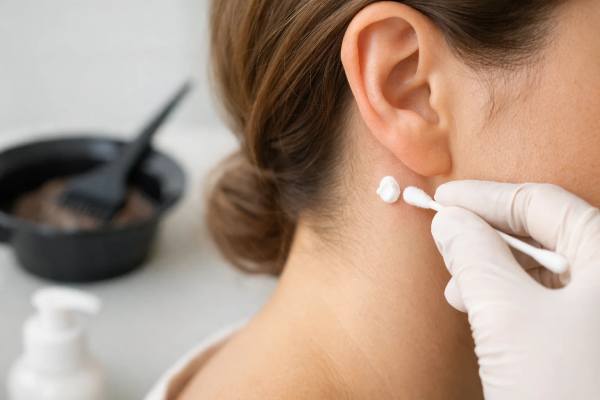
- Clean and dry the test area. Many people use skin behind the ear or the inner elbow. Behind the ear is practical, but do not place the test on broken or irritated skin.
- Prepare a small amount exactly as the package directs.
- Apply only a small test spot. More product does not make the test more accurate.
- Leave it for the time instructed, then keep watching the area for at least 48 hours. Because delayed reactions can appear later, continue checking up to 72 hours if possible.
- Stop immediately if you develop marked burning, swelling, blistering, or spreading redness.
What counts as a failed test? Itching that builds instead of fading, bright or deep redness, visible swelling, bumps, oozing, or a rash that keeps intensifying are all strong reasons not to proceed. A faint temporary pink mark from friction is less concerning than a reaction that worsens over time. Pay attention to symptoms as much as appearance. A very itchy small patch often matters more than a mild flat stain.
A few common mistakes ruin the value of the test. One is confusing a strand test with a skin test. A strand test checks color result and hair feel, not skin safety. Another is testing too close to the dye appointment, when there is no time for a delayed reaction to appear. A third is testing once, seeing nothing, and assuming you are “not allergic.” That conclusion is too strong.
There is also an important limit. If you have had a past significant dye reaction, especially facial swelling or a reaction after a black henna tattoo, do not rely on a home test to clear you. Home screening is not designed to settle higher-risk cases. And never use scalp hair dye on eyebrows or eyelashes.
If you already deal with inflamed or broken skin from a condition like scalp eczema, postpone testing until the barrier is calmer. Otherwise, even a tolerable formula may look worse than it truly is.
How to Patch Test Scalp Products
Scalp products are a broader category than most people realize. They include shampoos, conditioners, masks, oils, dry shampoos, exfoliating acids, anti-dandruff treatments, growth foams, styling products, and leave-on serums. Because they differ in contact time and strength, a useful patch test has to match the type of formula.
For leave-on products, the safest home method is a repeated small-area trial. Apply a pea-sized amount to a discreet area behind the ear or along a small hidden section near the hairline once daily for two to three days. That repeated exposure is helpful because some reactions appear only after the second or third contact. Watch for delayed itch, scaling, burning, tenderness, redness, or a rash that extends beyond the exact spot where you applied it.
For rinse-off products like shampoos, a single occluded dab can overstate the risk because real use involves water and brief contact. A better approach is to mimic normal use more closely: apply a small amount to a limited area during washing, leave it on only for the usual time, rinse thoroughly, then monitor the area for the next one to three days. If that goes well, your next step can be one partial scalp wash before full use.
What reactions are worth taking seriously? Persistent stinging, worsening itch, new flaking, small bumps, or a feeling that the scalp is “hot” the next day all count. So does tenderness around the hairline, ears, or nape. Products do not need to cause dramatic blistering to be a bad fit. A formula that repeatedly leaves the scalp tight, sore, or inflamed is telling you something.
Ingredient type matters too. Fragrance, essential oils, menthol, exfoliating acids, harsh alcohol-heavy tonics, preservatives such as isothiazolinones, and vehicles like propylene glycol can all be troublemakers in the right person. A leave-on product has more opportunity to cause problems than a wash-off formula simply because it stays in contact with skin longer.
This is also where home testing can reveal the difference between reactivity and damage. A serum that burns sharply on first contact may be too irritating for your scalp even if it does not cause a classic delayed rash. That still makes the test useful. The goal is not merely to avoid “true allergy.” It is to avoid predictable inflammation and barrier disruption.
One caution: do not test strong exfoliants, concentrated essential oils, or products intended for damaged-skin repair on already raw or cracked areas. If a formula causes rapid pain, whitening, blistering, or a sharply tender patch, think beyond allergy and consider the possibility of chemical burns from hair products. That is a stop signal, not a push-through moment.
How to Read a Reaction Correctly
The hardest part of patch testing is often not doing it. It is interpreting what you see without overcalling or undercalling it. A correct read depends on timing, symptoms, pattern, and intensity.
Allergic reactions are usually delayed. The test spot may look quiet at first and then become itchier, redder, bumpier, or more swollen over the next one to three days. The rash may look eczematous rather than sharply burned. With hair dye, a reaction can also show up beyond the test site, especially around the hairline, eyelids, ears, or neck after full use. That spread matters because hair dye allergy often flares in places where product runs or where skin is thinner.
Irritant reactions often feel different. They tend to sting or burn sooner, may look dry, glazed, tight, or sharply red, and usually stay more limited to the exact contact zone. They can still be significant. A product that reliably causes burning is not “fine just because it is not an allergy.” Repeated irritation can damage the skin barrier and make future reactions more likely.
Then there are false signals. Rubbing the test area, sweating heavily, layering other products nearby, or applying the product to inflamed skin can make a harmless product look guilty. The opposite also happens. Some people test negative behind the ear and still react on the scalp because the scalp is warmer, more occluded, and already irritated. Wash-off products may also test oddly if they are left on the arm much longer than they would ever touch the scalp in real life.
A simple way to read the result is to ask four questions:
- Did the reaction intensify instead of fade?
- Was itch more prominent than brief stinging?
- Did the skin stay abnormal for more than a day?
- Would I feel comfortable applying this to a much larger, harder-to-rinse area?
If the answer to the first three is yes, or the fourth is no, do not proceed.
Take photos with dates. That small habit makes patterns easier to judge, especially when reactions are delayed. Save the box or ingredient list too. If you later need medical patch testing, that information can help connect the rash to a specific allergen or product class.
Finally, trust pattern over wishful thinking. A product that “usually only tingles a little” but leaves you itchy by the next morning is not passing. If your scalp symptoms remain confusing, compare them with other causes of persistent itchy scalp patterns so you do not mistake infection, eczema, or psoriasis for a simple cosmetic reaction.
When Home Testing Is Not Enough
Home testing is a good screening habit, but it has a clear ceiling. Once reactions become recurrent, strong, or hard to interpret, more do-it-yourself testing stops being efficient and can become risky.
A dermatologist-run patch test becomes more useful when you react to several products, cannot identify the trigger, or need to know which ingredient families to avoid. This is common with hair dye users, salon professionals, and people whose scalp reacts to multiple leave-on products. In clinic, allergens are placed in standardized patches, usually on the back, left in place for about 48 hours, and then read again over several days. That delayed reading matters because some allergic reactions take time to declare themselves. The result is not merely “this product bothered me.” It is often “you are allergic to this specific allergen or group.”
You should skip home experiments and seek medical advice sooner if you have had facial swelling, eyelid swelling, widespread rash, blistering, scalp cracking, or symptoms that escalate after each exposure. Rapid lip or throat swelling, trouble breathing, dizziness, or widespread hives are emergency signs, not watch-and-wait symptoms.
There is also a quality-of-life reason to get help earlier. Many people spend months rotating through “gentle” shampoos, fragrance-free products, and so-called clean alternatives without understanding that the true culprit may be a preservative, dye intermediate, fragrance component, or a separate scalp disorder altogether. That trial-and-error loop wastes time and keeps the skin inflamed.
If you are trying to reduce risk on your own, a few habits help. Introduce one new product at a time. Keep ingredient lists or photos. Avoid dyeing or trialing actives on an already irritated scalp. Be cautious with black henna history, repeated salon exposure, and heavily fragranced formulas. And remember that tolerance can change. A product that suited you last year can still become a problem now.
The main message is simple: use home patch testing as an early warning tool, not a final verdict. It is best for catching obvious problems before full exposure. It is not designed to settle severe reactions, repeated flares, or ingredient-level questions. When the scalp starts burning, swelling, or flaring in patterns that do not make sense, broaden the lens. Sometimes the issue is not the newest product alone but a bigger picture of barrier injury, allergy, or an underlying cause of burning scalp sensations that needs proper diagnosis.
References
- Dermatological adverse effects of hair dye use: A narrative review 2023. ([PubMed][1])
- What is New in Contact Allergy To Cosmetics for Physicians, Cosmetologists, and Cosmetic Users? 2025. ([PMC][2])
- PATCH TESTING 2024.
- Hair Dyes | FDA 2025. ([U.S. Food and Drug Administration][3])
- Hair dye reactions – NHS 2025. ([nhs.uk][4])
Disclaimer
This article is for educational purposes only and is not a diagnosis or personal medical advice. Patch testing at home can help screen for possible reactions, but it cannot reliably identify the exact allergen, rule out future sensitization, or replace clinician-guided patch testing when symptoms are severe, recurrent, or unclear. Seek urgent medical care for breathing trouble, throat tightness, severe facial swelling, or widespread hives after using hair dye or scalp products.
If this article helped, please share it on Facebook, X, or your preferred platform so others can spot reactions earlier and choose products more safely.