
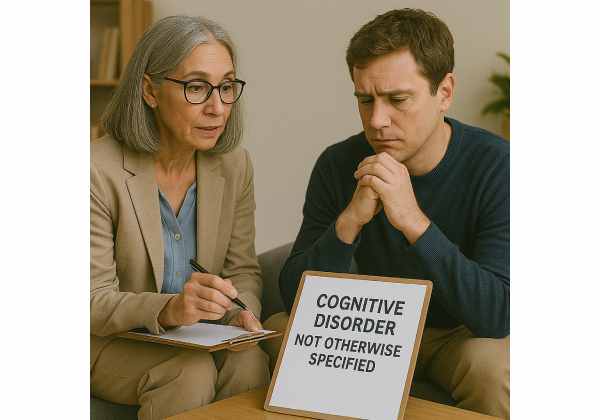
A cognitive diagnosis can feel confusing when the wording is broad, outdated, or unfamiliar. “Not otherwise specified” does not describe one single disease. It is a legacy diagnostic label that was used when a person had meaningful problems with thinking, memory, attention, language, or other cognitive abilities, but the available information did not fit neatly into a more specific diagnosis.
The most useful way to understand this label is to look beyond the name itself. The key questions are what cognitive abilities are affected, how quickly the changes appeared, whether daily functioning is affected, what medical or psychiatric conditions could explain the symptoms, and whether the pattern suggests a temporary, progressive, mixed, or uncertain cause.
Table of Contents
- What Cognitive Disorder NOS Means
- How It Fits Current Diagnostic Language
- Symptoms of Cognitive Disorder NOS
- Signs Others May Notice
- Possible Causes and Contributors
- Risk Factors for Cognitive Disorder NOS
- Diagnostic Context and Related Conditions
- Complications and Urgent Warning Signs
What Cognitive Disorder NOS Means
Cognitive Disorder Not Otherwise Specified, often shortened to Cognitive Disorder NOS, is a broad older diagnostic term for clinically significant cognitive symptoms that could not be classified more precisely at the time of evaluation. It is not a single disease, and it does not by itself identify the cause, severity, prognosis, or expected course.
In this context, “cognitive” refers to the brain functions used for thinking and everyday problem-solving. These include memory, attention, language, learning, planning, judgment, processing speed, visual-spatial skills, and social understanding. A cognitive disorder means there is a meaningful change or impairment in one or more of these areas, beyond normal variation, stress-related distraction, or ordinary forgetfulness.
“Not otherwise specified” was a diagnostic convention used when symptoms clearly belonged to a general family of conditions but did not meet the full criteria for a named disorder, or when there was not enough information to identify the exact cause. In practice, the label could appear in older medical records, neuropsychological reports, psychiatric evaluations, disability paperwork, or billing documentation.
The phrase can be used in several situations. A clinician might have used it when cognitive symptoms were real but still evolving, when a person’s symptoms were mixed, when medical information was incomplete, or when the symptoms did not line up cleanly with dementia, delirium, amnestic disorder, traumatic brain injury, substance-related cognitive impairment, or another defined condition.
That uncertainty matters. Two people with the same legacy label may have very different situations. One person may have mild attention and memory problems after a concussion. Another may have cognitive changes related to a medical illness, medication effect, depression, sleep disorder, alcohol use, early neurodegenerative disease, or several factors combined. The label is best understood as a starting point for diagnostic clarification, not as a complete explanation.
A useful interpretation depends on the pattern of symptoms. Clinicians look at whether the problem is mostly memory-based, attention-based, language-based, executive, visual-spatial, or global. They also look at timing. Sudden confusion over hours or days has a different meaning from slow decline over years. Cognitive changes that fluctuate throughout the day suggest different possibilities than changes that are steady and progressive.
The term also does not automatically mean dementia. Dementia is generally associated with cognitive decline severe enough to interfere with independent daily functioning. Some cognitive disorders are milder, temporary, secondary to another condition, or uncertain at the time they are first recognized. For that reason, the phrase should not be treated as a final answer without the clinical details behind it.
How It Fits Current Diagnostic Language
Cognitive Disorder NOS is largely a legacy term; current diagnostic language usually uses neurocognitive disorder categories and more specific cause-based descriptions when enough information is available. Modern terminology is designed to describe both the severity of cognitive impairment and the most likely underlying cause.
Older diagnostic systems grouped several conditions under cognitive disorders, including delirium, dementia, amnestic disorders, and other cognitive disorders. In newer psychiatric classification, the broader category is usually called neurocognitive disorders. This newer language separates mild neurocognitive disorder from major neurocognitive disorder and encourages clinicians to identify likely causes when possible.
Mild neurocognitive disorder generally means there is evidence of cognitive decline, but the person remains broadly independent in everyday activities, even if tasks take more effort, compensation, or reminders. Major neurocognitive disorder means the impairment is more severe and interferes with independence. This distinction is important because severity is based not only on test scores but also on real-world function.
The modern framework also tries to identify etiology, or cause. A neurocognitive disorder may be linked to Alzheimer’s disease, vascular disease, traumatic brain injury, Parkinson’s disease, Lewy body disease, frontotemporal degeneration, HIV, Huntington’s disease, substance or medication effects, multiple causes, or an unknown cause. When the cause is uncertain, current systems may use terms such as unspecified neurocognitive disorder or major or mild neurocognitive disorder due to unknown etiology.
This is why older records can be misleading if read too literally. A diagnosis written years ago as Cognitive Disorder NOS may not translate into one exact modern diagnosis. It may need to be interpreted in light of the person’s age, medical history, symptom pattern, cognitive testing, functional changes, and any later evaluations.
| Term or concept | What it usually means | Important limitation |
|---|---|---|
| Cognitive Disorder NOS | Older broad label for cognitive symptoms that did not fit a specific category | Does not identify a cause or severity by itself |
| Mild neurocognitive disorder | Cognitive decline with preserved basic independence | Still requires evidence of decline and clinical judgment |
| Major neurocognitive disorder | Cognitive decline that interferes with independent daily functioning | May have many possible causes, not only Alzheimer’s disease |
| Unspecified neurocognitive disorder | Current-style wording for cognitive symptoms when criteria or cause remain unclear | Usually needs more context to understand its meaning |
This distinction also helps separate cognitive disorder labels from normal aging. Normal aging may involve slower recall, occasional word-finding difficulty, or needing more time to learn new information. A disorder is more likely when there is a clear decline from the person’s previous level, objective impairment on examination or testing, or daily-life consequences. The difference between mild cognitive impairment and normal aging often depends on the pattern, persistence, and functional impact of the symptoms.
Symptoms of Cognitive Disorder NOS
Symptoms can vary widely because Cognitive Disorder NOS is a broad label, but they usually involve a noticeable change in one or more thinking abilities. The most important clue is not one isolated lapse; it is a pattern of cognitive difficulty that is new, persistent, worsening, unusually disruptive, or inconsistent with the person’s prior abilities.
Memory symptoms are often the most visible. A person may repeat questions, misplace important items more often, forget recent conversations, rely heavily on notes, or struggle to retain new information. In some cases, older memories remain strong while recent memory becomes less reliable. In other cases, the main issue is not storage of memory but attention, organization, or retrieval.
Attention and concentration problems may look like distractibility, losing track of conversations, difficulty following a movie or meeting, or needing to reread the same material. These symptoms can overlap with stress, anxiety, depression, ADHD, poor sleep, medication effects, and medical problems, so they are not specific on their own. Persistent recent forgetfulness becomes more concerning when it is paired with errors, functional change, or decline from baseline.
Executive function symptoms involve planning, sequencing, judgment, and flexible problem-solving. A person may struggle to manage bills, prepare a familiar recipe, organize paperwork, follow multi-step instructions, switch tasks, or make decisions that previously felt routine. Executive difficulties can be especially noticeable at work or in complex household responsibilities.
Language symptoms can include trouble finding words, naming objects, following complex speech, expressing thoughts clearly, or understanding written information. Mild word-finding problems are common and not always a sign of disease. More concerning signs include frequent pauses, vague substitutions, loss of vocabulary, difficulty understanding familiar words, or worsening communication over time.
Visual-spatial symptoms affect how a person interprets space, distance, objects, and visual relationships. They may have trouble reading maps, judging steps or curbs, parking a car, navigating familiar places, copying shapes, or locating items in plain sight. These symptoms can sometimes be mistaken for vision problems, clumsiness, or inattention.
Processing speed may also change. The person may still arrive at correct answers but need much longer than before. They may feel mentally slowed, overwhelmed by busy environments, or unable to keep up with rapid conversation. Slowed thinking can occur in neurocognitive disorders, depression, sleep deprivation, medication effects, neurological illness, and systemic medical conditions.
Some cognitive disorders also affect social cognition, behavior, or emotional regulation. A person may become less tactful, more impulsive, unusually apathetic, suspicious, irritable, emotionally flat, or less aware of others’ reactions. These changes can be especially important when they are new and out of character.
Signs Others May Notice
Cognitive changes often become clearer through everyday behavior than through self-report alone. Family members, close friends, coworkers, or caregivers may notice patterns the person does not recognize, especially when insight is reduced or symptoms develop gradually.
One common sign is a change in reliability. A person who was previously organized may miss appointments, forget obligations, leave tasks unfinished, lose track of deadlines, or make repeated mistakes in familiar routines. They may insist they completed something that was not done or seem surprised when others point out a repeated problem.
Another sign is difficulty with complex daily tasks. Managing finances, medications, transportation, cooking, home maintenance, technology, or paperwork may become unusually hard. The person may avoid tasks they used to handle, ask for more help, or become frustrated when a routine requires several steps.
Communication changes may also stand out. Others may notice repeated stories, trouble following group conversations, vague language, unusual pauses, or difficulty answering direct questions. The person may lose the thread of a conversation, respond off-topic, or have trouble explaining what they mean.
Behavioral changes can be subtle but important. A person may become more withdrawn, suspicious, impatient, disinhibited, impulsive, anxious, or apathetic. They may lose interest in hobbies, neglect personal appearance, show poor judgment with money, or become unusually vulnerable to scams. These changes may reflect cognitive impairment, mood symptoms, neurological disease, medication effects, substance use, or a combination of factors.
Work or school signs can include reduced performance, difficulty learning new systems, more errors, slower task completion, trouble adapting to change, or conflicts that arise from misunderstanding instructions. In younger adults, cognitive symptoms may be mistakenly attributed only to stress or motivation. In older adults, they may be dismissed too quickly as “just aging.”
Driving and navigation changes deserve special attention. Getting lost in familiar areas, new dents on a vehicle, confusion at intersections, delayed reactions, or difficulty judging distance can suggest visual-spatial, attention, or executive function problems. These signs do not identify a specific diagnosis, but they show that cognitive symptoms may have real-world safety implications.
Some people are fully aware that something has changed. Others have limited insight, meaning they do not recognize the extent of their impairment. Reduced insight can happen in several neurological and psychiatric conditions. It can also create tension because the person may feel criticized while others are responding to genuine changes.
Possible Causes and Contributors
Cognitive Disorder NOS can reflect many possible causes, and more than one factor may be present at the same time. The broad label is most useful when it prompts a careful look at timing, symptom pattern, medical history, medication exposure, mental health symptoms, substance use, and neurological findings.
Neurodegenerative diseases are one possible category. Alzheimer’s disease commonly affects new learning and memory early, though symptoms can vary. Lewy body disease may involve fluctuating cognition, visual hallucinations, parkinsonian movement features, and sleep-related symptoms. Frontotemporal degeneration may cause early changes in behavior, personality, language, or executive function. Parkinson’s disease, Huntington’s disease, prion diseases, and other neurological disorders can also affect cognition.
Vascular causes are another major group. Strokes, transient ischemic attacks, small-vessel disease, long-standing high blood pressure, diabetes, high cholesterol, and other cardiovascular conditions can contribute to cognitive impairment. Vascular cognitive problems may appear suddenly after a stroke, gradually through accumulated small-vessel injury, or in a mixed pattern alongside neurodegenerative disease.
Brain injury can cause cognitive symptoms that vary by severity, location, and recovery course. Attention, processing speed, memory, mood, sleep, and executive function may be affected after traumatic brain injury. Persistent symptoms after a head injury should be interpreted in context, especially when headaches, dizziness, sleep changes, emotional symptoms, or neurological signs are also present. Related patterns may appear after concussion symptoms or more severe injuries.
Medical and metabolic conditions can also affect cognition. Thyroid disease, vitamin B12 deficiency, anemia, kidney or liver disease, abnormal blood sugar, electrolyte disturbances, infections, inflammatory or autoimmune disease, seizures, and low oxygen states can all contribute to confusion or cognitive decline. Some of these problems cause broad mental slowing rather than a narrow memory disorder.
Sleep problems are often overlooked. Insomnia, circadian rhythm disruption, excessive daytime sleepiness, and obstructive sleep apnea can impair attention, memory, mood, and processing speed. Cognitive complaints related to sleep apnea symptoms may resemble depression, ADHD, or early cognitive decline.
Medication and substance effects are also important. Sedatives, some sleep medications, anticholinergic drugs, opioids, certain seizure medications, some psychiatric medications, alcohol, cannabis, intoxication, withdrawal states, and medication interactions can affect cognition. The risk may be higher in older adults, people taking multiple medications, and those with kidney or liver impairment.
Psychiatric symptoms can contribute to cognitive impairment as well. Depression can slow thinking, reduce attention, impair memory retrieval, and lower motivation. Anxiety can interfere with concentration and working memory. Trauma-related symptoms, psychosis, severe stress, and dissociation may also affect cognitive performance. These conditions can coexist with neurological disease, so the presence of mood or anxiety symptoms does not automatically rule out a neurocognitive disorder.
Risk Factors for Cognitive Disorder NOS
Risk factors raise the likelihood of cognitive impairment, but they do not prove that a person has Cognitive Disorder NOS or any specific neurocognitive condition. They are best understood as background clues that help clinicians judge probability, urgency, and differential diagnosis.
Age is one of the strongest risk factors for many cognitive disorders, especially neurodegenerative and vascular causes. Cognitive impairment can occur at any age, but progressive neurocognitive disorders become more common later in life. Younger adults with cognitive symptoms often require careful attention to head injury, sleep, mood, substances, autoimmune or inflammatory disease, seizures, medications, and medical causes.
Family history can matter, particularly for Alzheimer’s disease, frontotemporal dementia, Huntington’s disease, and some other neurological conditions. Genetics may influence risk, but most cognitive disorders are not explained by a single gene. A family history is most concerning when several relatives were affected, symptoms began unusually early, or the pattern suggests a known inherited condition.
Cardiovascular and metabolic risk factors can increase vulnerability to cognitive impairment. High blood pressure, diabetes, smoking, obesity, high cholesterol, atrial fibrillation, prior stroke, and vascular disease may affect brain health through blood vessel injury, inflammation, and reduced resilience. These risks are especially relevant when cognitive symptoms involve slowed processing, attention, executive function, or stepwise decline.
Brain injury is another risk factor. A history of moderate or severe traumatic brain injury, repeated head impacts, or neurological complications after injury can increase the chance of later cognitive symptoms. The relationship is complex, and not every person with a concussion develops a lasting cognitive disorder.
Sensory impairment can contribute to functional cognitive difficulty and may be associated with later cognitive decline. Hearing loss and vision loss can make it harder to take in information, follow conversations, navigate environments, and perform well on some cognitive tasks. Sensory problems can also increase social withdrawal and apparent confusion.
Psychiatric and social factors may add risk or complicate interpretation. Depression, chronic stress, loneliness, trauma exposure, substance use disorders, and severe sleep disruption can all affect cognitive performance. These factors can be causes, contributors, consequences, or coexisting conditions.
A history of delirium is also important. Delirium is an acute, fluctuating state of confusion and impaired attention, usually triggered by illness, surgery, medications, infection, dehydration, or another medical stressor. People with prior cognitive impairment are at higher risk of delirium, and delirium itself may be associated with later cognitive decline.
Medication burden becomes more relevant with age, frailty, and multiple health conditions. The more medications a person takes, the greater the chance of drug interactions or cognitive side effects. This does not mean medications are always the cause, but it does make them part of the diagnostic picture.
Diagnostic Context and Related Conditions
Cognitive Disorder NOS can only be understood properly through diagnostic context, not by the label alone. The surrounding evaluation usually matters more than the wording of the legacy diagnosis.
A cognitive assessment typically begins with a history of the symptoms. Important details include when the changes started, whether they were sudden or gradual, whether they fluctuate, which abilities are affected, and whether daily functioning has changed. Clinicians often compare the person’s current abilities with their previous level of education, work, language, culture, and everyday responsibilities.
Information from someone who knows the person well can be especially valuable. Cognitive symptoms may be underreported because the person has limited insight, feels embarrassed, adapts around deficits, or notices only the most frustrating moments. A close observer may describe changes in routines, judgment, communication, or safety that do not appear during a short appointment.
Screening and testing can help identify objective impairment. Brief tools may assess memory, orientation, attention, language, clock drawing, or executive tasks. More detailed neuropsychological testing can map strengths and weaknesses across several cognitive domains. This type of cognitive testing does not diagnose every cause by itself, but it can show whether the pattern is more consistent with attention problems, memory encoding difficulty, executive dysfunction, language impairment, or broader decline.
Medical evaluation often includes a review of medications, alcohol and substance use, neurological symptoms, sleep, mood, and systemic health. Clinicians may order laboratory tests to look for contributors such as thyroid disease, vitamin B12 deficiency, anemia, infection, metabolic problems, kidney or liver dysfunction, inflammatory markers, or abnormal blood sugar. The exact set of blood tests used in memory-loss workups depends on the person’s symptoms and medical background.
Brain imaging may be considered when the history suggests stroke, tumor, hydrocephalus, traumatic injury, atypical symptoms, rapid decline, focal neurological signs, or a need to assess structural brain changes. MRI is often more detailed than CT for many non-emergency cognitive questions, while CT may be used in urgent settings or when MRI is not available or appropriate.
Several related conditions can resemble or overlap with a cognitive disorder. Delirium is usually acute and fluctuating, often over hours or days, and attention is prominently affected. Depression may cause slowed thinking, low motivation, and memory complaints. Anxiety can impair concentration. ADHD is usually longstanding rather than a new decline. Sleep disorders can create brain fog and poor attention. Substance use, medication effects, seizures, and endocrine problems can all complicate the picture.
The diagnostic challenge is that these categories are not always separate. A person may have depression and early neurocognitive disease, sleep apnea and vascular risk, medication effects and mild cognitive impairment, or delirium superimposed on dementia. That is one reason a broad NOS label may appear before a more specific diagnosis becomes clear.
Complications and Urgent Warning Signs
The complications of Cognitive Disorder NOS depend on the underlying cause, severity, speed of change, and affected cognitive domains. Even mild cognitive impairment can create real consequences when it affects judgment, attention, memory, or problem-solving in everyday situations.
Functional complications may include missed bills, medication errors, unsafe cooking, driving problems, workplace mistakes, missed appointments, poor financial judgment, or difficulty managing health information. These problems may develop gradually, so they can be minimized until a serious error occurs.
Safety risks can arise when memory, attention, or judgment are impaired. A person may leave appliances on, get lost, fall more often, misunderstand instructions, take the wrong dose of medication, or become vulnerable to exploitation. Visual-spatial problems can increase risks with driving, stairs, tools, or unfamiliar environments.
Emotional and social complications are also common. Cognitive symptoms can lead to embarrassment, frustration, irritability, anxiety, depression, withdrawal, conflict with family, or loss of confidence. Others may misinterpret cognitive changes as laziness, stubbornness, carelessness, or lack of interest. The affected person may feel criticized or controlled, especially if insight is reduced.
Occupational and legal complications can occur when cognitive symptoms affect work performance, decision-making, finances, driving, or independent living. In some cases, cognitive impairment raises questions about capacity, consent, vulnerability, or the reliability of complex decisions. These concerns require careful, individualized evaluation rather than assumptions based on a label.
Progression is another possible complication, but it is not inevitable from the NOS label alone. Some cognitive symptoms improve when the contributing factor resolves. Others remain stable. Some progress to a more specific neurocognitive diagnosis over time. The expected course depends on the cause and the pattern of impairment.
Certain warning signs should be treated as time-sensitive because they may reflect delirium, stroke, seizure, infection, head injury, intoxication, withdrawal, or another urgent condition. Prompt professional evaluation is especially important when cognitive symptoms are sudden, rapidly worsening, or accompanied by neurological or medical red flags.
Urgent warning signs include:
- Sudden confusion, disorientation, or major behavior change over hours or days
- Face drooping, arm weakness, speech trouble, vision loss, severe dizziness, or new trouble walking
- New seizure, fainting, or loss of consciousness
- Confusion after a head injury
- Fever, severe headache, stiff neck, or new sensitivity to light
- New hallucinations, severe agitation, or paranoia with confusion
- Severe sleepiness, inability to stay awake, or marked fluctuation in alertness
- Suspected overdose, intoxication, or withdrawal
- Suicidal thoughts, violent thoughts, or inability to maintain basic safety
These signs do not mean the person has one specific disorder, but they do mean the situation should not be dismissed as ordinary forgetfulness. For symptoms that may require emergency-level attention, an overview of ER-level mental health or neurological symptoms can help clarify why sudden cognitive or behavioral changes are handled differently from gradual memory concerns.
References
- DSM-5-TR Update: Supplement to the Diagnostic and Statistical Manual of Mental Disorders, Fifth Edition, Text Revision 2022 (Diagnostic Manual Update)
- Clinical descriptions and diagnostic requirements for ICD-11 mental, behavioural and neurodevelopmental disorders 2024 (Diagnostic Manual)
- Alzheimer’s Association clinical practice guideline for the Diagnostic Evaluation, Testing, Counseling, and Disclosure of Suspected Alzheimer’s Disease and Related Disorders (DETeCD-ADRD): Executive summary of recommendations for primary care 2025 (Guideline)
- The Alzheimer’s Association clinical practice guideline for the diagnostic evaluation, testing, counseling, and disclosure of suspected Alzheimer’s disease and related disorders (DETeCD-ADRD): Validated clinical assessment instruments 2025 (Guideline)
- Dementia prevention, intervention, and care: 2024 report of the Lancet standing Commission 2024 (Commission Report)
- Delirium: prevention, diagnosis and management in hospital and long-term care 2023 (Guideline)
Disclaimer
This article is for general educational purposes only and is not a substitute for professional medical advice, diagnosis, or treatment. Cognitive symptoms can have many possible causes, including urgent medical conditions, so personal concerns should be discussed with a qualified health professional.
Thank you for taking the time to read about this complex topic; sharing it may help someone recognize why cognitive changes deserve careful, compassionate evaluation.





