A reactive scalp can turn everyday routines—washing, conditioning, coloring—into a cycle of burning, itching, and flakes that never quite settle. Contact dermatitis is one of the most common reasons this happens. It is not a single diagnosis but a pattern of skin inflammation triggered by something that touches the scalp: hair dye ingredients, fragrance, preservatives, surfactants, and even “clean” botanical extracts. The challenge is that scalp contact dermatitis often looks like dandruff, eczema, or psoriasis, so people keep switching products and accidentally re-triggering the same reaction.
The advantage of getting the pattern right is immediate: you can identify the likely trigger category, calm the flare without damaging the skin barrier further, and take smart steps toward a longer-term fix—often with patch testing and targeted avoidance rather than endless trial and error. This guide explains how scalp contact dermatitis presents, why hair dye allergy behaves differently than simple irritation, and what to do when your scalp reacts so you can return to a routine that feels predictable again.
Key Takeaways
- Scalp contact dermatitis can cause itching, burning, redness, scaling, and sometimes hair shedding, especially when triggers are repeatedly reintroduced.
- Hair dye reactions are often driven by specific sensitizers and can worsen with each exposure once an allergy develops.
- Severe swelling, blistering, eye involvement, or rapidly worsening pain should be treated as urgent until evaluated.
- The most effective “application” step is to stop the trigger and simplify to a short, gentle routine for 10–14 days while inflammation settles.
Table of Contents
- How scalp contact dermatitis presents
- Hair dye allergy and common sensitizers
- Everyday product reactions and irritant triggers
- Diagnosis and patch testing what to expect
- What to do during a flare
- Prevention and safer routine strategies
How scalp contact dermatitis presents
Scalp contact dermatitis is inflammation caused by something that touches the scalp. It comes in two main forms, and the difference matters because the timeline and strategy are not identical.
Allergic contact dermatitis is an immune reaction (delayed hypersensitivity). Once you become sensitized to an ingredient, even small exposures can trigger a flare. Symptoms often peak 24–72 hours after contact, though the scalp can sometimes react sooner because hair products sit on the skin under heat, occlusion, and friction.
Irritant contact dermatitis is direct barrier injury. It can happen to anyone if the product is harsh enough, left on too long, layered with other actives, or applied to already compromised skin. Symptoms often start minutes to hours after exposure and may feel more like stinging or burning than itch.
Common scalp symptoms
People describe scalp contact dermatitis in surprisingly consistent ways:
- Itch that feels deep, persistent, and hard to ignore
- Burning, tightness, or soreness that worsens after washing or styling
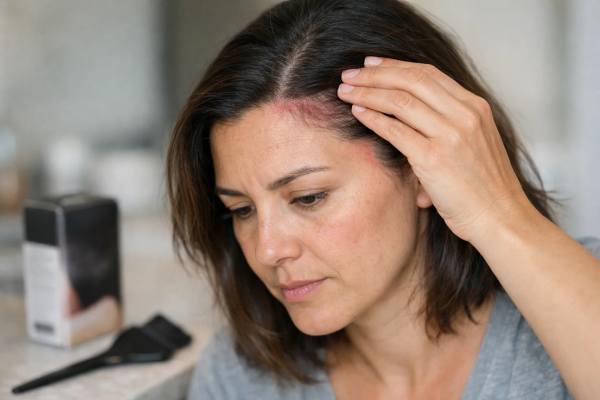
- Red patches, swelling at the hairline or behind the ears, and “hot spots” where product collects
- Flaking that can be dry and powdery or greasy and adherent
- Oozing, crusting, or tiny blisters in more intense reactions
- Tenderness when brushing or parting hair, sometimes with swollen lymph nodes behind the ears in severe flares
Because hair hides redness and blisters, the scalp can look “mostly fine” while symptoms feel intense. Many people only notice the full extent when they part hair in bright light or when the rash spreads to the ears, neck, eyelids, or sides of the face—areas where product runoff is common.
Why scalp dermatitis is often misread
Scalp contact dermatitis overlaps with dandruff and eczema, and it can coexist with them. A clue that contact dermatitis is playing a role is a flare that follows a change: new dye, new shampoo, a “natural” oil blend, a leave-in, a fragrance swap, or a new anti-dandruff active. Another clue is distribution: symptoms along the hairline, behind the ears, at the nape, or exactly where you apply a product.
If you are sorting through causes of itch beyond dermatitis alone, itchy scalp causes and when to worry can help you spot patterns that deserve faster evaluation.
Hair dye allergy and common sensitizers
Hair dye is one of the most frequent triggers of allergic contact dermatitis affecting the scalp, hairline, ears, and face. The reason is not simply that dye is “strong.” Permanent and some semi-permanent dyes rely on small reactive molecules that penetrate and bind—great for long-lasting color, but also more likely to sensitize the immune system.
How hair dye allergy typically shows up
A classic allergic pattern is delayed and expanding:
- Itching and burning that begins later the same day or the next day
- Redness and swelling at the hairline, temples, and ears
- Puffy eyelids or facial swelling (even though dye was “only on hair”)
- Crusting or weeping behind the ears or at the nape
- A rash that can spread beyond the scalp to the neck and upper face
Many people say, “I used this brand for years.” That history does not rule out allergy—sensitization can develop after repeated exposure, and once it develops, reactions can escalate with each re-exposure.
High-impact dye allergens and cross-reaction traps
Common sensitizers in oxidative (permanent) dyes include:
- p-phenylenediamine (PPD) and related aromatic amines
- toluene-2,5-diamine (PTD) and similar dye intermediates
- resorcinol, aminophenols, and other developer-dependent components
- persulfates in bleaching or highlighting systems that may accompany coloring
Cross-reactions are a major reason people struggle to “find a safe alternative.” If you are allergic to one aromatic amine, you may react to chemically related compounds in different shades or brands. “Black henna” is a frequent pitfall: it is often not pure henna and may contain PPD-like additives that can sensitize aggressively. Dark brow and lash tints can pose similar risks.
Why a consumer self-test can mislead
Many dye kits recommend an at-home spot test. These tests are not standardized in dose, timing, or skin site, and they can be falsely reassuring. They can also trigger sensitization or cause a reaction that is harder to interpret. A clinician-directed patch test is safer and more informative when hair dye allergy is suspected.
What not to do after a suspected dye allergy
- Do not re-dye “to confirm” if your last reaction involved swelling, blistering, or facial involvement.
- Do not assume “ammonia-free” means allergy-safe; the immune trigger is usually the dye intermediate, not the marketing claim.
- Do not move directly from permanent dye to bleaching as a workaround without guidance—bleach systems can cause their own reactions and scalp injury.
If a dye reaction caused intense burning and blistering during processing, it may be more than dermatitis. In that scenario, chemical burns from hair products and what to do immediately can help you recognize urgent patterns.
Everyday product reactions and irritant triggers
Not all scalp reactions come from dye. Many people with “mystery dandruff” or chronic itch are reacting to rinse-off and leave-on products—sometimes due to allergy, sometimes due to cumulative irritation that chips away at the scalp barrier.
Common allergen categories in hair care
Scalp allergic contact dermatitis is often driven by ingredients that are not obvious from the front label. Frequent categories include:
- Fragrance (including essential oils and fragrance blends)
- Preservatives (notably isothiazolinones such as methylisothiazolinone in some product types, and other preservative families)
- Surfactants and co-surfactants that can be allergenic in some people (for example, certain betaines or amines used for cleansing and conditioning feel)
- Acrylates and resins found in styling products, sprays, and some hair systems
- Botanical extracts that are “natural” but still biologically active and capable of sensitization
A practical clue is a reaction that worsens with a leave-on product: scalp serums, oils, dry shampoo, edge control, gels, and sprays. Leave-ons increase contact time and can concentrate allergens at the hairline and crown.
If you suspect fragrance is driving itch, stinging, or persistent flaking, fragrance allergy and itchy scalp ingredients can help you identify common fragrance markers and how they hide in ingredient lists.
Irritant dermatitis from overdoing actives
Irritant reactions are extremely common and often accidental. Typical triggers include:
- Frequent use of strong anti-dandruff shampoos without a recovery wash
- Layering exfoliating acids, scrubs, and “detox” products on the scalp
- Hot water washing and aggressive scrubbing with nails or stiff scalp brushes
- Alcohol-heavy styling products that sting on compromised skin
- Leaving products on longer than directed or using higher-frequency routines than the scalp can tolerate
Irritant dermatitis often feels like burning and tightness more than classic itch. The scalp may look shiny, tender, and inflamed, then flake as it heals. People often misread this flaking as “still dandruff” and intensify treatments, which keeps the cycle going.
Why product buildup can masquerade as dermatitis
Buildup is not the same as dermatitis, but it can contribute. Heavy styling products can trap irritants against skin, increase friction, and encourage scratching. If you notice flaking that improves dramatically after a single thorough cleanse and better rinsing habits, buildup may be amplifying symptoms—but an underlying allergy can still be present.
The important takeaway is that “everyday” products can still be high-impact when used frequently, layered, or applied to a scalp that is already inflamed. Your goal is to identify whether you are dealing with a true immune allergy, a barrier injury pattern, or both—because the long-term solution differs.
Diagnosis and patch testing what to expect
A reliable diagnosis prevents months of product cycling. For scalp contact dermatitis, the most useful tool is patch testing, which identifies delayed hypersensitivity to specific allergens. The scalp can be tricky because standard patch test series do not always include the exact ingredients found in a person’s routine, and many scalp allergens are in “secondary” categories like fragrance components, preservatives, or specialized surfactants.
What a good evaluation includes
Clinicians typically start with pattern recognition:
- Timing: did symptoms start minutes after use (irritant) or peak days later (allergic)?
- Distribution: hairline, behind ears, neck, eyelids, crown, or diffuse?
- Exposures: dye, bleach, relaxers, scalp serums, dry shampoo, hair sprays, and any new products in the last 1–3 months
- Skin context: eczema history, sensitive skin, recent sunburn, scratching, or scalp scaling that weakened the barrier
They may also look at the scalp with magnification to assess inflammation, scale type, and whether scratching is contributing to breakage.
Patch testing in plain language
Patch testing is not the same as a prick test and does not diagnose immediate anaphylaxis risk. Small amounts of allergens are applied to the skin (usually the back) under occlusion, then read over several days. The goal is to see whether the immune system generates a delayed inflammatory reaction to specific substances.
Practical points people appreciate knowing:
- Testing often uses a baseline series plus add-ons based on your exposures.
- Your clinician may request your personal products so they can test “as is” or in diluted form when appropriate.
- Results are interpreted for relevance: a positive test matters most if the allergen is actually in your routine.
Why scalp cases often need targeted testing
Scalp allergic contact dermatitis is frequently missed when only a standard screening series is used. Hair products contain many unique ingredients, and the actual culprit may be absent from a basic panel. That is why “bring your products” is not a throwaway instruction—it can be the difference between a negative test and an actionable diagnosis.
What to do while waiting for testing
If you are flaring now, focus on stabilizing the scalp first: simplify products, avoid dye and leave-ons, and reduce scratching. Patch testing is best interpreted when the skin is calm enough that background inflammation does not confuse results.
For a structured way to patch-test personal products and avoid common mistakes with home “trialing,” patch testing hair dye and scalp products can help you understand what clinicians mean by safe, staged testing.
What to do during a flare
When your scalp is actively reacting, the goal is to stop exposure, reduce inflammation, and protect the barrier. The most common misstep is adding more actives—more acids, more dandruff shampoo, more oils—because flaking looks worse. In contact dermatitis, that usually prolongs the flare.
Step 1: remove the trigger and rinse thoroughly
If you suspect a product triggered the flare, stop it immediately. Rinse the scalp with cool to lukewarm water and use a gentle cleanser once if residue remains. Be meticulous around the hairline, behind the ears, and the nape, where products pool.
If symptoms began during a chemical service (dye, bleach, relaxer) and include intense burning or blistering, treat it as potentially urgent and avoid “neutralizing” with home remedies.
Step 2: simplify to a short calm routine for 10–14 days
During the recovery window, use:
- A mild, fragrance-minimized cleanser as needed
- Conditioner only on lengths if it does not sting
- No leave-on scalp oils, essential oils, or fragranced sprays
- No exfoliating acids, scrubs, or “detox” products
For itch, cool compresses for 5–10 minutes can reduce the urge to scratch. Keeping nails short and using fingertip pads (not nails) if you must touch the scalp helps prevent secondary injury.
Step 3: reduce inflammation safely
For many people, short courses of anti-inflammatory treatment are what finally break the cycle. Clinicians commonly use topical corticosteroid solutions, foams, or lotions for scalp inflammation, chosen based on severity and location. If the rash extends to eyelids or face, the treatment approach changes because that skin is thinner and more sensitive.
Avoid self-treating severe flares with random over-the-counter steroid creams on the scalp without guidance, especially if there is oozing, crusting, or possible infection. Incorrect use can worsen certain infections and delay healing.
Step 4: watch for infection and escalation
Contact dermatitis can crack the barrier, making infection more likely—especially when scratching is intense. Seek medical care sooner if you develop:
- rapidly increasing pain, warmth, or swelling
- pus, honey-colored crusting, foul odor, or fever
- swollen lymph nodes behind the ears with worsening scalp tenderness
- widespread rash beyond scalp and hairline
Hair shedding during flares
Inflammation and stress can trigger temporary shedding, and intense scratching can also break hairs. Try not to interpret short-term shedding as permanent loss. Once the scalp calms, follicles often recover, but it may take several months for density to look normal again.
The key is restraint: during a flare, the most effective routine is usually the simplest one that keeps the scalp clean and calm.
Prevention and safer routine strategies
Preventing scalp contact dermatitis is less about finding a single “hypoallergenic” product and more about controlling exposure and building a routine that respects your barrier. Once the scalp becomes reactive, even previously tolerated products can sting during recovery—so prevention often starts with pacing.
Build a low-reactivity baseline routine
A helpful baseline includes:
- One gentle cleanser that does not sting
- One conditioner you apply to lengths only
- One styling product you can tolerate, used away from the scalp when possible
Then add new items one at a time, spaced several days apart, so you can identify what truly changes symptoms. This is especially important for scalp serums and “growth” products, which are often fragrance-heavy and left on for long periods.
Supporting the barrier matters. Ingredients that reduce dryness and friction (without heavy fragrance) can make the scalp more resilient over time; ceramides and scalp barrier dryness explains why barrier support can reduce reactivity in some people.
Safer strategies for people who color their hair
If hair dye allergy is suspected or confirmed, “safer” usually means avoidance of the specific allergen family, not a generic switch. Practical approaches to discuss with a clinician or experienced colorist include:
- Using non-oxidative options when feasible (for example, certain temporary color techniques that do not rely on the same intermediates)
- Keeping dye off the scalp whenever possible (technique and placement matter)
- Avoiding “black henna” and unregulated dyes
- Wearing nitrile gloves for any handling of dye products, even at home
- Treating patch testing results as a map: it helps you avoid not only the main allergen but common cross-reactors
Reduce irritant load
Even without an allergy, many scalps react to excessive intensity. A prevention checklist that works well in real life:
- Wash with lukewarm water and avoid aggressive scrubbing
- Limit scalp exfoliation to occasional, gentle use if truly needed
- Rinse thoroughly—product residue is an underrated trigger
- Avoid frequent tight hairstyles during itchy phases to reduce friction and scratching
- Treat flares early, before scratching becomes the main driver of damage
Know your red flags
Prevention is also recognizing when self-management is no longer appropriate. If reactions include facial swelling, blistering, eye involvement, or rapidly worsening pain, seek medical care and bring the product ingredient list. Severe reactions should not be “tested” again.
Over time, many people achieve stability not by finding the perfect product, but by learning their trigger categories, keeping a calm baseline routine, and using targeted testing to remove guesswork. That combination is what turns an unpredictable scalp into a manageable one.
References
- Allergic contact dermatitis of the scalp: a review of an underdiagnosed entity 2024 (Review)
- Hair Product Allergy: A Review of Epidemiology and Management 2024 (Review)
- North American Contact Dermatitis Group Patch Test Results: 2021-2022 2025 (Epidemiology and Patch Test Data)
- Hair Dyes Sensitization and Cross-Reactions: Challenges and Solutions: A Systematic Review of Hair Dye Allergens’ Prevalence 2024 (Systematic Review)
Disclaimer
This article is for educational purposes only and does not provide medical advice, diagnosis, or treatment. Scalp rashes can result from allergic contact dermatitis, irritant dermatitis, seborrheic dermatitis, psoriasis, infections, and other conditions that may require different care. Seek urgent medical attention for eye exposure to chemicals, trouble breathing, widespread hives, severe facial swelling, blistering, rapidly worsening pain, fever, or signs of infection. Do not intentionally re-expose yourself to a suspected allergen to “confirm” a reaction. For persistent or recurrent scalp symptoms, consult a qualified clinician—often a dermatologist or allergist—for evaluation and appropriate testing.
If this guide helped you make sense of scalp reactions, consider sharing it on Facebook, X (formerly Twitter), or your preferred platforms so others can recognize triggers earlier and avoid repeated flares.