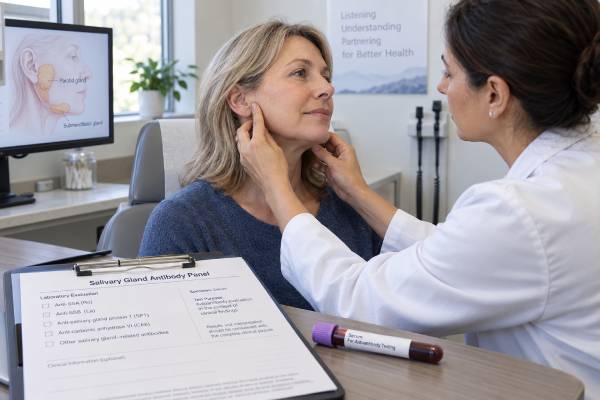
An early Sjögren syndrome antibody panel usually refers to blood tests for antibodies against salivary gland protein 1 (SP1), carbonic anhydrase 6 (CA6), and parotid secretory protein (PSP). These markers were proposed as a way to detect Sjögren disease before the better-established anti-SSA/Ro antibody appears, especially in people with dry eyes or dry mouth who are SSA-negative. Some commercial panels measure IgG, IgA, and IgM versions of all three antibodies.
The name “early Sjögren panel” can sound more definitive than the evidence supports. Research has produced inconsistent results, and a recent independent outpatient study found poor ability of the serum markers to distinguish Sjögren disease from healthy controls, nonspecific salivary inflammation, or other autoimmune rheumatic diseases. SP1, CA6, and PSP are not included in the 2016 ACR/EULAR classification criteria. A positive result therefore does not establish early Sjögren disease, while a negative result does not rule it out. Diagnosis still depends on the full clinical picture and objective evaluation of tear production, eye-surface damage, salivary flow, salivary glands, and sometimes minor salivary gland biopsy.
- SP1, CA6, and PSP antibodies are investigational or adjunctive markers, not accepted stand-alone diagnostic tests.
- Anti-SSA/Ro and minor salivary gland biopsy remain the highest-weighted classification items.
- Dryness can result from medications, aging, eye disease, dehydration, diabetes, sleep disorders, and many other causes.
- Seronegative Sjögren disease is possible and requires objective gland-focused evaluation.
- Treatment should be based on symptoms and confirmed organ involvement, not an “early antibody” result alone.
Table of Contents
- What the early Sjögren panel measures
- What the evidence shows for SP1, CA6, and PSP
- How standard Sjögren evaluation works
- How SSA-negative Sjögren disease is investigated
- Other causes of dry eyes and dry mouth
- How to interpret positive, negative, and mixed results
- Practical next steps and monitoring
What the Early Sjögren Panel Measures
Sjögren disease is an autoimmune condition in which immune activity targets exocrine glands, especially the lacrimal glands that produce tears and the salivary glands that produce saliva. It can also affect joints, nerves, lungs, kidneys, blood cells, skin, and other organs. The best-known blood marker is anti-SSA/Ro, but not every person with Sjögren disease has that antibody.
The search for earlier or additional biomarkers led researchers to three tissue-associated targets:
- Salivary gland protein 1 (SP1): a protein expressed in salivary and lacrimal tissues.
- Carbonic anhydrase 6 (CA6): an enzyme secreted in saliva and tears that contributes to local chemical balance.
- Parotid secretory protein (PSP): a protein associated with salivary gland secretion and innate defense.
The markers were first identified through animal-model work and then studied in human cohorts. The biological idea is plausible: immune reactivity against gland-associated proteins might emerge during localized gland injury, before a broader systemic antibody profile becomes evident. Some early reports found these antibodies in people with lower salivary-gland biopsy focus scores or without anti-SSA/Ro and anti-SSB/La.
Commercial panels may report IgG, IgA, and IgM antibodies to each target, producing as many as nine individual results. That creates an interpretation challenge. A panel can be called positive because of one weak IgM value, several immunoglobulin classes to one antigen, or antibodies to multiple antigens. Laboratories may use different cutoffs and assay designs, and the clinical meaning of each combination has not been standardized.
The word early can refer to several different situations:
- Symptoms began recently.
- Objective gland damage is mild.
- Anti-SSA/Ro is absent.
- A person has dryness but does not meet classification criteria.
- Disease is suspected before systemic complications appear.
Those situations are not interchangeable. A person can have years of dryness with little structural gland damage, or significant gland inflammation before recognizing symptoms. Anti-SSA/Ro can be present before diagnosis, and some established cases remain SSA-negative. An early-panel result cannot accurately date disease onset.
The test is best viewed as a proposed biomarker panel rather than a definitive shortcut around the usual Sjögren antibody and diagnostic evaluation.
What the Evidence Shows for SP1, CA6, and PSP
Studies of SP1, CA6, and PSP have not reached one consistent conclusion. Small or selected cohorts have reported that one or more markers may occur in Sjögren disease, including in some patients who lack traditional antibodies. Other studies have found the same markers in people with non-Sjögren dry eye, other autoimmune diseases, nonspecific chronic salivary inflammation, or no defined autoimmune illness.
This difference matters because a diagnostic marker needs more than biological association. It should reliably separate people with the disease from people who resemble them clinically but have another cause. Its performance should remain useful across independent populations, laboratories, age groups, and assay platforms.
A 2025 rheumatology outpatient study directly addressed that question. It included people with confirmed Sjögren disease, lupus, rheumatoid arthritis, systemic sclerosis, nonspecific chronic sialadenitis, and controls. Serum positivity for one or more of the novel antibodies did not differ meaningfully across the groups. The markers showed poor discrimination between Sjögren disease and chronic sialadenitis or controls, leading the authors to conclude that the serum panel was unlikely to be useful as a diagnostic test in that setting.
Pediatric data also illustrate the limitation. In a cohort evaluating children with suspected or diagnosed juvenile Sjögren disease, the combined early antibodies had low specificity. A test with low specificity produces many positives among people who do not have the target disease, which can be especially problematic when the condition is uncommon.
Other publications remain more favorable. Some have reported greater frequency of tissue-specific antibodies in selected Sjögren cohorts or suggested a role in anti-SSA-negative disease. A 2025 study reported diagnostic associations and possible differences among immunoglobulin classes. These findings keep the markers scientifically interesting, but they do not erase the need for independent replication and standardized thresholds.
Several factors can explain conflicting results:
- Different reference standards: one study may define Sjögren disease by classification criteria, another by clinician diagnosis, and another by symptoms or biopsy.
- Spectrum of participants: comparing established Sjögren disease with healthy volunteers often makes a test look better than comparing it with medication-related dryness, nonspecific sialadenitis, lupus, or rheumatoid arthritis.
- Small sample sizes: estimates of sensitivity and specificity become unstable.
- Assay variation: antigen preparation, immunoglobulin class, cutoff, and platform influence positivity.
- Selection and commercial conflicts: some early studies involved assay developers or highly selected samples, making independent validation particularly important.
- Multiple-result effect: measuring nine antibody-class combinations increases the opportunity for at least one weak positive.
The balanced conclusion is not that SP1, CA6, and PSP have no biological relevance. It is that current evidence does not support using them alone to diagnose “early Sjögren syndrome,” exclude the disease, predict progression, or decide on systemic treatment. Major classification criteria and current clinical guidance continue to emphasize anti-SSA/Ro, objective ocular and salivary tests, and salivary gland histopathology rather than this panel.
How Standard Sjögren Evaluation Works
Sjögren disease is evaluated by assembling evidence from several domains. Symptoms begin the investigation, but objective testing is needed because the sensation of dryness does not always match measured gland function.
The 2016 ACR/EULAR classification criteria use five weighted items:
| Item | Weight in the criteria | What it contributes |
|---|---|---|
| Anti-SSA/Ro positive | 3 points | Evidence of a characteristic systemic autoimmune response |
| Minor salivary gland biopsy focus score at least 1 focus per 4 mm² | 3 points | Evidence of focal lymphocytic sialadenitis in gland tissue |
| Ocular staining score at or above the specified threshold | 1 point | Objective eye-surface injury from tear-film dysfunction |
| Schirmer test at or below 5 mm in 5 minutes | 1 point | Reduced tear production |
| Unstimulated whole salivary flow at or below 0.1 mL per minute | 1 point | Reduced saliva production |
A total score of four or more classifies primary Sjögren disease in an appropriate patient after exclusions are considered. Anti-SSA/Ro and a qualifying biopsy carry the greatest weight. SP1, CA6, PSP, isolated anti-SSB/La, ANA, and rheumatoid factor are not scoring items in these criteria.
Classification criteria are designed for consistency in research and are not identical to clinical diagnosis. A clinician may diagnose disease in someone who does not yet meet the threshold, or decide that a person who reaches it has an exclusion or a better explanation. Still, the criteria show which findings have the strongest validation.
A full evaluation may include:
- detailed review of eye and mouth symptoms, duration, medications, dental problems, gland swelling, fatigue, pain, neuropathy, rashes, cough, and systemic symptoms;
- anti-SSA/Ro testing, with attention to whether Ro60 and Ro52 are reported separately;
- ANA, anti-SSB/La, rheumatoid factor, immunoglobulins, blood count, kidney and liver tests, urinalysis, and complement when clinically relevant;
- examination by an eye specialist using validated tear and surface-staining methods;
- measured unstimulated salivary flow;
- salivary gland ultrasound in centers with appropriate expertise;
- minor salivary gland biopsy when the result is likely to resolve uncertainty.
The purpose is not to accumulate every possible test. It is to document whether autoimmune gland disease is present and whether systemic organs are involved.
How SSA-Negative Sjögren Disease Is Investigated
A negative anti-SSA/Ro result does not end the evaluation when the clinical picture is convincing. Some people with Sjögren disease are seronegative for SSA, and they may require more emphasis on objective gland testing and histopathology.
The first step is to confirm what “SSA-negative” means. Assays differ in their detection of Ro60 and Ro52. ANA by indirect immunofluorescence can occasionally be negative even when a specific anti-Ro assay is positive, and the reverse can occur. Repeating the same broad panel many times is usually less informative than reviewing the method and ordering a well-validated specific assay if needed.
Next, clinicians look for objective evidence:
Eye testing
The Schirmer test measures tear production but can vary with environment, technique, medication, and reflex tearing. Ocular surface staining evaluates damage to the cornea and conjunctiva and may provide complementary information. Dry-eye specialists can distinguish aqueous-deficient dry eye from evaporative disease related to meibomian gland dysfunction, eyelid problems, contact lenses, or environmental exposure.
Salivary testing
Unstimulated whole salivary flow is simple but requires standardized collection. Dental decay, oral yeast infection, difficulty eating dry food, and recurrent gland swelling add clinical context. Salivary gland ultrasound can show inhomogeneity and structural change in major glands, although methods and operator training matter and ultrasound is not currently one of the five formal 2016 criteria items.
Minor salivary gland biopsy
A lip biopsy can be especially valuable in an SSA-negative patient. The pathologist looks for focal lymphocytic sialadenitis and calculates a focus score. Sample size, gland quality, sectioning, and pathology expertise affect accuracy. Nonspecific chronic sialadenitis, age-related change, smoking, medication effects, and other conditions can complicate interpretation. The procedure should be used when the expected diagnostic value outweighs discomfort, numbness risk, and the possibility of an indeterminate sample.
The early antibody panel does not replace these steps. A positive SP1, CA6, or PSP result may encourage a clinician to review the case carefully, but it cannot convert subjective dryness into confirmed autoimmune gland disease. Likewise, a negative early panel should not block biopsy or objective testing when signs are persuasive.
Other Causes of Dry Eyes and Dry Mouth
Dryness is common, while Sjögren disease is only one possible cause. A careful differential diagnosis protects people from both missed autoimmune disease and an incorrect lifelong label.
Medication is a frequent contributor. Antihistamines, anticholinergic drugs, some antidepressants, bladder medications, sleep aids, muscle relaxants, decongestants, opioids, and other agents can reduce tear or saliva production. The combined effect of several medications may be greater than any single drug. Medication changes should be made with the prescribing clinician, not stopped abruptly because of a laboratory result.
Common eye-related alternatives include meibomian gland dysfunction, blepharitis, prior eye surgery, contact-lens use, prolonged screen exposure, low-humidity environments, incomplete eyelid closure, and allergic eye disease. Mouth dryness may result from dehydration, mouth breathing, sleep apnea, anxiety, diabetes, radiation to the head or neck, salivary duct disease, chronic infection, or neurologic conditions.
Other systemic disorders can resemble Sjögren disease or cause salivary gland abnormalities. Examples include hepatitis C, HIV, sarcoidosis, IgG4-related disease, graft-versus-host disease, lymphoma, amyloidosis, and medication-induced sicca. The 2016 criteria specify exclusions because some conditions can create similar symptoms, biopsy findings, or gland enlargement.
Age and hormonal changes can influence mucosal symptoms, but persistent dryness should not be dismissed as normal aging when there are recurrent dental cavities, inability to eat without liquids, severe eye injury, parotid enlargement, neuropathy, inflammatory arthritis, purpura, low blood counts, or other systemic findings.
An early-panel positive result is particularly vulnerable to misinterpretation in this setting. If the pretest probability of Sjögren disease is low and a common non-autoimmune cause explains the symptoms, a weak isolated antibody has a low positive predictive value. The diagnosis should move forward only when independent evidence supports it.
How to Interpret Positive, Negative, and Mixed Results
The report should be read at the level of each antigen and immunoglobulin class, not just the summary word “positive.” Interpretation begins with five questions: Why was the test ordered? Which assay was used? How far above the cutoff is the result? Are established Sjögren markers present? Do objective gland tests support autoimmune disease?
One weak positive marker
An isolated weak IgM, IgA, or IgG result may be nonspecific. It should not be treated as proof of early disease. The clinician may review assay reliability, repeat an established test if there is a technical concern, or proceed to objective eye and salivary evaluation based on symptoms—not simply repeat the novel panel until it changes.
Multiple novel antibodies positive
Several positives may appear more compelling, but a larger number does not overcome poor validation. Multiple results could reflect true gland-directed autoimmunity, broad immune activation, cross-reactivity, or a low assay threshold. The finding becomes more meaningful only when it aligns with reduced tear or salivary production, characteristic staining, ultrasound abnormalities, biopsy, or systemic features.
Novel antibodies positive, SSA negative
This is the situation the panel is marketed to address. The appropriate conclusion is “Sjögren disease remains possible,” not “early Sjögren is confirmed.” A structured seronegative evaluation is required. Anti-SSB/La alone also has limited diagnostic value when SSA is absent and is not an independent 2016 classification item.
Novel antibodies positive, SSA positive
Anti-SSA/Ro carries much stronger established diagnostic weight. SP1, CA6, or PSP generally does not change the core diagnosis or create a validated activity score. It should not be used to estimate gland damage, lymphoma risk, pregnancy risk, or treatment response unless future evidence establishes such roles.
All early antibodies negative
A negative result cannot exclude Sjögren disease because sensitivity is inadequate and the markers are not present in all cases. Objective testing remains appropriate when symptoms or systemic findings are convincing.
Borderline or changing results
There is no validated rule that conversion from IgM to IgG proves progression, or that falling levels demonstrate treatment success. Serial measurement is not an established monitoring strategy. Clinical symptoms, dental and ocular health, gland function, and systemic-organ markers are more useful.
Practical Next Steps and Monitoring
After an early Sjögren panel, the next step should address the unresolved clinical question rather than the antibody itself.
For prominent eye symptoms, formal ophthalmic evaluation can document tear deficiency, surface damage, eyelid or meibomian disease, and the need for protective treatment. Severe pain, light sensitivity, reduced vision, or a red eye requires prompt assessment because corneal injury or infection can threaten sight.
For mouth symptoms, measured salivary flow, oral examination, and preventive dental care are important. Fluoride strategies, regular dental review, saliva-support measures, and treatment of candidiasis can prevent complications even while the diagnosis remains uncertain. Persistent unilateral gland swelling, a firm mass, enlarged lymph nodes, unexplained weight loss, fever, or night sweats warrants prompt evaluation rather than attribution to “early Sjögren.”
Rheumatology assessment is particularly useful when dryness occurs with objective inflammatory or systemic findings, such as:
- recurrent salivary gland enlargement;
- inflammatory joint swelling;
- purpura or vasculitic skin lesions;
- unexplained neuropathy;
- persistent low blood counts;
- kidney tubular abnormalities;
- chronic cough, breathlessness, or abnormal lung imaging;
- high immunoglobulins, low complement, cryoglobulins, or monoclonal proteins.
Monitoring for confirmed Sjögren disease is tailored to phenotype. Some people mainly need eye, mouth, and dental care. Others require surveillance of lungs, kidneys, nerves, blood counts, immunoglobulins, complement, or lymphoma warning signs. Novel salivary gland antibodies do not determine that schedule.
A useful conversation with the ordering clinician includes these questions:
- Is this assay accepted by the specialist who will interpret it?
- What were the exact SP1, CA6, and PSP results and immunoglobulin classes?
- Were anti-SSA/Ro, ANA, anti-SSB/La, rheumatoid factor, and immunoglobulins tested with validated methods?
- Have tear production, ocular staining, and salivary flow been measured objectively?
- Would salivary gland ultrasound or minor salivary gland biopsy change management?
- Which alternative causes of dryness have been reviewed?
The current evidence supports a cautious role for the early Sjögren antibody panel. It may generate a hypothesis in a difficult case, but it cannot confirm early disease, replace anti-SSA/Ro or biopsy, or justify immunosuppressive treatment by itself. The most reliable path is a symptom-led, objective, multidisciplinary evaluation that protects the eyes and mouth while determining whether systemic autoimmune disease is truly present.
References
- Diagnostic Use of Testing for Novel Murine Autoantibodies for Sjögren Disease in the Rheumatology Outpatient Setting (2025), Arthritis Care & Research.
- British Society for Rheumatology guideline on management of adult and juvenile onset Sjögren disease (2025), Rheumatology.
- Not all autoantibodies are clinically relevant. Classic and novel autoantibodies in Sjögren’s syndrome: A critical review (2022), Frontiers in Immunology.
- The Diagnostic Performance of Early Sjögren’s Syndrome Autoantibodies in Juvenile Sjögren’s Syndrome: The University of Florida Pediatric Cohort Study (2021), Frontiers in Immunology.
- 2016 American College of Rheumatology/European League Against Rheumatism Classification Criteria for Primary Sjögren’s Syndrome (2017), Arthritis & Rheumatology.
- Weight of salivary gland ultrasonography compared to other items of the 2016 ACR/EULAR classification criteria for Primary Sjögren’s syndrome (2020), Journal of Internal Medicine.
Disclaimer
This article is for general education and does not diagnose or exclude Sjögren disease. SP1, CA6, and PSP assay methods and cutoffs vary, and results should be interpreted by clinicians alongside validated antibody tests, objective eye and salivary measurements, examination, and biopsy when appropriate. Seek prompt care for vision change, severe eye pain, breathing difficulty, neurologic symptoms, or persistent firm salivary gland enlargement.