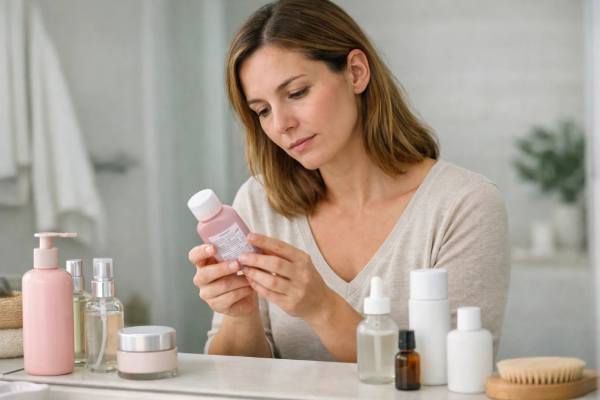
A face cream, shampoo, perfume, sunscreen, and body lotion can each seem harmless on their own. The harder question is what happens when those products are used every day, layered together, and repeated for years. That is where concern about endocrine disruptors in cosmetics begins. These are chemicals that may interfere with hormone signaling, sometimes by mimicking, blocking, or altering the way hormones are made, transported, or broken down.
The topic can feel overwhelming because the beauty aisle is full of broad promises and vague labels. “Clean,” “natural,” and “non-toxic” sound reassuring, but they do not always tell you which ingredients matter most or how to reduce exposure in a practical way. At the same time, not every scented lotion or preservative poses the same level of concern, and fear-based advice often ignores dose, frequency, and cumulative exposure.
This guide takes a steadier path: what endocrine disruptors in cosmetics are, why fragrance and phthalates get so much attention, and which safer choices are actually worth making.
Key Insights
- Reducing endocrine disruptor exposure from cosmetics can lower one small but meaningful part of your overall daily chemical burden.
- Fragrance-free routines often cut exposure more effectively than chasing every single suspect ingredient one by one.
- Leave-on products such as lotions, creams, sunscreens, and perfumes deserve more attention than products that rinse off quickly.
- “Natural” does not automatically mean hormone-safe, and “unscented” may still contain masking fragrance ingredients.
- A practical starting point is to replace one or two heavily scented daily products first, then simplify the rest of your routine over time.
Table of Contents
- What Counts as an Endocrine Disruptor
- Ingredients That Raise Concern
- Why Fragrance Is Complicated
- What the Health Evidence Shows
- How to Read Labels
- Safer Choices That Matter
What Counts as an Endocrine Disruptor
An endocrine disruptor is a substance that can interfere with the endocrine system, the network that uses hormones to regulate growth, metabolism, fertility, development, stress response, and more. That interference does not always mean a chemical will cause disease in every person who uses a product containing it. It means the substance has the potential to affect hormone signaling in ways that raise concern, especially with repeated exposure, sensitive life stages, or mixtures of multiple chemicals.
In cosmetics and personal care products, endocrine-disrupting concern usually centers on a few broad categories: phthalates, certain fragrance ingredients, some preservatives such as parabens, some ultraviolet filters used in sunscreens, and a smaller group of other compounds that may have estrogenic, anti-androgenic, or thyroid-related activity. These chemicals do not all behave the same way. Some have stronger mechanistic evidence than others. Some are more relevant in fragrance-heavy products, while others show up in lotions, sunscreens, makeup, hair care, or nail products.
One of the most important ideas in this topic is the difference between hazard and risk. Hazard asks whether a substance can affect hormones under some conditions. Risk asks how much that matters in real life based on amount, route, frequency, timing, and who is exposed. A chemical may have endocrine-disrupting properties in laboratory settings, but the real-world concern depends on how much gets into the body and how often.
That does not make the issue trivial. Cosmetics are often used daily, sometimes several times a day, and often in combinations. They may be applied directly to skin, lips, scalp, nails, or underarm areas. Some are leave-on products, which matters because contact lasts longer than with wash-off products. Exposure can also be cumulative across categories. A person might not get much from one product, but might get repeated low-dose exposure from five or ten.
That is why this topic is often discussed in terms of a broader exposure load rather than a single “bad” bottle. Cosmetics are one piece of the picture, alongside food contact materials, household dust, cleaning products, and packaging. If you are already trying to reduce everyday hormone-active exposures, this guide to food packaging and endocrine disruptors fits naturally with the same strategy.
Another point worth keeping in view: endocrine disruptor science often deals with uncertainty. Some ingredients are well studied, some are poorly studied, and some have been replaced by newer compounds with thinner evidence. That is why the most useful consumer approach is not panic or perfection. It is informed prioritization: understand which product types matter most, where labels are least transparent, and which swaps are likely to make the biggest difference.
Ingredients That Raise Concern
When people ask about endocrine disruptors in cosmetics, they are usually really asking which ingredients deserve the closest look. The answer is not one single list, but several ingredient groups stand out because they appear often in personal care products and have been repeatedly examined for hormone-related effects.
Phthalates are among the best-known. In cosmetics, they have been used as solvents, plasticizers, and fragrance fixatives. They became especially controversial because some phthalates have been linked to hormone disruption, with particular concern around reproductive and developmental effects. In the beauty context, phthalate exposure has historically been associated with fragrances, nail products, and some hair products. The challenge for consumers is that you may not always see the full picture from the label if a phthalate is part of a fragrance mixture rather than listed plainly.
Fragrance ingredients deserve their own category because “fragrance” is not a single chemical. It is a mixture term. That means a scented product may contain dozens or even far more individual compounds, while the package simply says “fragrance” or “parfum.” Some fragrance-related compounds are primarily an allergy or irritation issue, while others raise endocrine concerns. This is one reason fragrance is often the first place clinicians and exposure-reduction experts tell people to simplify.
Parabens are preservatives used to prevent microbial growth. They are effective and widely studied, which makes them more complicated than internet lists suggest. Some parabens have weak estrogenic activity, which is why they are often included in endocrine disruptor discussions. At the same time, blanket “paraben-free” messaging can be misleading, because a substitute preservative is not automatically better studied or safer in every respect.
Ultraviolet filters used in some sunscreens and cosmetic products are another area of active discussion. Certain organic UV filters have raised concern in laboratory and animal models for estrogen, androgen, or thyroid effects. That does not mean sunscreen is the enemy. It means ingredient choice matters, especially for products used daily and reapplied often.
Other ingredients that may come up include triclosan in older hygiene products, some synthetic musks, and certain replacement chemicals that arrived after older ingredients lost favor. The pattern here is familiar: once public pressure or regulation shifts, manufacturers reformulate, but the replacement may not always be deeply studied.
The main lesson is not that every bottle on your shelf is dangerous. It is that a few ingredient classes keep showing up in the same discussions for a reason. The highest-yield products to scrutinize are often:
- perfume and body sprays
- scented lotions and creams
- hair sprays and styling products
- nail products
- heavily fragranced body wash and shampoo
- some sunscreens and makeup used every day
Hormone effects can involve estrogen pathways, androgen pathways, or thyroid-related signaling. If thyroid disruption is one reason this topic worries you, a quick review of how thyroid hormones work can make those concerns easier to understand in context.
Why Fragrance Is Complicated
Fragrance is complicated because it is both common and opaque. A product can smell pleasant, luxurious, herbal, “clean,” or barely scented at all, and still leave you with very little useful information about what created that smell. On many cosmetic labels, fragrance ingredients can be grouped under a single term, which means consumers often cannot see the individual compounds inside the mixture.
That matters for two reasons. First, fragrance is a major source of repeat exposure. People do not just use perfume. They use fragranced body wash, shampoo, conditioner, lotion, deodorant, hair products, makeup, laundry products, room sprays, and candles. Even if each item contains only a small amount of a concerning compound, daily layering can add up.
Second, fragrance is not only a scent issue. It is a disclosure issue. A label that lists “fragrance” may tell you less than a label with a long but specific ingredient list. That makes it hard to compare products, harder to avoid a known trigger, and harder to tell whether a “safer” option is actually simpler.
Phthalates come into this discussion because some have been used in fragrance formulations, particularly as solvents or fixatives that help scents last longer. That is one reason phthalates and fragrance are so often paired in the same conversation. A consumer may not be reacting to the smell itself so much as to the fact that fragrance functions as a hidden chemical bucket.
There is another wrinkle: unscented and fragrance-free are not always the same thing. An unscented product may still include ingredients added to mask the smell of the base formula. In practice, someone trying to reduce exposure often does better with fragrance-free products than with products that merely seem to have no obvious smell.
This is also where “natural fragrance” can mislead people. Essential oils and botanical aroma blends may sound gentler than synthetic fragrance, but they are still chemically active mixtures. Some may be more relevant for irritation and sensitization than endocrine disruption, but “plant-based” is not a guarantee of low risk or low complexity.
The most useful mindset is to stop treating fragrance as a cosmetic detail and start treating it as an exposure category. That does not mean nobody should wear perfume. It means fragrance is one of the clearest places where a label can hide a lot, a routine can become cumulative fast, and a simpler choice can meaningfully reduce your daily load. If you only change one part of your routine, fragrance is often the smartest place to begin.
What the Health Evidence Shows
The health evidence around endocrine disruptors in cosmetics is strong enough to justify caution, but not neat enough to support alarmist claims. That is the honest middle ground. The science points to real concerns, especially around reproductive health, development, thyroid signaling, metabolic effects, and combined exposures. At the same time, most people are not being poisoned by one face cream. The harder question is what repeated low-level exposure means over time, especially during vulnerable windows.
Pregnancy, infancy, puberty, and adolescence are often discussed as more sensitive periods because hormones play such a central role in development. People with high product use, including beauty professionals and salon workers, may also face greater exposure through repeated handling and inhalation. Individuals with chronic skin conditions may absorb products differently or use more leave-on products than average.
One challenge in this field is that human studies often measure biomarkers of exposure, not direct proof that a particular bottle caused a particular health outcome. That means researchers may find that heavier use of certain product types is associated with higher urinary phthalate or paraben metabolites, but translating that into a precise personal risk is harder. Cosmetics are also not the only source of these chemicals, which makes causation messy.
Still, several patterns are consistent enough to take seriously:
- personal care products are a meaningful source of endocrine-disrupting chemical exposure
- fragrance-heavy products are an important contributor
- phthalates, some UV filters, and some preservatives remain recurring concerns
- cumulative exposure matters more than the drama around one ingredient
- vulnerable groups deserve more caution, not less
Another important nuance is that absence of certainty is not absence of concern. Cosmetic exposure is usually chronic, low-dose, and mixed with other daily exposures. That is precisely the kind of situation where consumers often want practical prevention, even when science is still refining the exact size of risk.
This is also why “my labs are normal, so my products do not matter” is not a very useful frame. Endocrine disruptors do not announce themselves neatly. They may not create a dramatic hormone panel abnormality in a healthy adult using ordinary products. The concern is more about long-term hormone signaling, developmental sensitivity, and repeated exposure across multiple sources.
The best take-home message is a measured one: the evidence does not support obsessing over every trace ingredient, but it does support reducing unnecessary exposure when it is easy to do so. That is especially true for heavily fragranced leave-on products and routines built around many overlapping items.
How to Read Labels
Reading cosmetic labels for endocrine disruptors is less about memorizing a giant blacklist and more about learning a few high-yield patterns. The first is that ingredient lists are useful, but not complete in the way many people assume. Some ingredients are spelled out clearly. Others, especially fragrance mixtures, may be hidden behind broader terms.
A practical label-reading approach looks like this:
- Start with product type, not just ingredient list.
A scented body lotion used twice daily is often a better target for replacement than a rarely used makeup item, even if both contain questionable ingredients. - Flag vague fragrance terms.
Words like “fragrance,” “parfum,” or strong scent marketing tell you the product belongs in a closer look category, especially if it is a leave-on product. - Look for simpler formulas.
A shorter ingredient list is not always safer, but highly complex fragranced formulas often make exposure harder to understand and avoid. - Prioritize leave-on over rinse-off.
Lotions, creams, deodorants, sunscreens, serums, and perfumes usually matter more than products washed away quickly. - Be careful with greenwashing.
“Clean,” “pure,” “botanical,” and “natural” are marketing language, not guarantees of endocrine safety.
It also helps to know what labels cannot tell you. A product may say “phthalate-free,” which can be helpful, but that alone does not resolve all fragrance questions. A product may say “unscented,” yet still contain masking fragrance. A product may say “paraben-free,” while replacing parabens with a less familiar preservative you know nothing about.
This is why routine simplification beats ingredient perfection. When a person tries to become an amateur toxicologist for every bottle, the process usually collapses under its own weight. A better approach is to identify the products that contribute the most frequent exposure and start there.
A simple ranking system works well:
- highest priority: perfume, body sprays, scented lotions, daily hair products
- medium priority: daily wash-off products, makeup used across large skin areas
- lower priority: occasional-use products with limited contact time
Consumers often expect that safer shopping means reading every label like a medical chart. In reality, it is often more about pattern recognition. If the product is strongly scented, applied often, left on the skin, and hard to decode from the label, it deserves more scrutiny than a plain product with a straightforward ingredient list.
Safer Choices That Matter
The safest choice is not always the most expensive, the most “clean,” or the most aggressively marketed. Usually, it is the simpler one. In exposure reduction, the biggest wins come from a small number of practical changes done consistently.
The first and most effective move is to reduce fragrance. That can mean switching to fragrance-free body lotion, deodorant, shampoo, or sunscreen before you worry about rare ingredients deep in a makeup bag. If perfume is part of your routine, consider whether it is a daily habit or an occasional one. Frequency matters.
The second move is to cut the number of products you use on a normal day. Many people can maintain the same skin and hair results with fewer layers than they think. Fewer products means fewer opportunities for hidden fragrance, phthalates, preservatives, and other additives.
The third move is to focus on the products that cover the most skin or are reapplied often. A fragranced hand cream used six times a day may matter more than a lipstick used once. A daily sunscreen matters more than a niche product used twice a month. This is also why replacing products one by one is smarter than throwing everything away.
A realistic lower-exposure strategy might look like this:
- choose fragrance-free moisturizer and body lotion
- choose fragrance-free or low-fragrance shampoo and conditioner
- reduce use of body sprays and room-filling scented products
- replace heavily fragranced leave-on products before rinse-off ones
- avoid treating “natural scent” as automatically safer
- keep routines short enough that you can sustain the change
There is also value in thinking beyond the bathroom shelf. Cosmetics are only one source of endocrine-disrupting exposure. If you are already reducing load from personal care products, then food storage, packaging, and household products are the next logical places to review. The goal is not to live chemical-free. It is to lower repeated, unnecessary exposure in areas you can control without making life harder than it needs to be.
One final point deserves emphasis: safer does not mean perfect, and it does not mean panic. You do not need a zero-risk lifestyle to make meaningful progress. You need a few repeatable habits, a better sense of which labels are least transparent, and a willingness to ignore marketing that sounds cleaner than it is.
The most durable routine is the one that feels ordinary after a month. If your choices are too strict to maintain, they will not last. If they are targeted, simple, and focused on the biggest sources of daily exposure, they usually will.
References
- Role of personal care products as endocrine disruptors affecting reproductive age women 2025 (Review)
- Synthetic Endocrine Disruptors in Fragranced Products 2024 (Review)
- Endocrine Disruptors in Cosmetic Products and the Regulatory Framework: Public Health Implications 2023 (Review)
- Fragrances in Cosmetics 2022 (FDA)
- Phthalates in Cosmetics 2022 (FDA)
Disclaimer
This article is for educational purposes only and is not a substitute for personal medical advice, diagnosis, or treatment. Endocrine disruptor research is evolving, and individual risk depends on product type, frequency of use, life stage, skin exposure, and other environmental sources. If you are pregnant, trying to conceive, managing a hormone-sensitive condition, or concerned about symptoms that may be endocrine-related, discuss product choices and broader exposure concerns with a qualified clinician.
If this article helped you sort through a confusing topic, consider sharing it on Facebook, X, or another platform so more people can make calmer, better-informed choices about cosmetics and hormone health.