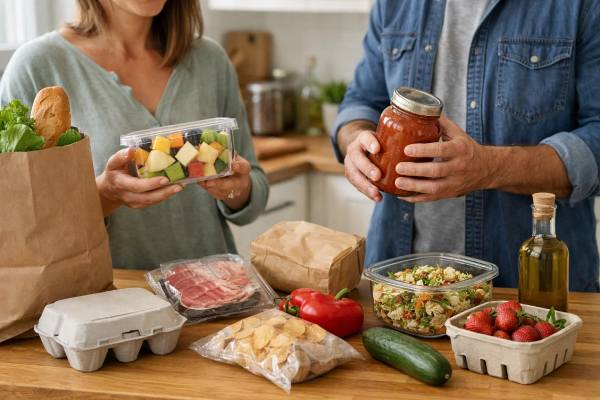
Food packaging is easy to overlook because it feels passive. It holds soup, seals leftovers, lines cans, wraps cheese, and carries takeout home. Yet packaging is not always chemically silent. Some materials can transfer small amounts of substances into food, especially with heat, fat, time, and wear. Among the best-known concerns are BPA and certain phthalates, two groups of chemicals linked to endocrine disruption.
That phrase can sound abstract until it touches everyday life: fertility worries, thyroid questions, earlier puberty, metabolic disease, and the unease many people feel about constant low-dose exposure. The challenge is staying practical. You do not need to panic over a single receipt, one plastic lid, or one canned meal. But it is reasonable to understand where exposure comes from and which habits make the biggest difference.
The most helpful approach is not perfection. It is smart reduction. That means focusing on the packaging situations that matter most, separating stronger evidence from weaker claims, and choosing changes that are realistic enough to keep.
Key Insights
- Food packaging can be a meaningful source of exposure to BPA, phthalates, and other food-contact chemicals, especially over time.
- Heat, long storage, fatty foods, and damaged plastic can increase the chance that chemicals migrate into food.
- Reducing exposure does not require throwing everything out at once; the biggest gains usually come from changing how hot food is stored, reheated, and packaged.
- “BPA-free” does not automatically mean chemically simple or risk-free, so broader habits matter more than one label claim.
- Prioritize glass, stainless steel, or ceramic for reheating and for food that is hot, oily, or stored for long periods.
Table of Contents
- Why Food Packaging Matters
- BPA and Phthalates Explained
- How Hormone Disruption Happens
- Where Exposure Adds Up
- What Actually Lowers Exposure
- Limits, Tradeoffs, and Perspective
Why Food Packaging Matters
Food packaging matters because it sits at the intersection of chemistry and daily routine. We eat several times a day, often from containers, wraps, coatings, lids, sachets, trays, pouches, and cans that were designed to keep food safe, shelf-stable, and convenient. Those benefits are real. Packaging reduces spoilage, limits contamination, and makes transport possible. But some packaging materials also contain chemicals that are not tightly bound in place. Over time, a portion can migrate into food.
This is not limited to one kind of product. Migration can happen from hard plastic, flexible plastic, can linings, printing inks, adhesives, and other food-contact materials. The amount that transfers depends on conditions. Heat tends to increase migration. So does longer contact time. Fatty foods can be especially relevant because some chemicals move more easily into oils and fats than into water-based foods. Acidic foods can also change how some materials behave.
That helps explain why the conversation has moved beyond a simple “plastic is bad” message. The more accurate question is: in which situations does packaging become a more important contributor to exposure? A cold, brief contact is not the same as hot soup in a lined can, greasy takeout in a plastic-coated container, or leftovers reheated in old plastic.
It also helps to understand that food packaging is only one source of endocrine-disrupting chemicals, not the only one. People can encounter related chemicals through dust, personal care products, household items, and manufacturing processes. But diet remains especially important because ingestion is direct and repeated. That is one reason food-contact chemicals attract so much scientific attention.
Another complication is scale. Modern packaging is chemically complex. Many people recognize BPA and phthalates by name, but packaging can contain many other intentionally added and non-intentionally added substances. Some have been studied well. Many have not. That uncertainty is part of the concern. A package does not need to contain a famous chemical to be worth questioning.
This does not mean every packaged food is dangerous or that all exposure can be eliminated. It means food packaging is a practical place to reduce exposure because it is modifiable. You can change how you reheat food, what you store hot foods in, how often you rely on canned or heavily packaged items, and what materials you use at home.
It also helps to separate packaging from the broader nutrition conversation. A minimally processed meal in a plastic container and an ultra-processed meal in a paper box are not the same issue. For a clearer look at that distinction, see how ultra-processed foods affect hormone health beyond the packaging itself.
BPA and Phthalates Explained
BPA, or bisphenol A, is a chemical long used in polycarbonate plastics and epoxy resins. In food packaging, epoxy resins matter most because they have commonly been used as internal coatings in cans and some other food-contact materials. BPA is classified as an endocrine disruptor because it can interact with hormone signaling in ways that raise concern for reproductive, developmental, immune, and metabolic health.
Phthalates are a large family of chemicals used mainly to make plastics more flexible or to help materials hold fragrance, color, or texture. In food packaging, certain phthalates have been used in processing equipment, tubing, gloves, wraps, inks, adhesives, and flexible plastics. Some phthalates are better studied than others, and they are not all equally hazardous. The most concerning members are the ones linked to anti-androgen effects, reproductive harms, and developmental disruption.
This is where people often get lost. BPA is not the same thing as phthalates, and “phthalate-free” does not mean “BPA-free.” A container can avoid one class and still involve others. The same goes for “BPA-free” labels. They may reduce exposure to BPA itself, but they do not automatically prove that the replacement materials are simpler or fully understood.
There is also a tendency to think of these chemicals as active only at high doses. Endocrine disruptors are more complicated than classic toxins. Hormones normally work at very low levels, so chemicals that mimic, block, or alter hormone signaling can matter even when exposures are small and chronic. That does not mean every low-level exposure causes disease. It means the old assumption that “tiny equals irrelevant” does not always fit endocrine biology.
Regulators have responded more aggressively to BPA than in the past, especially in Europe, where food-contact restrictions have tightened sharply. That reflects growing concern, not absolute scientific simplicity. BPA is one of the best-studied examples, but it is not the end of the story. Researchers are now looking closely at replacement bisphenols, non-intentionally added substances, and the combined effect of chemical mixtures.
For consumers, the most important takeaway is not to memorize every chemical acronym. It is to understand the patterns:
- hard and flexible plastics are chemically different
- can linings matter
- heat and storage time matter
- “free-from” claims can be helpful but incomplete
- lower exposure usually comes from habits, not one miracle product
That is why the smartest changes tend to be broad: fewer hot foods in plastic, less microwaving in plastic, more glass or stainless steel for storage, and more attention to heavily packaged foods that make contact with wrappers, films, and coatings for long periods.
When people start reading about these chemicals, they often jump quickly to the language of “detox.” A more grounded way to think about it is in terms of source control, not cleansing. This practical look at hormone “detox” myths helps explain why exposure reduction usually matters more than chasing a cleanse.
How Hormone Disruption Happens
The endocrine system is a communication network. Hormones act like chemical messengers that help coordinate metabolism, fertility, growth, stress responses, appetite, thyroid function, and more. Endocrine disruptors matter because they can interfere with that messaging in several ways rather than through one single mechanism.
Some chemicals can mimic a natural hormone and activate a receptor when they should not. Others can block a hormone from doing its job. Still others may alter hormone production, transport, metabolism, or breakdown. In practical terms, that means a chemical does not have to look exactly like estrogen or testosterone to create endocrine effects. It may shift how the system behaves instead of simply replacing one hormone.
BPA is often discussed because of its estrogen-like activity, but its effects are not limited to one pathway. Phthalates are often associated with anti-androgen effects, especially in relation to male reproductive development, but their story is broader too. Research has explored links with fertility, pregnancy outcomes, body composition, insulin resistance, thyroid signaling, and neurodevelopment. The strength of evidence varies by outcome, age group, timing of exposure, and specific chemical.
That last point is essential. Endocrine disruption is rarely a neat, immediate cause-and-effect event in one adult on one day. The concern is often about repeated exposure over time, especially during sensitive windows such as fetal development, infancy, childhood, puberty, and pregnancy. Even so, adults are not irrelevant. Hormone-sensitive tissues remain active throughout life, and metabolic health, reproductive function, and immune signaling do not stop being important after childhood.
This is also why “I feel fine, so it cannot matter” is too simple. Many endocrine-related effects are subtle, cumulative, or detectable first in population-level patterns rather than obvious individual symptoms. At the same time, it is also a mistake to blame every case of acne, fatigue, infertility, or weight gain on packaging chemicals. Hormone symptoms have many causes, and chemical exposure is just one piece of a much larger picture.
A balanced view sounds like this:
- endocrine disruptors are biologically plausible and scientifically credible concerns
- the strongest concern is usually chronic exposure, not one isolated event
- vulnerable life stages matter especially
- individual symptoms are often nonspecific
- exposure reduction is sensible even when perfect certainty is impossible
That perspective helps avoid two extremes. One is denial: assuming low-dose daily exposures are irrelevant. The other is fatalism: assuming every wrapped snack has already done measurable harm. The truth is more practical. We are dealing with a modifiable exposure category, not a reason for despair.
If you are sorting through symptoms that may or may not be hormone-related, it helps to keep the wider clinical picture in view. This guide to common hormone imbalance symptoms and when to test can help prevent environmental concerns from crowding out more immediate medical causes.
Where Exposure Adds Up
Exposure usually adds up through ordinary repetition, not one dramatic incident. That is why the most useful question is not “Which single product is worst?” but “Which habits create repeated contact between food and higher-risk packaging?”
Several patterns stand out.
Hot food in plastic is one of the most practical concerns. Heat can increase migration, so the container used for reheating matters. A plastic tub that seems harmless in the fridge becomes a different situation in the microwave. The same logic applies to pouring very hot liquids into plastic-lined or plastic containers.
Fatty foods are another common issue. Cheese, oils, creamy sauces, meats, and greasy takeout can interact differently with packaging than dry crackers or cold fruit. Because some chemicals move more readily into fats, oily foods sitting in plastic wraps, coated paper, or flexible containers may deserve more attention than many people realize.
Canned foods can also be important, especially if they are a frequent staple rather than an occasional convenience. Not every can is the same, and many manufacturers have changed their linings, but canned foods remain a relevant source in the BPA conversation because linings are a classic point of contact between packaging chemistry and food.
Takeout and ready-made meals are easy to miss because the exposure moment is brief from the consumer’s point of view. But the food may already have spent time in contact with heated packaging, transport containers, gloves, tubing, and processing materials before it reaches the table. Restaurant meals also tend to involve more unknowns than food prepared at home.
A few home patterns matter too:
- storing hot leftovers in plastic instead of cooling first
- using old, scratched, cloudy, or warped containers
- covering food with plastic wrap during heating
- letting acidic or oily foods sit for days in soft plastic containers
- assuming all recycling numbers or “microwave-safe” labels are health guarantees
“Microwave-safe” mainly refers to whether a container can tolerate heat without visibly melting or deforming under tested conditions. It does not function as a broad certification that no chemicals will migrate. Likewise, a recycling code describes a material category, not an endocrine safety score.
It is also worth noting what probably matters less. Brief contact with dry foods, occasional packaged items, or plastic used only for transport rather than heat and storage is generally not where the biggest exposure wins are likely to come from. That matters because reduction works better when it is prioritized. Swapping the highest-impact habits beats trying to live a chemically perfect life.
People worried about hormone-sensitive life stages often ask whether they need to be stricter during pregnancy or while feeding children. The answer is usually yes, within reason. The same basic steps apply, but the motivation is stronger because developing bodies are more vulnerable to endocrine disruption.
If chemical exposure is one of several concerns around how modern foods affect metabolism, this guide to early insulin resistance signs and practical next steps can help keep the bigger metabolic picture in view.
What Actually Lowers Exposure
The best exposure-reduction strategy is not to replace every container in your kitchen overnight. It is to focus on the situations most likely to increase migration and to make the easiest changes first. That keeps the plan realistic and sustainable.
The most effective first-line moves are usually these:
- Reheat food in glass, ceramic, or stainless steel instead of plastic.
- Move hot takeout out of its container once you get home.
- Let food cool slightly before storing it in plastic, or use glass for leftovers.
- Reduce reliance on canned foods if they are a daily habit.
- Avoid storing oily, acidic, or very hot foods in worn plastic for long periods.
Those steps matter because they target heat, time, and food chemistry, the main conditions that can increase migration.
Some intervention research suggests that exposure to BPA and certain phthalates can drop meaningfully within days when people sharply reduce contact with canned and plastic-packaged foods. That does not mean everyone must live on unpackaged produce and glass jars. It means diet-related exposure is modifiable enough to reward practical changes.
A useful home checklist looks like this:
- Use glass containers for meal prep and leftovers you plan to reheat.
- Choose stainless steel or glass water bottles for regular use.
- Do not microwave plastic wrap on top of food.
- Replace old plastic containers that are scratched, cloudy, peeling, or warped.
- Favor fresh or frozen foods over canned foods when that swap is easy and affordable.
- Be especially selective with packaging for baby food, pregnancy meals, and children’s hot meals.
The next layer is shopping strategy. You do not need to avoid every packaged item, but you can reduce repeated exposure by choosing less heavily packaged staples where possible. For example, dry beans, oats, rice, yogurt in glass, or tomato products in glass may make sense in some households. The point is not purity. It is reducing the most repeated sources.
A few things deserve caution rather than overconfidence. “BPA-free” is better interpreted as one data point, not a full safety verdict. Likewise, biodegradable, compostable, paper-based, or recycled packaging may still involve coatings, inks, adhesives, or additives. If the food is hot, greasy, or stored for a long time, material simplicity still matters.
What about dishwasher and microwave use? Heat and wear gradually age plastics, so even containers that seemed fine at first may become less appealing over time. Many people find a simple rule easiest to follow: cold storage is one category, heating is another. Keep plastic for lower-contact jobs when needed, and use glass or stainless steel for the hot, oily, or repeated-use tasks.
There is also no need to confuse exposure reduction with orthorexia. A thoughtful strategy should make life easier, not smaller. If replacing a few lunch containers and changing your reheating habits removes a large share of your concern, that is a meaningful win.
For people who tend to build large “detox” routines, it is worth remembering that lowering source exposure usually beats adding another product or protocol. Health changes that matter are often boring, physical, and repeatable.
Limits, Tradeoffs, and Perspective
A useful article on endocrine disruptors should leave you informed, not frightened. That requires acknowledging the limits of what we know and the limits of what any individual can control.
First, not all packaging carries the same risk, and not all chemicals within a class behave identically. BPA is not every bisphenol. One phthalate is not every phthalate. Packaging also varies by polymer type, manufacturing process, additives, coatings, and intended use. That is one reason blanket statements can mislead.
Second, endocrine disruption research often deals in probabilities, associations, and mechanistic concerns rather than tidy clinical certainties for one person. Population-level evidence can still be important. Public health decisions are often made because a repeated, low-dose exposure is widespread and avoidable, not because every individual can feel its effect in real time.
Third, replacement is not always simple. People may hear “just use glass,” but cost, weight, breakage, childcare, disability, and storage can make that advice incomplete. A practical plan should fit a real household. Sometimes the best option is not perfect material purity. It is reducing the highest-contact situations while preserving convenience, safety, and food access.
That is why a tiered mindset helps:
- highest priority: no hot food in old plastic
- next priority: reduce routine canned and highly packaged food contact
- lower priority: do not obsess over occasional or low-contact exposures
It is also worth resisting symptom over-attribution. Endocrine disruptors are important, but they are rarely the only explanation for hormone concerns. Irregular periods, infertility, fatigue, unexplained weight change, acne, hair loss, hot flashes, and mood changes deserve ordinary medical thinking too. A person can reduce exposure thoughtfully and still need thyroid testing, gynecologic care, metabolic evaluation, or specialist advice.
The same applies to children. Reducing exposure in babies and kids is a sensible precaution, but it should not turn every packed lunch into a crisis. Consistency matters more than intensity. A family that regularly cools food before packing it, avoids microwaving plastic, and uses simpler materials for hot meals is already doing something meaningful.
The bigger perspective is encouraging. This is one of the few environmental health areas where personal habits can plausibly shift exposure. That does not solve the need for better regulation, safer product design, and clearer labeling, but it does mean the consumer is not powerless.
If symptoms, lab questions, or fertility concerns are already part of the picture, this guide to when an endocrinologist may be helpful can help separate environmental concern from signs that deserve a more direct medical workup.
References
- Food packaging and endocrine disruptors 2024 (Review)
- Phthalates, bisphenols and per-and polyfluoroalkyl substances migration from food packaging into food: a systematic review 2025 (Systematic Review)
- Evidence for widespread human exposure to food contact chemicals 2025
- Human exposure to Bisphenol A in Europe 2023 (Official Briefing)
- Food Packaging and Bisphenol A and Bis(2-Ethyhexyl) Phthalate Exposure: Findings from a Dietary Intervention 2011 (Intervention Study)
Disclaimer
This article is for educational purposes only and does not replace medical advice, diagnosis, or treatment. Research on endocrine disruptors in food packaging is important, but individual symptoms such as fatigue, infertility, irregular periods, thyroid concerns, weight changes, or early puberty should not be self-diagnosed as packaging-related without appropriate medical evaluation. Exposure reduction can be a reasonable prevention strategy, especially during pregnancy and childhood, but it is not a substitute for clinical care or for urgent assessment of significant symptoms.
If you found this article useful, please share it on Facebook, X, or another platform you trust so more people can make calmer, better-informed choices about food packaging and hormone health.