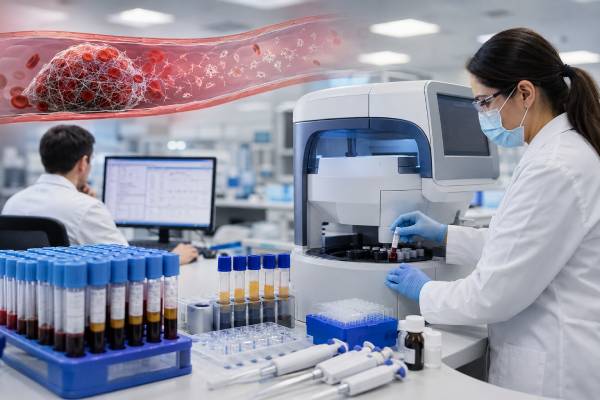
Fibrin degradation products, often called FDP or fibrin split products, are small protein fragments released when the body breaks down fibrin or fibrinogen during clot cleanup. The FDP test helps show whether clot formation and clot breakdown are unusually active. Doctors most often use it when they suspect disseminated intravascular coagulation, called DIC, a serious condition where widespread clotting uses up platelets and clotting factors and then raises the risk of dangerous bleeding. FDP also rises after surgery, trauma, blood clots, severe infection, liver disease, some cancers, pregnancy complications, and clot-dissolving treatment.
An FDP result does not diagnose one disease by itself. It needs clinical context and other coagulation tests, especially platelet count, PT/INR, aPTT, fibrinogen, and D-dimer. A high value means the body is breaking down fibrin or fibrinogen faster than expected. The next step is finding why that process is happening.
- The FDP test measures clot-breakdown fragments from fibrin, fibrinogen, and related soluble complexes.
- A normal FDP result is often below 5 mcg/mL or below 10 mcg/mL, depending on the laboratory method and specimen type.
- High FDP is common in DIC, but it also occurs with trauma, surgery, pulmonary embolism, deep vein thrombosis, liver disease, cancer, eclampsia, and fibrinolytic therapy.
- FDP is broader than D-dimer because D-dimer mainly reflects breakdown of cross-linked fibrin, while FDP includes fragments from fibrin and fibrinogen.
- No fasting is usually needed, but the blood tube must be filled correctly because FDP is a coagulation test.
- Urgent care matters when high FDP appears with bleeding, shock, severe infection, chest pain, shortness of breath, stroke symptoms, or pregnancy complications.
Table of Contents
- What the FDP Test Measures
- Why the Test Is Ordered
- FDP Normal Range and Result Meaning
- High FDP Causes
- FDP, DIC, and Dangerous Clot Breakdown
- FDP vs D-Dimer
- How the Test Is Done
- Follow-Up Tests and Urgent Warning Signs
What the FDP Test Measures
The FDP test measures protein fragments that appear when plasmin, the body’s main clot-dissolving enzyme, cuts apart fibrin or fibrinogen. Fibrin is the mesh-like protein that strengthens a blood clot. Fibrinogen is the soluble blood protein that becomes fibrin during clot formation.
A healthy clotting system works in two balanced stages. First, the body forms a clot where a blood vessel is injured. Platelets gather, clotting proteins activate, and fibrin forms a stable mesh. Later, once the clot is no longer needed, the fibrinolytic system breaks down that mesh so blood flow and tissue repair continue normally.
FDP levels rise when this breakdown process becomes more active than usual. That rise does not always mean a harmful clot is present. It means the body is producing or clearing clot-related material at a higher rate.
The term “FDP” is broad. It includes:
- fragments from fibrinogen breakdown
- fragments from non-cross-linked fibrin
- fragments from cross-linked fibrin
- soluble fibrin-related complexes
- mixed breakdown products that vary by assay
This broad detection explains why FDP is useful in conditions with heavy clotting and fibrinolysis, such as DIC, but also why it lacks disease specificity. A high FDP result points to abnormal hemostasis, not a single diagnosis.
In everyday interpretation, FDP answers one practical question: Is the body breaking down clotting proteins more than expected? The harder question is why. That answer comes from symptoms, medical history, physical exam findings, and related blood tests.
Why the Test Is Ordered
Doctors order an FDP test when they need evidence of increased fibrin or fibrinogen breakdown. It is most useful when a person has signs of a serious clotting disorder, unexplained bleeding, a severe inflammatory illness, or a condition known to disturb coagulation.
FDP testing is less common than D-dimer testing in many modern hospitals, but it still has value in selected settings. It gives a wider view of fibrin and fibrinogen breakdown and helps support the diagnosis of DIC when interpreted with other markers.
Common reasons for ordering FDP include:
- suspected disseminated intravascular coagulation
- unexplained bleeding or oozing from IV sites, wounds, gums, or surgical drains
- severe sepsis or shock
- major trauma, burns, or extensive tissue injury
- complications of pregnancy, such as placental abruption, amniotic fluid embolism, severe preeclampsia, eclampsia, or HELLP syndrome
- suspected or known acute promyelocytic leukemia or other malignancy-associated coagulopathy
- severe liver disease with abnormal clotting tests
- monitoring after clot-dissolving treatment, such as thrombolytic therapy
- suspected massive clot formation or clot breakdown in the bloodstream
FDP is usually not ordered alone. A doctor often combines it with a coagulation panel, complete blood count, platelet count, fibrinogen, D-dimer, kidney tests, liver tests, and markers of infection or tissue injury.
The test has the most meaning when results are followed over time. A single high FDP value shows abnormal activity at one moment. A rising FDP level, falling platelet count, prolonged PT, low fibrinogen, and worsening organ function together create a much stronger warning pattern.
FDP Normal Range and Result Meaning
FDP reference ranges vary because laboratories use different methods, specimen types, antibodies, reporting units, and cutoffs. Many labs report a normal result as less than 5 mcg/mL. Others use less than 10 mcg/mL, which is the same as less than 10 mg/L when converting units directly.
Always use the reference range printed on the lab report. FDP assays are often semi-quantitative, meaning the result places the sample into a range rather than giving a highly precise concentration.
| FDP result | Usual interpretation | Common next step |
|---|---|---|
| Normal or negative | No clear evidence of increased fibrin or fibrinogen breakdown at the time of testing | Interpret with symptoms and repeat testing if DIC or clotting remains a concern |
| Mildly high | Recent clot formation, inflammation, surgery, trauma, pregnancy, liver disease, or another non-specific cause | Review clinical context and compare with D-dimer, fibrinogen, PT/INR, aPTT, and platelets |
| Moderately high | Active clot breakdown or fibrinogen breakdown is more likely | Evaluate for DIC, thrombosis, severe infection, malignancy, obstetric complications, or liver disease |
| Markedly high | Strong evidence of major fibrinolytic activity, especially concerning when other clotting tests are abnormal | Urgent assessment if bleeding, shock, organ dysfunction, severe infection, trauma, or pregnancy complications are present |
A low FDP result is usually not treated as a medical problem. Low or undetectable FDP means the test did not find increased breakdown fragments. It does not rule out every blood clot, especially if the clot is small, old, localized, or tested at the wrong time.
A high FDP result needs careful interpretation. FDP rises when the body breaks down clotting proteins, but that process occurs in many conditions. A high result by itself does not prove DIC, deep vein thrombosis, pulmonary embolism, or cancer.
Two people with the same FDP number can have very different medical situations. A mildly high FDP after major surgery often fits expected healing and clot remodeling. The same value in a person with sepsis, falling platelets, prolonged PT, and oozing from IV sites raises much greater concern.
High FDP Causes
High FDP means fibrin or fibrinogen breakdown is increased. The result reflects a process, not a diagnosis. The most important causes fall into several clinical groups.
Disseminated intravascular coagulation
DIC is one of the classic causes of high FDP. In DIC, clotting becomes activated throughout the bloodstream instead of staying limited to one injury site. Small clots form in many blood vessels, platelets and clotting factors get consumed, and fibrinolysis releases FDP as the body tries to break down the excess fibrin.
DIC often occurs during severe illness rather than as a standalone disease. Common triggers include sepsis, major trauma, severe burns, obstetric emergencies, advanced cancer, acute promyelocytic leukemia, pancreatitis, severe liver failure, and major transfusion reactions.
In DIC, FDP usually rises along with other abnormal findings, such as low platelets, prolonged PT, prolonged aPTT, high D-dimer, low or falling fibrinogen, and signs of organ stress.
Blood clots and thromboembolism
Deep vein thrombosis and pulmonary embolism raise fibrin-related breakdown products when the body digests clot material. D-dimer is usually the preferred test for suspected venous thromboembolism because it is more specific for cross-linked fibrin breakdown. FDP still rises in many thrombotic episodes and supports the idea that clot formation and breakdown are active.
Symptoms matter more than the FDP value alone. One-sided leg swelling, calf pain, chest pain, sudden shortness of breath, coughing blood, fainting, or a rapid unexplained heartbeat needs urgent medical assessment.
Surgery, trauma, burns, and tissue injury
Surgery and injury activate clotting and healing. The body forms clots to stop bleeding and then remodels them as tissue repairs. FDP often rises after major surgery, fractures, crush injuries, burns, or internal bleeding. Higher or persistent levels raise more concern when paired with bleeding, shock, falling hemoglobin, low platelets, or abnormal coagulation tests.
This is one reason FDP is not a general screening test for blood clots after surgery. Recent procedures frequently raise clot-breakdown markers even without a new dangerous clot.
Severe infection and inflammation
Sepsis strongly activates coagulation. Inflammation injures blood vessel lining, increases tissue factor activity, disturbs natural anticoagulant pathways, and changes fibrinolysis. FDP rises when this process leads to fibrin formation and breakdown.
A person with infection, fever, confusion, low blood pressure, fast breathing, reduced urine output, mottled skin, or abnormal lactate needs urgent care. FDP adds information, but the clinical picture drives the level of concern.
Liver disease
The liver makes many clotting proteins and clears many coagulation byproducts. Severe liver disease can produce abnormal FDP results through several routes: reduced clearance, altered fibrinogen production, increased fibrinolysis, infection, portal vein thrombosis, bleeding, or DIC-like changes in critical illness.
This overlap makes interpretation difficult. In advanced liver disease, a high FDP result needs comparison with liver function tests, platelet count, fibrinogen, PT/INR, bilirubin, albumin, kidney function, infection markers, and the person’s bleeding or clotting history.
Cancer and leukemia
Some cancers increase clotting activity. Advanced solid tumors, metastatic adenocarcinoma, and acute promyelocytic leukemia are well-known examples. Acute promyelocytic leukemia is especially important because it can trigger severe bleeding and DIC. In that setting, high FDP, low fibrinogen, and abnormal PT/aPTT are treated as urgent findings.
A high FDP result alone does not mean cancer. It becomes more meaningful when there are other signs, such as unexplained weight loss, abnormal blood counts, enlarged lymph nodes, persistent bleeding, or known malignancy.
Pregnancy complications
Pregnancy changes clotting balance, and many clotting markers shift during normal pregnancy. FDP becomes more concerning when paired with severe symptoms or obstetric complications. Placental abruption, amniotic fluid embolism, eclampsia, HELLP syndrome, retained dead fetus, severe hemorrhage, and sepsis can trigger DIC.
Heavy bleeding, severe abdominal pain, severe headache, vision changes, seizures, fainting, chest pain, shortness of breath, or reduced fetal movement requires immediate obstetric care.
FDP, DIC, and Dangerous Clot Breakdown
FDP plays an important role in DIC evaluation because DIC involves both clot formation and clot breakdown. The body activates coagulation throughout the circulation, then activates fibrinolysis to clear fibrin deposits. FDP rises as that breakdown accelerates.
DIC is dangerous because it produces two opposing problems at the same time:
- Too much clotting: small clots block blood flow in organs, contributing to kidney injury, lung dysfunction, liver injury, shock, skin changes, or neurologic symptoms.
- Too much bleeding risk: platelets and clotting factors get used up, and high FDP can interfere with normal clot formation.
Doctors do not diagnose DIC from FDP alone. They look for an underlying illness plus a pattern of laboratory changes. Common DIC-related tests include platelet count, PT/INR, aPTT, fibrinogen, D-dimer or FDP, peripheral smear, and markers of organ function.
A typical DIC pattern includes:
- high FDP or D-dimer
- falling platelet count
- prolonged prothrombin time
- prolonged aPTT in many cases
- low or falling fibrinogen, especially in bleeding-type DIC
- anemia or falling hemoglobin when bleeding occurs
- abnormal kidney, liver, oxygen, or lactate results in severe illness
Fibrinogen deserves special attention. Because fibrinogen is an acute-phase protein, it can appear normal or high early in inflammation even when DIC is developing. A “normal” fibrinogen level during severe sepsis does not always reassure doctors if it is falling quickly or paired with rising FDP, falling platelets, and worsening PT.
DIC also has different patterns. Some forms are dominated by bleeding, some by organ failure from microclots, and some by marked fibrinolysis. Acute promyelocytic leukemia and some obstetric emergencies are often associated with severe fibrinolytic activity and bleeding risk. Sepsis-associated DIC often has strong inflammation, endothelial injury, and microvascular clotting.
Treatment focuses on the trigger. Antibiotics and source control treat sepsis. Delivery or obstetric intervention treats some pregnancy-related causes. Cancer-directed therapy treats acute promyelocytic leukemia or malignancy-associated DIC. Blood products, platelets, cryoprecipitate, fibrinogen concentrate, plasma, or anticoagulation are chosen according to bleeding, clotting, fibrinogen level, platelet count, and the underlying disease.
FDP vs D-Dimer
FDP and D-dimer are related but not identical. Both reflect clot breakdown, but they measure different parts of that process.
D-dimer is a specific fragment released when plasmin breaks down cross-linked fibrin. Cross-linked fibrin forms after thrombin converts fibrinogen into fibrin and factor XIII stabilizes the clot. Because of this, D-dimer is more closely tied to breakdown of formed, stabilized clots.
FDP is broader. It detects fragments from fibrinogen, fibrin, and related soluble complexes. That broader detection helps in disorders where fibrinogen breakdown and fibrinolysis are prominent, but it also reduces specificity.
| Feature | FDP | D-dimer |
|---|---|---|
| What it reflects | Breakdown of fibrin, fibrinogen, and related complexes | Breakdown of cross-linked fibrin |
| Specificity for formed clots | Lower | Higher |
| Common clinical use | DIC evaluation, fibrinolysis assessment, selected coagulation workups | Blood clot exclusion in low-risk patients, DIC support, thrombotic risk assessment in context |
| Common reporting style | Often semi-quantitative | Often quantitative |
| Main limitation | Many non-specific causes of elevation | Also non-specific when high, especially after surgery, trauma, pregnancy, cancer, inflammation, or hospitalization |
In suspected pulmonary embolism or deep vein thrombosis, doctors usually prefer the D-dimer blood test because validated diagnostic pathways use D-dimer with clinical probability scoring. A negative D-dimer in a low-risk person often helps avoid imaging. A high D-dimer does not prove a clot; it signals the need for further assessment when symptoms and risk factors fit.
In suspected DIC, either FDP or D-dimer provides evidence of increased fibrin-related markers. Many scoring systems use a category such as “fibrin-related marker” rather than only one named test, because available assays differ by institution.
The two tests sometimes move together, but discordant patterns occur. FDP can rise from fibrinogen breakdown even when D-dimer is less striking. D-dimer can rise strongly when cross-linked fibrin breakdown dominates. The result pattern helps specialists understand the type of clotting and fibrinolysis involved.
How the Test Is Done
The FDP test is a blood test. A clinician draws blood from a vein, usually into a blue-top tube containing sodium citrate. Sodium citrate prevents the sample from clotting before the laboratory measures FDP.
No fasting is usually required. Regular medicines should not be stopped unless the prescribing clinician gives that instruction. The test is often ordered during urgent evaluation, hospitalization, surgery recovery, pregnancy complications, cancer care, or severe infection, so preparation is usually minimal.
Because FDP is a coagulation test, collection quality matters. A poor sample can distort the result. Important collection details include:
- The blue-top tube must be filled to the correct level.
- The sample must be mixed gently soon after collection.
- Hemolyzed, clotted, or poorly filled specimens can be rejected.
- Very high hematocrit, often above 55%, requires citrate adjustment.
- Timing matters when levels are changing quickly during acute illness.
- Recent thrombolytic therapy, major surgery, trauma, or active bleeding affects interpretation.
Many FDP assays use latex agglutination or immunologic methods. In latex agglutination, particles coated with antibodies clump when FDP is present. The lab compares the reaction against controls or dilutions to estimate the level. This explains why some results appear as ranges rather than exact numbers.
Turnaround time depends on the laboratory. A hospital lab handling a critically ill patient may process coagulation markers quickly. Reference laboratories often take longer, sometimes a few days. D-dimer is more widely available for rapid emergency testing in many settings.
A result should be interpreted using the laboratory’s own reference range. FDP testing is not standardized in the same way across every assay, so comparing numbers from different laboratories can mislead. A change from 8 to 20 mcg/mL in the same lab often means more than comparing 8 mcg/mL from one lab with 8 mcg/mL from another.
Follow-Up Tests and Urgent Warning Signs
Follow-up depends on why FDP was ordered. A high FDP result in a stable person after surgery has a different meaning from high FDP in someone with sepsis, bleeding, low blood pressure, and falling platelets.
Doctors often review the following tests with FDP:
- platelet count and complete blood count
- PT and INR
- aPTT or PTT
- fibrinogen
- D-dimer
- peripheral blood smear
- liver enzymes, bilirubin, albumin, and kidney function
- lactate, blood cultures, and infection markers when sepsis is possible
- imaging studies when deep vein thrombosis or pulmonary embolism is suspected
- pregnancy-specific testing and fetal assessment when relevant
The pattern matters more than one result. For example, high FDP with normal platelets, normal PT/INR, normal fibrinogen, and no symptoms often points toward a less urgent or non-specific cause. High FDP with a falling platelet count, prolonged PT, low fibrinogen, and bleeding suggests a much more serious coagulation disorder.
Seek urgent medical care when an abnormal FDP result occurs with:
- bleeding that does not stop
- vomiting blood or passing black, tarry, or bloody stool
- blood in urine
- widespread bruising, pinpoint red or purple spots, or rapidly spreading skin discoloration
- severe headache, confusion, fainting, weakness on one side, or trouble speaking
- chest pain, sudden shortness of breath, coughing blood, or collapse
- one swollen painful leg, especially with warmth or redness
- fever, low blood pressure, fast breathing, severe weakness, or reduced urination
- severe abdominal pain or heavy bleeding during pregnancy or after delivery
- oozing from IV lines, wounds, drains, gums, or surgical sites
Do not treat a high FDP number by trying to “thin” or “thicken” the blood on your own. Aspirin, NSAIDs, anticoagulants, supplements, alcohol, and some herbal products can worsen bleeding risk in the wrong setting. DIC and major clotting disorders require diagnosis of the trigger and careful treatment guided by laboratory trends and clinical status.
A normal FDP result also needs context. If symptoms strongly suggest a clot, bleeding disorder, severe infection, or pregnancy emergency, clinicians continue evaluation even when one marker is normal. Blood tests support decisions; they do not replace clinical assessment.
For patients tracking results over time, the most useful questions are specific:
- Is FDP rising, falling, or stable?
- Are platelets dropping?
- Is PT/INR getting longer?
- Is fibrinogen low or falling?
- Is D-dimer also high?
- Is there active bleeding, clotting, infection, liver failure, cancer, trauma, or pregnancy-related disease?
- Has treatment improved the underlying cause?
FDP becomes most useful when it helps connect symptoms, clotting test patterns, and disease severity. A high result deserves attention, but the safest interpretation comes from the full picture.
References
- Updated definition and scoring of disseminated intravascular coagulation in 2025: communication from the ISTH SSC Subcommittee on Disseminated Intravascular Coagulation 2025 (Position Statement)
- Clinical practice guidelines for management of disseminated intravascular coagulation in Japan 2024. Part 1: sepsis 2025 (Guideline)
- Phenotypes of Disseminated Intravascular Coagulation 2024 (Review)
- Disseminated Intravascular Coagulation 2024 (Review)
- Fibrinolytic Disorders 2026 (Clinical Laboratory Guidance)
- 115402: Fibrinogen Degradation Products (FDP), Plasma 2026 (Test Directory)
Disclaimer
This article is educational and does not replace care from a qualified medical professional. FDP results can signal serious clotting or bleeding disorders, especially when paired with abnormal platelets, PT/INR, aPTT, fibrinogen, or D-dimer. Seek urgent medical care for unexplained bleeding, chest pain, shortness of breath, stroke symptoms, severe infection symptoms, shock, or pregnancy-related emergencies.