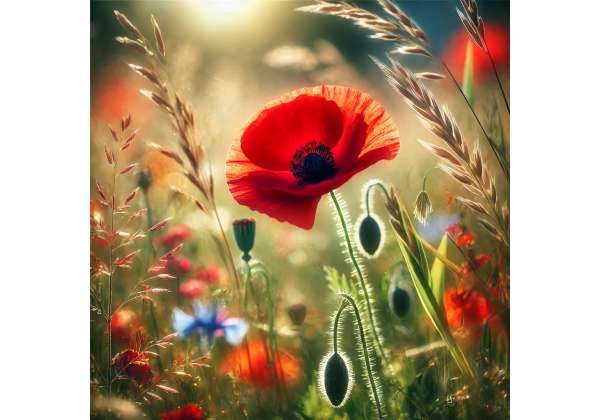
Field poppy, or Papaver rhoeas, is the bright red wild poppy long associated with open meadows, grain fields, and traditional herbal practice across Europe, North Africa, and Western Asia. It is often called corn poppy, red poppy, or common poppy. Although it belongs to the same genus as the opium poppy, it should not be treated as the same kind of plant. Field poppy is valued mainly for its petals and aerial parts, which have been used in folk medicine for cough, mild restlessness, throat irritation, and gentle calming support.
What makes this herb interesting is its unusual balance of softness and uncertainty. Its petals contain anthocyanins, mucilage, flavonoids, and distinctive rhoeadine-type alkaloids, which may help explain its traditional use as a mild antitussive and sedative. At the same time, modern evidence remains limited, and recent poisoning reports show that “wild” and “safe” are not synonyms. The most useful way to approach field poppy is as a modest traditional herb with real pharmacological activity, but without strong clinical proof or a well-established modern dose.
Quick Overview
- Field poppy is best known for mild traditional use in cough, throat irritation, nervous restlessness, and gentle evening calming.
- Its petals contain anthocyanins, mucilage, flavonoids, and rhoeadine-type alkaloids rather than the better-known alkaloid pattern of opium poppy.
- Conservative tea-style preparations use about 0.5–1 g dried petals per 100–200 mL water, but this is a preparation range rather than a clinically validated treatment dose.
- Large or concentrated use can cause drowsiness, nausea, confusion, and other toxic effects, especially when foraged or prepared casually.
- Pregnant or breastfeeding people, children, and anyone taking sedatives or using alcohol heavily should avoid self-use.
Table of Contents
- What is Field Poppy
- Key ingredients and medicinal properties
- Does Field Poppy help with cough and rest
- Other possible benefits and uses
- How Field Poppy is used
- How much Field Poppy per day
- Safety, side effects, and who should avoid it
- What the evidence really shows
What is Field Poppy
Field poppy is an annual herb in the Papaveraceae family, recognizable by its scarlet petals, dark basal markings, fine hairs, and milky latex. It grows widely across Europe, the Mediterranean, western Asia, and parts of North Africa, and it has spread with agriculture so successfully that many people think of it as the classic red poppy of roadsides and grain fields. Botanically, it is distinct from Papaver somniferum, the opium poppy, even though both belong to the same genus.
That distinction is the first thing readers need to understand. Field poppy is not a legal or herbal stand-in for opium poppy. The public often hears “poppy” and assumes strong narcotic effects, major opioid alkaloids, or potent pain relief. That is not the right lens here. Comparative phytochemical work shows that Papaver rhoeas is associated especially with rhoeadine-type alkaloids, while morphine and codeine belong more characteristically to P. somniferum. In practical terms, field poppy is better described as a mild traditional calming and respiratory herb than as an analgesic opioid plant.
Historically, the plant has had several lives at once. It has been used as a decorative wildflower, a food plant in some regions, a source of red coloring for syrups and culinary preparations, and a folk remedy. Traditional medicine has associated it with cough, disturbed sleep, mild pain, sore throat, nervousness, and minor digestive discomfort. In parts of Turkey and nearby regions, folk uses also extended to antispasmodic, antipyretic, and sedative purposes. Petals are the most familiar medicinal part, though flowers, young aerial parts, and occasionally other parts appear in ethnobotanical records.
This mixed identity matters because it shapes expectations. Field poppy is not a mainstream evidence-based herb with standard capsules and dosing charts. It is a traditional botanical whose reputation rests on gentle symptom relief rather than strong pharmacological precision. Readers looking for a firm clinical protocol will not really find one. Readers looking for a historically used plant with mild soothing potential will understand it better.
A good way to place field poppy in context is to think of it as a borderline herb-food-flower plant. Like many mild traditional botanicals, it sits between folk medicine and everyday culture. That makes it appealing, but it also makes it easy to overtrust. Recent poisoning reports after tea and food use are a reminder that even a familiar wildflower can produce real adverse effects when the amount, plant stage, or preparation is poorly controlled.
Key ingredients and medicinal properties
Field poppy does not rely on one famous compound. Its effects seem to come from a mix of alkaloids, pigments, mucilage, phenolics, and other secondary metabolites. The most distinctive phytochemical feature is its rhoeadine-type alkaloid pattern. Studies on Papaver rhoeas have identified compounds such as rhoeadine, rhoeagenine, isorhoeadine, glaucamine, glaudine, epiglaucamine, and related alkaloids, along with compounds like roemerine in some samples. This is one reason the plant cannot simply be discussed as a weaker version of opium poppy. Its chemistry is different in kind, not just in intensity.
The petals also contain anthocyanins and other flavonoids. These compounds help produce the flower’s vivid red coloration and likely contribute to antioxidant activity. Phytochemical work on the species and broader Papaver reviews also describe phenolic compounds, tannins, coumarins, terpenoids, and saponin-like components in certain extracts. In leaves and petals, researchers have also found flavonols such as quercetin, kaempferol, myricetin, and isorhamnetin. Infusion studies support the idea that the petals can supply polyphenols, vitamin C, and minerals, though that does not automatically translate into strong therapeutic outcomes.
Another important constituent class is mucilage. This matters more than many summaries admit. Mucilage helps explain why field poppy has often been used for dry or irritated mucous membranes, especially in cough mixtures and soothing syrups. A mucilage-rich herb does not work like a stimulant. It works more like a coating and softening plant, especially when used in mild preparations. That makes field poppy pharmacologically gentler than its poppy name may suggest, at least in traditional tea or syrup-style use.
Its likely medicinal properties can be grouped into a few practical categories:
- Mild sedative or calming support linked to alkaloid content.
- Antitussive and throat-soothing potential linked to mucilage and traditional use.
- Antispasmodic and gentle smooth-muscle calming effects suggested in historical use.
- Antioxidant and antimicrobial effects supported mainly by in vitro and extract studies.
- Possible anti-inflammatory and analgesic effects in experimental models.
This phytochemical pattern makes field poppy more comparable to softly acting calming herbs than to strong narcotic plants. Readers looking for another gentle evening herb may find chamomile for mild calming and digestive comfort a more predictable option, but field poppy remains interesting because it combines soothing petals with a distinctive alkaloid signature.
The key limitation is variability. Alkaloid content changes by geography, plant part, growth stage, and extraction method. A flower infusion, a hydroalcoholic extract, and a whole-aerial-part preparation may not behave alike. That is why “medicinal properties” should be discussed with modesty. The plant clearly contains active chemistry. It is much less clear how consistently that chemistry translates into safe, reproducible human benefit.
Does Field Poppy help with cough and rest
If field poppy helps in any classic herbal role, this is the most plausible one. Traditional medicine has repeatedly used the petals and aerial parts for cough, irritated airways, disturbed sleep, nervousness, and mild restlessness. Those uses make botanical sense. A plant that combines mucilage with mildly active alkaloids could reasonably offer a blend of throat-soothing and calming effects, especially when taken as a warm infusion or syrup.
For cough, the realistic expectation is not suppression of a severe or dangerous cough. It is a gentler effect: softening irritation, taking the edge off a dry or scratchy throat, and possibly reducing the urge to cough when the cough is mild and aggravated by irritation rather than serious infection. This is one reason the herb appears in folk cough syrups for children in some regions, although modern readers should be far more cautious about pediatric use than older traditions were.
For sleep and rest, field poppy also seems mild rather than dramatic. Traditional descriptions portray it as calming, softly sedative, or helpful for disturbed sleep. That wording matters. It is not presented as a knockout herb. It is closer to an evening-settling plant, one that may support quieting down rather than forcing sleep. That makes it conceptually closer to linden as a gentle calming infusion than to stronger herbal sedatives or pharmaceutical sleep aids.
Modern evidence supports only part of that tradition. Preclinical studies and older behavioral work in animals suggest sedative and central nervous system effects, but the data are not perfectly consistent. Some experiments support calming or antidepressant-like activity, while others complicate the picture and suggest that results depend heavily on the extract used, the dose, and the model. In plain language, the plant seems active, but not straightforward.
That uncertainty should shape expectations:
- Field poppy may help mild evening restlessness.
- It may be more useful for coughs linked to irritation than for deep chest disease.
- It is not proven for chronic insomnia.
- It should not be treated as a primary remedy for anxiety disorders, depression, or severe sleep problems.
- It may add gentle support in a mixed herbal formula rather than acting as a solo powerhouse.
There is also a practical issue that often gets overlooked. When people feel a plant is “mild,” they may take more of it, combine it with alcohol, or stack it with other sedatives. With field poppy, that is the wrong conclusion. A mild traditional reputation does not cancel its alkaloid activity or its poisoning potential at excessive or poorly controlled intakes. So the most honest answer is yes, field poppy may help cough and rest in a modest traditional sense, but only within a narrow, cautious, non-heroic framework.
Other possible benefits and uses
Beyond cough and rest, field poppy has been studied for a surprising range of effects. This is where the plant starts to look more scientifically interesting than clinically useful. Extract-based studies have reported antioxidant, antimicrobial, anti-inflammatory, analgesic, anti-struvite, and mood-related effects. Those findings justify attention, but they do not justify overpromotion.
Antioxidant activity is the clearest of these secondary benefit areas. Petal infusions and organ extracts have shown meaningful polyphenol content and measurable antioxidant behavior in laboratory assays. Leaves and flowers appear especially rich in phenolic compounds and flavonoids, which likely account for much of this effect. That makes field poppy relevant not only as a medicinal flower but also as a functional edible plant in some cultural food settings.
Antimicrobial activity is also plausible. Alkaloid-rich extracts from Papaver rhoeas have shown activity against selected bacteria and fungi in vitro, with some samples performing notably better than others. The catch is obvious: test-tube antimicrobial action does not mean a cup of tea will treat an infection. It simply tells us that the plant contains compounds worth studying.
Experimental anti-inflammatory and analgesic effects have also been reported. A recent study on stem and flower extracts found reductions in carrageenan-induced edema and writhing responses in animal models. That sounds promising, but it is still early-stage evidence. It may reflect genuine pharmacological potential, yet it does not give field poppy the status of a proven pain herb.
One newer and more unusual line of research looks at anti-struvite activity, meaning the ability of extracts to interfere with crystal formation linked to certain urinary stones. This is scientifically intriguing, but it remains far from routine clinical use. Readers who want respiratory herbs with clearer traditional positioning are usually better served by great mullein for better-known soothing respiratory support rather than by projecting too much onto preliminary field poppy data.
Traditional uses outside cough and sleep are also worth noting, though with caution. Ethnobotanical records mention sore throat, menstrual complaints, digestive disturbance, asthma, kidney stones, mild pain, and even blood sugar–related folk use in some settings. These records are culturally valuable, but they are not equal in reliability. Some are likely based on local experience, some on symbolic use, and some on broad herbal traditions that were never clinically tested.
A helpful rule is to separate “possible” from “practical.” Field poppy possibly has broader anti-inflammatory, antimicrobial, and antioxidant value. Practically, the best-supported everyday use remains mild symptomatic soothing. That gap between fascinating research and modest real-world herbal use is exactly why this plant deserves a careful, not romantic, interpretation.
How Field Poppy is used
Field poppy has traditionally been used in relatively simple forms. The petals are the best-known medicinal part, especially when dried and made into infusions, syrups, or soothing blends. In some regions, flowers and young aerial parts have also been used as food or added to home remedies. Historically, preparations were meant to be gentle. This was not a plant usually handled like a concentrated stimulant or a high-potency extract.
The most classic form is a petal infusion. This suits the plant’s character. Petals release pigments, mild mucilage, and some soluble phytochemicals into water, creating a light, often visually striking tea. Syrups made with petals have also had a long cultural life, especially for throat comfort and mild cough. These sweeter preparations probably survived in tradition because they are easy to take, especially in small amounts, and they make use of the flower’s color and softening reputation.
Less defensible today are casual whole-plant uses. Recent poisoning reports show that the flowers and leaves can cause significant symptoms when consumed as tea or food. That means older practices involving fresh aerial parts should not be copied without context. The plant’s activity seems to shift with growth stage, preparation, and amount used. A modest petal infusion is one thing. Broad foraging and freehand culinary use are another.
In modern herbal logic, field poppy belongs in gentle combinations more than in concentrated solo extracts. If someone were exploring traditional respiratory-style blends, it would make more sense alongside demulcent herbs such as marshmallow for broader mucosal soothing support than as a high-dose standalone herb. The petals fit naturally into tea and syrup traditions because their action is likely soft, coating, and mildly calming.
Common practical forms include:
- Dried petal tea or infusion.
- Petal syrup for seasonal throat irritation.
- Gentle blended teas aimed at evening calm or mild dry cough.
- Culinary use of petals or young parts in some local traditions, though this is not a safety-free practice.
What should be avoided are improvised concentrated tinctures, large decoctions of mixed plant parts, or uncertain foraged material. Unlike mainstream herbs with standardized extracts and established supply chains, field poppy remains a plant where route and form matter enormously. The safest interpretation of “how to use it” is not “as much as you want in any form.” It is “in mild, petal-focused, carefully sourced preparations, and only with modest expectations.”
That distinction is especially important for people who see edible flower trends online and assume all ornamental or wild petals are equally safe. Field poppy is edible in some contexts, yes, but it is also pharmacologically active enough to cause trouble when used carelessly. In other words, traditional use supports modest preparation, not enthusiastic improvisation.
How much Field Poppy per day
This is the weakest area in the evidence base. Field poppy does not have a modern, clinically validated daily dose. There is no widely accepted monograph-backed amount for capsules, extracts, tinctures, or strong therapeutic tea use. That does not mean people have never used it in measured ways. It means the measurements come mostly from tradition, product custom, or research preparation methods rather than from solid clinical trials.
The most defensible number comes from infusion research rather than therapeutic dosing research. In one petal-infusion study, researchers prepared infusions using 0.5 g dried petals in 100 mL water. That is useful as a preparation reference, especially because it shows what a relatively light research infusion looks like. It does not prove that this amount is the optimal medicinal dose for cough, sleep, or anxiety.
That leaves a practical but careful conclusion:
- There is no established evidence-based oral dose for symptom treatment.
- Petal-based preparations are more defensible than whole-plant or leaf-heavy preparations.
- A conservative tea-style preparation range is roughly 0.5–1 g dried petals per 100–200 mL water.
- Stronger preparations should not be assumed safer or more effective.
- Extracts and tinctures vary too much to recommend a general dose.
Why dosing is so uncertain:
- Different plant parts are not chemically identical.
Petals, leaves, stems, and aerial parts can vary meaningfully in alkaloid and polyphenol content. - Growth stage appears to matter.
Recent poisoning data suggest that plant stage may influence toxicity severity. - Extraction method changes the result.
A hot infusion, hydroalcoholic extract, and alkaloid-rich fraction do not behave the same way. - Human trials are lacking.
Most efficacy data come from animals, in vitro work, or folk use.
This means “more” is not a rational strategy. Field poppy is not the sort of herb that benefits from dose escalation at home. If someone wants a clearer, evidence-friendlier calming herb, valerian for stronger sleep-focused use is better studied and easier to dose in standardized form, even though it carries its own precautions.
For field poppy, the safest dose guidance is really a set of limits. Stay with light petal preparations, avoid concentrated extracts without expert supervision, and do not turn traditional reputation into permission for repeated or high-dose use. When the science on dose is thin and poisoning cases are real, restraint is part of responsible dosing.
Safety, side effects, and who should avoid it
Field poppy is often described as mild, but safety data show that mild does not mean harmless. Recent adult poisoning reports from Türkiye describe gastrointestinal and neurological symptoms after consumption as herbal tea or as a food plant. Severe cases involved serious neurological symptoms, and delayed presentation was associated with worse prognosis. That makes one point very clear: this is not a risk-free wildflower.
The main safety concern is central nervous system and gastrointestinal toxicity at excessive or poorly controlled intake. Reported and described symptoms include nausea, vomiting, drowsiness, confusion, altered consciousness, convulsions, and small pupils. Some case literature also notes presentations that resemble anticholinergic-type effects, including agitation, hypertension, tachycardia, and muscle twitching. In practice, that means the herb can look either sedating or paradoxically disturbing depending on amount, preparation, and probably plant stage.
Important side effects and risks include:
- Drowsiness and impaired alertness.
- Nausea, vomiting, and stomach upset.
- Confusion or unusual neurological symptoms at higher intake.
- Additive sedation when combined with alcohol or calming medications.
- Unpredictable effects from foraged material or mixed plant-part use.
The people who should avoid self-use are easy to identify:
- Pregnant or breastfeeding people.
- Children, especially for unsupervised internal use.
- Anyone taking sedatives, sleep medications, opioids, antipsychotics, or heavy amounts of alcohol.
- People with seizure disorders or unexplained neurological symptoms.
- Anyone planning to drive, operate machinery, or stay highly alert after use.
- People with liver concerns should also be cautious because plant poisoning cases have included serious systemic effects in the broader literature.
There is also a sourcing problem. Wild or home-harvested field poppy may be misidentified, contaminated, or used at the wrong growth stage. This is a major reason modern safety is harder than historical safety. Folk traditions often depended on local knowledge that is now missing. A person harvesting “a red poppy” from the field does not necessarily have that knowledge.
One more subtle risk is herb stacking. People sometimes combine multiple calming plants in the belief that natural sedatives are always interchangeable. That is not a wise approach here. Combining field poppy with stronger nervous-system herbs, alcohol, or sleep products could increase sedation or unpredictability. The fact that its traditional role overlaps with cough and rest does not make it a casual bedtime additive.
The safest way to summarize field poppy is this: it may be gentle at low petal-infusion strength, but it becomes a poor self-care choice once the amount is uncertain, the preparation is concentrated, or the user belongs to a higher-risk group. That is why caution is not an afterthought with this herb. It is part of the herb’s identity.
What the evidence really shows
The evidence for field poppy is real but uneven. Its traditional uses are well documented, its phytochemistry is substantial, and modern studies support antioxidant, antimicrobial, anti-inflammatory, analgesic, and central nervous system activity in extracts. At the same time, human clinical evidence for everyday therapeutic use is extremely limited. That gap is the most important fact in the entire article.
What the science supports most strongly is identity and composition. Field poppy clearly contains distinctive rhoeadine-type alkaloids, anthocyanins, mucilage, flavonoids, and other phenolic compounds. It also clearly shows bioactivity in vitro and in animals. This part of the story is not speculative. The plant is chemically active.
What the science supports moderately is traditional plausibility. A petal-rich herb with mucilage and mild alkaloids could plausibly soothe cough, quiet restlessness, and act as a soft evening herb. Traditional use and pharmacology line up reasonably well here. But “plausible” is not the same as “clinically proven.”
What the science supports weakly is modern self-treatment. There are no strong human trials showing that field poppy reliably improves insomnia, treats anxiety, controls cough, or relieves pain in standard doses. There are also no standardized consumer dosing rules that are backed by robust clinical evidence.
And what the evidence warns clearly about is safety. Recent adult poisoning data confirm that field poppy can cause serious symptoms after tea or food use, especially when intake is uncontrolled. That warning shifts the whole benefit-risk balance. It does not erase the herb’s traditional uses, but it does prevent casual enthusiasm.
So the fairest verdict is this:
- Field poppy is a legitimate traditional herb, not a myth.
- Its mild calming and cough-soothing reputation is plausible.
- Its broader laboratory effects are interesting but still preliminary.
- Its human evidence is thin.
- Its safety margin is too uncertain for carefree self-experimentation.
That combination makes field poppy best understood as a modest, historically important herbal flower with real chemistry and limited clinical certainty. It may still have a role in careful, low-dose, petal-focused herbal practice. But it has not earned the status of a broadly evidence-based, self-dosed remedy.
References
- Papaver Plants: Current Insights on Phytochemical and Nutritional Composition Along with Biotechnological Applications 2022 (Review)
- Papaver rhoeas L. stem and flower extracts: Anti-struvite, anti-inflammatory, analgesic, and antidepressant activities 2023
- Mineral Composition and Antioxidant Potential in the Common Poppy (Papaver rhoeas L.) Petal Infusions 2020
- Variation of alkaloid contents and antimicrobial activities of Papaver rhoeas L. growing in Turkey and northern Cyprus 2017
- Clinical Profile and Prognostic Indicators of Papaver Rhoeas Poisoning in Adults: A Retrospective Analysis from Türkiye 2025
Disclaimer
This article is for educational purposes only and is not medical advice. Field poppy is a pharmacologically active plant with limited clinical evidence and documented poisoning risk when used carelessly. It should not be used as a substitute for professional care for insomnia, anxiety, severe cough, seizures, or unexplained gastrointestinal or neurological symptoms. Always consult a qualified healthcare professional before using field poppy internally, especially if you are pregnant, breastfeeding, taking sedatives, or considering giving any herbal preparation to a child.
If this article was helpful, please share it on Facebook, X, or another platform where careful herbal information can reach the people who need it.