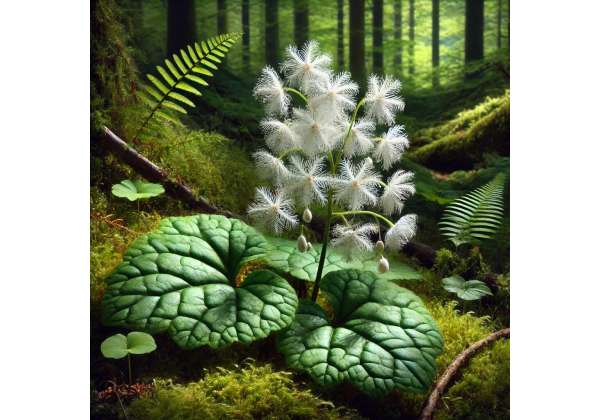
Foam flower, botanically known as Tiarella cordifolia, is a woodland perennial better known for its airy white blooms than for its medicinal history. Yet this shade-loving North American plant has a quiet place in traditional herbal records. Native communities and later folk healers used it as a mouthwash, a mild diuretic tea, a soothing wash for sore eyes, and an astringent plant for diarrhea, wounds, and irritated tissues. Those uses point to a simple but interesting profile: foam flower appears to be a tannin-rich herb with drying, toning, and fluid-moving actions rather than a dramatic modern “super herb.”
That distinction matters. Tiarella cordifolia is not a mainstream medicinal plant, and modern clinical research on it is extremely limited. Most of what is known comes from ethnobotanical records, older herbals, and extension or botanical sources. Still, the plant is worth understanding because it offers a good example of how a modest woodland herb can have narrow, practical folk uses. The most accurate modern view is careful and restrained: foam flower may be useful in traditional, short-term ways, but its evidence base is thin and its claims should stay modest.
Key Facts
- Foam flower has been used traditionally as a mild diuretic and astringent herb for mouth irritation, sore eyes, diarrhea, and minor wounds.
- Its most plausible active group is tannins, which help explain its drying, toning, and tissue-soothing folk uses.
- There is no validated modern standardized dose; older herbal use relied mainly on weak teas or infusions, often about 4 oz per serving up to 2 or 3 times daily.
- Because modern safety data are limited, self-treatment should be brief and conservative.
- Pregnant or breastfeeding people, small children, and anyone with kidney disease or persistent eye symptoms should avoid unsupervised medicinal use.
Table of Contents
- What is foam flower?
- Foam flower active compounds
- Traditional urinary and digestive uses
- Foam flower for mouth, eyes, and wounds
- How to use foam flower
- How much foam flower per day?
- Side effects and who should avoid it
- What the research actually says
What is foam flower?
Foam flower, or Tiarella cordifolia, is a low-growing perennial native to moist woodlands of eastern North America. It belongs to the saxifrage family and spreads by runners to form small colonies of heart-shaped leaves topped by frothy spikes of tiny white flowers. In garden writing, it is usually treated as an ornamental shade plant. In older herbal and ethnobotanical records, however, it appears under names such as coolwort, false miterwort, and foamflower, with several modest medicinal uses attached to it.
The first important point is that foam flower is not a major pharmacopoeial herb. It was never as famous as echinacea, goldenseal, marshmallow, or willow bark. Its medical reputation is quieter and more regional. That does not make it worthless. It means it should be understood on its own scale. Folk uses focused on the leaves and roots, usually in the form of infusions, washes, or poultices rather than highly concentrated extracts.
A second point is that most traditional uses are astringent or fluid-related. Records describe leaf tea as a diuretic, root or leaf infusions as mouthwashes, and crushed roots or plant washes for wounds, sore eyes, diarrhea, and irritated skin. Those are all conditions where a tannin-rich herb could make practical sense. This pattern suggests foam flower was valued less as a strong internal medicine and more as a useful household plant for minor complaints.
Native American records are especially important to the plant’s history. Reported uses include mouth care, sore-eye washes, diarrhea support, wound poultices, and mild tonic or diuretic uses. Some older herbal sources also extend its role to bladder, liver, and “gravel” complaints, but those claims should be read carefully. They come from historical materia medica rather than modern clinical testing.
Another useful distinction is between foam flower’s historical identity and its modern reputation. Today, most people know it only as a woodland garden plant. As a result, there is a gap between its ornamental profile and its folk-medicine record. That gap can tempt writers to overcompensate and turn it into a hidden miracle herb. That would be inaccurate. The better reading is simpler: this is a modest native woodland plant with a narrow but interesting herbal past.
In modern terms, foam flower is best approached as a lightly documented folk herb with traditional astringent, diuretic, and topical uses. It is not an evidence-based primary treatment for kidney disease, eye infection, digestive disease, or chronic mouth disorders. But as a historical medicinal plant, it remains worth documenting carefully and honestly.
Foam flower active compounds
Foam flower is one of those plants where the chemistry appears simpler than the folklore around it. The most consistently reported medicinal clue is its high tannin content. That matters because tannins are among the plant compounds most strongly associated with astringent action. Astringent herbs tend to dry, tone, and tighten superficial tissues. They can reduce weepy irritation, support minor wound care, and sometimes help with diarrhea or inflamed mucous membranes. That single chemical pattern already explains much of foam flower’s folk use.
Tannins also help explain why the herb was used as a mouthwash and sore-eye wash in historical sources. When diluted and used appropriately, tannin-rich plants can create a tightening, drying sensation that some traditions valued in mouth sores, coated tongue, and mild tissue irritation. The same logic applies to wound dressings and irritated skin. In other words, foam flower does not need exotic phytochemistry to make historical sense. A strong tannin profile is enough to explain a lot.
Older sources also suggest that the plant likely contains other common polyphenolic compounds, including flavonoid-type constituents. Chemotaxonomic work in the genus Tiarella has pointed to flavonoid chemistry, though foam flower has not been studied with the same depth given to better-known medicinal species. That means it is reasonable to describe the plant as polyphenol-rich, but not reasonable to claim a fully mapped list of active compounds with modern pharmacological certainty.
A practical way to think about the plant’s chemistry is this:
- Tannins are the most likely main medicinal contributors.
- Additional polyphenols may support mild antioxidant or tissue-protective effects.
- The plant does not have a well-established modern extract profile.
- No specific modern standardized “marker compound” defines commercial use.
This last point matters for readers looking for supplement-style certainty. Foam flower is not like turmeric, berberine, or milk thistle, where named compounds drive much of the commercial discussion. Its medicinal story is still rooted in whole-plant traditional use. That tends to make the plant feel less impressive in modern marketing terms, but also more realistic historically.
There is another subtle but useful insight here. Tannin-rich plants often work best externally or in short, targeted internal use. They are not usually ideal as broad daily tonics because too much astringency can become irritating or overly drying. That fits foam flower well. Its likely chemistry argues for narrow, practical uses rather than chronic supplement use.
For comparison, this puts foam flower closer to herbs valued for local tissue support than to flashy systemic remedies. Readers who know witch hazel for astringent topical use will recognize the general idea, although the plants are not chemically identical and should not be treated as interchangeable. Foam flower’s chemistry supports a modest herbal role, not a dramatic one.
So when people ask about the “key ingredients” in foam flower, the clearest answer is tannins first, likely some additional polyphenols second, and a great deal of uncertainty after that. The plant’s active profile is plausible, but far from fully established.
Traditional urinary and digestive uses
Foam flower’s internal folk uses cluster around two themes: fluid movement and astringent support. Older records describe leaf tea as a diuretic, while other herbal sources extend the plant’s use to bladder complaints, gravel, mild liver support, indigestion, and dyspepsia. The key to reading these claims responsibly is to distinguish traditional use from modern proof. These are historical patterns, not clinically validated indications.
The diuretic story is the most straightforward. A tea made from the leaves was reportedly used to increase urine flow, and some later herbals described the plant as helpful for fluid retention, bladder discomfort, or urinary gravel. This does not mean foam flower is a proven treatment for kidney stones, urinary tract infection, or edema from heart or kidney disease. It means older herbalists regarded it as a mild fluid-moving herb. In practical terms, that places it in the same broad conceptual family as gentle urinary supports like corn silk for mild urinary comfort, though foam flower is far less established and much less commonly used today.
Its digestive uses make sense for a different reason. Tannins can sometimes help reduce excess secretions and soothe irritated mucous membranes, which may explain why the plant was used for diarrhea and indigestion. A tannin-rich herb may be useful when the problem is loose, inflamed, and overactive rather than sluggish and heavy. That distinction matters. Foam flower does not fit the role of a warming digestive stimulant like ginger or gentian. It fits better as a drying, toning herb in minor digestive upset.
Historically reported internal uses include:
- Mild diuretic tea from the leaves
- Support for bladder or gravel complaints
- Help with diarrhea
- Relief for indigestion or dyspepsia
- General tonic use in older herbals
This is a very different evidence level than saying the plant “supports kidney and liver health” in a modern supplement sense. Readers should be careful with that kind of wording. When older herbals say a plant was “hepatic” or “tonic,” they often mean it was considered helpful in general function, not that it has demonstrated organ-specific biochemical effects in modern trials.
A useful insight here is that foam flower was likely chosen because it was available, not because it was uniquely powerful. In woodland communities, a nearby native plant with mild astringent and diuretic effects could easily become part of household medicine. That helps explain why it appears in ethnobotanical records even though it never became a dominant commercial herb.
The most honest modern takeaway is that foam flower’s urinary and digestive uses are traditional and plausible, but weakly evidenced. They may reflect real mild actions, especially from tannins and astringency, but they do not support strong modern claims. For readers who want better-supported urinary or digestive herbs, there are more studied options. Foam flower remains historically interesting rather than clinically settled.
Foam flower for mouth, eyes, and wounds
Foam flower’s most specific and compelling folk uses are local ones: mouth complaints, sore eyes, wounds, skin irritation, and minor superficial inflammation. This is the part of its traditional profile that makes the most practical sense, because tannin-rich herbs have long been used where tissue tone, drying, and mild antimicrobial support are desirable.
One traditional use involved holding an infusion in the mouth to remove a white coating from the tongue or help with mouth sores. In modern terms, this sounds like a folk approach to oral thrush-like symptoms or nonspecific mouth irritation. The same general logic applies to sore-eye washes in older records. Herbalists and Native communities often used very dilute plant infusions externally in ways that modern medicine would approach much more cautiously. That does not make the old practice meaningless, but it does mean we should not translate it directly into modern eye self-treatment. Eye symptoms today deserve more caution because infection, corneal injury, and allergic disease can look similar early on.
Topical wound use appears in several traditional reports. Crushed roots were used as poultices on wounds, and extension sources describe foam flower as useful because of its astringent tannin content. This is plausible. Astringent plants can help dry excess moisture, reduce mild irritation, and support superficial tissue contraction. In the same broad way, foam flower resembles traditional topical herbs such as calendula for minor skin support, though calendula has a much richer modern herbal literature.
The local folk uses often include:
- Mouthwash for white-coated tongue or sore mouth
- Dilute wash for sore eyes
- Poultice for wounds
- Astringent support for sores
- External use for irritated skin
The most important modern lesson is restraint. Topical foam flower may be reasonable to discuss as a historical astringent herb for minor superficial complaints, but that is not the same as recommending it for open wounds, infected skin, or eye inflammation without proper care. Folk use and clinical recommendation are not identical.
There is also a practical reason local uses may have survived longer than internal ones. With a tannin-rich plant, you can often feel the action quickly. The drying, tightening effect in the mouth or on the skin is obvious. Internal effects, by contrast, are milder and easier to overinterpret. So it makes sense that foam flower remained remembered as a wash, mouth herb, and poultice plant in regional traditions.
This is probably where foam flower was most useful historically: not as a daily health tonic, but as a household plant for small, local, practical problems. That modest framing is important. It honors the record without exaggerating it. Foam flower may have had real value for mouth, skin, and wound support in folk settings, but modern use should stay cautious, limited, and very clear about when professional care is needed.
How to use foam flower
Foam flower was used primarily as a tea, infusion, wash, or poultice rather than as a modern capsule herb. That matters because the plant’s likely active profile, especially its tannins, suits water-based traditional preparation better than flashy extract marketing.
The simplest internal form is a weak tea or infusion made from the leaves, roots, or both. Historically, this was used as a mild diuretic, tonic, or digestive aid. Because the evidence is so limited, the safest modern approach is not to treat foam flower as a routine internal supplement. It makes more sense to view it as an old household tea herb that, where used at all, should be used briefly and conservatively.
External forms make more historical sense. These include:
- A cooled infusion as a mouth rinse
- A diluted external wash for minor skin irritation
- A poultice from crushed roots or plant matter for superficial wounds
- A gentle wash for external use only, not for deep tissues
This pattern reinforces a useful point: foam flower is mostly a folk-preparation herb, not a standardized extract herb. That distinguishes it from plants that have been fully absorbed into the supplement industry. There is no major tradition of measured capsules, tincture standards, or commercial extract profiles around Tiarella cordifolia. If readers encounter such products, they should realize they are moving beyond the strongest historical record.
A practical way to match the form to the traditional goal looks like this:
- For urinary or digestive folk use, a weak tea was the usual form.
- For mouth complaints, a rinse or held infusion made more sense.
- For wounds or skin irritation, external poultice or wash use was more common.
- For eye complaints, historical use exists, but modern self-use is not advisable.
That last point deserves emphasis. Historical sore-eye use should be read as ethnobotany, not as a modern home remedy recommendation. Eye symptoms can worsen quickly, and contamination risk matters.
Another important consideration is plant identification. Foam flower is usually grown as an ornamental now, and the name Tiarella cordifolia has also gone through taxonomic clarification in recent years. That means casual foragers may not always be working with exactly the species concept described in older literature. Accurate identification is part of safe use.
For readers looking for better-supported ways to soothe mucous membranes or irritated tissues, plants like marshmallow root for gentler mucosal support may be easier to justify in modern herbal practice. Foam flower remains more of a historical regional remedy than a mainstream herbal medicine.
So how should it be used today? Carefully, sparingly, and mostly as a documented folk herb rather than a modern evidence-based treatment. It is a plant best understood before it is used.
How much foam flower per day?
This is the section where caution matters most: there is no validated modern standardized medicinal dose for foam flower. No widely accepted monograph defines a safe daily range, and no modern clinical trials have established what an effective oral dose should be. That means any dosage discussion must be framed as traditional or historical, not evidence-based in the modern sense.
Older herbal texts give the clearest dosing pattern. One traditional infusion or decoction formula described using 1 ounce of herb to 1 pint of water, with 4 ounces of the infusion taken 2 or 3 times daily until symptoms improved. That is a substantial old-style herbal dose, and it reflects a different era of materia medica rather than a current clinical standard. It is useful mainly as a historical reference point.
Modern practical dosing, if the plant is used at all, should be more conservative than old herbal texts suggest. A reasonable safety-first framework would be:
- Prefer weak tea rather than strong decoction
- Use short-term only
- Limit internal use to a narrow purpose
- Stop quickly if the herb causes stomach upset or excessive dryness
For topical use, amount matters less than concentration and application site. A mild cooled infusion used as a mouth rinse or external wash is more sensible than a concentrated extract. Stronger preparations are not automatically better with tannin-rich herbs. Excess astringency can irritate tissues just as easily as it can tone them.
A good way to think about foam flower dose is not “How much can I take?” but “How little would still fit the historical use?” This is especially important because the plant is not well studied, not commercially standardized, and not a major current medicinal herb. With plants like this, low-intensity use is usually more defensible than aggressive dosing.
Timing also depends on the purpose:
- Internal folk use was usually divided across the day
- Mouthwash use was local and repeated briefly as needed
- Topical poultices or washes were applied to the affected area for short courses
The most sensible stopping rules are simple:
- Do not continue self-use if symptoms worsen.
- Do not continue internal use beyond a short trial.
- Do not use historical eye-wash traditions as a reason to delay proper care.
- Do not assume “natural” means you can improvise freely.
Readers looking for a better-established mild diuretic tea often end up with dandelion leaf or root traditions instead, because those have a clearer modern herbal context. Foam flower does not. Its dosing is mostly a matter of historical record and modern restraint.
So the bottom line is clear: a traditional dose exists in older herbals, but a validated modern dose does not. That gap should shape how cautiously the herb is approached.
Side effects and who should avoid it
Because foam flower is not a well-studied medicinal herb, its safety profile is defined more by caution than by detailed modern data. That means the right question is not “What serious adverse effects are proven?” but “What risks make unsupervised use a poor idea?” On that question, several common-sense cautions stand out.
The most likely side effects come from the plant’s likely tannin content. Tannin-rich herbs can cause:
- Dryness of the mouth or digestive tract
- Stomach upset if taken too strong or too often
- Nausea in sensitive users
- Irritation if overused on already damaged tissues
Topical use can also be irritating if the preparation is too concentrated. This is especially true on broken skin or mucous membranes. Astringent herbs need dilution and restraint, not a “stronger is better” approach.
Who should avoid foam flower unless guided by a knowledgeable clinician?
- Pregnant people
- Breastfeeding people
- Young children
- People with kidney disease
- Anyone with persistent eye symptoms
- Anyone with chronic digestive disease or unexplained diarrhea
Pregnancy and breastfeeding are caution areas simply because modern safety data are missing. There is no good reason to take a poorly studied folk herb during these stages when safer and better-known options exist. The same logic applies to children. Historical use in babies or children does not create modern proof of safety.
Eye use deserves special emphasis. Old records describing leaf infusions for sore eyes are interesting historically, but they should not be translated into modern self-treatment advice. Eye symptoms are high-stakes. Infection, abrasion, allergy, chemical exposure, and more serious conditions can look similar at first. A home infusion is not a reliable or sterile solution.
Internal use also should not replace proper care for:
- Painful urination
- Suspected kidney stones
- Blood in urine
- Persistent indigestion
- Ongoing diarrhea
- Mouth sores that do not heal
This is where foam flower’s modesty becomes its safety lesson. The plant belongs in the category of gentle folk remedies, and gentle folk remedies are easiest to misuse when people ask them to do more than they ever realistically could.
The most sensible modern safety rule is simple: treat foam flower as a historically interesting herb with limited evidence and limited data, not as a casual daily remedy. If someone wants an astringent herb for local support or a mild diuretic tradition, there are often better-known options. Foam flower is safest when it is approached with curiosity, restraint, and a willingness to stop early.
What the research actually says
Foam flower is a good example of a plant with more ethnobotanical value than modern clinical validation. The strongest evidence is traditional. The weakest evidence is modern human research. That is not a criticism of the plant. It is simply the reality of the literature.
What is documented fairly well is the plant’s folk-use pattern. Native American and regional records repeatedly associate Tiarella cordifolia with mouth care, sore eyes, diarrhea, wounds, mild diuretic use, and general tonic applications. The plant also appears in older medicinal plant guides from Appalachia, which confirms that its herbal use persisted beyond purely Indigenous records and entered regional materia medica.
What is only modestly documented is chemistry. Several modern and near-modern botanical sources describe the plant as rich in tannins, and older chemotaxonomic work in the genus points to flavonoid chemistry. That is enough to create a plausible pharmacological story. A tannin-rich woodland herb could reasonably have astringent, drying, and superficial tissue-supportive uses. But plausible chemistry is not the same as tested efficacy.
What seems to be almost absent is modern clinical evidence. No meaningful human trial base has developed around foam flower. There is no accepted therapeutic monograph comparable to those for widely used European medicinal herbs. There is no modern dosing standard derived from trials. There is no clear body of toxicology beyond general caution. That leaves the herb in a narrow evidentiary category: historically documented, pharmacologically plausible, and clinically underdeveloped.
A practical evidence ranking looks like this:
- Strongest: ethnobotanical and folk-medicine documentation
- Moderate: general plausibility from high tannin content
- Weak: modern phytochemical detail specific to medicinal action
- Very weak: direct human outcome data
- Unresolved: long-term safety, standardization, and effectiveness
This matters because it prevents two common mistakes. The first is dismissing the plant entirely because it lacks clinical trials. That would ignore the value of well-documented traditional knowledge. The second is inflating it into a hidden therapeutic gem. That would ignore how little modern confirmation actually exists.
Foam flower is most honestly described as a historical astringent and mild diuretic folk herb. Its probable benefits are narrow, local, and modest. Its medicinal claims should stay close to that record. If readers want a plant that is deeply studied, this is not it. If they want a careful picture of a real but lightly evidenced traditional herb, foam flower is a very good example.
That may actually be its most useful lesson today: not every medicinal plant needs to be turned into a modern cure-all to be worth understanding.
References
- Tiarella cordifolia (Piedmont Foamflower) – FSUS 2025
- A guide to medicinal plants of Appalachia 1969
- Discover the Tiarella 2007
Disclaimer
This article is for educational purposes only and does not replace medical advice, diagnosis, or treatment. Foam flower is a lightly documented folk herb, not a clinically established therapy. Do not use it to self-treat urinary pain, suspected kidney stones, eye infections, persistent diarrhea, chronic mouth sores, or worsening wounds. Because safety data are limited, avoid medicinal use during pregnancy, breastfeeding, and in children unless advised by a qualified healthcare professional.
If you found this article helpful, please share it on Facebook, X, or your preferred platform so more readers can find careful, evidence-aware information about foam flower.