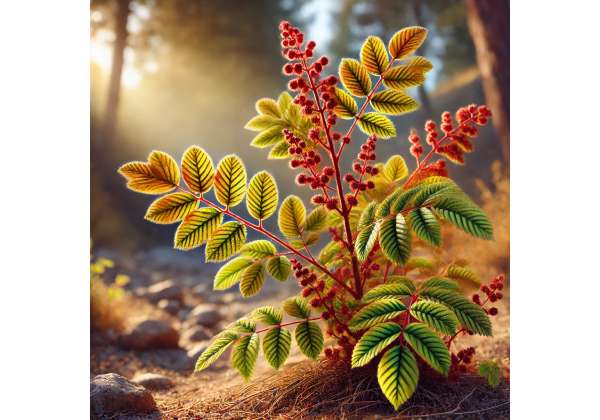
Fragrant sumac, or Rhus aromatica, is a North American shrub best known for its lemon-scented leaves, bright red fruits, and longstanding place in traditional Indigenous and regional plant use. It is not a mainstream herbal supplement in the modern sense, yet it has several qualities that make it worth a closer look. Its leaves, bark, and fruit are naturally rich in tannins and other polyphenols, which helps explain its traditional reputation as an astringent plant for minor bleeding, tissue tightening, and soothing irritated surfaces. Newer research also points to antioxidant potential in the fruit, aromatic volatile compounds in the leaves, and interesting antiviral activity in laboratory settings.
Still, fragrant sumac is a plant where context matters more than hype. It is different from the culinary Mediterranean sumac used as a spice, and it is not backed by strong human clinical trials. The most practical way to understand it is as a traditional astringent and tart edible fruit shrub with promising chemistry, modest real-world herbal use, and a safety profile that calls for restraint rather than casual experimentation.
Key Facts
- Fragrant sumac is mainly valued for astringent, antioxidant, and traditional topical-support properties.
- The fruit can be used as a tart beverage base, while leaves and bark are the more strongly astringent parts.
- A conservative traditional-style infusion range is about 2 to 4 g dried fruit per 240 to 250 mL water.
- Medicinal use should be cautious because there is no standardized human dose and little clinical evidence.
- Pregnant or breastfeeding people, children, and anyone with strong Anacardiaceae allergies should avoid medicinal use.
Table of Contents
- What is fragrant sumac exactly?
- Key compounds and why they matter
- What can fragrant sumac help with?
- How is fragrant sumac used?
- How much should you take?
- Side effects and who should avoid it
- What the evidence actually says
What is fragrant sumac exactly?
Fragrant sumac is a low, spreading shrub in the Anacardiaceae family, the same broad family that includes cashew, mango, and the poison ivy group. It is native to much of North America and grows in open woods, rocky slopes, roadsides, and dry banks, often forming thickets through root suckers. The plant is especially easy to recognize by its trifoliate leaves, its strong scent when the foliage is crushed, and its dense clusters of red, hairy drupes. In the landscape it is often planted for erosion control, drought tolerance, and vivid orange-red fall color, but its medicinal story is older than its landscaping popularity.
Traditional use focused less on the showy shrub and more on what its parts could do. The fruit was made into a tart drink similar to “Indian lemonade.” The bark and leaves were valued for their high tannin content and used where an astringent effect was desired. Historical records also describe use for dyeing, tanning leather, smoking mixtures, and minor medicinal purposes linked to bleeding, diarrhea, sore tissues, and surface irritation. That profile tells you a lot about the herb’s character: fragrant sumac is not primarily a stimulant, sedative, or nutritive tonic. It is, above all, an astringent plant.
That astringent identity matters because many online descriptions blur fragrant sumac with other members of the genus. The most common mix-up is with culinary sumac, usually Rhus coriaria, the red spice used in Middle Eastern cooking. They share a genus name and some broad polyphenol chemistry, but they are not interchangeable. Culinary sumac has a much deeper food tradition and a much larger modern research base. Fragrant sumac is a regional wild shrub with a smaller evidence base and more limited medicinal standardization.
It is also worth separating fragrant sumac from poison sumac. Despite the similar common names, poison sumac belongs to the Toxicodendron group and is the plant associated with strong urushiol dermatitis. Fragrant sumac is not poison sumac. Still, because it sits in the same larger family as several reactive plants, people with a history of severe contact dermatitis to related species should approach any medicinal use carefully.
A practical way to picture fragrant sumac is this: it is a traditional North American shrub whose leaves and bark behave like tannin-rich astringents and whose fruits behave more like tart, antioxidant-rich wild drupes. That combination makes it interesting, but it also sets limits. This is not a polished capsule herb with standardized extracts. It is a plant where identity, plant part, and purpose matter. If you want a food spice, this is not the first choice. If you want a regional astringent herb with edible fruit and modest medicinal promise, it becomes much more relevant.
Key compounds and why they matter
Fragrant sumac’s medicinal profile comes from several overlapping groups of compounds rather than one famous active ingredient. That is both a strength and a complication. It helps explain the plant’s broad traditional use, but it also means one preparation can behave quite differently from another. A fruit infusion, a bark decoction, and an essential-oil analysis are not describing the same thing.
The first group to know is tannins. These are probably the most important compounds for understanding fragrant sumac as an herb. Tannins bind proteins and create the tightening, drying, puckering effect people notice in strong tea, pomegranate rind, or tannin-rich bark remedies. In herbal terms, that can translate into less surface seepage, a firmer feel in mucous membranes, and a traditional role in gargles, washes, and minor wound care. It also helps explain why fragrant sumac bark and leaves were historically useful for tanning leather. A plant that can tan hide will usually behave as a strong astringent on tissue too.
The second major group is polyphenols and flavonoids. Recent fruit studies on Rhus aromatica varieties report notable phenolic and flavonoid content, along with measurable antioxidant activity across different extracts. That does not automatically mean the herb produces dramatic health effects in people, but it does support the idea that the fruit contains bioactive compounds capable of scavenging free radicals in laboratory assays. This is part of why the fruit draws attention as a functional wild food rather than just a decorative berry.
The third group is volatile compounds. A recent essential-oil study found that fragrant sumac leaf material contained a volatile profile dominated by limonene, with smaller amounts of sesquiterpenes that shifted over the season. That finding matches the plant’s noticeable lemony aroma. It also gives a chemical basis for the scent that people often describe before they know the plant’s name. An important nuance, though, is that aromatic does not automatically mean therapeutic. A fragrant leaf can smell medicinal without being appropriate for casual essential-oil use or internal dosing.
These compounds matter because they point toward a few likely actions:
- Astringent surface action from tannins.
- Antioxidant behavior from polyphenols and flavonoids.
- Aroma-linked bioactivity from volatile compounds.
- Possible antiviral or antimicrobial effects in certain extracts.
A helpful comparison is witch hazel for topical astringency. Both plants are best understood through their tannin-driven behavior, even though their chemistry and clinical traditions are not identical. That comparison also shows why fragrant sumac is more promising for topical or short-term astringent use than for broad internal wellness claims.
One more point deserves emphasis: plant part matters. The fruit is the gentlest and most food-like part. The leaves and bark are more astringent. Roots appear in traditional records, but modern home use with roots is harder to justify because potency is less predictable and dosage is less clear. When readers ask whether fragrant sumac is “good for health,” the better answer is to ask which part, in what form, and for what outcome. With a plant like this, chemistry is not just science trivia. It is the reason safe use depends on details.
What can fragrant sumac help with?
The most realistic benefits of fragrant sumac are modest, local, and traditional rather than dramatic or highly clinical. That may sound underwhelming, but it is actually useful. Many herb profiles become less trustworthy when they turn every antioxidant assay into a promise of disease prevention. Fragrant sumac deserves a narrower, more honest framing.
Its most plausible benefit is astringent support. In traditional use, astringent plants are chosen when tissue feels lax, wet, irritated, or overly secretory. That can include minor mouth and throat irritation, superficial skin complaints, or short-term digestive looseness. Fragrant sumac fits that old herbal logic well because of its tannin-rich bark and leaves. The goal is not to “treat disease” in a modern drug sense. The goal is to tighten and calm tissue for a limited period.
Its second plausible benefit is antioxidant support from the fruit. Recent work on Rhus aromatica fruit found meaningful polyphenol, flavonoid, and antioxidant values, which supports the idea that the berries are more than ornamental. In practice, that makes fragrant sumac more interesting as a tart wild food or beverage ingredient than as a high-potency supplement. A sour berry drink made from correctly identified fruit is a more believable use than a sweeping claim that the plant protects against chronic disease.
Its third intriguing area is antiviral potential, but this is where careful language matters. One laboratory study found strong in vitro activity of an aqueous fragrant sumac extract against herpes simplex viruses. That is scientifically interesting. It does not mean people should self-treat herpes infections with homemade bark remedies. It means the plant has constituents worth studying further.
Potential real-world uses people most often ask about include:
- Gargles or rinses for mild mouth and throat irritation.
- Topical washes for minor superficial skin problems.
- Traditional astringent support for short-lived diarrhea.
- Tart fruit infusions as a wild food beverage.
- General interest in antioxidant-rich native fruits.
Less realistic uses include broad immune boosting, detox claims, hormone balance, or chronic disease treatment. The evidence is not there. A good rule is that fragrant sumac may be suitable when you want a short-term, tannin-rich, traditional herb and not suitable when you want a well-validated internal botanical for long-term health management.
If your interest is mostly in sour red fruits with a better-known health profile, cranberry and other tart berry supports are easier to place in modern practice. Fragrant sumac is more niche and more dependent on regional knowledge.
One subtle but important insight is that fragrant sumac may be more useful as a “form herb” than a “condition herb.” In other words, it is chosen because it is sour, drying, tannic, and aromatic, not because it has a long list of condition-specific human trials. That makes it valuable to experienced herbalists who think in patterns, but it also explains why it can disappoint readers looking for a supplement-style evidence sheet. The herb has real promise, but its best uses remain traditional, targeted, and limited in scope.
How is fragrant sumac used?
Fragrant sumac is used in a few very different ways, and the safest approach depends on which part of the plant you are working with. The fruit is the most approachable starting point because it has a food tradition. The leaves and bark are more medicinal in character because of their astringency. That difference should shape preparation.
The fruit is often prepared as a tart infusion or steeped drink. This is the classic “sumac lemonade” style use, although fragrant sumac fruits are usually smaller and less abundant than those of some other sumac species. The goal is a pleasantly sour, mildly astringent beverage rather than a concentrated extract. This kind of preparation fits the fruit’s identity as an edible wild ingredient with antioxidant potential.
Leaves and bark are used more like astringent herb material. In traditional herbal logic, these parts are better suited to short-term rinses, gargles, compresses, or carefully limited decoctions. The stronger the astringency, the more important it is to match the preparation to the purpose. A mouth rinse is one thing. A strong daily internal decoction for weeks is another.
Common practical forms include:
- Fruit infusion
Crushed ripe dried fruit steeped in cool or warm water for a tart drink. - Gargle or mouth rinse
A diluted infusion or decoction used briefly for mild throat or oral irritation, then spit out. - Topical wash or compress
A weak bark or leaf preparation applied to minor, non-deep skin irritation. - Traditional short-term decoction
Used more cautiously when a stronger astringent effect is desired.
There are also a few practical mistakes to avoid:
- Do not assume all sumac species are interchangeable.
- Do not harvest near roadsides, herbicide-treated banks, or sprayed ornamental sites.
- Do not treat “wild edible” as proof that any amount is safe.
- Do not use concentrated bark preparations casually.
- Do not confuse fragrant sumac with poison sumac.
For minor external irritation, readers often compare it with calendula for irritated skin and gentle topical support. That comparison is helpful because calendula is softer, more soothing, and less tannic, while fragrant sumac is more drying and tightening. One is not automatically better. They simply have different personalities.
Preparation style should also match the outcome you want. If the goal is a refreshing seasonal drink, the fruit is the logical part. If the goal is a firming gargle or wash, the bark or leaves make more sense. If the goal is long-term internal health support, fragrant sumac is usually not the first herb to choose.
A final practical note: with native shrubs, correct identification is part of safe use. Fragrant sumac has three leaflets, but so do several plants people fear or misidentify. The red fruit clusters, fragrant crushed leaves, shrub habit, and habitat can help distinguish it from more problematic look-alikes. Good herbal use starts with botany, not with recipes. That is especially true for lesser-known shrubs where the distance between a folk remedy and a mistake can be small.
How much should you take?
Fragrant sumac has no well-established modern medicinal dosage. That is the most important dosage fact, and it should come first. There are no standard monographs, no widely accepted clinical dosing guidelines, and no familiar commercial extracts that define a normal therapeutic range. Any dosage advice therefore needs to be conservative, form-specific, and framed as traditional use rather than evidence-based prescription.
For the fruit, the gentlest approach is a food-style infusion:
- About 2 to 4 g dried crushed fruit per 240 to 250 mL water.
- Steep for 10 to 20 minutes, then strain.
- Use once or twice daily as a short-term beverage.
This is not a magic number and should not be presented as one. It is simply a modest range that respects the fruit’s tart, polyphenol-rich character without pushing it into concentrated medicinal territory. Some people prefer a cool steep rather than a stronger hot extraction when the goal is a lighter drink.
For a traditional gargle or rinse, a similar or slightly stronger preparation may be used briefly and then spit out. Because tannin-rich herbs can feel drying, this is best reserved for short-term use over a few days, not as a permanent daily habit.
Leaves and bark are harder to dose well at home because they are more potent in astringency. A cautious traditional preparation might use a small amount of dried material as a short decoction, but this is where variation becomes a real problem. Bark age, harvest conditions, drying quality, and extraction time all affect how strong the final liquid becomes. For that reason, casual internal bark use is not something I would encourage.
A few dosage rules are worth keeping in mind:
- Start with the fruit, not the bark.
- Think in days, not months.
- Stop if the mouth, throat, or stomach feels overly dry or irritated.
- Separate oral use from medicines by a few hours if possible, since tannin-rich plants may reduce absorption in theory.
- Avoid medicinal dosing in children.
Duration matters just as much as quantity. Fragrant sumac is better suited to brief, situational use than to long daily courses. If someone is using it for mouth irritation, loose stools, or a topical rinse, the usual question should be whether the issue is resolving within a short window. If it is not, the right solution is reassessment, not simply more herb.
If your main goal is urinary support rather than astringent surface action, uva ursi for urinary-focused traditional use is a better-known point of comparison. Fragrant sumac appears in older discussions of urinary complaints, but that historical thread is too thin to justify confident modern dosing.
So the practical answer is simple: there is no proven medicinal dose, but there is a reasonable conservative range for fruit infusion. That makes fragrant sumac a plant to sip lightly, gargle briefly, or apply thoughtfully, not one to megadose.
Side effects and who should avoid it
Fragrant sumac is not known as a highly toxic herb, but “not highly toxic” is not the same as “freely medicinal.” Its safety questions come less from dramatic poisoning reports and more from limited human data, tannin intensity, species confusion, and family-related sensitivity concerns.
The most likely short-term side effects come from its astringency. Taken too strong or too often, tannin-rich preparations may leave the mouth feeling rough, the throat dry, or the stomach unsettled. In some people they can contribute to nausea, constipation, or general digestive discomfort, especially when bark or leaf preparations are concentrated. That does not make the plant dangerous in all forms. It means the line between helpful and overly drying can be narrow.
Allergic or irritant reactions are another concern. Fragrant sumac is not poison sumac, and it is not the same plant as poison ivy. Still, it belongs to the same broader family, so people with a history of strong sensitivity to Anacardiaceae plants should be cautious. The safest assumption is not that fragrant sumac will cause a rash in everyone, but that very sensitive individuals should patch-test topical use and avoid adventurous internal use.
Groups that should avoid medicinal use include:
- Pregnant people.
- Breastfeeding people.
- Young children.
- Anyone with a history of severe plant-contact dermatitis.
- Anyone using it in place of care for persistent diarrhea, oral lesions, or skin infection.
- People with chronic digestive irritation who do poorly with drying herbs.
Interaction data are limited. There are no well-defined drug-interaction studies for fragrant sumac itself, but the general chemistry suggests a few practical cautions. Strong tannin-rich herbs may interfere with the absorption of certain medications, iron, and minerals if taken at the same time. That is not a proven fragrant sumac interaction list. It is a sensible caution based on how astringent polyphenols behave.
There is also a safety issue that has nothing to do with chemistry: misidentification. Many readers recognize the phrase “sumac” but do not identify shrubs confidently. Using the wrong species is a bigger risk than most article readers expect. That is why medicinal use of bark or leaves is best left to people who know the plant well.
Another reason for caution is evidence quality. When clinical data are scarce, side effects are easier to underestimate because usage patterns are not well mapped. That is a good reason to choose the mildest effective form, use it briefly, and stop at the first sign that the herb is not a good fit.
If you mainly want a better-established soothing topical herb, plantain for minor skin support is often easier to use and better tolerated. Fragrant sumac is more drying, more niche, and more dependent on proper preparation.
The safest bottom line is this: fruit used lightly as a traditional beverage is the lowest-risk path. Bark and leaf medicines deserve more restraint. When there is uncertainty, caution is not a limitation of herbal knowledge. It is part of good herbal practice.
What the evidence actually says
The evidence for fragrant sumac is promising but thin. That is the clearest summary. There is enough research to show the plant contains interesting bioactive compounds and that some extracts do meaningful things in laboratory settings. There is not enough research to support confident human therapeutic claims for most health conditions.
The strongest modern evidence clusters into three areas.
First, phytochemistry and antioxidant activity. Recent work on Rhus aromatica fruit, especially the Mexican variety var. schmidelioides, shows appreciable phenolic compounds, flavonoids, carotenoids, and antioxidant activity in different extracts. This supports the idea that the fruit is a genuine bioactive wild food. It does not prove that drinking fragrant sumac infusion will transform health markers in people. It does mean the plant has real chemical substance behind its reputation.
Second, volatile-oil chemistry. A recent essential-oil study found that Rhus aromatica aerial material yielded oil dominated by limonene, with the profile shifting over the season. This is useful because it gives a chemical explanation for the plant’s fragrance and shows that harvest timing can change the result. It also reminds us that “fragrant” is not just a poetic common name.
Third, in vitro antiviral activity. A well-cited laboratory study found strong activity of an aqueous fragrant sumac extract against HSV-1 and HSV-2 in cell culture. That is one of the most specific pharmacological findings on the plant. Yet it remains an in vitro result. It supports scientific interest, not home treatment instructions.
What is missing is just as important:
- No strong human trials for routine medicinal use.
- No standardized dosage model.
- Very little safety mapping for repeated internal use.
- Limited species-specific clinical evidence compared with more established herbs.
This is where genus confusion can mislead readers. Reviews of other Rhus species, especially culinary sumac, show anti-inflammatory and antioxidant promise, but that does not automatically transfer to fragrant sumac in the same dose, form, or use case. Shared family chemistry is helpful context, not proof of interchangeability.
A useful comparison is green tea and other evidence-backed polyphenol-rich plants. Fragrant sumac may contain interesting antioxidants, but it is nowhere near that level of human evidence. That does not diminish its value. It just places it accurately.
So what should a thoughtful reader conclude? Fragrant sumac is a legitimate traditional plant with credible astringent use, edible fruit, interesting phytochemistry, and a notable lab antiviral signal. It is not a clinically validated supplement for daily disease management. In practical herbal terms, it belongs in the category of “worth knowing, worth respecting, and not worth exaggerating.” That balance is what keeps both the tradition and the science honest.
References
- Seasonal Variation in Essential Oil Composition and Yield of Rhus aromatica Aiton (Fragrant Sumac) and a Preliminary Comparison with Rhus trilobata 2025
- Phenolic Compounds and Antioxidant Activity of the Rhus aromatica var. schmidelioides (Schltdl.) Engl. Fruit Extracts 2025
- Physicochemical, nutritional properties, and antioxidant potential of ‘limilla’ fruit (Rhus aromatica var. schmidelioides (Schltdl.) Engl.) 2024
- Antiviral activity of Rhus aromatica (fragrant sumac) extract against two types of herpes simplex viruses in cell culture 2009
- Fragrant sumac (Rhus aromatica) Plant Fact Sheet 2011
Disclaimer
This article is for educational purposes only and is not medical advice. Fragrant sumac is a traditional plant with limited human research, so it should not replace diagnosis, prescription treatment, or poison-control guidance. Speak with a qualified healthcare professional before using it medicinally, especially if you are pregnant, breastfeeding, giving it to a child, taking regular medicines, or have a history of strong reactions to related plants. Seek prompt medical care for persistent diarrhea, severe mouth sores, infected skin problems, or any suspected allergic reaction.
If this article was useful, please share it on Facebook, X, or your preferred platform to help more readers find reliable herbal information.