Fritillary bulb, usually referring to the dried bulb of Fritillaria cirrhosa or closely related pharmacopeial species sold as Chuanbeimu, is a traditional respiratory herb best known for easing cough, loosening stubborn phlegm, and soothing dry, irritated airways. Its reputation comes from a long history in East Asian medicine, where it has been used for lingering coughs, throat dryness, and chest discomfort rather than as a quick fix for every kind of cold. Modern research points to a group of steroidal alkaloids as its most important active compounds, especially peimine, peiminine, imperialine, and related molecules that appear to influence inflammation, mucus handling, and airway reactivity. At the same time, the evidence is still uneven: most of the strongest data come from laboratory and animal studies, not large human trials. That makes fritillary bulb a useful herb to understand carefully. The practical questions are not only what it may help with, but also which product is authentic, how much is reasonable, when to use it, and when to avoid it.
Essential Insights
- Fritillary bulb is used mainly for cough, sticky phlegm, throat dryness, and irritated airways.
- Its best-studied compounds are steroidal alkaloids such as peimine, peiminine, imperialine, and peimisine.
- Traditional crude-bulb use is commonly around 5 to 10 g per day, while extracts vary by product.
- Human research is limited, so benefits should be viewed as supportive rather than proven treatment.
- Avoid unsupervised use during pregnancy, breastfeeding, and with known heart-rhythm problems or QT-prolonging medicines.
Table of Contents
- What is fritillary bulb?
- Key ingredients and how they work
- Does Fritillaria cirrhosa help coughs and phlegm?
- Other possible benefits and uses
- How to use it well
- How much per day?
- Safety and research limits
What is fritillary bulb?
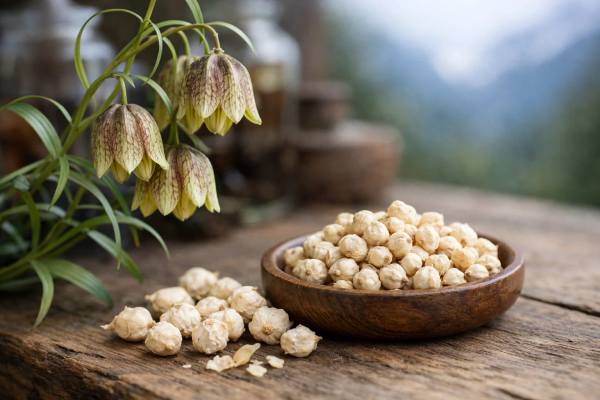
Fritillary bulb is the dried medicinal bulb associated with Fritillaria cirrhosa, a Himalayan and western Chinese alpine plant in the lily family. In practice, the name can be confusing. Some sellers use it narrowly for Fritillaria cirrhosa itself, while others use it more broadly for Fritillariae Cirrhosae Bulbus, a pharmacopeial group that includes several closely related source species. That distinction matters because price, chemical profile, and authenticity can vary a lot from product to product.
Traditionally, this herb is valued for “moistening the lungs,” easing cough, and helping break up difficult phlegm. In modern plain language, that usually translates to use in dry, irritated coughs, coughs that linger after illness, throat discomfort, and chest congestion with sticky sputum. It is not usually presented as a stimulant herb or a general tonic. Its historical niche is respiratory comfort.
The plant itself grows slowly in high-altitude habitats, often above 3,200 meters. That slow growth, paired with strong demand, has contributed to heavy harvesting pressure. As a result, wild populations and related source species have received increasing conservation attention, and the supply chain has become more vulnerable to substitution and adulteration. For buyers, that means identity is not a small detail. A bottle labeled simply “fritillaria” may not tell you enough.
A practical way to think about fritillary bulb is this:
- It is a specialized respiratory herb, not an all-purpose remedy.
- It is species-sensitive, meaning the exact botanical source matters.
- It is premium and commonly substituted, so quality control matters.
- It is better suited to guided use than casual experimentation when symptoms are significant.
Another helpful point is that fritillary bulb is not identical to all other “beimu” products. Some related fritillaries are used for thicker, hotter phlegm patterns or for different traditional indications. So two products with similar common names can behave differently in practice. That is one reason knowledgeable sourcing and clear labeling are important, especially for concentrated extracts and capsules.
Key ingredients and how they work
The best-known active compounds in fritillary bulb are isosteroidal alkaloids. The names that appear most often in research are peimine, peiminine, imperialine, peimisine, and related molecules such as sipeimine and isopeimine. These alkaloids are widely considered the herb’s main pharmacologically active fraction, and many modern papers use them as marker compounds for quality testing.
What do these ingredients seem to do? The short answer is that they appear to act on several pathways at once rather than one single target. That is typical of many herbal medicines. In experimental models, fritillary alkaloids have shown effects that may matter for respiratory symptoms:
- They can reduce inflammatory signaling, including pathways linked to cytokines and cellular stress.
- They may lower mucus-related airway irritation.
- They appear to influence airway remodeling and fibrotic signaling in some animal studies.
- Some compounds may help relax bronchial tension or improve cough-related responses in preclinical models.
That sounds broad, but the pattern makes sense. A lingering cough is rarely just “a cough.” It can involve irritated tissues, inflammatory mediators, sticky secretions, hypersensitive airways, and poor mucus clearance. A multi-compound herb may provide modest support across several of those processes rather than a dramatic effect on just one.
Fritillary bulb also contains smaller amounts of other constituents, including sterols, nucleosides, organic acids, and volatile compounds. These likely contribute to the overall profile, but the alkaloids receive the most attention because they show up most consistently in mechanistic and quality-control research.
From a practical standpoint, the ingredients matter for two reasons. First, they help explain why the herb is used mainly for respiratory discomfort rather than broad wellness claims. Second, they explain why product identity is important. If the alkaloid pattern changes because the species is different or the material is diluted, the expected effect may change as well.
This is also where safety starts to overlap with chemistry. The same steroidal alkaloids tied to benefit are also the reason researchers look closely at possible off-target effects, including cardiac ion-channel effects at higher exposures. So the “key ingredients” story is not just about efficacy. It is also part of why dose, product quality, and sensible caution matter.
Does Fritillaria cirrhosa help coughs and phlegm?
This is the core reason most people look up fritillary bulb, and it is where the herb makes the most sense. Traditionally, Fritillaria cirrhosa is used for coughs that feel dry, irritating, stubborn, or accompanied by sticky sputum that is hard to clear. It is often described as especially suitable when the throat feels scratchy, the chest feels tight from retained mucus, or the cough lingers after the most acute phase of an illness has passed.
The realistic expectation is support, not a guaranteed cough stop. Fritillary bulb is not like taking a fast-acting over-the-counter suppressant that numbs the cough reflex for a few hours. It is better thought of as a herb that may gradually improve the airway environment: less irritation, easier expectoration, and less inflammatory signaling around the cough cycle. That profile lines up with both its traditional use and modern preclinical findings.
What kind of cough may fit best?
- Dry cough with throat irritation
- Cough with sticky or scant sputum
- Post-viral cough that feels “stuck”
- Cough associated with airway inflammation rather than simple nasal drip alone
What kind of cough may fit less well?
- Acute bacterial illness with fever and shortness of breath
- Cough caused by smoking, reflux, or medication side effects unless the cause is being addressed
- Severe wheezing or chest pain that needs medical assessment
- A cold, watery cough pattern where a different soothing or warming approach may be more useful
Many people comparing respiratory herbs also look at platycodon, which is another herb associated with mucus clearance and throat support. The difference is that fritillary bulb is usually chosen when dryness and irritation are part of the picture, not just phlegm alone.
The research summary here is promising but still incomplete. Reviews and experimental studies support antitussive, expectorant, anti-inflammatory, and airway-protective effects. More recent animal studies also suggest the total alkaloid fraction may reduce airway remodeling and inflammatory markers in asthma-like models. That is encouraging, but it still does not equal proof that every cough in humans will improve.
So the honest answer is yes, fritillary bulb may help coughs and phlegm, especially when symptoms match its traditional respiratory profile. But the evidence is strongest for mechanism and animal data, not for large, modern human trials.
Other possible benefits and uses
Beyond ordinary cough support, fritillary bulb is often discussed for broader respiratory and anti-inflammatory effects. This is where the herb begins to attract more ambitious claims, so it is important to separate traditional use, plausible mechanisms, and actual evidence.
The most credible “other” uses still stay close to the lungs and airways. Preclinical work suggests fritillary alkaloids may help with:
- airway inflammation linked to asthma-like responses
- mucus overproduction and structural airway irritation
- fibrosis-related signaling in damaged lung tissue
- oxidative and inflammatory stress in respiratory cells
That does not mean the herb has been proven to treat asthma or pulmonary fibrosis in people. It means researchers see biologically interesting signals that may help explain its traditional role in chronic respiratory formulas. Recent animal studies are especially notable because they looked at mechanisms such as JAK2/STAT3, NF-κB, and TGF-β-related pathways, which are involved in inflammation and tissue remodeling.
There are also older and more preliminary discussions around analgesic, antioxidant, antimicrobial, and even anticancer activity. Those findings are much further from routine clinical use. For a reader focused on practical health decisions, the main takeaway is simple: the farther a claimed benefit moves away from cough and airway support, the thinner the evidence usually becomes.
In daily use, fritillary bulb often appears in syrups, powders, capsules, and multi-herb formulas designed for chest and throat comfort. Some formulas pair it with softer demulcents, aromatic herbs, or harmonizing ingredients. People exploring similar soothing combinations may also compare it with licorice root, which is widely used in throat and respiratory blends for its coating and balancing qualities.
A useful way to rank the herb’s likely benefits is:
- Most plausible: cough, sticky phlegm, throat and airway irritation
- Reasonably plausible but not proven: inflammatory airway support in chronic respiratory conditions
- Interesting but early-stage: fibrosis-related, anti-tumor, and broader anti-inflammatory applications
That ranking helps keep expectations realistic. Fritillary bulb is worth considering because its respiratory tradition is coherent and its chemistry is active. But it is not a substitute for inhalers, antibiotics, pulmonary evaluation, or specialist care when symptoms are serious or progressive.
How to use it well
How you use fritillary bulb affects both safety and the chance of getting a meaningful result. The herb is sold in several forms, and each has trade-offs.
Common forms include:
- sliced dried bulb for decoction
- powdered bulb
- granules
- capsules or tablets
- cough syrups and lozenges
- multi-herb respiratory formulas
A traditional decoction gives the most direct connection to classic use, but it is not always convenient and quality can vary. Granules and capsules are easier to measure, yet they depend heavily on the manufacturer’s quality controls. Syrups are practical for cough, but they may include sugar, honey, or many additional herbs, which can change both the effect and the tolerability.
To use fritillary bulb thoughtfully, focus on four checkpoints.
- Confirm identity. Look for the Latin name, the plant part used, and whether the product specifies Fritillaria cirrhosa or a broader Chuanbeimu source.
- Choose a purpose. Use it for a defined respiratory goal, such as a lingering dry cough or sticky sputum, not as a vague daily tonic.
- Start with a conservative amount. Especially with concentrated extracts, beginning lower makes it easier to see tolerance.
- Reassess quickly. If symptoms are not clearly improving within several days, or if they are worsening, the plan should change.
For people who mainly want a soothing, coating herb for throat irritation, marshmallow root may be a simpler comparison point because it is more obviously demulcent. Fritillary bulb is less about coating alone and more about combining soothing, expectorant, and anti-inflammatory actions.
It is also smart to avoid casual mixing with multiple unknown respiratory products at the same time. If a person takes a fritillary syrup, a cough capsule, an herbal tea, and an over-the-counter suppressant together, it becomes hard to judge what is helping and what may be causing side effects.
When the herb is used well, it is usually part of a short, specific strategy. That might mean a few days during a stubborn post-cold cough, or a clinician-guided course inside a broader herbal formula. The more serious the respiratory condition, the less appropriate self-directed use becomes.
How much per day?
Dosage is one of the trickiest parts of fritillary bulb because the answer depends on the form. Traditional crude-bulb dosing and modern extract dosing are not interchangeable.
A practical rule is this: traditional crude fritillary bulb is commonly used around 5 to 10 g per day, usually as a decoction or another clinician-guided preparation. That range is the most defensible general figure for article readers because it reflects pharmacopoeial-style use rather than guesswork based on supplements. Concentrated powders, granules, and capsules can differ widely, so their label dose may represent much more or much less raw herb than it appears.
For day-to-day decision-making, the safest framework is:
- Crude dried bulb: commonly about 5 to 10 g daily
- Powder or extract: follow a reputable product label unless a qualified clinician recommends otherwise
- Multi-herb syrup: use only the labeled amount, since fritillary bulb may be only one part of the formula
Timing matters too. If the stomach is sensitive, taking it after food is usually more comfortable. If the main problem is nighttime cough, the later dose is often the one people notice most. Hydration also matters because no expectorant-style herb works especially well when fluid intake is poor.
Duration should usually be limited and purposeful. A short course of several days may be reasonable for a mild, lingering cough. Longer use is better supervised, especially if the symptom is persistent enough to suggest asthma, reflux, infection, medication side effects, or another underlying cause.
Stop self-treatment and seek medical advice sooner if any of these apply:
- cough lasts more than two to three weeks
- wheezing is significant
- fever returns or persists
- there is blood in sputum
- chest pain or shortness of breath appears
- the person is pregnant, breastfeeding, elderly with multiple medicines, or has heart disease
In other words, a number like 5 to 10 g per day is useful, but it is only the starting point. The right dose is also shaped by product strength, symptom type, treatment duration, and the person taking it.
Safety and research limits
Fritillary bulb is often described as a relatively low-toxicity herb within traditional dosing ranges, but “relatively low” does not mean risk-free. The safest way to read the evidence is this: there is a long history of use and some reassuring toxicology signals, yet modern human safety data remain limited, product quality varies, and certain alkaloids may have clinically relevant off-target effects at higher exposures.
Possible side effects are not fully mapped in large human studies, but the main concerns are:
- stomach upset or discomfort with concentrated products
- dizziness or feeling unwell if the dose is too high
- unpredictable effects from mixed or adulterated products
- theoretical or preclinical cardiac risk related to hERG channel effects of certain alkaloids
That last point is important. Recent research suggests some steroidal alkaloids from Fritillaria species can block hERG channels in laboratory testing, which is a known pathway linked to QT prolongation risk in other contexts. This does not prove that normal traditional use causes arrhythmias in most people. It does mean the herb should be used more cautiously in anyone with a known rhythm disorder, a history of prolonged QT, or medicines that already increase QT risk.
The people who should be most cautious are:
- pregnant or breastfeeding adults
- infants and very young children unless guided by a clinician
- anyone with known heart-rhythm problems
- people taking several prescription medicines, especially QT-prolonging drugs
- people with serious liver, kidney, or lung disease who are self-treating instead of being evaluated
The research limits matter just as much as the safety list. Most of the best evidence for fritillary bulb comes from cell studies, animal models, chemical profiling, and pharmacology reviews. Those are valuable, but they do not answer the biggest patient-facing questions: how well it works in real-world cough, what dose is optimal by formulation, and which side effects show up most often in diverse adults.
So the bottom line is balanced. Fritillary bulb is not an evidence-free folk remedy, but it is also not a thoroughly modern, trial-proven respiratory medicine. Use it as a targeted supportive herb, choose authentic products, stay near conventional dose ranges, and treat persistent respiratory symptoms as a reason for medical assessment rather than indefinite self-treatment.
References
- Efficacy, chemical composition, and pharmacological effects of herbal drugs derived from Fritillaria cirrhosa D. Don and Fritillaria thunbergii Miq 2022 (Review)
- Total alkaloids of bulbus of Fritillaria cirrhosa alleviate bleomycin-induced inflammation and pulmonary fibrosis in rats by inhibiting TGF-β and NF-κB signaling pathway 2023 (Animal Study)
- Molecular quantification of fritillariae cirrhosae bulbus and its adulterants 2024 (Quality and Authentication Study)
- Total alkaloids in Fritillaria cirrhosa D. Don alleviate OVA-induced allergic asthma by inhibiting M2 macrophage polarization 2025 (Animal Study)
- hERG Channel Blockade and Antagonistic Interactions of Three Steroidal Alkaloids from Fritillaria Species 2025 (Safety Study)
Disclaimer
This article is for educational purposes only and does not replace medical advice, diagnosis, or treatment. Fritillary bulb is a biologically active herb, and evidence in humans is still limited. Product identity, dose, and medication interactions matter. Seek medical guidance before use if you are pregnant, breastfeeding, have a heart-rhythm condition, take prescription medicines, or have a cough that is severe, persistent, or associated with fever, chest pain, wheezing, or shortness of breath.
If this article was useful, please share it on Facebook, X, or your preferred platform to help others find balanced, practical information about fritillary bulb.