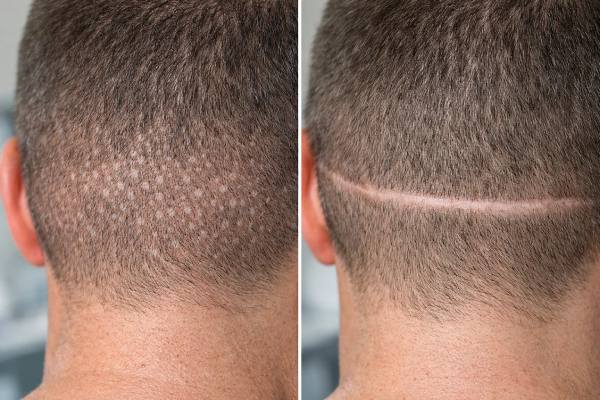
A hair transplant is not a choice between “modern” and “old-fashioned” surgery. It is a choice between two donor-harvesting methods that each solve a different problem. FUE, now more precisely called follicular unit excision, removes individual follicular units one by one. FUT, also called strip surgery, removes a narrow strip of scalp so grafts can be dissected under magnification. Both can produce natural-looking results. Both can leave scars. And both depend far more on planning, donor management, and surgical skill than on marketing language.
That is why the real question is not which method is universally better. It is which method fits the patient’s hair characteristics, loss pattern, preferred hairstyle, donor reserves, tolerance for scarring, and long-term goals. Someone who wants to wear a very short fade may prioritize scar pattern. Someone who needs a large number of grafts may care more about donor efficiency. Someone with diffuse thinning may need to pause and rethink surgery altogether.
When the differences are explained clearly, FUE and FUT stop sounding like competing brands and start looking like two tools with different trade-offs.
Key Insights
- Both FUE and FUT can create natural results when graft placement, hairline design, and donor planning are done well.
- FUE usually leaves many small dot scars, while FUT leaves one linear donor scar that can be easier or harder to hide depending on hairstyle and healing.
- FUT often remains more efficient for large graft sessions, while FUE is often preferred by people who want shorter hairstyles or no linear scar.
- Neither method is scar-free, and neither stops future hair loss in untreated native hair.
- Ask for donor-area photos at short and longer hair lengths, plus one-year results from patients with hair characteristics similar to yours.
Table of Contents
- What FUE and FUT involve
- How graft yield can differ
- Pros and cons of FUE
- Pros and cons of FUT
- Scarring differences and healing
- Which option fits best
What FUE and FUT involve
Both FUE and FUT are methods of moving permanent donor hair, usually from the back and sides of the scalp, into thinning or bald areas. That sounds simple, but it helps to understand one core principle: a transplant does not create new hair. It redistributes existing hair from a stronger zone to a weaker one. The success of either method depends on donor quality, realistic graft planning, and a loss pattern that is stable enough to justify surgery.
In FUE, the surgeon removes follicular units individually from the donor area using a small punch. Those grafts are then sorted, stored, and implanted into recipient sites. In FUT, the surgeon removes a strip of donor scalp, closes the wound, and the team dissects that strip under microscopes into individual follicular units before implantation.
The recipient part of the operation can look quite similar afterward. The biggest difference is how the grafts are harvested from the donor zone.
That difference affects several things at once:
- The pattern of scarring
- The speed and character of donor healing
- The number of grafts that may be practical in one sitting
- The way donor reserves are preserved for future procedures
- The hairstyle options that are easiest to maintain later
Patients are often told that FUE is “minimally invasive” and FUT is “strip surgery,” which can make the choice sound obvious. In reality, both are surgical procedures. Both require local anesthesia, careful graft handling, and planning for the hair loss that may continue after the transplant. Both can look excellent or disappointing depending on surgeon judgment.
There are also situations where the choice is not purely one or the other. Some patients have FUT first to obtain a large graft count efficiently, then use FUE later for refinement or scar camouflage. Others are clear FUE candidates from the start because they want to wear a short cut or need grafts from beard or body hair in advanced cases.
The timeline after either procedure is also more alike than many people expect. Transplanted hairs often shed in the early weeks. New visible growth usually begins around months 3 to 4, stronger cosmetic change often arrives between months 6 and 9, and maturation can continue to 12 months or longer. That means a transplant should be judged over seasons, not days.
A final point matters just as much as technique: diagnosis. A transplant works best in stable pattern hair loss. It is a poorer fit for uncontrolled shedding, active inflammation, or diffuse instability across the donor zone. In other words, the method matters, but the diagnosis comes first.
How graft yield can differ
One of the most practical differences between FUE and FUT is not visible in the mirror on day one. It shows up in graft yield, donor management, and long-term planning. Patients often ask which method “gets more grafts.” The honest answer is that it depends on the case, the surgeon, and what kind of grafts are being harvested.
FUT has traditionally been valued for donor efficiency. Because the follicular units are dissected from a strip under magnification, the surgeon can often preserve the surrounding donor area for future surgery and harvest a large number of grafts in a single session. This can be especially attractive for patients with extensive baldness who may need substantial coverage and who do not mind keeping enough length to hide a linear scar.
FUE has its own strengths. It lets the surgeon selectively harvest follicular units from a broader donor field and avoid a linear scar. A 2024 comparative study found that FUE cases can show a higher proportion of multi-hair grafts in some hands, likely because surgeons can visually choose more favorable follicular units during harvesting. That does not prove universal superiority. It simply shows that graft composition is influenced by how each method is performed and selected.
When people compare yield, they are often really comparing three different questions:
- How many grafts can be safely harvested now?
FUT may offer an advantage in larger sessions, especially when scalp laxity is good. - How much donor hair remains for later?
FUT may preserve surrounding donor density differently, while FUE spreads extraction across the donor zone. - How natural will the donor area look after healing?
This depends on scar pattern, hair length, hair color contrast, density, curl, and whether the donor was overharvested.
Overharvesting is one of the most important and under-discussed issues in FUE. Because the small extraction sites are scattered, it is possible to thin the donor zone too aggressively and create a see-through or “moth-eaten” look, especially when the hair is cut short. FUT avoids that particular pattern, but it trades it for a linear scar and greater wound tension.
Hair characteristics also influence yield. Coarse hair, wavy hair, and strong donor density often create better visual coverage per graft than fine, straight hair. Curved follicles can also make FUE more technically demanding, which is why surgeon experience with specific hair types matters.
This is where sales language can mislead patients. A clinic may advertise a very high graft number, but the better question is whether that number is safe and sustainable. A good transplant plan is not just about how much donor hair can be removed today. It is about how much should be removed while preserving options for the future. That is a very different conversation, and it is one reason the “best” method is rarely the same for every person.
Pros and cons of FUE
FUE became popular for understandable reasons. It avoids a single linear donor scar, it usually allows a faster-feeling donor recovery, and it appeals to people who want to keep their hair shorter on the back and sides. For many patients, those are decisive advantages. But FUE is easiest to understand when its strengths and weaknesses are placed side by side instead of being wrapped in “scarless” language.
The main advantages of FUE include:
- No linear scar in the donor area
- Small punctate scars that are often easier to hide with shorter hair
- Less postoperative tightness in the donor scalp
- Useful access to beard or body donor hair in selected advanced cases
- Good fit for patients who strongly value hairstyle flexibility
FUE is often attractive for people who wear fades, close crops, or very short sides. It can also be useful when a prior linear scar needs softening or when a patient has tighter scalp laxity and is not an ideal strip candidate.
The main limitations are just as important:
- It is usually more time-intensive and often more expensive per graft
- The donor zone can be visibly thinned if harvesting is too aggressive
- Transection risk may be higher in difficult hair types if technique is weak
- Large sessions may be less efficient than FUT in some patients
- It is still surgery, with real risk of shock loss, infection, cysts, or poor growth
FUE also has a marketing problem. Patients are often told it leaves “no scar,” when the more accurate statement is that it leaves many very small scars. These are often cosmetically favorable, but they are still scars. On the right scalp with the right haircut, they can be subtle. On a pale scalp with dark hair, low donor density, or aggressive extraction, they can become obvious.
Another overlooked issue is donor depletion over time. FUE makes it easy to focus on the front result and forget the back of the head. But donor management is part of the cosmetic outcome. A natural hairline paired with a thinned-out donor zone is not a true success.
FUE can be especially strong when the priority list looks like this:
- Avoid a linear scar
- Keep the option of shorter hairstyles
- Harvest a modest to moderate number of grafts
- Accept a higher per-graft cost
- Work with a surgeon known for conservative donor management
For patients worried about how tiny donor scars might look with very short cuts, adjunct options such as scalp micropigmentation can sometimes help, but they do not correct poor planning. That is the key takeaway with FUE: it is an excellent method, but it is not a shortcut past judgment, anatomy, or long-term donor math.
Pros and cons of FUT
FUT remains an excellent operation in the right patient, even though it is sometimes framed as outdated. That framing misses why experienced surgeons still use it. Strip harvesting can be highly efficient, it can preserve donor resources in a disciplined way, and it often makes sense for patients who need larger graft numbers and are comfortable wearing enough hair length to conceal a linear scar.
The main advantages of FUT include:
- Strong donor efficiency for larger sessions
- No diffuse punch pattern across the donor area
- Often lower cost per graft than FUE
- Useful preservation of surrounding donor density for future planning
- High-quality graft dissection under magnification
For patients with advanced hair loss, that efficiency can matter. When the frontal third, mid-scalp, and crown all compete for limited donor supply, harvesting strategy becomes more important than trend. FUT can be a rational first move because it may obtain a large number of grafts while leaving the surrounding donor zone relatively intact for possible future FUE refinement.
The main disadvantages are clear:
- It leaves a linear donor scar
- Donor tightness and soreness can be greater early on
- Sutures or staples may be needed, depending on technique
- Very short haircuts may reveal the scar
- Poor healing, wound tension, or individual scar tendency can widen the line
This is why FUT and hairstyle are closely linked. A patient who never plans to clip the back and sides short may view the scar as a reasonable trade. A patient who wants a tight fade usually will not. The scar is not the only factor, but it is often the emotional center of the decision.
Recovery can also feel different. Many patients describe more donor tightness after FUT, especially during the first days and when stretching the scalp. Exercise restrictions often last around 10 to 14 days, though protocols vary by surgeon. None of this means FUT is unsafe. It means the donor wound behaves like a true incision, because it is one.
The quality of closure matters as much as the strip itself. A good trichophytic closure can sometimes help hair grow through the scar and soften its visibility, but outcomes still depend on scalp tension, healing tendencies, and how much hair length is available for coverage.
FUT may be the better fit when the priorities look like this:
- Maximize grafts efficiently
- Preserve donor options for future surgery
- Accept one linear scar rather than diffuse donor extraction
- Wear hair long enough to cover the donor area
- Focus on long-term donor strategy, not only short-term convenience
During the months before growth becomes visible, many patients use styling camouflage such as hair fibers for thinning hair to reduce contrast in the recipient area. That can be helpful after either method. The larger point is that FUT is not a compromise operation. In the right hands and the right patient, it is a deliberate donor-management strategy.
Scarring differences and healing
The clearest visual difference between FUE and FUT is the scar pattern. FUE leaves many small circular scars scattered through the donor area. FUT leaves one linear scar where the strip was removed and the wound was closed. That sounds simple, but scar visibility is shaped by more than pattern alone.
With FUE, the usual cosmetic advantage is flexibility. The scars are tiny and spread out, so many patients can wear shorter hair without obvious donor evidence. But “tiny” is not the same as invisible. If too many grafts are taken from one zone, the donor can look patchy or see-through, especially in bright light or at very short lengths. The scars themselves may be minor, while the thinning around them becomes the more obvious problem.
With FUT, the trade-off is the opposite. The surrounding donor density is often better preserved because hairs are not removed diffusely across the back and sides, but the price is a line. Sometimes that line heals fine and remains well hidden under moderate hair length. Sometimes it widens, becomes raised, or stays more visible than expected. Published reviews of complications show that hypertrophic or keloid-like donor scarring is more strongly associated with FUT than FUE, even though serious problems remain uncommon overall in experienced hands.
Several factors influence scar visibility after either technique:
- Hair length and hairstyle
- Hair color versus scalp contrast
- Hair shaft thickness and curl
- Individual healing tendency
- Smoking status and wound care
- Surgical tension, punch spacing, and donor management
- Sun exposure during healing
Healing also differs in feel. FUE donor sites usually crust and close as many small wounds, while FUT heals as a single incision. That is why FUT often carries more early tightness and why FUE often feels easier in the donor area during the first recovery phase. The recipient area, however, may look fairly similar after either method because the implantation process is separate from donor harvesting.
There are also scar myths worth correcting. FUE is not scar-free. FUT is not automatically disfiguring. Both can look subtle or obvious depending on execution and biology. A beautifully planned FUE can be ruined by donor overharvesting. A carefully closed FUT can remain discreet for years under the right hair length. The scar is not just about technique. It is about how the technique was applied.
Early after surgery, protecting the donor area from sun is practical and often overlooked. Ultraviolet exposure can worsen color contrast in healing scars, which is one reason a simple plan for scalp sun protection matters during the first months.
If a patient is making the choice mainly on scarring, the most useful request is not “Will I scar?” Everyone scars. The better question is: “Show me your healed donor results on patients with my hair length, density, curl, and skin tone.” That is where abstract promises become useful reality.
Which option fits best
The best choice between FUE and FUT usually becomes clearer when the patient stops asking which technique is superior and starts asking which trade-off is most acceptable. A useful decision framework looks at five things: hairstyle goals, graft needs, donor quality, future hair-loss risk, and surgeon expertise.
FUE may fit better if you:
- Want the option of shorter hair on the back and sides
- Strongly want to avoid a linear scar
- Need a modest to moderate graft session
- May need beard or body donor hair in select cases
- Value donor comfort and a faster-feeling recovery
FUT may fit better if you:
- Need a large number of grafts
- Have good scalp laxity
- Usually wear the donor area longer
- Want a donor strategy that may preserve surrounding density differently
- Accept one line scar as a trade for efficiency
There are also patients who should slow down before choosing either. Surgery is less attractive when the hair loss pattern is still rapidly changing, when the donor area itself looks unstable, or when the patient has unrealistic expectations about density. A transplant can improve the look of thinning. It cannot restore the fullness of an untouched teenage scalp, and it does not stop further native hair loss. Many patients still need medical treatment after surgery to protect surrounding non-transplanted hair.
That is especially true in younger patients. A 26-year-old with a receding hairline may be making a decision that affects donor planning for the next 20 years. A small, aggressive hairline procedure done too early can age badly if the native hair continues to recede behind it. That is why experienced surgeons think in stages, not snapshots.
Before committing, ask these questions:
- What is my diagnosis, and is it stable enough for surgery?
- How many grafts do you recommend now, and why not more?
- What will my donor area look like if I shave it short later?
- How do you plan for future loss behind the transplant?
- Can I see healed donor and recipient results on patients like me?
- Who performs the key surgical steps?
The last question matters more than many patients realize. Hair restoration is often marketed as a simple cosmetic service, but it is still surgery. Good candidates benefit from medical assessment first, especially if they have sudden shedding, scalp inflammation, or diffuse loss. That is one reason it helps to know when to see a dermatologist for hair loss before assuming that transplantation is the right first move.
The most balanced answer, then, is this: FUE is often better for scar pattern and short-hair flexibility. FUT is often better for large-session efficiency and structured donor conservation. The better procedure is the one that solves your real problem without creating a larger one later.
References
- Hair transplantation: Basic overview 2021 (Review)
- CME article Part II. Hair transplantation: Surgical technique 2021 (Review)
- Patient Selection for Follicular Unit Extraction versus Linear Strip Donor Harvesting 2024 (Review)
- Strip Harvesting Follicular Unit Transplantation Versus Follicular Unit Excision: Comparing the Number of Hairs and the Ratio of Hairs to Follicular Unit 2024 (Comparative Study)
- A Scoping Review on Complications in Modern Hair Transplantation: More than Just Splitting Hairs 2024 (Scoping Review)
Disclaimer
This article is for educational purposes only and does not replace medical advice, diagnosis, or treatment. Hair transplantation is a surgical procedure that requires individualized assessment of diagnosis, donor stability, scarring risk, medical history, and long-term hair-loss progression. A qualified physician should evaluate anyone considering FUE or FUT, especially people with active scalp disease, sudden shedding, diffuse thinning, or a history of abnormal scarring.
If this article helped you compare FUE and FUT more clearly, please consider sharing it on Facebook, X, or your preferred platform so others can make a more informed hair-transplant decision.