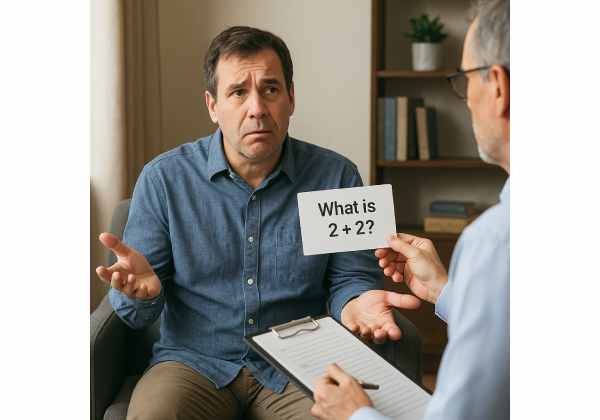
Ganser syndrome is a rare and controversial psychiatric syndrome most known for “approximate answers,” where a person gives replies that are obviously wrong but close enough to suggest they understood the question. It has historically been described in people under intense psychological stress, including forensic or hospital settings, but it can also appear alongside medical, neurological, dissociative, mood, psychotic, or substance-related conditions.
Because Ganser syndrome can look like confusion, psychosis, deliberate deception, dementia, functional neurological symptoms, or a medical emergency, it is not something that can be identified safely from one symptom alone. The key issue is the whole pattern: the person’s level of awareness, behavior, memory, physical symptoms, hallucination-like experiences, stress context, and whether another condition better explains what is happening.
Table of Contents
- What Ganser Syndrome Means
- Core Symptoms and Signs
- Why Approximate Answers Matter
- Causes and Etiology Debate
- Risk Factors and Associated Conditions
- Diagnostic Context and Differential Diagnosis
- Effects and Complications
What Ganser Syndrome Means
Ganser syndrome refers to a rare pattern of mental-state changes, not a common everyday reaction to stress. Its classic feature is approximate answering, usually combined with altered awareness, dissociative features, hallucination-like experiences, or physical symptoms that do not neatly match a known neurological disease.
The syndrome was first described in the late 19th century by Sigbert Ganser in prisoners, which is why older literature sometimes calls it “prison psychosis.” That term is now less useful because it can imply that the condition only happens in legal settings or that it is simply a tactic to avoid responsibility. Modern discussion is more cautious. Ganser syndrome has been reported in forensic settings, but also in hospitals, outpatient psychiatry, neurological presentations, and people facing severe psychological or physical stress.
A person with Ganser syndrome may answer simple questions incorrectly in a way that seems “beside the point.” For example, when asked how many legs a dog has, the person might say “five.” When asked the color of grass, they might say “blue” or another nearby but wrong answer. The answer is not usually random gibberish. It often suggests the person has partly understood the question but is responding through an altered or impaired mental state.
Ganser syndrome has been placed differently across psychiatric traditions. It has been discussed as a dissociative condition, a factitious-type presentation, a stress response, a psychosis-like state, a functional neurological presentation, or a syndrome that can sometimes accompany neurological disease. That uncertainty matters because the same outward behavior can have very different meanings. A person may be confused, dissociated, psychotic, intoxicated, neurologically impaired, frightened, overwhelmed, or consciously exaggerating symptoms. The label should not be used casually.
The word “dissociation” is especially important in this topic. Dissociation involves a disruption in normally integrated functions such as awareness, memory, identity, emotion, perception, or body control. Some people with Ganser-like symptoms also show amnesia, depersonalization, derealization, or a narrowed “twilight” state of consciousness. For broader context, related dissociative experiences are discussed in dissociation symptoms and triggers, although Ganser syndrome is a much rarer and more specific pattern.
Ganser syndrome is also distinct from simply being evasive, joking, lying, confused by a hard question, or making mistakes because of low education. The questions involved are usually simple, and the clinical concern comes from the whole mental-state picture. A single odd answer does not establish the syndrome.
Core Symptoms and Signs
The most recognized signs of Ganser syndrome are approximate answers, clouded awareness, conversion or functional physical symptoms, and hallucination-like experiences. Not every reported case has every feature, but the classic picture includes more than incorrect answers alone.
The core symptoms often described include:
- Approximate answers to simple questions, such as giving a wrong but near answer.
- Clouding of consciousness, sometimes described as a dazed, dreamlike, or twilight state.
- Disorientation, including confusion about time, place, or circumstances.
- Amnesia or patchy memory for the episode.
- Hallucination-like experiences, including visual or auditory perceptions that may be difficult to distinguish from psychotic symptoms.
- Functional or conversion-like symptoms, such as weakness, sensory changes, speech changes, or odd motor behavior that does not clearly follow a neurological pattern.
- Emotional disturbance, anxiety, fearfulness, flatness, or abrupt shifts in behavior.
- Brief or fluctuating course, sometimes with sudden onset and improvement.
The syndrome can be unsettling because the person may seem both aware and not fully aware. They may interact, answer questions, and follow parts of a conversation, yet their answers and behavior remain strikingly abnormal. This is one reason Ganser syndrome has attracted debate: it sits in a difficult space between dissociation, psychosis, neurological symptoms, and possible intentional production.
Clouded consciousness is a major safety issue. A person who appears confused, disoriented, unusually drowsy, agitated, or unable to give reliable information needs careful evaluation because delirium, seizures, intoxication, withdrawal, infection, metabolic problems, head injury, and other medical conditions can look psychiatric at first. Sudden confusion is not something to assume is “just stress.” Related diagnostic issues are often considered when clinicians evaluate sudden confusion and delirium-like symptoms.
Hallucination-like symptoms in Ganser syndrome can include seeing or hearing things that others do not. In some older descriptions, these are called “pseudohallucinations,” but that term is used inconsistently and can be misleading. What matters clinically is the person’s experience, level of conviction, distress, risk, and whether the symptoms fit another condition such as schizophrenia spectrum illness, severe mood disorder, substance-related psychosis, delirium, trauma-related dissociation, or neurological disease.
Functional physical symptoms may also appear. These can include paralysis-like weakness, sensory loss, abnormal gait, mutism, or seizure-like episodes. Such symptoms are real experiences to the patient, even when they are not explained by structural neurological disease. However, they require careful assessment because genuine neurological conditions and functional symptoms can overlap. A person can also have both a neurological disorder and functional symptoms at the same time.
Some cases include striking behavior that looks theatrical, childlike, fearful, or inconsistent. That does not prove the person is pretending. Psychiatric and neurological symptoms can fluctuate, especially when attention, stress, dissociation, or altered awareness is involved. At the same time, clinicians must consider deliberate feigning or exaggeration when there are strong external incentives, especially in legal or institutional settings. That distinction is complex and should not be made from appearance alone.
Why Approximate Answers Matter
Approximate answers are the signature feature of Ganser syndrome because they are wrong in a distinctive way. The answer is usually close enough to show that the question was understood, but incorrect enough to signal a disturbance in response, awareness, or intention.
Clinicians sometimes use the German terms “Vorbeireden” or “Vorbeigehen,” meaning speaking or going beside the point. In practice, this may look like:
| Question | Approximate answer | Why it stands out |
|---|---|---|
| How many legs does a horse have? | Five | The answer is wrong but close to the obvious correct answer. |
| What is 2 plus 2? | Five | The person appears to understand that a number is expected. |
| What color is snow? | Black | The answer may be opposite or near the category of expected response. |
| How many days are in a week? | Eight | The reply is not unrelated, but it is clearly incorrect. |
Approximate answers differ from ordinary mistakes. A person who does not know the answer to a question may guess randomly, say they do not know, or give an answer based on misunderstanding. A person with aphasia may use the wrong word because of a language disorder. A person with dementia may confabulate or lose track of the question. A person with delirium may be too inattentive to respond consistently. A person who is malingering may intentionally give wrong answers to appear impaired. Approximate answers can occur in several of these contexts, so they are not diagnostic by themselves.
The pattern becomes more meaningful when the questions are very simple and the responses repeatedly fall just beside the correct answer. The person may also show altered awareness, inconsistent performance, memory gaps, or other dissociative or functional signs. That combination is what has historically defined Ganser syndrome.
Still, approximate answering must be interpreted with care. Cultural background, language barriers, hearing problems, intellectual disability, low literacy, severe anxiety, sleep deprivation, intoxication, neurological injury, and medication effects can all affect responses. A clinician also needs to consider whether the person understands the question, whether an interpreter is needed, and whether the testing situation itself is frightening or coercive.
The feature is also important because it can be mistaken for manipulation. Approximate answers can look intentional because they are so obviously wrong. But in dissociative or altered-consciousness states, behavior may appear purposeful from the outside while not being under normal voluntary control. The reverse is also possible: intentionally produced symptoms can look clinically dramatic. That is why Ganser syndrome sits at the boundary of several diagnostic categories and why careful assessment is essential.
In mental health evaluation, the meaning of a symptom often depends on context, consistency, timing, and associated signs. A strange answer during a stressful interview has a different meaning from a sudden episode of confusion after a head injury, a new psychotic episode, a seizure-like event, or intoxication. The approximate answer is a clue, not the whole explanation.
Causes and Etiology Debate
There is no single proven cause of Ganser syndrome. The main debate is whether it is best understood as dissociation, a stress-related syndrome, a factitious presentation, a psychosis-like state, a functional neurological condition, or a response that can occur with organic brain or medical illness.
Older descriptions often linked the syndrome to hysteria, malingering, or prison settings. More recent writing is more nuanced. Reported cases suggest that Ganser-like presentations can follow severe psychological stress, traumatic experiences, frightening circumstances, acute medical illness, head injury, neurological disease, mood episodes, psychosis, or substance-related states. In some cases, no clear psychiatric disorder is found.
A dissociative explanation is one of the most common. In this view, overwhelming stress disrupts normal integration of awareness, memory, perception, and behavior. The person may enter a narrowed or dreamlike state in which responses become distorted. The approximate answers, amnesia, and altered consciousness fit this model, especially when symptoms arise after intense stress and improve as the episode resolves.
A functional or conversion-related explanation focuses on symptoms that affect movement, sensation, speech, or consciousness without matching a known structural neurological disease. Functional neurological symptoms are not considered voluntary faking. They are understood as problems in nervous system functioning, attention, prediction, and control rather than simple damage to a nerve or brain region. This can help explain why some people with Ganser syndrome have weakness, sensory loss, abnormal movements, or seizure-like symptoms.
A factitious or malingering explanation is considered when symptoms appear intentionally produced. Factitious disorder involves deception driven by a psychological need to adopt the sick role, without obvious external reward. Malingering involves intentional production or exaggeration for external gain, such as avoiding legal consequences, obtaining shelter, or securing medication. Ganser syndrome has historically been confused with both, especially in forensic contexts. The difficult part is that unusual symptoms in high-stakes settings are not automatically deceptive; severe stress, psychosis, intoxication, delirium, trauma, or brain injury can also occur in those settings.
A psychosis-related explanation is considered when hallucinations, delusions, disorganized thinking, or severely impaired reality testing are prominent. Some people with Ganser-like symptoms have also had mood disorders, schizophrenia spectrum conditions, or brief psychotic episodes. In those cases, approximate answers may be part of a broader disturbance in thought and perception. The diagnostic question becomes whether Ganser syndrome is the main pattern or whether another psychotic disorder better explains the presentation. Clinicians often use a broader psychosis evaluation when hallucinations, delusions, or disorganized thinking are present.
Organic or medical explanations also matter. Some reported cases involve head trauma, infections, seizures, neurocognitive disorders, toxic states, or other brain-related conditions. These reports do not prove that every case is medical, but they show why a purely psychological assumption can be risky. When symptoms begin suddenly, fluctuate, involve altered consciousness, or include neurological signs, medical and neurological causes must be considered.
The safest conclusion is that Ganser syndrome is likely heterogeneous. In plain terms, the same syndrome-like pattern may arise through different pathways in different people. That is why it is often described as rare, controversial, and diagnostically challenging rather than as a simple, single-cause disorder.
Risk Factors and Associated Conditions
Ganser syndrome is so rare that precise risk estimates are not reliable. Most knowledge comes from case reports and case series, so risk factors should be viewed as patterns seen in reported cases rather than proven predictors.
The strongest recurring association is exposure to severe stress. This may include legal jeopardy, imprisonment, acute interpersonal conflict, traumatic events, medical crisis, hospitalization, or overwhelming psychological pressure. The syndrome’s historical link to prisoners may reflect a real stress context, but it may also reflect where unusual behavior was most likely to be observed, documented, and debated.
Possible risk factors and associated contexts include:
- Severe acute psychological stress, especially when the person feels trapped or threatened.
- Forensic or institutional settings, including custody, court-related stress, or hospitalization.
- History of trauma or dissociative symptoms.
- Recent head injury or neurological illness.
- Medical illness that affects awareness, attention, or brain function.
- Mood disorders, psychotic disorders, or severe anxiety states.
- Substance intoxication, withdrawal, or toxic exposure.
- Functional neurological symptoms, such as weakness, sensory symptoms, or seizure-like episodes.
- Personality vulnerabilities or poor coping under extreme stress, when documented clinically.
These associations do not mean that Ganser syndrome is predictable. Many people experience severe stress and never develop approximate answers, dissociation, or hallucination-like symptoms. Conversely, a person may develop a Ganser-like presentation without an obvious stressor. The absence of an obvious trigger does not rule it out, and the presence of a stressor does not prove it.
Trauma history is relevant but should not be assumed. Some dissociative conditions are strongly linked with trauma, but not every person with dissociative symptoms has a known trauma history, and not every trauma survivor develops dissociation. Overconfident assumptions can lead to poor care and missed diagnoses. The same caution applies to forensic settings: legal stress may be relevant, but it does not prove intentional deception.
Substance-related causes need special attention. Alcohol, sedatives, stimulants, hallucinogens, cannabis, withdrawal states, and medication effects can all alter awareness, behavior, speech, and perception. A person who seems to give bizarre answers may be intoxicated, withdrawing, delirious, or experiencing a drug-induced psychotic state. In unclear cases, clinicians may consider toxicology screening in mental health and brain symptom workups as part of a broader assessment.
Age is not a reliable discriminator. Ganser syndrome has been described in adults and adolescents, though adult cases appear more common in the literature. In older adults, however, a Ganser-like pattern requires especially careful medical consideration because delirium, dementia, stroke, seizures, medication effects, infections, and metabolic problems become more likely. In children and teenagers, developmental stage, trauma, family stress, school stress, neurological problems, and communication differences all need thoughtful assessment.
The most useful way to think about risk is not “who gets Ganser syndrome,” but “what situations make this presentation more plausible and what dangerous alternatives must not be missed.” Severe stress, dissociation, altered awareness, functional symptoms, and unusual answering are important clues, but they are not enough to settle the diagnosis.
Diagnostic Context and Differential Diagnosis
Ganser syndrome is a clinical pattern that requires careful differential diagnosis. The main diagnostic task is to understand whether the symptoms are better explained by delirium, neurological illness, substance effects, psychosis, dementia, dissociation, functional neurological disorder, factitious disorder, malingering, or another psychiatric condition.
There is no single blood test, brain scan, questionnaire, or bedside question that proves Ganser syndrome. Assessment usually depends on a full history, mental status examination, collateral information when available, neurological examination when indicated, review of medications and substances, and attention to the timing of symptoms. The person’s level of consciousness is especially important. Clouding of consciousness raises the stakes because many medical conditions can affect attention and awareness.
Conditions that may need to be considered include:
- Delirium, especially when symptoms are sudden, fluctuating, or accompanied by fever, infection, dehydration, medication changes, intoxication, withdrawal, or metabolic disturbance.
- Seizures or postictal states, which can cause confusion, odd behavior, memory gaps, and altered responsiveness.
- Traumatic brain injury, stroke, tumors, encephalitis, or other neurological disorders.
- Psychotic disorders, including brief psychotic disorder, schizophrenia spectrum conditions, and mood disorders with psychotic features.
- Dissociative disorders, especially when there is amnesia, depersonalization, derealization, identity disruption, or trauma-related symptoms.
- Functional neurological disorder, when physical symptoms affect movement, sensation, speech, or episodes of unresponsiveness.
- Dementia or other neurocognitive disorders, especially in older adults.
- Intellectual disability, language barriers, aphasia, hearing problems, or educational limitations.
- Factitious disorder or malingering, especially when intentional production of symptoms is a serious question.
The evaluation may be urgent when symptoms begin suddenly or include red flags. Immediate professional evaluation is especially important if the person has new confusion, severe agitation, suicidal or violent statements, hallucinations with dangerous commands, recent head injury, seizure-like activity, fever, stiff neck, severe headache, weakness on one side, chest pain, overdose risk, intoxication, withdrawal, or inability to stay safe. These signs do not mean the person has Ganser syndrome; they mean a potentially dangerous condition may be present.
Brain imaging or neurological testing is not used to “prove” Ganser syndrome, but it may be considered when symptoms suggest a neurological cause. For example, sudden weakness, head trauma, seizure-like episodes, altered consciousness, or new cognitive change may prompt tests that are also used in broader brain-symptom workups. In some situations, clinicians may consider tools discussed in brain MRI evaluation or other neurological testing, depending on the clinical picture.
Mental health assessment also needs to separate screening from diagnosis. A questionnaire can identify dissociation, depression, anxiety, psychosis risk, substance use, or cognitive concerns, but Ganser syndrome is not diagnosed by a screening score. It depends on observation, history, context, and exclusion of better explanations. The broader difference between a screening result and a clinical diagnosis is discussed in screening versus diagnosis in mental health.
The diagnostic process can be sensitive because the symptoms may raise questions about credibility. A careful evaluator avoids two errors: assuming the person is faking because the presentation is unusual, and assuming the symptoms are purely psychiatric without checking for medical or neurological causes. Both errors can cause harm.
Effects and Complications
Ganser syndrome can affect safety, functioning, relationships, and diagnostic clarity even when the episode is brief. The largest risks often come from confusion, misinterpretation, and missed alternative diagnoses.
During an episode, the person may be unable to give reliable information, make safe decisions, follow instructions, or explain what happened. If awareness is clouded, they may wander, become frightened, respond to hallucination-like experiences, or be vulnerable to accidents. If functional physical symptoms are present, they may have difficulty walking, speaking, seeing, moving, or responding normally. If the episode occurs in custody, court, school, work, or a hospital, the behavior may be judged harshly before it is understood.
Misdiagnosis is a major complication. Ganser syndrome can be mistaken for malingering, psychosis, dementia, delirium, intellectual disability, intoxication, or neurological disease. Each mistake has consequences. A person mislabeled as deceptive may be denied appropriate evaluation. A person mislabeled as psychotic may not receive the right medical workup. A person with delirium, seizure disorder, head injury, or intoxication may be placed at risk if the symptoms are dismissed as “psychiatric.” A person with true intentional feigning may also be misunderstood if the evaluator avoids the question entirely.
Legal and forensic complications are especially important. Because Ganser syndrome has a long association with prison and court settings, it may arise in evaluations of competence, criminal responsibility, disability, or institutional behavior. In these contexts, the stakes are high and the incentives may be complex. The presence of approximate answers should not automatically settle questions about intent, responsibility, or deception. Forensic evaluation usually requires careful documentation, collateral records, observation over time, and consideration of both psychiatric and external-incentive explanations.
The syndrome may also create distress for families. Relatives may see sudden bizarre answers, confusion, hallucination-like behavior, or physical symptoms and not know whether the person is ill, frightened, pretending, or “losing touch with reality.” This uncertainty can lead to conflict, shame, anger, or fear. Clear diagnostic language matters because the wrong explanation can damage trust.
Some complications relate to associated conditions rather than Ganser syndrome itself. If the presentation occurs with severe depression, trauma symptoms, psychosis, substance use, head injury, seizure disorder, or delirium, those conditions carry their own risks. Symptoms such as suicidal thoughts, command hallucinations, violent behavior, overdose, severe withdrawal, or neurological deficits should be taken seriously regardless of what label is being considered. A practical overview of urgent warning signs appears in when to go to the ER for mental health or neurological symptoms.
Long-term outcome is hard to summarize because cases vary and the evidence base is limited. Some reported episodes resolve quickly, sometimes with amnesia for the event. Others occur alongside broader psychiatric, neurological, or functional problems that last longer. The prognosis depends less on the name “Ganser syndrome” and more on the underlying explanation, severity of altered awareness, medical findings, co-occurring conditions, and whether the episode is part of a recurring pattern.
The most important practical point is that Ganser syndrome should be treated as a serious diagnostic signal. Approximate answers may be memorable, but the real concern is the wider disturbance in awareness, perception, behavior, and function. Careful evaluation protects the person from both missed medical illness and unfair assumptions about intent.
References
- Ganser syndrome – a dissociative disorder or a factitious disorder? A case report 2022 (Case Report)
- Ganser Syndrome Following Acute Psychological Stress in a Patient with Organicity: Implications for Etiopathogenesis 2025 (Case Report)
- A systematic report review of Ganser syndrome: 118 years of case studies 2017 (Review)
- Clinical Practice Guidelines for Assessment and Management of Dissociative Disorders Presenting as Psychiatric Emergencies 2023 (Guideline)
- Assessing dissociation: A systematic review and evaluation of existing measures 2025 (Systematic Review)
- Functional Neurologic Disorder 2023 (Review)
Disclaimer
This content is for general educational purposes only and is not a substitute for professional medical advice, diagnosis, or treatment. Ganser-like symptoms, sudden confusion, hallucinations, memory gaps, or new neurological signs should be evaluated by a qualified clinician, especially when they appear suddenly or affect safety.
Thank you for taking the time to read about this rare and often misunderstood condition; sharing this article may help others approach unusual mental health symptoms with more care and less stigma.