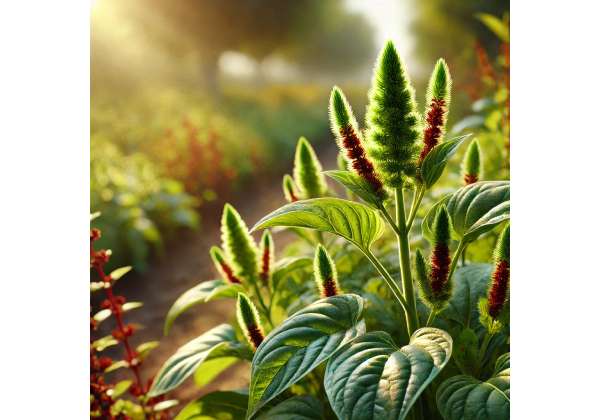
Green amaranth, most often identified as Amaranthus tricolor, is a fast-growing leafy vegetable valued across Asia, Africa, and the Caribbean for both food and traditional household medicine. Its tender leaves and young stems are mild, earthy, and easy to cook, but its real appeal lies in how much nutrition it delivers in a small serving. Green amaranth provides carotenoids, vitamin C, vitamin K, folate, potassium, magnesium, and plant pigments that help explain its reputation as a strengthening green.
In practice, this plant is best understood as a nutrient-dense food first and a medicinal herb second. It may support eye health, normal blood formation, digestion, and overall dietary quality, especially when used regularly in meals rather than taken as a cure-all. At the same time, it is not risk-free for everyone. Like other leafy greens, it can contain oxalates and nitrates, and that matters for people with certain kidney conditions, infants, and those who need to keep vitamin K intake steady.
Used well, green amaranth is a practical, affordable, highly useful green with more substance than hype.
Quick Facts
- Green amaranth is rich in carotenoids, vitamin C, folate, potassium, and other micronutrients that support everyday nutrition.
- Its strongest real-world benefits come from regular food use, especially for dietary diversity, eye support, and mineral intake.
- A practical food-first range is about 75 to 150 g cooked leaves per serving, or roughly 1 to 2 cups.
- People with recurrent kidney stones, advanced kidney disease, or strict potassium limits should use caution.
- Very large or frequent servings are not ideal for infants or for anyone relying on highly variable vitamin K intake while using warfarin.
Table of Contents
- What is green amaranth
- Key ingredients and active compounds
- Green amaranth benefits and uses
- How to use green amaranth
- How much green amaranth per day
- Safety side effects and who should avoid it
- What the research really shows
What is green amaranth
Green amaranth is an edible leafy form of Amaranthus tricolor, a species grown both as a vegetable and, in some cultivars, as an ornamental plant. Depending on the region, it may also be called edible amaranth, Chinese spinach, Joseph’s coat, callaloo, or simply amaranth greens. The plant grows quickly, tolerates heat well, and produces soft leaves and tender stems that can be harvested early and repeatedly. That combination of speed, resilience, and good nutrient density is one reason it remains important in traditional food systems.
The leaves can be bright green, green with bronze tones, or mixed with red and yellow, depending on the cultivar. When people say “green amaranth,” they usually mean the leafy vegetable form rather than the grain amaranth sold as a pseudo-cereal. That distinction matters because the seeds and the leaves do not serve the same role in the diet. The grain is valued for protein and starch, while the leaves are prized for vitamins, minerals, fiber, and colorful phytochemicals.
As a food, green amaranth behaves like a cross between spinach and tender beet greens. It wilts quickly, cooks in minutes, and works well in soups, sautés, stews, dal, omelets, rice dishes, and blended sauces. The young leaves can be eaten raw in small amounts, but most households prefer them lightly cooked because the texture softens and the bitterness decreases.
As a traditional remedy, the plant has been used for digestive complaints, general weakness, mouth irritation, and recovery meals after illness. Those uses are culturally important, but modern readers should keep the scale of the claims in perspective. Green amaranth is most credible as a supportive food that improves overall nutrient intake, not as a stand-alone treatment for disease.
That food-first identity is one of its biggest strengths. Unlike many herbs that are used only occasionally, green amaranth fits naturally into ordinary meals. It can improve the nutritional quality of lunch or dinner without asking the reader to learn a complicated protocol. In that sense, it belongs in the same broad conversation as moringa leaf nutrition: a practical plant that matters because people can actually eat it often.
Another useful point is seasonality. In hot climates, green amaranth often fills a gap when cool-season greens struggle. For households seeking affordable leafy vegetables in summer or in lower-resource settings, that reliability is part of its real medicinal value. It supports health not only because of what is in the leaf, but because the crop is accessible, fast, and easy to prepare.
Key ingredients and active compounds
Green amaranth is rich in the kinds of nutrients that make leafy vegetables genuinely useful over time: carotenoids, vitamin C, vitamin K, folate, potassium, magnesium, calcium, iron, fiber, and a range of phenolic compounds. The exact profile varies by cultivar, maturity, soil conditions, and whether the leaves are green, red-green, or deeply pigmented. Still, a few groups of compounds consistently explain why the plant attracts nutritional and medicinal interest.
The first major group is carotenoids, including beta-carotene and related pigments. These compounds support vision, epithelial health, and antioxidant defense. They are especially relevant in diets that fall short in orange and dark green vegetables. Green amaranth is not a magic bullet for eye health, but as a regular food it can help raise carotenoid intake in a simple and affordable way. That is one reason it is often compared with kale’s carotenoid-rich leaves, even though the taste and culinary traditions differ.
The second group is vitamin C and phenolic antioxidants. These compounds help protect plant tissue from stress, and in human diets they contribute to antioxidant capacity and collagen-related functions. Vitamin C also matters because it can support iron absorption when green amaranth is eaten with legumes or grains. In practical meals, that pairing is often more important than the raw iron number on a chart.
A third key group includes folate and mineral elements such as potassium, magnesium, manganese, and calcium. Folate supports normal cell division and red blood cell formation. Potassium and magnesium contribute to fluid balance, muscle function, and cardiovascular regulation. Calcium content in leafy greens sounds promising, but its usefulness depends partly on how much is absorbed, and that is where the plant’s anti-nutritional compounds become relevant.
Green amaranth also contains flavonoids, phenolic acids, chlorophyll-related compounds, and in some cultivars betalain-type pigments. Redder cultivars generally show more dramatic pigment chemistry, but green forms still provide a meaningful mix of protective plant compounds. These are not isolated drug-like molecules in clinically defined doses. They work as part of a food matrix, alongside fiber and minerals.
Then there are the compounds that deserve caution: oxalates, nitrates, and to a lesser extent phytates. These are normal plant constituents, not signs that the food is unsafe. But they do affect how the plant should be used. Oxalates may reduce mineral availability and matter for people with calcium oxalate kidney stone risk. Nitrates are more complicated. In moderate adult diets they may contribute to nitric oxide pathways, yet for infants and some special situations, high levels in leafy vegetables can raise concern.
So the chemistry of green amaranth has two sides. One side supports its value as a nutrient-dense, antioxidant-rich leafy vegetable. The other side reminds us that smart preparation matters. That dual character is exactly why it is more useful to treat green amaranth as a functional food than as a simplistic “healing herb.”
Green amaranth benefits and uses
The most realistic health benefits of green amaranth come from steady dietary use. This is not the sort of plant where one cup changes everything. Its value builds through repetition, especially in meals that would otherwise be low in greens, folate, potassium, or carotenoids.
One practical benefit is better micronutrient density. Adding green amaranth to soups, bean dishes, eggs, or grain bowls increases the nutrient quality of a meal without adding much energy. For people who need more variety in a plant-based pattern, it helps fill the gap between staple foods and more expensive produce.
A second benefit is support for eye and skin health, largely because of carotenoids and vitamin C. The plant will not act like a supplement formulated for macular degeneration, but it can contribute to long-term intake of nutrients associated with healthy vision and tissue repair.
A third benefit is support for normal blood formation and recovery nutrition. Green amaranth contains folate and iron, and meals that combine it with vitamin C-rich ingredients, lentils, beans, or modest amounts of animal protein can be especially helpful in diets that need more iron-aware planning. That does not mean it treats anemia on its own, but it can be part of a smarter dietary pattern.
A fourth likely benefit is digestive support. The leaves provide water, fiber, and bulk, which can help with regularity when paired with adequate fluid intake. Lightly cooked amaranth is often gentler than raw fibrous greens, which makes it suitable for people who want more vegetables but not a large raw salad.
There is also growing interest in cardiometabolic support, partly because leafy greens can improve diet quality broadly and partly because nitrate-rich vegetables may support nitric oxide pathways. Green amaranth belongs in that conversation, though it is more honest to frame the effect as dietary support rather than therapy. In this respect it sits near other nitrate-aware greens, such as watercress for cardiovascular support, where the food pattern matters more than any single serving.
Traditional uses go further. In some systems of medicine, amaranth leaves have been used for mouth irritation, digestive upset, inflammatory discomfort, and convalescent meals. Modern laboratory work also suggests antioxidant, antimicrobial, and anti-inflammatory potential in extracts. Those findings are interesting, but they do not automatically translate into proven treatment for infections, liver disease, diabetes, or inflammatory disorders in people.
So where does that leave the reader? In a strong and practical place. Green amaranth helps most when it is used as:
- A regular leafy vegetable in mixed meals
- A nutrient-dense option in hot seasons
- A gentle cooked green for people who dislike tougher leaves
- A budget-friendly way to diversify plant intake
- A traditional recovery food that fits modern nutrition goals
The honest promise of green amaranth is not that it cures disease. It is that it strengthens the nutritional foundation on which good health depends.
How to use green amaranth
Green amaranth is easy to use, but the best method depends on whether the goal is taste, digestibility, or reducing anti-nutritional compounds. For most people, light cooking is the sweet spot. It softens the leaf, improves palatability, and can reduce some of the oxalate and nitrate burden, especially when boiling water is discarded.
The simplest household uses include:
- Stir-frying the leaves with garlic, onion, and a little oil
- Adding chopped leaves to lentils, beans, or chickpea stews
- Folding them into omelets, scrambled eggs, or tofu
- Simmering them briefly in soups or broths
- Mixing them with rice, millet, or other grains
- Blending tender cooked leaves into sauces or savory purees
Young leaves can also go into salads, but they are usually more satisfying when mixed with milder lettuce-type greens rather than used alone. Mature stems can be fibrous, so it helps to chop them finely or cook them a few minutes longer than the leaves.
If digestibility is the priority, a useful sequence is:
- Wash well to remove grit.
- Separate thicker stems if needed.
- Boil or steam briefly for 2 to 5 minutes.
- Drain if you want a lower oxalate load.
- Finish with seasoning, fat, and protein.
That last step matters. A little fat helps with carotenoid absorption, and pairing the greens with beans, sesame, yogurt, fish, or eggs usually makes the meal more complete. If the diet is mostly plant-based, combining green amaranth with vitamin C-rich ingredients such as tomatoes, peppers, or lemon can help with non-heme iron use.
Dried leaf powders exist, but they should be approached differently from fresh food. Powders are more concentrated by weight, sometimes more variable in quality, and easier to overuse. If someone buys a dried product, it is wiser to treat it as a food ingredient than as a medicine. It can go into soups, flatbreads, smoothies, or savory porridges, much as one might use purslane in practical kitchen use for nutrient support rather than for dramatic medicinal claims.
A few common mistakes are worth avoiding:
- Cooking the leaves too long until they turn dull and mushy
- Using old, oversized leaves without trimming tough stems
- Relying on it alone for iron repletion
- Giving large portions of pureed leafy greens to infants day after day
- Assuming raw is always healthier than cooked
For everyday health, green amaranth works best as a frequent supporting ingredient, not as an occasional “superfood event.” A handful in dal, a cup in soup, or a pan of sautéed greens beside a main meal is enough to make it useful. The best use is often the one a household will repeat.
How much green amaranth per day
There is no established medicinal dose for green amaranth in the way there might be for a standardized extract. This plant is mainly used as food, so the most responsible dosage advice is culinary rather than pharmacological. A practical adult range is about 75 to 150 g cooked leaves per serving, which is roughly 1 to 2 cups cooked, depending on how finely the greens are chopped and how much water they lose.
For tender raw leaves, a reasonable amount is usually 1 to 2 loosely packed cups mixed into a meal, though many people prefer smaller raw portions because the texture is more assertive than lettuce. When cooked, the leaves shrink quickly, so what looks like a large bundle often becomes one modest serving.
A useful way to think about intake is by purpose:
- For general diet quality: 3 to 5 servings per week is a realistic and beneficial pattern.
- For variety in a plant-forward diet: smaller servings can be used more often, rotated with spinach, kale, mustard greens, watercress, and herbs.
- For powdered leaf products: follow the label, but keep the mindset food-first; many people do well staying in the low-gram range rather than treating powders like concentrated medicine.
Timing is flexible. Green amaranth can be eaten at lunch or dinner, and in many cuisines it appears in breakfast dishes too. There is no special time of day when it suddenly becomes more effective. What matters more is meal context. Because the plant contains fat-soluble carotenoids, pairing it with some oil, nuts, seeds, eggs, or dairy improves usefulness. If iron support is the goal, pair it with tomatoes, citrus, or peppers instead of tea or coffee.
For people new to leafy greens, it is smart to start at the lower end:
- Begin with about 1/2 to 1 cup cooked.
- See how digestion feels.
- Increase gradually over the week.
- Rotate with other greens rather than eating only one kind daily.
That rotation matters because no single green does everything. Green amaranth is rich in some micronutrients and phytochemicals, while other greens contribute different strengths. Households that use it as part of a broader pattern often get more benefit than those that try to make it the only “healthy green” on the plate.
For children, portions should simply be smaller and age-appropriate. For infants and toddlers, leafy vegetable purees should be freshly prepared and not used in excessive amounts every day. For adults with normal health, though, a serving or two in a day is usually well within the range of a sensible diet.
The key message is simple: use green amaranth regularly enough to matter, but not so narrowly that it replaces all other leafy vegetables.
Safety side effects and who should avoid it
For most healthy adults, green amaranth is safe when eaten as a normal food. The main safety questions are not dramatic poisoning risks but how the plant fits specific medical situations. The most important issues are oxalates, nitrates, vitamin K consistency, potassium load in advanced kidney disease, and ordinary food hygiene.
Oxalates are relevant for people with a history of calcium oxalate kidney stones. Green amaranth is not unique here; many leafy vegetables contain oxalates. The practical solution is not always total avoidance. Some people do better with smaller servings, light boiling with the water discarded, adequate hydration, and dietary rotation rather than daily large portions.
Nitrates are more nuanced. In adults, dietary nitrates from vegetables are not automatically harmful and may even support nitric oxide biology. The concern is stronger for infants and very young children, especially if leafy vegetable purees are stored poorly or served in large repeated amounts. Fresh preparation matters more than fear. Avoid leaving chopped or pureed greens sitting at room temperature for long periods.
Vitamin K is another important point. Green amaranth, like many dark leafy vegetables, may affect people taking warfarin. The issue is not that the plant must be banned, but that intake should be consistent from week to week rather than swinging between none and very large portions.
Potassium can matter for people with advanced chronic kidney disease or those on prescribed potassium restriction. Even a healthy food can become a problem when kidney handling is impaired.
Common mild side effects are limited and usually digestive:
- Bloating if large servings are introduced suddenly
- Loose stools in very high amounts
- Bitterness or mouthfeel aversion in mature leaves
- Rare allergy or contact irritation during handling
People who should be especially cautious include:
- Those with recurrent calcium oxalate kidney stones
- People with advanced kidney disease
- Adults taking warfarin who do not keep vitamin K intake stable
- Infants receiving repeated large portions of leafy green puree
- Anyone with a known amaranth or related plant allergy
A few preparation habits improve safety:
- Wash thoroughly.
- Cook and serve promptly.
- Refrigerate leftovers quickly.
- Reheat only once.
- Rotate with other greens, including options such as watercress in mixed green rotation, instead of eating oversized portions every day.
It is also worth resisting the “natural means unlimited” mindset. Because green amaranth is a vegetable, people sometimes assume there is no upper boundary. In reality, even very healthy leafy greens work best as part of a diverse pattern. Used with that level-headed approach, green amaranth is safe for most households and especially valuable where affordable, nutrient-dense vegetables are needed.
What the research really shows
The research on green amaranth is promising, but it supports a more grounded story than many herbal summaries suggest. The strongest evidence says that Amaranthus tricolor is a nutrient-rich leafy vegetable with useful phytochemicals and genuine food-system value. It does not yet justify sweeping claims that it treats chronic disease in humans by itself.
What the evidence supports well:
- The leaves are nutritionally dense.
- They contain meaningful levels of carotenoids, vitamin C, minerals, and phenolic compounds.
- They show antioxidant potential in laboratory testing.
- Some extracts and cultivars show antimicrobial or anti-inflammatory activity in preclinical work.
- The crop has practical value in hot climates and food security settings.
Where the evidence becomes thinner is in direct clinical outcomes. Human trials specifically proving that green amaranth lowers blood sugar, treats anemia, protects the liver, or reduces inflammation in a clinically significant way are still limited. Some of the more exciting claims come from cell studies, animal experiments, or analyses of isolated extracts. Those are useful for mechanism, but they are not the same as robust dietary intervention evidence in people.
This matters because readers often encounter the phrase “medicinal properties” and assume drug-like certainty. With green amaranth, medicinal potential exists, but it is mostly indirect and supportive. The plant may help create a healthier dietary pattern, and that pattern may support cardiovascular health, metabolic health, and micronutrient adequacy over time. That is a meaningful benefit, just not a sensational one.
The research also reinforces an important caution: anti-nutritional factors are part of the picture. Oxalates, nitrates, and phytates do not cancel out the plant’s benefits, but they do mean the best preparation method depends on the user. Cooking technique, storage, and portion size all shape the final nutritional outcome.
The most honest research-based takeaway is this:
- Green amaranth deserves more attention as a public-health food.
- It appears more credible as a functional vegetable than as a therapeutic extract.
- Its benefits are most likely to emerge through repeated, ordinary consumption.
- Safety concerns are manageable for most people but not irrelevant.
- Future research should focus on bioavailability, human feeding studies, cultivar differences, and cooking effects.
That conclusion is not disappointing. In many ways, it is more useful. Green amaranth does not need to be a miracle herb to matter. It is already valuable because it is accessible, nourishing, adaptable, and realistic. In nutrition, the plants that improve daily meals often do more good than the plants surrounded by the biggest claims.
References
- Multifunctional Edible Amaranths: A Review of Nutritional Benefits, Anti-Nutritional Factors, and Potential in Sustainable Food Systems 2026 (Review)
- Antioxidant and Antimicrobial Effects of Baby Leaves of Amaranthus tricolor L. Harvested as Vegetable in Correlation with Their Phytochemical Composition 2023
- The Dual Nature of Amaranth-Functional Food and Potential Medicine 2022 (Review)
- Nitrates and Nitrites in Leafy Vegetables: The Influence of Culinary Processing on Concentration Levels and Possible Impact on Health 2025
- Oxalate in Foods: Extraction Conditions, Analytical Methods, Occurrence, and Health Implications 2023 (Review)
Disclaimer
This article is for educational purposes only and is not a substitute for personal medical advice, diagnosis, or treatment. Green amaranth is generally safe as a food, but its oxalate, nitrate, vitamin K, and potassium content can matter in certain medical situations, including kidney stone risk, chronic kidney disease, warfarin use, and infant feeding. Anyone using it for a health condition, or making major dietary changes for medical reasons, should consult a qualified clinician or registered dietitian.
If this article helped you, please share it on Facebook, X, or your preferred platform to help more readers find practical, balanced health information.