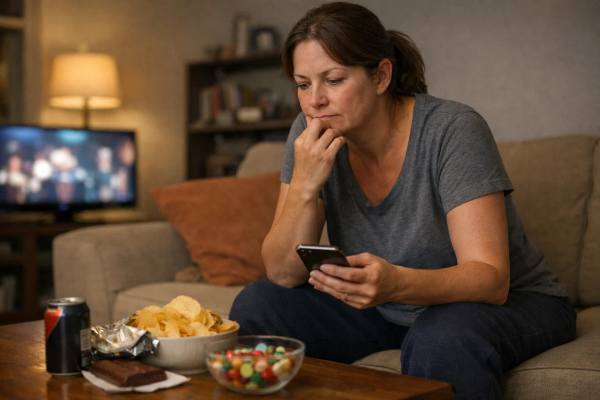
If you keep eating in the same moments, places, and moods, that pattern is usually not random. It is often a habit loop. The cue happens, the behavior follows, and some kind of reward teaches your brain to do it again next time. That is why evening snacking, stress eating, desk grazing, and “just one bite” habits can feel automatic even when you want to lose weight.
Understanding habit loops does not mean blaming yourself. It means seeing your eating behavior clearly enough to change it. This article explains how cue-routine-reward loops work, how they shape everyday eating, how to identify your personal triggers, and how to rebuild loops so healthier choices become easier and more repeatable.
Table of Contents
- What a habit loop really is
- The cues that drive eating
- Why rewards keep behaviors stuck
- How to map your own loop
- How to rebuild an eating loop
- Making new loops stick
- When habits are not the whole problem
What a habit loop really is
A habit loop is a repeating pattern that links a trigger to a behavior and then to a reward. In eating, that often looks simple on the surface:
- You sit on the couch after work.
- You open a snack.
- You feel relief, pleasure, distraction, or comfort.
Do that enough times, and your brain starts predicting the reward before the food even appears. Over time, the cue alone can create an urge. That is one reason cravings often seem to come out of nowhere. They usually do not. They are being pulled forward by context.
The three parts of the loop are straightforward:
- Cue: the signal that starts the pattern
- Routine: the behavior itself
- Reward: the payoff that makes the behavior worth repeating
The reward is not always taste. Sometimes it is a mental shift. Food can provide a break from stress, a pause after work, a sense of permission, a way to avoid boredom, a reward for being “good” all day, or a fast change in mood. When a behavior reliably solves a small problem in the moment, the brain keeps it.
This is why weight loss often stalls even when people know what to eat. Knowledge and automatic behavior are different things. You can understand calories, protein, portions, and meal quality and still find yourself standing in the kitchen every night at 9:30. That does not mean you lack discipline. It often means the loop is stronger than your current plan.
A useful shift is to stop asking, “Why do I keep doing this?” and start asking, “What is the loop?” That question is calmer and more practical. It turns a frustrating pattern into something you can study.
Many people also do better when they stop expecting constant motivation and start building systems around repeated behavior. That is the same reason healthy habits that stick matter more than short bursts of willpower.
The cues that drive eating
Most overeating habits are triggered by cues that feel ordinary. You may think you are eating because you are hungry, but the real driver is often time, place, emotion, or environment. The more often a cue and a behavior happen together, the more tightly linked they become.
Common eating cues fall into a few categories:
| Cue type | What it looks like | Typical eating pattern |
|---|---|---|
| Time | 3 p.m., after dinner, late at night | Snacking even without real hunger |
| Place | Couch, car, office desk, kitchen counter | Automatic eating in that location |
| Emotion | Stress, boredom, loneliness, frustration | Comfort eating or reward eating |
| Social cue | Family movie night, coworkers bringing treats | Joining in without much thought |
| Preceding action | Finishing work, watching TV, making tea | A linked follow-up snack habit |
| Sensory cue | Seeing snacks, smelling food, hearing wrappers | Cravings triggered by the environment |
Some cues are obvious. Others are subtle. A person may say, “I always snack at night,” but the real cue is not the clock. It is finally sitting down, being alone, and feeling mentally done. Another person may think they lack self-control at work when the real cue is visual exposure: candy bowl, pastries in the break room, or snack drawers within reach.
This is why changing your eating often starts with identifying the cue more precisely than “I get cravings.” That description is too broad to fix. “I want chips when I answer my last email and walk into the kitchen” is much more useful.
Cues also stack. A stressful day plus skipped lunch plus a visible snack plus a familiar time window creates a stronger loop than any one factor on its own. That is why some urges feel much harder to resist than others.
If your biggest challenge is eating on autopilot when you are emotionally drained, it helps to understand the difference between triggers like stress, boredom, and fatigue. Patterns such as boredom versus stress eating often look similar from the outside but respond to different fixes.
Why rewards keep behaviors stuck
People often assume the reward in an eating habit is just pleasure from food. Taste matters, but it is only part of the picture. The real reward is whatever makes the behavior feel useful in that moment.
That reward might be:
- relief from tension
- a break from work
- comfort after conflict
- stimulation when bored
- a sense of celebration
- a feeling of “I deserve this”
- temporary escape from difficult thoughts
- the soothing rhythm of chewing and snacking
This is why telling yourself to “just stop” often fails. If the habit is providing something valuable, your brain keeps voting for it. The routine may not be ideal, but the reward is real.
Consider a common evening loop:
- Cue: the kids are asleep and the house is finally quiet
- Routine: you eat dessert or snack in front of the TV
- Reward: you get relief, privacy, and a sense that the day is now yours
The food is not only calories. It is also a transition marker. It signals that obligations are over. If you remove the food without replacing the reward, the loop feels incomplete. That is when cravings stay strong.
This idea explains why many eating habits come back after stressful periods. When life gets harder, the reward value of quick, familiar food often increases. That is also why healthier replacements fail when they do not match the real payoff. A rice cake will not replace chips if what you actually want is stress relief, crunch, and a sense of reward.
A practical rule is this: do not only change the food. Change the function. If the behavior helps you unwind, reward yourself, delay work, or cope with feelings, the replacement has to address that job.
For example:
- If the reward is comfort, a soothing routine may work better than a “healthier treat.”
- If the reward is stimulation, movement or music may work better than tea.
- If the reward is fullness after under-eating, a real snack may work better than trying to distract yourself.
This is where some people benefit from a more deliberate self-soothing plan without food. It gives the brain another route to relief instead of asking willpower to do all the work.
How to map your own loop
Before you can change a habit loop, you need to see it clearly. Vague awareness helps a little. Specific observation helps much more. The goal is not to judge yourself. The goal is to notice what reliably happens before and after the behavior.
A simple loop map looks like this:
- What was the cue?
Where were you, what time was it, what had just happened, and what were you feeling? - What did you do?
What exactly did you eat or drink, and how automatic did it feel? - What was the reward?
Did you feel calmer, fuller, distracted, less lonely, less bored, or more rewarded? - What happened next?
Did the urge stop, continue, or turn into more grazing?
For one week, pick just one repeating eating behavior to study. Not all of them. One. Good choices include:
- late-night snacking
- stress eating after work
- desk snacking
- picking at food while cooking
- eating sweets after dinner
- ordering takeout when overwhelmed
Write down a few details each time the pattern happens. You do not need a perfect journal. Short notes are enough.
Example loop map
- Cue: 5:45 p.m., parked in driveway, mentally exhausted after work
- Routine: walk inside and eat crackers while standing at the counter
- Reward: quick relief and transition from work mode to home mode
- Next step: keep grazing until dinner is ready
That example tells you much more than “I have no willpower in the evenings.” It shows that the real problem may be unstructured transition time, not crackers.
Once you identify a loop, it becomes easier to pair it with a more specific strategy. If your urge is triggered by emotional overload, you may need a reset before food. If it is driven by unplanned hunger, you may need a better afternoon meal structure. If it is tied to a repeated place or sequence, you may need to break the chain.
This is also where habit tracking can help. You are not tracking to be obsessive. You are tracking to make the pattern visible enough to change.
How to rebuild an eating loop
The most effective way to change a habit loop is usually not to erase it. It is to redesign it. In practical terms, that means keeping the cue or the reward in mind while changing the routine in between.
There are four main ways to do that.
1. Remove or weaken the cue
If a visible snack starts the loop, move it. If the cue is sitting on the couch with a family-size bag, stop bringing that setup into the room. If the cue is the break room pastry box, change your route or keep a planned alternative with you.
Environment matters because it reduces how often the loop gets activated in the first place. That is why a food environment reset can change eating behavior faster than relying on repeated resistance.
2. Insert a pause between cue and routine
A short pause helps break automaticity. It can be 30 seconds, six slow breaths, a glass of water, or walking to another room. The pause is not meant to magically erase hunger. It is meant to stop autopilot long enough to choose.
This works especially well for emotional cues and fast reward-seeking loops.
3. Swap the routine, keep the reward
This is the most important strategy. Ask what you are really getting from the behavior and choose a replacement that offers a similar payoff.
| If the cue is | And the reward is | Try a new routine like |
|---|---|---|
| After-work stress | Relief | Five minutes alone, breathing, tea, or a short walk before entering the kitchen |
| Nighttime boredom | Stimulation | A hobby, hot shower, stretching, or flavored tea |
| Desk fatigue | Energy break | Walk, water, gum, or a planned snack |
| Emotional discomfort | Comfort | Call someone, journal, sit outside, or use a calming routine |
| Real hunger | Fullness | A structured protein-and-fiber snack instead of random grazing |
4. Make the better routine easier than the old one
If your replacement requires more effort than the old habit, it usually loses. Put the planned snack where you will see it. Keep walking shoes by the door. Have a ready-made evening routine. Lower friction as much as possible.
For especially sticky loops, preplanning helps. A clear implementation intention such as “If I want to snack while cooking, I will chew gum and plate cut vegetables first” is more useful than a vague goal to “do better.”
Making new loops stick
A better loop becomes durable through repetition, consistency, and simplicity. People often make the mistake of trying to rebuild everything at once: meal prep, workouts, sleep, stress, cravings, and social eating. That usually creates too much friction.
A more effective approach is to choose one high-impact loop and repeat the replacement until it feels more automatic.
What helps a new loop take hold
- Keep the cue stable.
The same trigger helps a new routine attach faster. For example, every time you get home from work, you do the same two-minute reset before food. - Make the routine small.
Tiny actions repeat better than ambitious ones. A short walk, a plated snack, or one cup of tea works better than a complicated self-improvement ritual. - Keep the reward immediate.
“This helps me lose weight someday” is too delayed for habit learning. “This makes me feel calmer right now” is much stronger. - Repeat in the same context.
Habits strengthen through consistency. The more often the cue and replacement happen together, the less mental effort the new behavior requires. - Expect a lag before it feels natural.
A new routine can be correct long before it feels automatic. Early repetition matters more than early confidence.
One of the best ways to reinforce a new loop is to attach it to an action you already do. That is where habit stacking can help. If you already make tea at night, your new loop might become: make tea, sit down, breathe for one minute, then decide whether you still want the snack.
Another key principle is not turning a lapse into a full collapse. If the old loop happens one night, do not treat that as proof that nothing is working. Habit change is rarely linear. You are not trying to be perfect. You are trying to increase the odds that the better pattern happens more often.
A useful mindset is consistency over drama. The quiet repetition of a simpler loop usually beats a highly motivated reset that lasts three days. That same principle shows up in consistency versus motivation: the goal is to make good choices easier to repeat, not emotionally intense.
When habits are not the whole problem
Habit loops explain a lot, but not everything. Sometimes an eating pattern looks like a bad habit when the real driver is stronger or more complex.
A few examples:
- You are chronically under-eating.
In that case, the “habit” may partly be a predictable biological response to restriction. - Poor sleep is driving cravings and impulse control problems.
You may need to address recovery, not just food cues. - Stress is overwhelming your coping capacity.
The loop is real, but the bigger issue is that food is your fastest available regulator. - There is binge eating, compulsive eating, or significant distress.
That may require more than habit redesign. - Your environment keeps re-triggering the loop.
Shift work, caregiving, constant food exposure, or a chaotic schedule can make healthy patterns harder to stabilize.
That is why habit work is most effective when it sits inside a broader system. Regular meals, adequate sleep, a calmer home food setup, and realistic planning all make loop change easier. Without that support, you may keep trying to fix one routine while the rest of your day keeps pushing you back into it.
If emotional eating is a big part of your pattern, it often helps to address the trigger directly rather than treating every episode as a food problem. Articles like coping with emotional eating after a hard day or stress management habits for weight loss fit well with loop work because they deal with the reward side of the pattern.
You should also consider extra support if eating feels out of control, happens with shame or secrecy, or is interfering with your health and daily life. A therapist, physician, or registered dietitian can help you sort out whether you are dealing with a habit, a stress pattern, disordered eating, or a combination.
The main takeaway is simple: your eating habits are not random, and they are not fixed. When you understand the cue, the routine, and the reward, you can change the pattern more intelligently than “trying harder.”
References
- Time to Form a Habit: A Systematic Review and Meta-Analysis of Health Behaviour Habit Formation and Its Determinants 2024 (Systematic Review and Meta-Analysis)
- Habits, Goals, and Effective Behavior Change 2024 (Review)
- The role of emotion in eating behavior and decisions 2023 (Review)
- The influence of stress on the neural underpinnings of disinhibited eating: a systematic review and future directions for research 2023 (Systematic Review)
- Regulating food craving: From mechanisms to interventions 2020 (Review)
Disclaimer
This article is for general educational purposes only and is not a substitute for medical advice, diagnosis, or treatment. If overeating feels compulsive, causes significant distress, or happens alongside binge eating, depression, anxiety, or another health concern, speak with a qualified healthcare professional.
If this article was useful, please share it on Facebook, X, or your preferred platform so others can better understand how habit loops shape eating behavior.