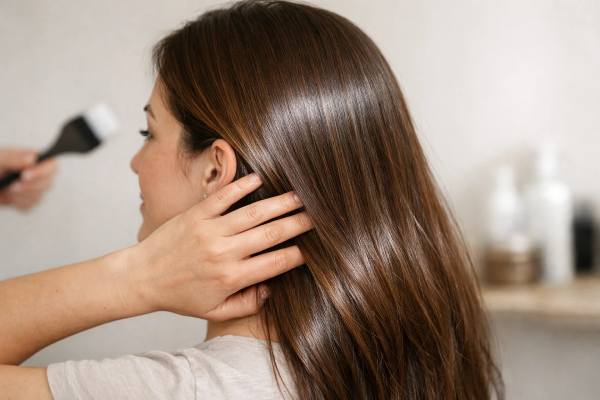
Hair gloss treatment sits in a useful middle ground between pure styling and full color service. It is not just about making hair look shiny for a night. A well-chosen gloss can make rough, dull strands reflect light better, soften frizz, refine tone, and make color look fresher without the commitment of a major chemical change. That is why it shows up so often after salon coloring, before events, and during the weeks when hair starts to look flat or faded.
What makes gloss interesting is that it works mostly on the hair fiber you already have. Hair is a dead fiber once it leaves the scalp, so treatments like gloss improve the surface, feel, and color payoff more than they change the biology of growth. That makes it a cosmetic tool with a clear job: polish the hair shaft, reduce visual roughness, and add a smoother finish.
Used well, gloss can be one of the lowest-drama ways to make hair look healthier. Used carelessly, it can disappoint, build up, or irritate a sensitive scalp. The key is knowing what it can actually do.
Key Insights
- Hair gloss can boost shine and reduce surface roughness, which helps hair look smoother and less frizzy.
- A tinted gloss can refresh faded color or adjust tone, but it does not lighten hair like bleach or permanent dye.
- Results usually last about 2 to 6 weeks, with shorter wear on porous hair or with frequent washing.
- Gloss does not repair split ends or reverse bleach damage, so it works best as a finishing treatment, not a rescue cure.
- Apply it on clean, damp hair and follow the product timing exactly; for most people, every 4 to 6 weeks is enough.
Table of Contents
- What a Hair Gloss Treatment Actually Is
- How Gloss Creates Shine and Tames Frizz
- What It Can and Cannot Do for Color
- Who Benefits Most and Who Should Be Cautious
- Salon Versus At Home Gloss
- How to Use Gloss for Best Results
What a Hair Gloss Treatment Actually Is
A hair gloss treatment is a shine-focused formula designed to improve the look and feel of the hair shaft. Depending on the product, it may be clear or tinted, purely conditioning or lightly color-depositing. In practical terms, gloss is meant to make hair look smoother, more reflective, and more polished. That is why people often describe the result as “glassier,” “healthier,” or “less fuzzy,” even when the underlying hair condition has not dramatically changed.
The most useful way to think about gloss is this: it is a surface-refining treatment. It helps the outer layer of the hair lie flatter and feel more even. When the surface is smoother, hair reflects light more evenly, which creates visible shine. When roughness is reduced, strands catch less on each other, so hair can also feel softer and look less puffy.
Gloss products usually fall into a few groups:
- Clear gloss: adds shine and softness without changing tone.
- Tinted gloss: refreshes tone, deepens color slightly, or offsets unwanted warmth or dullness.
- Salon demi-permanent gloss: often used after coloring to refine the final shade and improve finish.
- At-home gloss masks or rinses: easier to use, often more conditioning, and usually less dramatic.
The term gloss is sometimes used loosely. Some brands say glaze, others use shine treatment, and some place gloss products next to masks or color refreshers. That can be confusing, but the core purpose stays the same: improve cosmetic appearance with less commitment than a full permanent color service.
It also helps to know what gloss is not. It is not bleach, so it will not lighten hair. It is not a bond-builder by default, so it does not rebuild internal structure the way repair-focused treatments aim to. It is not the same as a long-lasting smoothing service either. If you want a broader comparison, see how gloss differs from longer smoothing treatments.
The best mental model is polish, not transformation. A gloss can make hair look significantly better in the mirror, but it works within the limits of your current hair condition. If your ends are heavily split, your color is very patchy, or your cuticle is severely worn from heat or bleach, gloss can improve the finish without fully hiding the problem.
That is exactly why gloss is popular. It offers visible payoff with relatively low commitment. For many people, that combination is more useful than a treatment that promises everything and delivers too much change all at once.
How Gloss Creates Shine and Tames Frizz
Shine is mostly about how evenly hair reflects light. Smooth hair acts more like a polished surface, so light bounces back in a cleaner way. Rough, lifted, or chipped cuticles scatter light, which makes hair look dull. Hair gloss works by improving that surface behavior. It coats, conditions, and smooths the hair fiber so the outer layer feels more uniform.
That is why gloss can create an immediate visual difference even when the hair itself is still dry or damaged underneath. The treatment does not need to rebuild the whole strand to make it look better. It only needs to improve the surface enough to change how the hair catches light and moves.
Frizz improvement comes from a similar mechanism. Frizz is not just “too much volume.” It is often a mix of lifted cuticles, uneven moisture absorption, static, swelling in humidity, and misaligned strands. Gloss helps by adding slip and reducing surface friction, so hairs do not snag or separate as easily. When the outer layer is smoother, the hair tends to sit together in a more controlled way.
This is why gloss often helps most when hair is:
- color-treated
- porous
- dry through the mid-lengths and ends
- exposed to frequent blow-drying or hot tools
- prone to a halo of top-layer fuzz in humid weather
Many gloss formulas use a mix of film-formers, conditioning agents, lightweight oils, acidic components, and sometimes silicones. That combination can lower roughness, improve combing, and make hair feel silkier. A good formula should leave the hair soft and reflective, not heavy and greasy.
Still, there are limits. Gloss can reduce surface frizz, but it will not fully control frizz caused by broken hairs, severe dehydration, or aggressive heat damage. It also will not stop hair from swelling in very humid conditions if the rest of the routine is not supporting moisture balance and heat protection. For that reason, gloss tends to work best as part of a routine rather than as a stand-alone fix. If your hair stays rough between treatments, it helps to understand how porosity affects smoothness and shine.
A useful expectation is this: gloss can make hair look calmer, sleeker, and shinier, but not necessarily straight. It can make waves look more defined and curls look more polished without flattening them. In fact, clear or lightweight gloss treatments can be especially helpful when someone wants less frizz and more luster without the “pressed down” feel of a heavier serum.
The strongest results usually show on the mid-lengths and ends, where wear is greatest. New growth near the scalp is often naturally shinier already. That is another reason salon gloss services often focus where the hair looks oldest and most weathered.
What It Can and Cannot Do for Color
Color is one of the biggest reasons people book or buy a hair gloss. A tinted gloss can refresh faded salon color, add richness, soften brassiness, or make the overall tone look more intentional. Even a clear gloss can help color look better because shinier hair reflects more light and shows dimension more clearly.
The effect is often subtle but noticeable. Brown hair can look deeper and more expensive. Blonde hair can look brighter, less dusty, or slightly more neutral. Red shades can look richer and less washed out. Dark hair can look more mirror-like. In many cases, gloss does not “change” the color dramatically so much as it improves the clarity of the color that is already there.
This is especially helpful after a few weeks of washing, heat styling, and sun exposure, when color tends to lose crispness. A gloss can act like a tune-up. It refines the tone without requiring a full recolor from roots to ends.
What a gloss can do for color:
- revive faded lengths
- tone down unwanted warmth or dullness
- add slight depth or richness
- blend the look of unevenness on the surface
- improve the finish after highlights or balayage
What a gloss cannot do:
- lighten hair
- replace bleach
- fully cover resistant gray the way permanent dye may
- correct major banding or severe color mistakes
- rebuild structural damage inside heavily processed hair
That last point matters. Bleached hair often grabs pigment unevenly because the cuticle is more porous and the internal structure is less uniform. A gloss can make it look better, but it can also fade faster or deposit darker in the most damaged areas. That is one reason very lightened hair needs a more careful plan. If that sounds familiar, bleached hair needs a different recovery plan than simple shine maintenance.
Another common misunderstanding is gray coverage. Gloss may soften the contrast of a few grays or make them catch tone differently, but it is not the same as dedicated permanent gray coverage. Someone with scattered early grays may love the softness. Someone expecting full, opaque coverage is more likely to be disappointed.
Timing also matters. Freshly colored hair often looks best with gloss because the tone is refined and the cuticle has been conditioned. But over-glossing can muddy certain shades, especially on very porous blondes or on hair that already has several layers of deposited tone.
For most people, the best use of gloss for color is maintenance, not correction. It shines when you like your shade but want it to look cleaner, glossier, and more expensive between major appointments. That is a narrow promise, but it is a realistic one, and realistic promises are usually what make beauty routines work.
Who Benefits Most and Who Should Be Cautious
Hair gloss is one of the more flexible cosmetic treatments because it can be adapted to many hair types. The people who tend to love it most are not always the ones with the “worst” hair. They are often the ones who want visible polish without a major haircut, drastic color shift, or long chemical service.
Gloss is especially useful for:
- color-treated hair that fades quickly
- dry or porous mid-lengths and ends
- hair that looks dull even when it feels clean
- frizz-prone textures that need more slip, not more stiffness
- fine hair that needs shine without thick oils
- curly or wavy hair that looks rough on the surface but still needs movement
Clear gloss can be a smart option for someone who wants a healthy-looking finish but does not want to alter tone. Tinted gloss can help people whose salon color looks flat by week three or four. It is also useful before weddings, photos, interviews, or travel, when the goal is polished hair rather than a major makeover.
That said, gloss is not ideal for everyone, every time. You should be more cautious if you have:
- a history of reactions to hair dye or fragranced products
- an irritated, flaky, burning, or broken scalp
- active eczema or contact dermatitis around the hairline
- very fragile, overprocessed hair that grabs color unpredictably
- a planned major color correction soon
Sensitive scalp is the big one. Even treatments marketed as gentle can contain fragrance, preservatives, direct dyes, oxidative dye components, or conditioning agents that bother reactive skin. If you have ever had itching, swelling, rash, or burning from color or hair products, take that seriously. It is worth reviewing patch testing before color products instead of assuming a gloss is automatically safer because it sounds milder.
It is also wise to separate hair needs from scalp needs. A gloss is designed for the fiber more than the scalp. If your scalp is inflamed, the solution is usually not a shinier coating on the hair shaft. In that situation, treating the scalp condition first matters more.
One more point: expectations should match your hair history. If your strands are naturally smooth and dark, a gloss may add a subtle, elegant upgrade. If your hair is heavily highlighted, dry, and fuzzy, the upgrade may be more dramatic but also shorter-lived. Hair with more wear often shows a bigger improvement at first and loses it faster.
That does not make gloss a bad choice. It just means the treatment works best when chosen with your texture, porosity, color history, and scalp sensitivity in mind. The more realistic the match, the better the result feels.
Salon Versus At Home Gloss
Both salon and at-home gloss can work well, but they are not interchangeable. The best choice depends on your goal. If you want a custom tone adjustment, a polished finish after highlights, or a fix for faded salon color, a professional gloss usually gives more control. If you mainly want added shine and softer texture, an at-home gloss may be enough.
A salon gloss has three main advantages. First, the formula can be tailored to your starting color, porosity, and desired tone. Second, application can be targeted, which matters when the ends are porous and the roots are not. Third, a stylist can judge when a color-depositing gloss needs to sit for less time to avoid over-toning.
At-home gloss is better suited to simpler goals:
- clear shine enhancement
- mild softness and frizz control
- subtle color refreshing between appointments
- convenience without a full service visit
The main risk at home is not usually dramatic damage. It is mismatch. The formula may be too rich for fine hair, too tinted for porous ends, or too weak to make a noticeable difference. That is why many people do best starting with a clear gloss before trying a tinted one.
As for wear time, most gloss results last roughly 2 to 6 weeks. The shorter end is common when hair is porous, washed often, exposed to frequent heat, or treated with stronger cleansing products. The longer end is more likely when hair is smoother, washing is less frequent, and the routine is gentle.
One hidden variable is buildup. Hair that already has layers of oils, leave-ins, and styling products may not take a gloss evenly, and repeated shine treatments can eventually leave the hair feeling coated rather than fresh. That does not mean gloss is bad. It means clean canvas matters. A smart reset can involve clarifying shampoo timing before the next treatment, not after every wash.
Another point of comparison is intensity. Salon gloss is usually more precise. At-home gloss is usually more forgiving. Precision helps if you want cooler beige instead of brass or a richer brunette instead of a flat one. Forgiveness helps if you mostly want glow and softness with low risk.
In general, choose salon gloss when color tone matters. Choose at-home gloss when shine matters most. If you are deciding between them, ask one simple question: am I trying to correct something or just polish it? Correction tends to belong in the salon. Polish is often manageable at home.
How to Use Gloss for Best Results
The best gloss results usually come from restraint. More product, more time, and more frequency do not automatically create more shine. In fact, overdoing gloss can leave hair heavy, flat, or slightly over-toned. A cleaner strategy is to use the right formula, on the right schedule, with a routine that protects the result.
A practical approach looks like this:
- Choose the formula by goal.
Use clear gloss for shine and softness. Use tinted gloss only when you clearly want to refresh tone, deepen color slightly, or soften unwanted warmth. - Start with clean, damp hair.
Heavy oils, dry shampoo residue, and styling buildup can block even application. Hair should be freshly washed unless the product specifically says otherwise. - Keep application off the scalp when possible.
Focus on mid-lengths and ends unless the instructions call for all-over use. This lowers the chance of irritation and prevents roots from getting too coated. - Follow timing exactly.
Extra minutes do not guarantee a better result. On porous or lightened hair, too much time can make tone grab darker or ashier than expected. - Rinse thoroughly and condition only if needed.
Some gloss formulas are rich enough on their own. Layering too much afterward can weigh hair down. - Protect the finish.
Use moderate heat, a gentle wash routine, and less aggressive brushing. Shine lasts longer when the cuticle is not being roughed up every day.
For most people, using gloss every 4 to 6 weeks is reasonable. Very porous hair may need refreshing sooner, while healthier, lower-porosity hair may hold the effect longer. Weekly use is usually unnecessary unless the product is an ultra-light shine mask specifically designed for frequent use.
Maintenance matters more than people think. If you gloss the hair and then use very hot tools, harsh cleansing, and repeated tension styling, the polished finish fades fast. On the other hand, a modest routine can stretch the result: cooler blow-drying, softer detangling, satin or silk sleep protection, and less washing when practical.
Pay attention to how the hair feels, not just how it looks under bright light. If it starts feeling coated, limp, or oddly dull despite looking shiny when freshly styled, that may point to accumulation rather than true smoothness. In that case, review the common signs of product buildup before adding another layer of gloss.
The real win with gloss is consistency, not intensity. A treatment that leaves your hair shiny, touchable, and easy to style for a few weeks is doing its job. It does not need to do everything else too.
References
- On Hair Care Physicochemistry: From Structure and Degradation to Novel Biobased Conditioning Agents 2023 (Review)
- With or without Silicones? A Comprehensive Review of Their Role in Hair Care 2025 (Review)
- Hair Product Allergy: A Review of Epidemiology and Management 2024 (Review)
- Contact dermatitis to hair cosmetics: Current diagnostic recommendations 2021 (Review)
- Systematic review on skin adverse effects of important hazardous hair cosmetic ingredients with a focus on hairdressers 2023 (Systematic Review)
Disclaimer
This article is for educational purposes only and does not replace medical advice, diagnosis, or treatment. Hair gloss is a cosmetic service, not a treatment for scalp disease, hair loss, or severe hair damage. If you have scalp burning, rash, swelling, sudden breakage, or a history of reactions to hair dye or fragranced products, seek advice from a dermatologist or other qualified clinician before using a gloss treatment.
If you found this article helpful, please share it on Facebook, X, or your preferred platform so others can use it too.