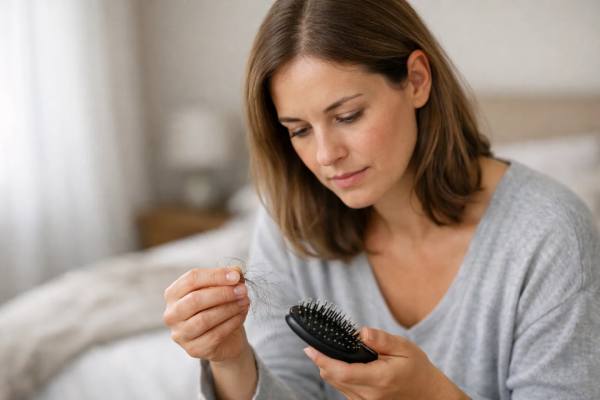
Noticing more hair in the shower a few weeks after surgery can be startling, especially when the procedure seemed to go well and your focus was supposed to shift toward healing. In many cases, this pattern is not permanent hair loss but telogen effluvium, a temporary shedding process that can follow major physical stress. Surgery, anesthesia, inflammation, blood loss, low appetite, rapid weight change, pain, and disrupted sleep can all push more follicles than usual out of the growth phase and into a resting phase. The confusing part is that the shedding usually shows up later, often when you think recovery should be getting easier.
Understanding that delay can make the experience less frightening. Postoperative telogen effluvium usually follows a recognizable timeline, tends to be diffuse rather than patchy, and often improves once the body stabilizes. The most helpful response is not panic buying supplements or overcorrecting with harsh hair routines. It is learning what is typical, what may prolong recovery, and which signs suggest you need a closer medical evaluation.
Quick Overview
- Hair shedding after surgery often starts 6 to 12 weeks later, not immediately after the procedure.
- Postoperative telogen effluvium is usually temporary and often improves once healing, nutrition, and overall stress recover.
- Anesthesia is not always the only trigger; the whole surgical stress response, blood loss, illness, and reduced intake may contribute.
- Support recovery with adequate protein, regular meals, gentle hair care, and medical follow-up if shedding lasts beyond 6 months or becomes patchy.
Table of Contents
- Why Surgery and Anesthesia Can Trigger Shedding
- The Telogen Effluvium Timeline After Surgery
- Signs That Fit Postoperative Telogen Effluvium
- Recovery Steps That Support Regrowth
- Is It Anesthesia or Another Cause
- When to Seek Testing and Treatment
Why Surgery and Anesthesia Can Trigger Shedding
Hair follicles are not passive strands. They are active mini-organs that respond to illness, inflammation, hormones, nutrient shifts, and physiologic stress. That is why hair often reflects what the body has been through several weeks earlier. After surgery, the issue is usually not that hair has been “damaged” at the scalp surface. The more common process is that many follicles are nudged out of active growth and into a resting phase at the same time. When that shift involves enough follicles, visible shedding follows.
This pattern is called telogen effluvium. In a healthy scalp, most hairs are in the growth phase and only a minority are in the resting phase. After a major stressor, that balance can change abruptly. Surgery is a classic trigger because it can combine several stresses at once:
- Tissue injury and inflammation
- General anesthesia or sedation
- Blood loss
- Fever or infection
- Pain and poor sleep
- Reduced appetite and lower protein intake
- Rapid weight change during recovery
- New medications or medication changes
This is why the question “Was it the anesthesia?” often has a slightly wider answer. Anesthesia may be part of the perioperative stress picture, but the operation itself, the recovery period, and any complications usually matter just as much. The body does not separate these neatly. The follicles respond to the overall burden.
The biology also explains why hair loss after surgery can feel so unfair. By the time shedding becomes obvious, the stressful event is over. You may have already stopped pain medication, returned to work, or resumed exercise. Yet the follicles are only then releasing hairs that were shifted into rest weeks earlier. If you understand the normal hair growth cycle, that delay makes more sense. The shedding is real, but it is often the visible end of an earlier event rather than a sign of new injury happening in that moment.
Not every postoperative hair problem is telogen effluvium. Very long procedures, prolonged pressure on one part of the scalp, severe nutritional compromise, or certain drugs can create different patterns. But diffuse shedding across the scalp after a stressful operation is a classic setup for temporary telogen effluvium.
The practical takeaway is that postoperative shedding often reflects the body’s recovery load, not a failure of wound healing and not necessarily permanent follicle damage. That perspective matters, because it shifts the focus from panic to support: heal well, eat enough, watch the timeline, and avoid treating every shed hair as evidence that the loss will continue indefinitely.
The Telogen Effluvium Timeline After Surgery
The timeline is the part that confuses most people. Classic postoperative telogen effluvium does not usually start the week after surgery. Instead, it tends to appear after a delay because follicles need time to move through the resting phase before they shed. That lag is what makes many people miss the connection at first.
A typical pattern looks like this:
- Week 0: Surgery, anesthesia, illness, blood loss, pain, or reduced intake acts as the trigger.
- Weeks 1 to 6: Hair often still looks normal. The shift is happening below the surface.
- Weeks 6 to 12: Shedding becomes noticeable. Many people first see more hair in the shower, brush, on the bathroom floor, or on clothing.
- Months 3 to 4 after the trigger: Shedding may feel heaviest.
- Months 3 to 6 after shedding starts: The rate often begins to settle if the trigger has passed and recovery is on track.
- Months 6 to 12 and beyond: Density gradually improves, though full cosmetic recovery can take longer in people with long hair.
This is why a person can have surgery in January and feel alarmed in March or April. The delay is not unusual. In fact, it is one of the most recognizable features of telogen effluvium.
The next frustration is that visible density loss and visible regrowth do not happen on the same schedule. Shedding may slow before the hair looks fuller. Regrowth needs time to emerge, gain length, and blend with the rest of the hair. Someone with a short haircut may notice improvement sooner because new growth becomes visible quickly. Someone with shoulder-length or longer hair may need many additional months before the scalp looks fuller again.
There is also a difference between the duration of shedding and the duration of recovery. Acute telogen effluvium often settles within a few months once the trigger is corrected, but the cosmetic rebound can stretch well beyond that. Hair grows slowly. Even when the follicles are back in growth mode, the mirror may lag behind the biology.
The timeline can also lengthen when the surgical event is followed by another stressor, such as infection, severe calorie restriction, chronic pain, medication changes, or prolonged poor sleep. In that case, the body may experience more than one push into shedding. Recovery can still happen, but the pattern feels less tidy.
What should make you pause is timing that does not fit at all. Shedding that starts within days, sharply defined bald patches, broken hairs rather than shed club hairs, or ongoing heavy loss far beyond 6 months deserves another look. If the course seems abrupt, severe, or simply atypical, a guide to when sudden shedding needs medical review can help you judge whether this is still likely to be straightforward telogen effluvium or something else.
Signs That Fit Postoperative Telogen Effluvium
Postoperative telogen effluvium usually has a recognizable look and feel. The hallmark is diffuse shedding. Rather than one sharply defined bald area, the hair seems thinner all over, especially through the top, crown, and part line. People often describe a smaller ponytail, more scalp show-through in bright light, and a sudden sense that their hair has lost body.
Common signs include:
- More hair coming out during washing or brushing
- Loose hairs on the pillow, clothing, or desk
- A widened part rather than a round bare patch
- Reduced overall volume
- Shedding from multiple scalp areas, not just one spot
- A scalp that usually looks normal, without scars or obvious inflammation
The hairs themselves can offer clues. In telogen effluvium, the shed hair is often a full-length strand with a small white club-shaped bulb at one end. That tells you the follicle cycled the hair out rather than snapping it in the middle. This is why telogen effluvium is often experienced as “hair everywhere” rather than “hair looking frayed.” Breakage can happen at the same time, especially if the hair is bleached or heat-damaged, but it is not the defining feature.
Another clue is what you do not see. Telogen effluvium usually does not create shiny, completely bare patches. It usually does not cause scarring. It may come with scalp sensitivity or a strange awareness of the scalp, but marked redness, pustules, thick scale, or crusting point away from routine postoperative shedding and toward another diagnosis.
That said, telogen effluvium can expose hair thinning that was already beginning. Someone with early pattern loss may feel that surgery “caused” a new sparse crown, when in reality the shedding unmasked a background tendency that had been easier to hide before. In that setting, the excess shedding improves, but the hair does not return all the way to the previous baseline. This is one reason the course deserves follow-up if recovery stalls.
A helpful distinction is between temporary shedding and permanent loss. Telogen effluvium is a shedding disorder, meaning follicles are still alive. The hair cycle has been interrupted, not destroyed. Over time, many people notice short regrowing hairs along the part or hairline, fewer strands coming out during wash days, and gradual return of fullness. That is very different from scarring processes, where follicles are lost and the scalp changes texture.
If you are watching the shower drain closely, try to focus less on one dramatic wash and more on the pattern over several weeks. Fluctuation is common. One heavy wash day after skipping a shampoo does not always mean things are worsening. What matters is whether diffuse shedding continues at a high level over time and whether the scalp picture remains consistent with temporary postoperative telogen effluvium.
Recovery Steps That Support Regrowth
There is no instant fix for telogen effluvium, because the condition reflects a hair-cycle shift that has already happened. The goal is to support the follicles as the body recovers and to avoid adding new stressors that keep the shedding going. In practice, the best recovery plan is often steady and unglamorous.
Start with the basics that most influence postoperative recovery:
- Meet protein needs consistently.
Hair is not essential tissue, so the body will prioritize wound healing and core functions before hair. Many adults recovering from surgery do better when protein intake is deliberate rather than accidental. A practical target is often around 1.0 to 1.2 grams of protein per kilogram of body weight per day, unless your clinician has advised a different plan because of kidney disease or another medical reason. - Avoid under-eating during recovery.
Appetite often drops after surgery, but a prolonged calorie deficit can prolong shedding. Small, regular meals can be easier than forcing large ones. - Correct documented deficiencies.
Iron, ferritin, vitamin B12, folate, zinc, and vitamin D may matter in selected cases, but supplements work best when they solve a real deficit. Random high-dose supplements are usually less helpful than targeted correction. - Keep hair care gentle.
Wash as needed for your scalp, detangle carefully, and reduce high-tension styles, frequent bleaching, and heavy heat. Shedding hairs are going to come out; harsh handling only adds breakage and stress. - Support sleep and pain control.
Ongoing pain, poor sleep, and chronic stress keep the body in a strained state. Hair recovery tends to look better when overall recovery is calmer.
People often ask about biotin, collagen powders, scalp serums, or growth shampoos. These may help only in selected situations, and they rarely override major problems such as low protein intake, iron deficiency, or continued illness. If your intake has been poor, it is smarter to first rule out protein-related shedding clues than to collect supplements that do not address the main issue.
Topical minoxidil is sometimes discussed for telogen effluvium, especially when shedding is prolonged or when a clinician suspects pattern thinning was uncovered at the same time. It is not required for every case, and it is not the right choice for everyone, but it can be worth discussing if recovery stalls. The same goes for low-dose oral treatments, which require medical supervision.
What usually helps most is consistency. Eat enough, especially protein. Rebuild strength gradually. Do not swing into restrictive eating because you are less active after surgery. Do not confuse frequent washing with causing the loss. And try not to judge recovery by the mirror every morning. Follicles improve slowly and quietly. The visible payoff comes later.
Is It Anesthesia or Another Cause
It is reasonable to wonder whether anesthesia itself caused the shedding, especially if you noticed the problem after a procedure and had never dealt with heavy hair fall before. In most cases, though, the cleaner answer is that surgery-related telogen effluvium is usually multifactorial. The anesthetic may be part of the event, but it is often not the only or even the dominant factor.
Think about what commonly surrounds surgery:
- Physical stress from tissue injury
- Inflammatory signaling
- Temporary reduced food intake
- Blood loss or low iron stores afterward
- Fever, infection, or antibiotics
- Rapid weight loss
- Medication starts or stops
- Emotional stress, pain, and sleep disruption
Any one of these can contribute. Together, they form a strong setup for postoperative shedding. That is why trying to blame one ingredient can be misleading.
There are also other postsurgical hair problems that should not be lumped together with classic telogen effluvium. One is pressure-related hair loss, sometimes called pressure alopecia. This is more likely after very long operations, prolonged intensive care stays, or extended immobility. Instead of diffuse shedding, it may appear as a localized tender patch, often toward the back of the scalp, and it can start earlier than classic telogen effluvium.
Another look-alike is medication-related shedding. Some drugs started around the time of surgery can affect the hair cycle. Beta-blockers, anticoagulants, retinoids, certain anticonvulsants, and hormonal changes are well-known examples. In those cases, the operation may be the visible milestone, but the medication shift may be part of the real explanation.
Then there is anagen effluvium, which is different again. That pattern is seen more often with chemotherapy or direct toxic injury to growing hairs. It tends to start sooner and behaves differently than classic telogen effluvium.
A final possibility is that surgery unmasks a background tendency that was already there. Early androgenetic thinning, for example, may go unnoticed until a stress shed removes enough extra density to make it obvious. The person understandably links the change to the operation because that is when the hair looked worse, but the surgery may have exposed rather than created the underlying problem.
So is it fair to say anesthesia can be associated with later shedding? Yes. Is it useful to treat anesthesia as the sole villain in every case? Usually not. The more practical question is broader: what changed around the time of surgery that could have stressed the hair cycle, and has that stress fully resolved now. That approach is more clinically useful and more likely to point you toward the right next steps.
When to Seek Testing and Treatment
Many cases of postoperative telogen effluvium improve with time and supportive care, but not every case should be managed by waiting alone. Medical review becomes more important when the story does not fit the usual pattern or when other risk factors could be keeping the shedding active.
It is worth seeking evaluation if:
- Shedding is still heavy beyond about 6 months
- Hair loss is patchy rather than diffuse
- The scalp is painful, very itchy, inflamed, scaly, or crusted
- You also notice eyebrow or eyelash loss
- You have symptoms of anemia, thyroid disease, or marked nutritional depletion
- You lost a significant amount of weight after surgery
- You had bariatric, gastrointestinal, or prolonged recovery surgery
- The thinning seems to reveal a persistent widened part or receding pattern rather than gradual rebound
A clinician will often start with the timeline, the type of surgery, the recovery course, your medications, and what your nutrition looked like afterward. Scalp examination matters too. A normal-looking scalp with diffuse shedding supports telogen effluvium. Inflammation, perifollicular change, broken hairs, or smooth bare patches suggest a different diagnosis.
Depending on the context, testing may include:
- Complete blood count
- Ferritin or iron studies
- Thyroid testing
- Vitamin B12 or folate
- Vitamin D or zinc in selected cases
- Hormonal testing when symptoms point that way
Iron deserves special mention. Low ferritin is common in some people with ongoing shedding, but it is not a one-size-fits-all explanation. The right threshold depends on the lab context and the whole clinical picture. A detailed look at ferritin and hair-growth interpretation can help frame that conversation without assuming every case needs iron.
Treatment depends on what the workup shows. Straightforward postoperative telogen effluvium may need little more than reassurance, nutrition support, and patience. A person with persistent shedding and low iron may need iron replacement. Someone whose stress shed unmasked pattern thinning may benefit from a longer-term hair-loss plan, not just watchful waiting. A patient with scalp inflammation may need anti-inflammatory treatment. The point of evaluation is not to medicalize every shed hair. It is to avoid missing the cases where “just wait” is no longer enough.
A good rule is simple: if the pattern is diffuse, delayed, and gradually calming, telogen effluvium remains likely. If the shedding is relentless, the scalp looks abnormal, or the recovery curve stalls, get a closer assessment. Temporary postoperative shedding is common. Untreated underlying contributors are common too.
References
- Telogen Effluvium – StatPearls – NCBI Bookshelf 2024 (Clinical Reference)
- Telogen Effluvium and Anesthesia Considerations: A Case Report – PMC 2025 (Case Report)
- Retrospective Review of 2851 Female Patients With Telogen Effluvium: A Single‐Center Experience – PMC 2025 (Retrospective Study)
- Use of 5% Topical Minoxidil Application for Telogen Effluvium: An Open‐Label Single‐Arm Clinical Trial – PMC 2025 (Clinical Trial)
- Telogen Effluvium Associated With Weight Loss: A Single Center Retrospective Study – PMC 2024 (Retrospective Study)
Disclaimer
This article is for educational purposes only and is not a diagnosis, treatment plan, or substitute for personal medical care. Hair shedding after surgery is often temporary, but it can overlap with iron deficiency, thyroid disease, medication effects, pattern hair loss, inflammatory scalp disorders, or other medical issues. Contact a qualified clinician if shedding is severe, lasts longer than expected, or comes with scalp pain, redness, scaling, patchy bald spots, or other concerning symptoms.
If this article was useful, please share it on Facebook, X, or your preferred platform so it can help someone else make sense of postoperative hair shedding.