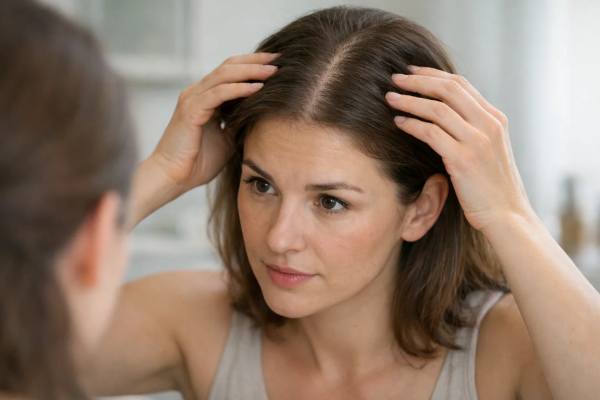
Hair loss in women is rarely just about hair. It can signal changes in hormones, nutrition, stress load, immune activity, or the scalp itself, and the pattern often offers the first clue. A widening part, extra hair in the shower, a suddenly visible crown, or smooth round patches do not all mean the same thing. That is why the best first step is not guessing at products, but learning what kind of loss you are seeing.
The reassuring part is that many causes of thinning are treatable, and some are temporary. Even when regrowth takes time, the right diagnosis usually makes the next steps much clearer. Women also tend to experience hair loss differently from men: more diffuse thinning, more overlap between causes, and more shedding linked to life stages such as postpartum recovery, perimenopause, illness, or rapid weight change. Understanding those patterns helps you focus on what actually helps, avoid unnecessary supplements, and know when a dermatologist should step in.
Key Insights
- Gradual widening at the part often points to female-pattern hair loss, while sudden all-over shedding more often suggests telogen effluvium.
- Hair loss in women is often multifactorial, with hormones, iron status, thyroid disease, stress, medications, and genetics overlapping.
- Pain, burning, scaling, pustules, or shiny scar-like areas raise concern for inflammatory or scarring disorders that need faster evaluation.
- Most evidence-based treatment plans require patience; topical minoxidil usually needs at least 3 to 6 months before improvement is clear.
- Track the timeline, pattern, recent illnesses, weight changes, and medications before your visit, because that history often narrows the diagnosis quickly.
Table of Contents
- How shedding, thinning, and breakage differ
- Female-pattern hair loss and slow widening
- Telogen effluvium after stress or illness
- Hormones, nutrients, and medical triggers
- Red flags and the diagnostic workup
- What helps and what to expect
How shedding, thinning, and breakage differ
Many women use “hair loss” to describe several different problems, but shedding, thinning, and breakage are not interchangeable. Sorting them out early helps prevent the wrong fix.
Shedding means hairs are leaving the scalp from the root. You might notice more strands on the pillow, in the shower, or on your brush, often with a small white club-shaped bulb at one end. Some daily shedding is normal because scalp hair cycles through growth, transition, rest, and release. If you want a deeper primer on that rhythm, the hair growth cycle explains why a trigger today may not show up as shedding until weeks later.
Thinning is different. It means your overall density is lower, even if you are not seeing dramatic shedding. The ponytail feels smaller, the part looks wider, or more scalp shows through under bright light. Thinning often reflects gradual miniaturization of follicles, which is common in female-pattern hair loss.
Breakage creates a third picture. Hair snaps along the shaft instead of falling from the root, so the loss is usually more obvious through frayed ends, short uneven pieces, halo frizz, or hair that refuses to gain length. Breakage may come from bleaching, heat, chemical straightening, rough detangling, or tight styling. It can coexist with true scalp hair loss, which is one reason self-diagnosis gets messy.
A few practical clues help:
- More hair all over the sink or shower drain suggests shedding.
- A broader part or see-through crown suggests thinning.
- Short snapped strands around the hairline or crown suggest breakage.
- Patchy bare spots suggest a different category entirely.
Lighting and styling can also mislead. Wet hair, sleek parts, dark roots against pale scalp, and scalp oils can exaggerate visible thinning. On the other hand, curly or textured hair may hide reduced density until the loss is already significant.
One detail that matters more than most women realize is timing. Sudden shedding that starts about 2 to 3 months after a fever, major stress, surgery, childbirth, medication change, or crash diet often points toward telogen effluvium. Slow change over years is more typical of patterned loss. Sudden patches, especially with eyebrow or lash changes, point somewhere else.
The simplest way to begin is to document what you see for 4 weeks: part width, shedding amount, symptoms such as itch or burning, and any recent body changes. That record often becomes as useful as the physical exam.
Female-pattern hair loss and slow widening
Female-pattern hair loss is the most common long-term cause of thinning in women. It usually develops gradually, not in dramatic clumps, which is why many women notice it late. The classic signs are a widening central part, reduced density over the crown, and a more visible scalp under overhead light. Unlike many men, women often keep the frontal hairline, at least early on.
The biology is more complex than a simple “too much testosterone” explanation. Genetics play a major role, and follicles become progressively smaller over time. Each cycle can produce a finer, shorter hair than the one before it. This is called miniaturization. In practice, the result is not always a receding hairline. More often, it is a diffuse loss of volume.
Age matters. Female-pattern loss becomes more common after menopause, but it can begin much earlier, including the twenties and thirties. A family history helps, though it is not required. Many women also have mixed patterns, where female-pattern loss coexists with stress-related shedding, iron deficiency, or postpartum change. That overlap is one reason treatment can feel inconsistent unless the whole picture is addressed.
When female-pattern loss appears alongside acne, unwanted facial hair, irregular periods, infertility, or sudden worsening, clinicians think more carefully about androgen excess. Polycystic ovary syndrome is one important possibility, but it is not the only one. A rapidly progressive pattern deserves a fuller hormonal review than a slow, stable widening over many years.
Women often ask whether female-pattern hair loss is reversible. A better word is manageable. The earlier treatment starts, the better the chance of preserving density. Once follicles have miniaturized for a long time, complete restoration becomes less likely. That is why waiting until the scalp is clearly visible can cost valuable time.
The emotional side deserves just as much respect as the medical side. Because the change is often diffuse, women may hear that they are “imagining it” long before the loss becomes obvious to others. Yet early patterned thinning can change how hair parts, holds volume, or frames the face well before bald spots appear. Those subtle shifts are real.
A useful mindset is this: female-pattern loss is usually not an emergency, but it is also not something to ignore for a year while trying random oils and supplements. If the part is widening month by month, the most efficient step is targeted treatment and a diagnosis you can follow over time.
Telogen effluvium after stress or illness
Telogen effluvium is the classic cause of sudden, diffuse shedding in women. It happens when more hairs than usual shift into the resting phase and then release weeks later. The lag is the key. The trigger often happens first, and the shedding begins about 2 to 3 months afterward, which makes the connection easy to miss.
Common triggers include:
- High fever or a significant infection
- Surgery or major blood loss
- Childbirth
- Rapid weight loss
- Very low-calorie or low-protein dieting
- Severe emotional stress
- Starting or stopping certain medications
- Major illness, hospitalization, or systemic inflammation
The shedding can be alarming. Women may notice handfuls in the shower, more hair on clothing, or a dramatic increase on wash days. The scalp usually looks normal, though the hair may feel noticeably thinner overall. What telogen effluvium does not usually do is create sharply defined bald patches or scar-like shiny areas.
Acute telogen effluvium is often self-limited. Once the trigger resolves, shedding usually eases over several months. That does not mean the hair looks “back to normal” right away. Density takes longer to recover than the shedding takes to calm down. Many women need 6 to 12 months to feel that their hair looks fuller again, and longer if the hair is long, curly, or naturally slow-growing.
Postpartum shedding is one of the most familiar versions. It can be intense, especially around the temples and front hairline, but in most cases it improves as the hair cycle resets. Another modern pattern is illness-related shedding after a severe viral infection or a period of rapid metabolic stress.
Chronic telogen effluvium is trickier. The shedding persists beyond 6 months, often with a normal-looking scalp and no obvious scar or patch. In some women, chronic shedding overlaps with female-pattern loss, which means the density does not fully rebound even after the shedding trigger improves.
The most helpful question is not “What product stops shedding fast?” but “What changed 8 to 12 weeks before this started?” That is often where the answer lives. Recent dieting, medication switches, postpartum recovery, a major breakup, a hospital stay, or an untreated deficiency may matter more than any shampoo.
Because telogen effluvium is so often reversible, it is also the diagnosis that leads many women to panic-buy treatments they do not actually need. Supportive care, correcting the trigger, adequate protein intake, and patience are usually more important than adding five scalp serums at once.
Hormones, nutrients, and medical triggers
Not all hair loss in women begins in the follicle itself. Sometimes the scalp is responding to a body-wide problem, and that is where lab work and medical history become essential.
Hormonal shifts are a major category. Menopause and perimenopause can lower the growth-supporting effects of estrogen and make patterned thinning more noticeable. Androgen excess can also matter, especially when hair loss comes with acne, irregular periods, scalp oiliness, or increased facial hair. Polycystic ovary syndrome is a common reason clinicians ask broader questions about cycles, fertility, weight patterns, and insulin resistance.
Nutritional problems matter too, but they are often oversimplified online. Iron deficiency is one of the most important to rule out, especially in women with heavy periods, restrictive eating, recent pregnancy, or endurance training. If iron status is part of the question, understanding ferritin and hair growth levels helps explain why a “normal” result is not always the full story in a thinning patient. Low protein intake can also worsen shedding, particularly after aggressive dieting, bariatric surgery, or prolonged appetite suppression. Vitamin B12, folate, zinc, and vitamin D may enter the discussion in selected cases, but they are not universal explanations.
Medical conditions can drive loss in several ways:
- Thyroid disease can shift the hair cycle and change texture.
- Autoimmune disease can trigger patchy or diffuse loss.
- Significant inflammation, chronic illness, or malabsorption can reduce density.
- Scalp disorders such as psoriasis or seborrheic dermatitis can amplify shedding.
Medications deserve a careful review. Retinoids, some mood stabilizers, anticoagulants, beta-blockers, certain hormonal changes, and some weight-loss scenarios can all contribute. With newer metabolic drugs, the issue is often less about a direct follicle effect and more about rapid weight loss, lower protein intake, and reduced iron intake occurring at the same time.
A crucial caution: more supplements are not always better. Excess vitamin A, too much selenium, and unbalanced zinc use can worsen shedding or create new problems. Hair is not a place to experiment with handfuls of pills without a clear deficiency or treatment target.
The most overlooked clinical insight is that several modest issues can add up. Mild female-pattern loss, borderline iron stores, perimenopause, and a recent viral illness may create a much bigger visible change together than any one factor would alone. That is why the best workup looks for combinations rather than one magical cause.
Red flags and the diagnostic workup
Some forms of hair loss in women need faster attention because delay can make regrowth harder. Patchy loss, scalp pain, pustules, marked scaling, burning, or a shiny smooth area that seems to lose follicle openings should move the problem out of the “watch and wait” category.
Alopecia areata is a common patchy cause. It often creates smooth round or oval bald spots and can appear suddenly. Some women also notice nail changes or loss of eyebrows and lashes. Because it is immune-mediated, it behaves differently from patterned thinning and may need targeted medical treatment.
Scarring alopecias are more urgent. These are inflammatory disorders that can permanently damage follicles if not treated promptly. Clues include tenderness, itching, burning, perifollicular scale, redness, pustules, or areas that look unusually smooth and shiny. Women sometimes mistake these symptoms for dandruff or product irritation for months, which delays diagnosis.
Traction matters too. Chronic pulling from tight ponytails, braids, glued styles, heavy extensions, or repeated tension at the same hairline can create thinning that begins as reversible and then becomes permanent if the stress continues. Women who wear protective styles long term may benefit from reviewing protective styles and scalp health when the hairline starts to look sparse.
A good dermatology visit usually includes:
- A focused history on timing, symptoms, hormones, medications, and family pattern
- A scalp exam that looks for density change, inflammation, scaling, and follicle openings
- A gentle pull test or trichoscopy to separate shedding from miniaturization or breakage
- Targeted laboratory tests when the history suggests deficiency, endocrine issues, or systemic illness
Not every woman needs an extensive hormone panel or a biopsy. Tests are most useful when they are guided by the pattern. Heavy periods may point toward iron studies. Irregular cycles may justify androgen evaluation. Diffuse shedding after a clear fever may need less testing than chronic unexplained thinning.
A biopsy becomes more useful when the diagnosis is uncertain, scarring is suspected, or more than one process may be overlapping. It is usually a small office procedure, not a major intervention.
The big takeaway is that hair loss should not be treated as cosmetic when the scalp is symptomatic. A quiet widening part can wait a few weeks for a routine visit. Painful, inflamed, or patchy loss should not.
What helps and what to expect
The best treatment depends on the pattern, the trigger, and whether the follicles are still capable of recovery. There is no single product that works for every kind of female hair loss.
For female-pattern hair loss, topical minoxidil remains the foundation for many women. The practical routine most clinicians use is 5% foam once daily, or a solution if tolerated, applied consistently to the areas of thinning rather than the hair shaft. Early shedding can happen in the first several weeks, which is unsettling but not always a bad sign. Meaningful improvement usually needs at least 3 to 6 months, and the fairest time to judge results is often closer to 6 to 12 months.
Some women who cannot tolerate topical therapy or need a stronger plan discuss oral options with a clinician. If that conversation comes up, it helps to understand low-dose oral minoxidil side effects before deciding whether the tradeoff is right for you. Women with androgen-driven loss may also benefit from antiandrogen therapy under medical supervision.
For telogen effluvium, treating the trigger is the real treatment. That can mean restoring nutrition, increasing protein, correcting iron deficiency, adjusting a culprit medication with medical guidance, or allowing the body to recover from illness or childbirth. The frustrating part is that the recovery curve is slower than the correction of the trigger.
For alopecia areata or inflammatory scalp disease, prescription therapies are usually needed. These may include injections, topical or oral anti-inflammatory treatment, or more advanced options for selected patients.
Supportive tools matter more than many women expect:
- Hair fibers, powders, and root camouflage can improve confidence immediately.
- Strategic cuts and part changes can reduce scalp contrast.
- Gentle washing is usually better than avoiding shampoo out of fear.
- Tight hairstyles, harsh chemical processing, and high-heat routines should be dialed down when the hair is fragile.
What usually does not help is chasing every trend at once. Most supplements, oils, and growth serums have far less evidence than their marketing suggests. A simpler routine with one evidence-based treatment, one or two corrections to the underlying cause, and consistent follow-up is often more effective than a crowded shelf.
Progress is best measured the same way each month: same lighting, same part, same distance, same dry hair. Hair loss recovery is often a game of small changes that become obvious only when you compare photos over time.
References
- Hair Loss in Women 2025 (Review)
- Female-pattern hair loss: therapeutic update 2023 (Review)
- Telogen effluvium: a 360 degree review 2023 (Review)
- Alopecia Areata: An Updated Review for 2023 2023 (Review)
- Practical Approach to Hair Loss Diagnosis 2021 (Review)
Disclaimer
This article is for educational purposes only and is not a substitute for medical advice, diagnosis, or treatment. Hair loss in women can reflect treatable medical conditions, including iron deficiency, thyroid disease, autoimmune disorders, hormonal imbalance, or inflammatory scalp disease. Seek professional evaluation if hair loss is sudden, patchy, painful, associated with scalp redness or scaling, or accompanied by menstrual changes, fatigue, or other systemic symptoms. Do not start prescription treatment or high-dose supplements without medical guidance.
If you found this article useful, please share it on Facebook, X, or your preferred platform.