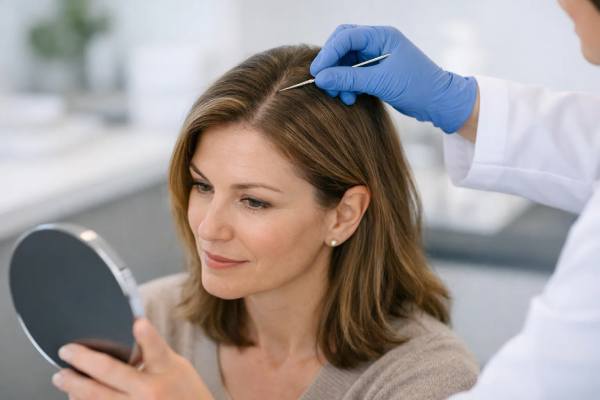
A hair transplant for women can be transformative, but it is not a universal fix for every kind of thinning. The best results tend to come when the diagnosis is precise, the donor hair is strong, and the pattern of loss is stable enough to plan around. That is why women often need a more careful workup than men before surgery is even on the table. Diffuse thinning, hormone-related shedding, scarring alopecia, and traction damage can all look similar at first, yet they do not behave the same way in the operating room.
For the right candidate, transplantation can restore density where styling no longer hides widening parts, temple recession, or thinning along the hairline. It can also improve shape and framing in a way that topical treatments alone often cannot. But the procedure moves existing follicles; it does not create new hair, stop every future loss pattern, or replace medical treatment when that treatment is still needed.
This guide explains which women are most likely to benefit, which situations call for caution, what happens during planning and recovery, and how to set expectations that are realistic from the start.
Key Facts
- Women with stable, localized thinning and a strong donor area often get the most natural transplant results.
- A transplant can improve density and hairline shape, but it does not stop ongoing hormone-related or diffuse shedding on its own.
- Active scalp inflammation, uncontrolled shedding, or weak donor density can make surgery a poor choice or a premature one.
- The most useful first step is a diagnosis-driven consultation that includes scalp exam, donor assessment, and a plan for medical stabilization when needed.
- Early recovery is faster than final growth, but cosmetic results usually take many months to declare themselves fully.
Table of Contents
- Which Women Are Good Candidates
- When a Transplant Is Not the Right First Step
- What a Good Consultation Should Cover
- FUE, FUT, and Donor Planning
- Recovery, Shedding, and Result Timeline
- Risks, Limitations, and Surgeon Selection
Which Women Are Good Candidates
A good female hair transplant candidate is usually someone with hair loss that is both diagnosable and planable. That sounds simple, but it is the central issue. Women do not all lose hair in the same pattern, and surgery works best when the thin area is distinct enough to target and the donor zone is strong enough to supply grafts without looking depleted.
The classic strong candidate has localized thinning rather than diffuse thinning everywhere. That may include widening through the frontal or mid-scalp area with a preserved donor region at the back and sides, temple recession, a high or uneven hairline, thinning related to an old scar, or stable traction alopecia after the damaging hairstyle has stopped. Some women also pursue transplantation after previous cosmetic or facial procedures if a scar or changed hairline has become visible.
Women with stable female pattern hair loss can also be candidates, but the word stable matters. Surgery tends to work best when the surgeon can identify a durable donor area and design around a pattern that is unlikely to shift dramatically in the near future. If the loss is still changing quickly, transplanted hair may grow well while surrounding native hair continues to miniaturize. That can create islands of density in a field that keeps thinning.
This is why candidacy is not only about the recipient area. It is also about donor reserve, scalp health, age, family history, and whether the person is willing to combine surgery with medical treatment. Many women need ongoing therapy before and after transplantation to protect the non-transplanted hairs that remain vulnerable. The transplant moves permanent or relatively permanent follicles; it does not freeze the biology of the rest of the scalp.
The best candidates often share several features:
- A clear diagnosis, not just “hair loss.”
- Adequate donor density in the occipital scalp.
- Hair caliber that offers good visual coverage.
- A limited or patterned area to improve.
- Realistic expectations about density and time.
- Willingness to use medical therapy when appropriate.
Hair texture and contrast also matter more than most people realize. Curlier hair, coarser strands, and lower contrast between hair and scalp often create the appearance of more fullness per graft. Fine, straight hair with high scalp contrast may require a more conservative design and especially careful expectation setting.
Women considering surgery should also understand that transplantation is not always a replacement for non-surgical care. In many cases, the best results come from combining surgery with diagnosis-specific treatment. If the underlying issue is female pattern thinning, the overview of female pattern hair loss stages and treatment can help explain why surgery and long-term maintenance often need to work together rather than compete.
When a Transplant Is Not the Right First Step
Many women who are interested in a transplant are not poor candidates forever. They are poor candidates right now. That distinction matters, because timing is one of the biggest reasons good surgery becomes disappointing surgery.
The clearest example is active shedding. A scalp in the middle of telogen effluvium, postpartum shedding, post-illness shedding, rapid weight-loss shedding, or medication-related shedding is often too unstable to map properly. The visible density may look much worse than the long-term baseline, which can tempt people into premature surgery. In that setting, the first job is to identify the trigger, allow the shedding to settle, and then reassess what thinning remains. Otherwise, a transplant may be planned around a temporary low point rather than the real underlying pattern.
Diffuse thinning is another major caution flag. If the donor zone itself is weak, miniaturized, or unstable, the surgeon may have nowhere safe to borrow from. This is especially important in women with diffuse unpatterned alopecia or extensive miniaturization across the entire scalp. In those cases, the back and sides may not behave like durable donor hair at all. Moving fragile follicles from one vulnerable area to another does not solve the core problem.
Active inflammatory or scarring scalp disease is also a major reason to pause. Conditions such as lichen planopilaris, frontal fibrosing alopecia, and active central centrifugal cicatricial alopecia can destroy follicles and compromise graft survival if surgery is performed while the disease is still active. Even women with a known history of scarring alopecia may need a long quiet period before transplantation is discussed. If that concern is on the table, the guide on lichen planopilaris diagnosis and treatment helps explain why disease control comes before restoration.
There are other reasons to hold off as well:
- Poorly understood hair loss with no confirmed diagnosis.
- Ongoing traction from extensions, braids, or tight styling.
- Unrealistic expectations about teenage-level density.
- Very limited donor supply relative to the size of the thin area.
- Medical issues that make surgery or healing less predictable.
- A plan to correct a problem that might respond better to medication alone.
Scalp camouflage can also affect judgment. Fibers, tinted sprays, and strategic styling sometimes make the thin area look smaller than it really is, while wet hair, harsh overhead light, or a very short cut can make it look much worse. That is why surgeons rely on magnified scalp exam, donor mapping, and standardized photos rather than appearance on a single bad hair day.
The practical rule is this: if the cause is still moving, inflamed, or unclear, surgery is usually not the first step. Stabilization, diagnosis, and donor analysis come first. The women who do best with transplantation are often the ones who were willing to wait until the plan became clear enough to be worth executing.
What a Good Consultation Should Cover
A good consultation for female hair transplantation should feel more like a medical evaluation with surgical planning than like a sales appointment. If the conversation jumps straight to graft numbers before the diagnosis is even settled, that is usually a warning sign.
The first goal is to define the type of hair loss. The surgeon or hair-restoration clinician should examine the scalp, pattern, and donor area carefully. In women, that often means looking for miniaturization not only in the thin region but also in the back and sides, because donor weakness can change the whole plan. The visit may also include a review of family history, medication use, past pregnancies, shedding episodes, scalp symptoms, styling history, and prior treatments. A patient with progressive widening at the part is different from one with a stable temple recession after traction. A patient with inflammation or tenderness is different from one with a quiet scalp and long-standing patterned loss.
Trichoscopy or magnified scalp assessment can be especially helpful. It may show whether the donor hairs are robust, whether miniaturization is widespread, and whether inflammation, scarring, or breakage is part of the picture. In some cases, blood work or dermatology evaluation is recommended before surgery, particularly when iron deficiency, thyroid disease, sudden shedding, or scarring alopecia are in the differential.
A strong consultation should also cover design and priorities. Women often do not need or want the same approach used in male hairline work. Many are less concerned with a low hairline and more concerned with part-line visibility, temple hollowing, frontal framing, or filling thin zones without making the donor area look stripped. The design question is not only “Where can we place grafts?” but also “What change matters most if donor supply is finite?”
Useful questions the consultation should answer include:
- What is my exact diagnosis or top working diagnosis?
- Is my donor area strong enough and stable enough?
- Am I likely to need medical treatment before or after surgery?
- What area should be prioritized first if graft supply is limited?
- What density is realistic in one session?
- Could the pattern progress in a way that changes the long-term cosmetic result?
This is also the stage where hair caliber, curl, color contrast, and scalp laxity come into play. These details influence how much visual coverage each graft can create. A woman with fine, dark, straight hair over a light-reflective scalp may need a more conservative goal than someone with thicker, wavier strands and lower contrast.
If the consultation suggests surgery too early, it is worth stepping back and comparing it with a broader candidacy framework such as general hair transplant candidacy and recovery basics. Women often need more diagnostic precision than men before a transplant is likely to look good not only at year one, but also years later.
FUE, FUT, and Donor Planning
One of the most common questions women ask is whether FUE or FUT is better. The honest answer is that neither method is universally better. The better choice depends on hairstyle preferences, donor characteristics, graft goals, scalp laxity, and how aggressively the donor area can be used without becoming visible.
FUE removes follicular units one by one, usually through tiny circular punches. Its biggest appeal is the absence of a linear scar. That matters to women who want flexibility with updos, shorter haircuts at the nape, or future styling freedom. But FUE is not scar-free. It leaves many tiny extraction scars, and if the donor area is overharvested, it can look patchy or thinned, especially in women whose hair is fine or who part their hair in ways that expose the back and sides. For women with diffuse donor miniaturization, FUE may be limited or even inappropriate.
FUT removes a strip of donor scalp and then closes the area as a linear incision, after which the grafts are dissected under magnification. Its main advantage is often efficiency and preservation of donor management, especially when a larger number of grafts is needed and the donor area is strong. The tradeoff is the linear scar, which some women accept easily if they normally wear their hair longer. Others do not want that limitation.
Donor planning matters more than the technique label. A skilled surgeon is thinking several moves ahead:
- Is the donor zone truly stable?
- How much reserve should be saved for the future?
- Will the chosen method create visible thinning where the patient parts or lifts her hair?
- Is the hair caliber fine, medium, or coarse?
- Is one session enough, or will staged work make more sense?
Women often prioritize density in a smaller visible area rather than broad but light coverage. That can make a conservative strategy smarter. A modest number of well-placed grafts in the frontal parting zone can change daily styling more than a diluted approach across a large area. Hairline work in women also tends to require restraint. A natural female hairline is soft, irregular, and age-appropriate. Lower is not always better.
There is also the question of scarring and graft survival in special cases, such as traction alopecia, scar revision, or transplanting into previously treated areas. These cases can do well, but they require a realistic conversation about blood supply, tissue quality, and density goals.
If you are weighing methods, FUE versus FUT differences is useful because women often choose based on scar assumptions alone, when donor visibility, long-hair styling patterns, and long-term reserve are usually the more important decision points. Technique matters, but planning matters more.
Recovery, Shedding, and Result Timeline
Most women are surprised by how ordinary the early recovery feels compared with how slow the cosmetic timeline is. The procedure itself may be a single day, or sometimes longer depending on graft count and technique, but visible growth is a months-long process. Understanding that mismatch helps prevent unnecessary panic.
In the first several days, the main focus is protecting the grafts, managing swelling or tenderness, and following wash instructions exactly. Tiny crusts usually form around the implanted hairs. These are part of normal healing. The donor area may feel tight, numb, tender, or sore depending on whether FUE or FUT was used. Most patients look socially presentable sooner than they expect if the surrounding hair is long enough to style around the recipient area, though this varies with shaving patterns and the size of the case.
Then comes the part many patients dislike most: shedding. A significant portion of transplanted hairs often shed in the first several weeks. This does not mean the transplant failed. The follicles remain, but the shafts enter a resting period before new growth begins. There can also be temporary “shock loss” in nearby native hair, especially when the surrounding hairs are already miniaturized or fragile. That usually improves, but the emotional effect can be real. If that part of the process worries you, shock loss after hair transplantation is worth understanding before surgery rather than after it starts.
A typical timeline is more gradual than many clinic advertisements imply:
- Early healing dominates the first one to two weeks.
- Shedding often becomes noticeable within the first one to two months.
- Early regrowth may start around month three or four.
- The cosmetic shift becomes more visible over months six through nine.
- Maturation, thickening, and texture refinement can continue through month twelve and sometimes longer.
Women should also know that transplanted hair is not instantly style-ready when it first returns. New growth may be finer, curl differently, or appear uneven before it matures. That is normal. Density also builds in layers. The first hairs that emerge are not the final look.
Postoperative care does not end when the scabs are gone. Ongoing medical therapy may still be needed to protect native hair, and follow-up helps track whether the transplanted zone is behaving as expected. Sometimes the real value of surgery becomes clear not when someone looks at the hair wet under bathroom lighting, but when daily styling becomes easier again: less camouflage powder, less exact part placement, and less fear of overhead light.
A transplant is ultimately judged over many months, not many mornings. Patience is not just a virtue here. It is part of the treatment course.
Risks, Limitations, and Surgeon Selection
A hair transplant for women can look beautifully natural, but it is still surgery, and the limitations are real. The biggest mistake is treating it like a cosmetic shortcut rather than a resource-management procedure. Every graft used today is a graft that cannot be used again elsewhere, which is why surgeon judgment matters as much as technical skill.
The most common limitation is donor supply. Women often have less truly “safe” donor reserve than men, especially when thinning is diffuse. That means a surgeon may need to choose carefully between part-line density, temple fill, scar camouflage, or hairline refinement rather than promising everything at once. The second limitation is progression. Even a well-done transplant can look less balanced later if surrounding native hair keeps thinning. That is why women with patterned loss often need a maintenance plan after surgery.
Potential risks include infection, poor growth, visible scarring, numbness, prolonged redness, cysts, uneven density, a pluggy or artificial hairline, and donor thinning that becomes visible when the hair is styled up. Shock loss can be temporary but stressful. In women with underlying inflammatory scalp disease, the stakes are higher because disease activity can threaten both native and transplanted follicles.
Surgeon selection should therefore be diagnosis-driven, not price-driven. A strong surgeon for female transplantation should be able to explain not just how they place grafts, but why you are or are not a candidate in the first place. They should discuss donor miniaturization, disease stability, graft allocation, future planning, and whether surgery should be combined with medication. A surgeon who is overly casual about scarring alopecia, diffuse thinning, or donor weakness is not being reassuring. They are missing the part that matters most.
Useful questions when comparing surgeons include:
- How often do you perform hair transplantation in women specifically?
- How do you assess donor miniaturization and diffuse thinning?
- Do you recommend medical stabilization before surgery in my case?
- What density is realistic, and what should I not expect?
- Who designs the hairline and makes the extraction plan?
- What does the donor area look like at one year in women with hair like mine?
Before-and-after photos matter, but they need context. Look for women with similar hair caliber, color contrast, curl pattern, and loss pattern, not just dramatic transformations with ideal donor hair. A good result in a woman with coarse wavy hair does not necessarily predict the same density in someone with fine straight hair.
It also helps to understand the long game. Surgery is often only one layer of a broader plan that may still include topical therapy, oral treatment, scalp care, or simply strategic observation. If you want a realistic sense of how the cosmetic result develops over time, monthly transplant result timelines can help anchor expectations.
The best candidate is not just the woman with hair to move. It is the woman whose diagnosis, donor reserve, goals, and long-term plan all fit together well enough for surgery to stay beautiful after the excitement of the first year has passed.
References
- Hair transplantation surgery 2022 (Review)
- Female pattern hair loss: A clinical, pathophysiologic, and therapeutic review 2023 (Review)
- Lichen planopilaris and frontal fibrosing alopecia: review and update of diagnostic and therapeutic features 2023 (Review)
- Central centrifugal cicatricial alopecia: challenges and solutions 2022 (Review)
- Female hair restoration 2020 (Review)
Disclaimer
This article is for educational purposes only and is not a substitute for personalized medical care or a surgical consultation. A hair transplant for women should only be planned after the type of hair loss, scalp health, and donor stability have been assessed carefully, because some causes of thinning need medical treatment first and some are poor surgical candidates. Seek a qualified hair-restoration surgeon or dermatologist for diagnosis, especially if your hair loss is sudden, patchy, inflamed, painful, or actively worsening.
If this article helped, please share it on Facebook, X, or another platform your readers trust.