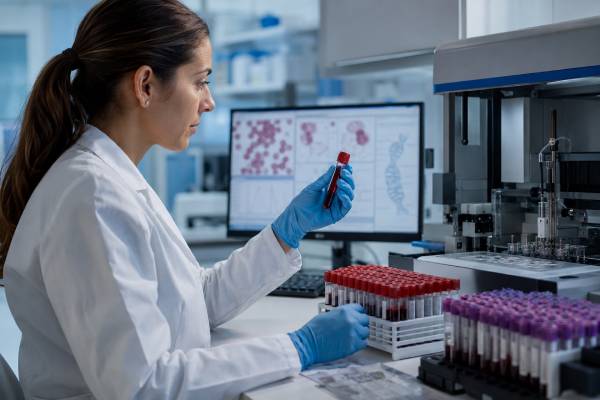
A high hepcidin blood test usually means the body is holding iron back from the bloodstream. Hepcidin is a hormone made mainly by the liver, and it controls how much iron enters the blood from food and how much stored iron gets released from cells. When hepcidin rises, iron becomes harder to absorb and harder to use, even when total body iron stores are not low. This pattern is common during inflammation, infection, chronic kidney disease, autoimmune disease, and some long-term illnesses.
High hepcidin is most useful when it is interpreted with a complete blood count, ferritin, serum iron, transferrin saturation, TIBC, and inflammation markers. It does not diagnose one condition by itself. In many cases, the important finding is not simply “too much hepcidin,” but iron restriction: the blood may show low circulating iron while ferritin is normal or high because iron is trapped in storage sites.
- High hepcidin usually points to iron restriction, meaning iron is present in the body but less available for red blood cell production.
- A high result is most often linked with inflammation, infection, chronic kidney disease, autoimmune disease, obesity-related inflammation, or recent iron treatment.
- Hepcidin reference ranges are not standardized across laboratories, so a “high” result should be judged against the lab’s own method and range.
- A common high-hepcidin pattern is low serum iron, low transferrin saturation, low or normal TIBC, and normal or high ferritin.
- High hepcidin can help explain poor response to oral iron, especially when inflammation is blocking iron absorption.
- Follow-up usually includes CBC, ferritin, iron panel, CRP or ESR, kidney function, liver tests, and review of symptoms, medications, and recent iron infusions.
Table of Contents
- What a High Hepcidin Result Means
- How Hepcidin Controls Iron Availability
- Common Causes of High Hepcidin
- High Hepcidin and Anemia Patterns
- How to Interpret High Hepcidin With Other Tests
- Symptoms and When Follow-Up Matters
- Follow-Up and Ways to Address High Hepcidin
- Questions to Ask About a High Hepcidin Result
What a High Hepcidin Result Means
A high hepcidin result means the body is sending a strong “hold iron back” signal. Hepcidin lowers the amount of iron moving into the bloodstream from the gut and from storage cells. When it stays high, less iron reaches the bone marrow, where red blood cells are made.
This can happen for a useful reason. During infection, the immune system may raise hepcidin to reduce iron availability to microbes. Many bacteria need iron to grow, so the body temporarily locks iron away as part of the inflammatory response.
The same response becomes a problem when inflammation is chronic. Long-term elevation can keep iron trapped in macrophages and liver cells. Blood iron falls, transferrin saturation falls, and red blood cell production may slow. This can produce iron-restricted anemia even when ferritin, the storage marker, is normal or high.
High hepcidin is different from high serum iron. In fact, high hepcidin often goes with low circulating iron. This is why a hepcidin result should not be read as “too much iron in the blood.” It is better understood as a signal that iron movement is being blocked.
Hepcidin testing is still less common than ferritin, iron, TIBC, and transferrin saturation. Many clinicians use it in selected cases, such as confusing anemia patterns, suspected iron restriction from inflammation, research settings, or specialized evaluation of iron disorders. A related overview of typical values is covered in hepcidin blood test reference values, but the lab’s own range remains the most important comparison because testing methods differ.
A high result may be described as:
- Appropriate high hepcidin, when iron stores are high or inflammation is active.
- Inappropriately high hepcidin, when the body needs iron for red blood cell production but hepcidin remains elevated.
- Relatively high hepcidin, when the value is not extremely elevated but is too high for someone with low serum iron or anemia.
That last point is important. A person with clear iron deficiency would usually be expected to suppress hepcidin to absorb more iron. If hepcidin is not low in that situation, inflammation, kidney disease, genetic iron-handling problems, or recent iron exposure may be interfering.
How Hepcidin Controls Iron Availability
Hepcidin works mainly through ferroportin, the protein that exports iron from cells into the bloodstream. Ferroportin sits on cells that absorb iron from food in the intestine, macrophages that recycle iron from old red blood cells, and liver cells that store iron.
When hepcidin rises, it binds to ferroportin and causes it to be removed from the cell surface. With fewer ferroportin channels available, iron cannot leave those cells as easily. The result is lower blood iron, lower transferrin saturation, and reduced iron delivery to the bone marrow.
This system protects the body from both iron deficiency and iron overload. When iron stores are low, hepcidin usually falls. Lower hepcidin allows more iron absorption from the gut and more iron release from storage. When iron stores are high, hepcidin usually rises. Higher hepcidin slows absorption and limits further iron loading.
Inflammation changes the system. Inflammatory signals, especially interleukin-6, tell the liver to make more hepcidin. The body may then act as if iron should be restricted even when red blood cell production needs more iron. This is the main mechanism behind many cases of anemia of inflammation, also called anemia of chronic disease.
Several forces push hepcidin up or down:
| Signal | Usual effect on hepcidin | Why it happens |
|---|---|---|
| Inflammation or infection | Raises hepcidin | The immune system limits iron availability during illness |
| High iron stores | Raises hepcidin | The body slows further iron absorption |
| Iron deficiency | Lowers hepcidin | The body tries to absorb and release more iron |
| Blood loss or increased red blood cell production | Lowers hepcidin | The marrow needs more iron to make hemoglobin |
| Chronic kidney disease | Often raises hepcidin | Inflammation and reduced clearance can both contribute |
| Recent iron infusion or high-dose iron intake | May raise hepcidin | The body responds to increased available iron |
Hepcidin also helps explain why oral iron sometimes fails. If hepcidin is high, the intestine may absorb less iron from supplements. This does not mean oral iron never works, but it can be less effective in active inflammation, chronic kidney disease, inflammatory bowel disease, and some other chronic inflammatory conditions.
Common Causes of High Hepcidin
High hepcidin has several possible causes. The most common are inflammation, chronic disease, kidney dysfunction, high iron exposure, and certain rare genetic or tumor-related conditions.
Inflammation, infection, and autoimmune disease
Inflammation is one of the strongest triggers for hepcidin. The body raises hepcidin during infections and inflammatory flares to reduce free iron availability. This can occur with pneumonia, chronic infections, inflammatory bowel disease, rheumatoid arthritis, lupus, vasculitis, and other immune-driven illnesses.
In these cases, ferritin may be normal or high because ferritin also rises as an inflammatory marker. A high ferritin result does not always mean iron overload. It may reflect stored iron, inflammation, liver injury, metabolic disease, or a mix of these. For that reason, high hepcidin is often interpreted alongside high ferritin causes and the rest of the iron panel.
Chronic kidney disease
Chronic kidney disease often raises hepcidin through two pathways. First, kidney disease is commonly linked with chronic inflammation. Second, the kidneys help clear some hepcidin from circulation, so impaired kidney function can contribute to higher levels.
This matters because kidney disease can cause anemia through several mechanisms at once: lower erythropoietin production, inflammation, iron restriction, blood loss from dialysis or testing, and reduced response to iron therapy. A high hepcidin result in kidney disease may help explain why iron is hard to mobilize even when ferritin is not low.
High iron stores, recent iron treatment, or repeated transfusions
Hepcidin rises when the body senses enough or excess iron. Recent intravenous iron, high-dose oral iron, or repeated blood transfusions can increase hepcidin. The timing of the blood draw matters. A hepcidin level measured soon after iron treatment may not reflect the person’s untreated baseline.
Repeated transfusions add iron directly to the body because each unit of red blood cells contains iron in hemoglobin. People with transfusion-dependent anemias may develop high iron stores, although hepcidin patterns can vary depending on the underlying disease and marrow activity.
Metabolic inflammation and fatty liver disease
Obesity, insulin resistance, and fatty liver disease can be associated with low-grade inflammation and higher ferritin. Hepcidin may rise in some people with these patterns. The result can look like mild iron restriction, inflammatory ferritin elevation, or a mixed picture.
Liver context is important because the liver produces most hepcidin. Fatty liver and inflammation may raise hepcidin, while advanced liver failure can impair hepcidin production. Liver enzyme results, alcohol history, metabolic risk factors, and imaging may help clarify the cause.
Iron-refractory iron deficiency anemia
Iron-refractory iron deficiency anemia is a rare inherited condition usually caused by variants affecting TMPRSS6, a gene involved in hepcidin regulation. In this disorder, hepcidin is inappropriately high for the body’s iron needs. People often have lifelong or childhood-onset microcytic anemia, very low serum iron, low transferrin saturation, and poor response to oral iron.
This is much less common than ordinary iron deficiency or anemia of inflammation. It becomes more relevant when iron deficiency appears severe, starts early in life, does not respond as expected to oral iron, and common causes such as blood loss or malabsorption have been addressed.
Rare hepcidin-producing tumors
Rare liver tumors, especially hepcidin-producing hepatic adenomas, can cause very high hepcidin and severe iron-restricted anemia. This is uncommon, but it is an example of why a markedly elevated hepcidin result with unexplained anemia deserves careful medical review.
High Hepcidin and Anemia Patterns
High hepcidin is closely tied to anemia of inflammation. This anemia usually develops slowly and is often mild to moderate. Red blood cells may be normal-sized at first, then become smaller if iron restriction continues or if true iron deficiency develops at the same time.
The body needs iron to make hemoglobin, the oxygen-carrying protein in red blood cells. When hepcidin blocks iron release, the marrow receives less usable iron. Hemoglobin production can fall even though the body still has iron stored.
A typical anemia of inflammation pattern may include:
- Low or low-normal hemoglobin
- Low serum iron
- Low transferrin saturation
- Low or normal TIBC
- Normal or high ferritin
- Normal or slightly small red blood cells
- Low or normal reticulocyte response
This differs from classic iron deficiency anemia, where hepcidin is usually low and the body is trying to absorb more iron. Classic iron deficiency often shows low ferritin, low serum iron, high TIBC, low transferrin saturation, high RDW, and smaller red blood cells. The pattern is described in more detail in low serum iron causes and low transferrin saturation patterns.
Mixed anemia is common. A person can have both true iron deficiency and inflammation. For example, someone with inflammatory bowel disease may lose blood from the gut while inflammation raises hepcidin. Ferritin may look “normal” even though usable iron is low. In this situation, ferritin alone can mislead.
A high hepcidin result may also explain why iron pills do not raise hemoglobin as expected. Oral iron depends on intestinal absorption. When hepcidin is high, the gut may block much of that absorption. Clinicians may then focus on treating inflammation, checking for ongoing blood loss, considering intravenous iron in selected settings, or using condition-specific anemia treatment.
Not every person with high hepcidin has anemia. If hemoglobin is normal, high hepcidin may reflect early inflammation, recent iron exposure, or higher iron stores without current red blood cell effects. Trends over time often say more than one isolated value.
How to Interpret High Hepcidin With Other Tests
Hepcidin is most informative when it is read as part of an iron and inflammation picture. A single high value cannot show whether the cause is infection, chronic inflammation, kidney disease, iron overload, or recent iron treatment.
A standard evaluation often includes a complete blood count, ferritin, serum iron, TIBC, transferrin saturation, kidney function tests, liver enzymes, and inflammation markers. Many clinicians start with an iron panel because it shows how much iron is circulating, how much binding capacity is available, and how saturated transferrin is.
| Pattern | Possible meaning | Common next step |
|---|---|---|
| High hepcidin, low serum iron, low TSAT, high ferritin | Inflammation-related iron restriction | Check CRP or ESR, review chronic inflammatory conditions |
| High hepcidin, low TSAT, normal ferritin | Early or mixed iron restriction; inflammation may be masking low stores | Consider soluble transferrin receptor, reticulocyte hemoglobin, repeat testing |
| High hepcidin after IV iron | Expected response to recent iron exposure | Interpret based on treatment timing and follow-up iron indices |
| High hepcidin with kidney disease and anemia | Functional iron deficiency and reduced erythropoietin may coexist | Assess kidney stage, iron status, erythropoiesis treatment plan |
| High hepcidin with low ferritin | Mixed iron deficiency plus inflammation, rare genetic pattern, or assay issue | Repeat iron studies and investigate blood loss or malabsorption |
| Low hepcidin, high TSAT, high ferritin | Possible hemochromatosis or iron-loading disorder | Evaluate transferrin saturation, ferritin trend, and genetic risk |
TIBC and transferrin are especially helpful. In classic iron deficiency, transferrin and TIBC often rise because the body makes more iron-carrying capacity. In inflammation, transferrin and TIBC often fall or stay low-normal because transferrin behaves as a negative acute-phase protein. This is why low TIBC with inflammation supports a different pattern than high TIBC from simple iron deficiency.
Reticulocyte hemoglobin can also help. Reticulocytes are young red blood cells, and their hemoglobin content reflects recent iron delivery to the marrow. A low value can show that the marrow is not receiving enough usable iron now, even before older red blood cell markers fully change. This can be useful when ferritin is difficult to interpret because of inflammation.
Inflammation markers add context. CRP tends to rise and fall quickly with inflammation, while ESR often changes more slowly and can be influenced by age, anemia, pregnancy, kidney disease, and immune proteins. A high hepcidin result with elevated high-sensitivity CRP or ESR supports an inflammatory driver, but the source still needs clinical evaluation.
Ferritin deserves special caution. Low ferritin strongly supports iron deficiency in many settings, but normal or high ferritin does not always rule it out when inflammation is present. Inflammatory disease can raise ferritin while iron availability remains poor.
Transferrin saturation also deserves attention. In hepcidin-driven iron restriction, TSAT is often low because iron is not reaching transferrin. In hereditary hemochromatosis, TSAT is often high because hepcidin activity is too low or ineffective, allowing too much iron into circulation. This is the opposite pattern from most high-hepcidin states.
Symptoms and When Follow-Up Matters
High hepcidin itself usually does not cause specific symptoms. Symptoms come from the condition raising hepcidin, the anemia it may contribute to, or the underlying iron disorder.
Possible anemia-related symptoms include:
- Fatigue or reduced exercise tolerance
- Shortness of breath with activity
- Lightheadedness
- Pale skin
- Fast heartbeat or palpitations
- Headaches
- Cold hands or feet
- Restless legs
- Trouble concentrating
Inflammation-related symptoms depend on the cause. Fever, night sweats, joint swelling, persistent diarrhea, abdominal pain, chronic cough, unexplained weight loss, urinary symptoms, or worsening pain can point toward infection, autoimmune disease, inflammatory bowel disease, cancer, kidney disease, or another condition that needs directed evaluation.
A high hepcidin result deserves more urgent medical attention when it appears with signs of severe anemia, active bleeding, serious infection, or organ stress. Seek prompt care for chest pain, fainting, severe shortness of breath, black or bloody stools, vomiting blood, heavy uncontrolled bleeding, confusion, high fever with weakness, or a rapidly falling hemoglobin result.
The degree of hepcidin elevation does not always match symptom severity. A person with a modestly high result can feel very unwell if anemia or inflammation is significant. Another person may have a high result after iron treatment and feel fine. Symptoms, hemoglobin, iron studies, kidney function, liver function, and the trend over time matter more than hepcidin alone.
Testing time can also affect interpretation. Hepcidin may vary during the day and can change after iron intake, iron infusion, inflammation, and illness. For repeat testing, clinicians may prefer a consistent collection time and a clear gap from iron treatment when possible. The lab report should state the specimen type, method, units, and reference interval.
Follow-Up and Ways to Address High Hepcidin
High hepcidin improves when the driver improves. There is no simple over-the-counter “hepcidin lowering” treatment that safely fits everyone. The right plan depends on whether the cause is inflammation, kidney disease, iron overload, recent iron therapy, true iron deficiency mixed with inflammation, or a rare iron-regulation disorder.
The usual follow-up starts with confirming the pattern. A clinician may repeat hepcidin or place more weight on standard iron studies, depending on how the test was ordered. They may also check CBC trends, ferritin, serum iron, transferrin saturation, TIBC, CRP, ESR, creatinine, eGFR, liver enzymes, and sometimes soluble transferrin receptor or reticulocyte hemoglobin.
When inflammation is the driver, treatment focuses on the source. This may mean treating infection, controlling autoimmune disease, managing inflammatory bowel disease, addressing chronic wounds, evaluating unexplained fever, or improving metabolic inflammation. As inflammatory signals fall, hepcidin may fall and iron availability may improve.
When kidney disease is the driver, anemia care may include iron strategy, erythropoiesis-stimulating medicines, dialysis-related management, and monitoring for both iron deficiency and iron overload. These decisions are individualized because ferritin and hepcidin can be harder to interpret in chronic kidney disease.
When recent iron treatment is the reason, high hepcidin may be expected. In that situation, the timing of the test is important. Taking more iron without a clear plan may worsen side effects or increase iron stores without improving anemia.
When true iron deficiency is present with inflammation, treatment can be more complex. Oral iron may work poorly when hepcidin is high, especially during active inflammatory disease. In some conditions, supervised intravenous iron is considered because it bypasses intestinal absorption. This is not a do-it-yourself decision; iron can be harmful when used in the wrong pattern, especially if ferritin and transferrin saturation suggest overload.
When iron overload is suspected, the pattern is usually not simply “high hepcidin.” Classic hereditary hemochromatosis is commonly linked with inadequate hepcidin activity and elevated transferrin saturation. If transferrin saturation is persistently high, the evaluation shifts toward iron-loading disorders rather than hepcidin-driven iron restriction.
General steps that support accurate interpretation include:
- Review the lab’s reference range, units, specimen type, and method.
- Note recent oral iron, IV iron, transfusions, infection, surgery, intense inflammation, or acute illness.
- Compare hepcidin with ferritin, transferrin saturation, TIBC, and CBC results from the same time period.
- Look at trends instead of relying on one isolated result.
- Avoid starting high-dose iron unless iron deficiency is confirmed and the clinician agrees it fits the pattern.
- Ask whether inflammation, kidney disease, liver disease, or chronic blood loss could be contributing.
Diet alone rarely fixes high hepcidin from active inflammation. Eating iron-rich foods may still support nutrition, but the hormone block can limit absorption. Vitamin C can improve nonheme iron absorption from plant foods, but it does not override major inflammation-driven hepcidin elevation. People with suspected iron overload should not add iron or high-dose vitamin C without medical advice.
Questions to Ask About a High Hepcidin Result
A high hepcidin result is easier to understand when the discussion focuses on the whole iron pattern, not the number alone. These questions can help make the follow-up more useful:
- Is my hepcidin high because of inflammation, iron stores, kidney disease, recent iron treatment, or another cause?
- Do my ferritin and transferrin saturation suggest iron restriction, true iron deficiency, iron overload, or a mixed pattern?
- Is my hemoglobin low, and if so, does the anemia look mild, moderate, severe, stable, or worsening?
- Should we check CRP, ESR, kidney function, liver enzymes, soluble transferrin receptor, or reticulocyte hemoglobin?
- Could recent illness, iron supplements, an iron infusion, transfusion, or timing of the blood draw have affected the result?
- Would oral iron likely work in my situation, or is inflammation blocking absorption?
- Do I need evaluation for blood loss, heavy menstrual bleeding, gastrointestinal bleeding, inflammatory bowel disease, autoimmune disease, chronic infection, or kidney disease?
- Should the test be repeated using the same laboratory and a similar collection time?
- Is there any reason to avoid iron supplements until the cause is clearer?
- What result or symptom would require faster follow-up?
For many people, the answer is not a special hepcidin treatment. It is finding and treating the reason the body is restricting iron. When inflammation falls, kidney-related anemia is managed, blood loss is corrected, or iron therapy is timed properly, the iron pattern often becomes easier to interpret.
References
- Hepcidin and Iron in Health and Disease 2023 (Review)
- Anemia of inflammation and iron metabolism in chronic diseases 2024 (Review)
- Potential Diagnostic Role of Hepcidin in Anemic Patients Affected by Inflammatory Bowel Disease: A Systematic Review 2024 (Systematic Review)
- EASL Clinical Practice Guidelines on haemochromatosis 2022 (Guideline)
- Iron-Deficiency Anemia in Chronic Kidney Disease 2025 (Review)
- An easy, fast, and efficient assay for the quantification of peptide Hepcidin-25 in serum and plasma with LC-MS/MS. 2022 (Assay Validation)
Disclaimer
This article is educational and does not replace care from a qualified healthcare professional. A high hepcidin result should be interpreted with symptoms, medical history, CBC results, iron studies, kidney function, liver tests, and inflammation markers. Do not start or stop iron treatment based only on hepcidin without medical guidance.