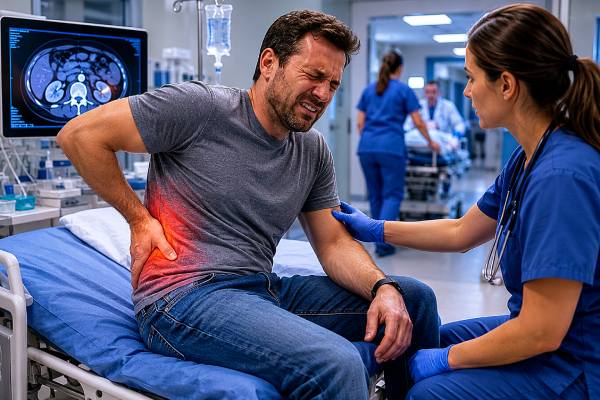
Kidney stone pain is famous for a reason: it often starts suddenly, becomes intense fast, and makes it hard to sit still. The pain usually comes from a stone blocking urine flow as it moves from the kidney into the ureter, the narrow tube that drains urine to the bladder. Pressure builds behind the blockage, the ureter squeezes around the stone, and the result is the severe, cramping pain often called renal colic.
Not every stone attack feels the same. Some people feel sharp flank pain. Others feel deep pressure in the side, lower belly, groin, or testicle. Blood in the urine, nausea, vomiting, urgency to pee, and burning can also happen. The key is knowing which symptoms fit a typical stone attack and which symptoms signal an emergency.
This guide explains what kidney stone pain feels like, why it moves, what other symptoms to watch for, when to go to the ER, what doctors usually do there, and what to do after the pain settles.
Table of Contents
- What Kidney Stone Pain Feels Like
- Why the Pain Moves and Comes in Waves
- Symptoms That Often Come With Stone Pain
- When to Go to the ER
- What Happens at the ER
- When Home Care Is Reasonable
- How Stones Pass and When Treatment Is Needed
- After the Attack: How to Prevent Another Stone
What Kidney Stone Pain Feels Like
Kidney stone pain usually feels severe, deep, and hard to ignore. It often starts in the flank, which is the area on either side of your back below the ribs and above the hip. People often describe it as stabbing, squeezing, cramping, or like a deep internal pressure that keeps building.
A classic stone attack starts suddenly. You might feel fine, then develop intense pain within minutes or over an hour. The pain often reaches a peak, eases slightly, then surges again. Unlike a pulled back muscle, changing position usually does not fix it. Many people pace, bend forward, rock in a chair, or keep shifting because no position feels comfortable for long.
Kidney stone pain is often one-sided. A stone in the right ureter usually causes right-sided flank or belly pain. A stone on the left usually causes left-sided pain. Pain on both sides at the same time is less typical and needs medical attention, especially with fever, low urine output, or known kidney disease.
The pain can be confusing because it does not always stay near the kidney. As the stone moves down the ureter, the pain can shift toward the lower abdomen, groin, genitals, or inner thigh. In men, a lower ureter stone can cause pain that feels like it is in the testicle. In women, it can feel like pelvic or lower abdominal pain. This movement is one reason kidney stones get mistaken for appendicitis, ovarian problems, bladder infection, bowel pain, or back injury.
A helpful clue is the combination of sudden severe flank pain, restlessness, nausea, and urinary symptoms. If the pain is mainly in the back and gets worse with bending, twisting, lifting, or pressing on the sore area, muscle strain becomes more likely. For a deeper comparison, see kidney pain vs back pain.
Why the Pain Moves and Comes in Waves
The worst kidney stone pain usually comes from obstruction, not from the stone “scratching” the kidney. When a stone enters the ureter and blocks urine flow, pressure rises behind it. The kidney and ureter stretch, and the ureter contracts in strong waves as it tries to push the stone forward.
That squeezing pattern explains the stop-and-start nature of renal colic. The pain can rise sharply, ease, and return. A person might have a brutal wave of pain, then a short period where it feels manageable, then another wave that is just as intense.
Where the pain is felt often reflects the stone’s location
A stone high in the ureter often causes flank pain near the side of the back. A stone in the middle part of the ureter can cause pain that wraps around toward the lower abdomen. A stone near the bladder can cause urinary urgency, frequent urination, burning, and pain that feels low in the pelvis or groin.
This pattern is useful, but it is not exact. Pain location does not reliably tell you the stone size. A tiny stone can cause intense pain if it blocks urine flow tightly. A larger stone sitting inside the kidney without blocking drainage can cause little or no pain. Stone size matters more for whether it will pass on its own than for how painful it feels.
Pain can improve before the stone has passed
A common mistake is assuming the stone is gone as soon as the pain fades. Pain can improve because the stone shifts, urine drains around it, or the ureter temporarily stops spasming. The stone can still be present.
This matters most when symptoms return, urine output drops, fever starts, or follow-up imaging shows ongoing blockage. If you were told you had a ureter stone, keep follow-up plans even if the pain calms down. Silent obstruction is uncommon, but it is important because prolonged blockage can harm kidney function.
Symptoms That Often Come With Stone Pain
Kidney stones often cause more than pain. The ureter, bladder, and kidneys are part of the same drainage system, so irritation in one area can create symptoms elsewhere.
Blood in the urine is common. It might look pink, red, tea-colored, cola-colored, or only show up on a urine test. Visible blood should always be taken seriously, even when a stone seems likely. Stones are a common cause, but blood in the urine also has other causes, including infection, kidney inflammation, prostate problems, and bladder or kidney tumors. Learn more about warning patterns in blood in urine.
Nausea and vomiting are also common during severe renal colic. The nerves involved in kidney and ureter pain connect with nausea pathways, so the stomach often reacts even though the problem is in the urinary tract. Vomiting becomes more concerning when you cannot keep fluids or pain medicine down.
Urinary urgency, frequency, and burning happen especially when the stone is low in the ureter near the bladder. This can feel like a UTI. The difference is that a stone often brings intense one-sided flank, groin, or lower belly pain, while a simple bladder infection usually causes burning, urgency, cloudy urine, and lower pelvic discomfort without severe flank pain.
Cloudy or foul-smelling urine points more toward infection, especially with fever or chills. Fever with a suspected stone is not a “wait and see” symptom. A blocked, infected urinary system can become dangerous quickly.
Some people also notice sweating, pale skin, fast breathing, or a racing heart during severe pain. Those reactions often come from the body’s stress response. They do not prove the stone is dangerous by themselves, but they show the pain needs treatment.
When to Go to the ER
Go to the ER for kidney stone symptoms when there are signs of infection, kidney stress, uncontrolled pain, dehydration, or a higher-risk situation such as pregnancy or having one kidney.
The most urgent warning sign is fever or chills with flank pain. A stone that blocks urine flow above an infection can trap bacteria under pressure. That situation needs fast antibiotics and sometimes urgent drainage with a ureteral stent or nephrostomy tube. Pain medicine alone is not enough.
Use this table as a practical decision guide:
| Go to the ER now if you have | Why it matters |
|---|---|
| Fever, chills, shaking, or feeling very ill | A blocked infected kidney is a urologic emergency. |
| Severe pain that does not improve with medicine | You may need stronger pain control, imaging, or urgent urology care. |
| Repeated vomiting or inability to keep fluids down | Dehydration makes symptoms harder to control and can affect kidney function. |
| No urine, very little urine, or trouble passing urine | This can signal significant blockage, dehydration, retention, or kidney stress. |
| Known one kidney, kidney transplant, advanced kidney disease, or both-sided pain | There is less reserve if urine flow is blocked. |
| Pregnancy with suspected stone pain | Diagnosis and pain treatment need pregnancy-safe choices. |
| New severe abdominal pain with uncertain cause | Appendicitis, aneurysm, ovarian torsion, ectopic pregnancy, bowel problems, and other emergencies can mimic stone pain. |
Age and medical history also matter. Older adults, people with diabetes, people taking immune-suppressing medicines, and people with recurrent UTIs should have a lower threshold for urgent care because infection signs can be subtle.
Do not drive yourself if the pain is severe, you feel faint, you have taken sedating medicine, or you are vomiting. Ask someone to take you or call emergency services.
What Happens at the ER
The ER team usually focuses on four questions: Is this likely a stone? Is there an infection or kidney problem? How big is the stone and where is it? Is it safe for you to go home?
You will usually be asked where the pain started, where it travels, whether you have had stones before, whether you have fever, whether you can urinate, and whether you are pregnant or could be pregnant. Tell the clinician about kidney disease, one kidney, blood thinners, allergies, recent UTIs, and any pain medicine already taken.
Tests often include urine, bloodwork, and imaging
A urinalysis checks for blood, white blood cells, nitrites, crystals, and signs of infection. Blood in the urine supports the diagnosis, but a stone is still possible without visible blood. White blood cells or nitrites raise concern for infection, especially with fever or a high heart rate.
Blood tests often check kidney function, electrolytes, white blood cell count, and signs of dehydration or infection. A pregnancy test is standard for people who could be pregnant because it changes imaging and medication choices.
Imaging depends on the situation. A non-contrast CT scan is highly accurate for finding ureter stones and measuring size and location. Ultrasound avoids radiation and is often preferred first in pregnancy and sometimes in younger patients or people with recurrent stones. Ultrasound can show kidney swelling from blockage, though it can miss smaller ureter stones. For a fuller comparison, see kidney ultrasound vs CT scan.
Pain control usually starts quickly
Nonsteroidal anti-inflammatory drugs, often called NSAIDs, are commonly used for renal colic because they reduce pain and lower the prostaglandin-driven pressure changes that contribute to ureter spasms. Ketorolac is a common ER option. NSAIDs are not right for everyone, especially people with advanced kidney disease, active stomach bleeding, certain blood thinner use, severe dehydration, or specific medication risks.
Opioids are sometimes used when NSAIDs are unsafe or not enough. Anti-nausea medicine helps if vomiting is part of the attack. Fluids are used when you are dehydrated or unable to drink, but forcing large amounts of IV fluid does not “blast out” a stone.
Urgent drainage is needed for some stones
Most stone attacks do not require emergency surgery. The major exception is an obstructed kidney with infection or sepsis. In that case, the priority is draining the infected urine with a ureteral stent placed through the bladder or a nephrostomy tube placed through the skin into the kidney. The stone itself is often treated later, after the infection is controlled.
Urgent urology care is also more likely with uncontrolled pain, worsening kidney function, a single functioning kidney, complete blockage, or a large stone that is unlikely to pass.
When Home Care Is Reasonable
Home care is reasonable only when symptoms are mild to moderate, you have no fever, you can drink and urinate, pain is controlled, and a clinician has not told you that you need urgent evaluation. A person with a known small stone and a clear follow-up plan is in a different situation from someone having first-time severe flank pain.
At home, the practical goals are simple: control pain safely, prevent dehydration, watch for red flags, and capture the stone if it passes.
Drink enough fluid to keep urine light yellow, but do not force water during severe nausea or vomiting. Chugging large amounts can worsen discomfort and does not guarantee faster passage. Steady fluid intake is more useful once you can drink comfortably.
Use pain medicine only as directed. Avoid stacking multiple NSAIDs, such as ibuprofen plus naproxen, unless a clinician specifically tells you to. People with kidney disease, stomach ulcers, blood thinners, heart failure, uncontrolled high blood pressure, or pregnancy should ask a clinician before using NSAIDs.
A urine strainer helps catch the stone. Stone analysis matters because calcium oxalate, uric acid, struvite, and cystine stones have different prevention plans. If you catch a hard speck, gravel-like piece, or tiny jagged stone, let it dry and place it in a clean container for testing.
Call a clinician or seek urgent care if pain keeps returning, symptoms last more than a couple of days, you do not see the stone pass, or you were told the stone is larger than a typical passable size. A first stone attack also deserves follow-up because the pain pattern alone does not confirm the diagnosis.
For symptoms that sit between “manageable at home” and “obvious emergency,” an urgent care visit can help with urine testing, basic pain control, and deciding whether ER imaging is needed. A broader red-flag checklist is available in urgent care for urinary symptoms.
How Stones Pass and When Treatment Is Needed
Whether a stone passes depends mainly on size and location. Smaller stones pass more often. Stones closer to the bladder generally pass more easily than stones higher in the ureter. The ureter is narrow, and even a few millimeters can change the plan.
A stone around 5 millimeters or smaller often has a reasonable chance of passing without a procedure. Stones above that range become less predictable. Stones around 10 millimeters or larger usually need urology treatment. The exact decision also depends on pain control, kidney swelling, infection risk, kidney function, anatomy, and how long the stone has been stuck. A detailed size guide is available in the kidney stone size chart.
Medical expulsive therapy sometimes includes an alpha blocker such as tamsulosin, especially for certain ureter stones. These medicines relax smooth muscle in the ureter and can help selected stones pass. They are not a magic fix, and they are not useful for every stone. Side effects can include dizziness, lightheadedness, or ejaculation changes in men.
Signs the stone may be moving lower
Pain moving from the flank toward the groin can mean the stone is traveling down the ureter. New urinary urgency, frequency, or bladder pressure can happen when the stone gets close to the bladder. Some people feel a sudden sharp urethral sensation when the stone finally passes.
Still, symptom changes are not proof. If pain stops and you never see a stone, follow-up imaging or clinician guidance matters, especially when the original stone was larger, there was kidney swelling, or kidney function was abnormal.
Treatment options when a stone will not pass
Common procedures include shock wave lithotripsy, ureteroscopy, and percutaneous nephrolithotomy. Shock wave lithotripsy uses external energy waves to break certain stones into smaller fragments. Ureteroscopy uses a small scope passed through the urethra and bladder into the ureter or kidney, often with laser fragmentation. Percutaneous nephrolithotomy is used for larger or complex kidney stones through a small back incision.
Each option has tradeoffs. Stone size, stone density, location, body anatomy, infection risk, bleeding risk, and local expertise all affect the best choice. If your clinician recommends a procedure, ask what happens if you wait, how likely the stone is to pass, what pain or stent symptoms to expect, and how follow-up confirms the stone is gone. For more detail, see kidney stone surgery options.
What helps while waiting
The safest “pass faster” plan is not dramatic. Take prescribed medicine correctly, drink steadily once nausea is controlled, stay active as tolerated, use a strainer, and keep follow-up. Jumping, extreme water loading, alcohol, and unproven cleanses create more risk than benefit. Practical next steps are covered in how to pass a kidney stone faster.
After the Attack: How to Prevent Another Stone
The best time to prevent the next stone is after the first one passes or gets treated. A painful attack often feels like a one-time crisis, but stone formers have a real chance of recurrence. Prevention works best when it is based on the stone type, urine chemistry, diet pattern, fluid intake, and medical history.
Start by asking whether the stone was analyzed. If not, ask whether you need follow-up imaging or metabolic testing. People with recurrent stones, a strong family history, one kidney, kidney disease, bowel disease, gout, cystine stones, childhood stones, frequent UTIs, or complex stones often need a deeper workup. A 24-hour urine test measures urine volume, calcium, oxalate, citrate, uric acid, sodium, pH, and other factors that point to a targeted prevention plan. For preparation details, see 24-hour urine testing for kidney stones.
Hydration is the foundation for most stone prevention plans. The goal is not a random number of glasses; the goal is enough urine volume that minerals stay diluted. Pale yellow urine throughout most of the day is a simple clue. People who sweat heavily, work outdoors, exercise intensely, or live in hot climates often need more fluid than they expect.
Diet changes depend on the stone type, but several basics apply often. Keep sodium low because high salt intake raises urine calcium in many people. Do not cut calcium too aggressively unless a clinician tells you to; normal dietary calcium with meals helps bind oxalate in the gut. Limit large portions of animal protein if uric acid or calcium stones are an issue. Reduce sugar-sweetened drinks, especially cola and high-fructose beverages.
Some people need medication prevention. Potassium citrate can help with low urine citrate or uric acid stones. Thiazide-type medicines are sometimes used for high urine calcium. Uric-acid-lowering treatment is used in selected cases. Antibiotic and surgical strategies matter for infection-related struvite stones. The right plan depends on testing, not guesswork.
A single stone attack is painful enough. A second one is often preventable with the right information. Keep the stone analysis, imaging report, and lab results in one place, and ask your clinician what specific risk factor caused your stone. General hydration advice helps, but targeted prevention is what turns a crisis into a plan. A broader prevention guide is available in kidney stone prevention.
References
- EAU Guidelines on Urolithiasis 2026 (Guideline)
- Surgical Management of Kidney and Ureteral Stones: AUA Guideline (2026). Part II: Evaluation and Treatment of Patients With Kidney and/or Ureteral Stones 2026 (Guideline)
- Renal and ureteric stones: assessment and management 2019 (Guideline)
- Acute Renal Colic 2024 (Review)
- Renal Calculi, Nephrolithiasis 2024 (Review)
- Comparison of the Efficacy of Nonsteroidal Anti-Inflammatory Drugs and Opioids in the Treatment of Acute Renal Colic: A Systematic Review and Meta-Analysis 2022 (Systematic Review)
Disclaimer
This article is for education about kidney stone pain and emergency warning signs. It cannot diagnose the cause of flank, abdominal, pelvic, or urinary pain. Seek urgent medical care for fever, chills, uncontrolled pain, repeated vomiting, low urine output, pregnancy, one kidney, kidney disease, or any severe new pain with an uncertain cause.