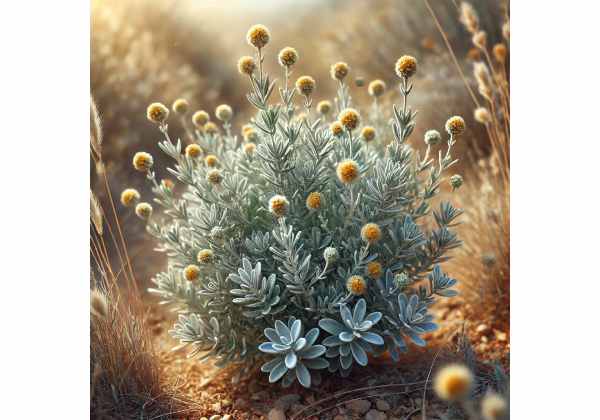
Lavender Cotton, botanically known as Santolina chamaecyparissus, is a silvery Mediterranean shrub prized more for its aromatic strength than for soft floral beauty. Despite its common name, it is not true lavender. Instead, it belongs to a different botanical group and has a more resinous, camphor-like scent. Traditional herbal use has centered on digestion, intestinal discomfort, topical cleansing, insect-repelling applications, and occasional use for menstrual and respiratory complaints. Modern research adds another layer, highlighting volatile oils, flavonoids, and phenolic compounds that may help explain its antimicrobial, antioxidant, anti-inflammatory, and spasm-modulating effects.
Still, this is not a broadly proven clinical herb. Most of the evidence comes from laboratory studies, essential-oil analysis, and traditional practice rather than large human trials. That makes Lavender Cotton an herb best approached with precision and modest expectations. Used carefully, it may offer value in aromatic topical use, gentle digestive support, and traditional household applications. Used too casually, especially in concentrated essential-oil form, it can be irritating or unsuitable for vulnerable groups.
Quick Overview
- Lavender Cotton may offer mild digestive support and traditional topical antimicrobial value.
- Its aromatic compounds also show promising antioxidant and anti-inflammatory activity in preclinical studies.
- A cautious tea range is 1 to 2 g dried aerial parts in 200 mL water, up to once or twice daily.
- Avoid internal use during pregnancy, in seizure-prone individuals, and in children unless a qualified clinician advises it.
Table of Contents
- What is Lavender Cotton
- Key ingredients in Lavender Cotton
- What can it realistically help with
- How to use Lavender Cotton
- How much per day
- Safety and who should avoid it
- What the evidence really says
What is Lavender Cotton
Lavender Cotton is a small evergreen shrub native to the western and central Mediterranean region. It is best known for its finely divided silvery leaves, button-like yellow flowers, and sharp aromatic scent. In gardens, it is often grown as a decorative border plant because it tolerates heat, wind, dry soil, and trimming remarkably well. In herbal history, though, it earned attention for more than appearance. It was used as a household medicinal and protective plant, especially where aromatic, bitter, and insect-repelling herbs were valued.
One of the most important points for readers is that Lavender Cotton is not the same plant as true lavender. The name confuses many people because both are gray-green, fragrant, and grown ornamentally. Yet Santolina chamaecyparissus has a more pungent, camphor-rich profile and a very different traditional use pattern. It was often treated less as a perfumed relaxation herb and more as a practical medicinal shrub for small digestive complaints, topical cleansing, and domestic insect control.
Traditional uses have included:
- Mild digestive discomfort and bloating
- Intestinal or vermifuge-style remedies in older folk practice
- Topical use for minor skin concerns
- Menstrual stimulation in traditional settings
- Aromatic sachets and insect-repelling bundles
- Occasionally respiratory and fever-related folk uses
That range already tells you something important about the herb’s character. Lavender Cotton belongs to the class of strong-smelling Mediterranean plants whose actions are often tied to volatile oils. These herbs were historically used when people wanted stimulation, cleansing, movement, or protection, not necessarily softness or sedation.
Its aerial parts, especially leaves and flowering tops, are the usual herbal material. These parts carry the scent and much of the plant’s chemical activity. Preparations varied from teas and infusions to steam-like household uses, poultices, and dried plant bundles placed in cupboards. In that sense, Lavender Cotton behaves more like a multi-purpose aromatic shrub than a standard single-use herb.
From a modern perspective, the herb is most interesting in three lanes:
- As a source of essential-oil compounds with antimicrobial and antioxidant potential
- As a traditional digestive and topical herb used in small amounts
- As an insect-repelling aromatic plant with practical household value
This gives it more in common with robust Mediterranean aromatics such as rosemary and other terpene-rich shrubs than with gentle floral infusions. That comparison matters because it helps set expectations. Lavender Cotton is not usually the herb to choose for broad daily wellness sipping. It is more targeted, more old-world in feel, and better suited to careful use.
For readers deciding whether it is mainly ornamental or medicinal, the truth is both. But its medicinal value depends on thoughtful preparation, conservative dosing, and respect for the fact that strong aroma can signal strong biologic action.
Key ingredients in Lavender Cotton
Lavender Cotton owes its medicinal interest largely to its volatile oil and to a smaller group of polyphenols and flavonoids found in its leaves and flowering tops. Like many aromatic Mediterranean shrubs, it is chemically variable. That means plants from different regions, grown in different soils or climates, may not smell exactly the same or behave identically in a lab. This variability is one reason the herb can be fascinating scientifically but tricky to standardize clinically.
The main groups of active constituents include:
- Monoterpenes
- Oxygenated monoterpenes
- Sesquiterpenes
- Flavonoids
- Phenolic acids
- Other minor aromatic and resin-like constituents
Among the volatile compounds, artemisia ketone is often reported as a major constituent in some Lavender Cotton chemotypes. Camphor, 1,8-cineole, borneol, beta-pinene, and myrcene may also appear in significant amounts depending on origin and extraction method. These compounds help explain the herb’s penetrating aroma and many of the properties traditionally linked to it, including insect-repelling action, topical cleansing potential, and stimulation of digestion.
Camphor and cineole are especially useful to understand. Both are familiar from strong aromatic herbs and oils used for chest rubs, muscle balms, and cleansing preparations. In Lavender Cotton, they are part of what gives the plant its sharp, medicinal identity. That does not mean the herb acts exactly like camphor products or eucalyptus oil, but it does explain the sensory experience many people notice right away: cooling, penetrating, and distinctly non-floral.
The plant also contains important phenolic and flavonoid compounds. Studies have identified caffeic acid, p-coumaric acid, luteolin, luteolin-7-O-glucoside, quercetin, and rutin in leaf extracts. These matter because they may contribute to antioxidant and anti-inflammatory effects that go beyond aroma alone. In other words, Lavender Cotton is not just an essential-oil plant. Its non-volatile compounds may be part of why crude extracts sometimes show biological activity that essential oil alone cannot fully explain.
Older pharmacologic work also points toward flavonoid-linked anti-inflammatory action, including compounds such as nepetin. This is useful because it suggests the herb’s traditional uses were not based on scent alone. Some of its chemistry plausibly interacts with inflammatory pathways and smooth-muscle responses.
A practical way to think about the plant’s ingredients is this:
- Volatile oils shape the immediate scent, topical activity, and household uses.
- Flavonoids and phenolic acids may support antioxidant and anti-inflammatory effects.
- The full herb can behave differently from the isolated essential oil.
That distinction matters a great deal. A tea from the dried aerial parts is not the same as ingesting the essential oil. A diluted topical preparation is not the same as applying neat oil to the skin. Readers often collapse these forms into one idea because they all come from the same plant, but their safety and intensity differ substantially.
Lavender Cotton also shares some aromatic logic with other cleansing and strongly scented herbs such as tea tree in topical traditions, though the chemistry is not identical and the two plants should not be treated as interchangeable. The take-home message is that this herb is chemically active in a way that justifies cautious interest, but also enough caution.
What can it realistically help with
The most useful answer is that Lavender Cotton may help in modest, practical ways, especially where aromatic and topical herbs have traditionally been used. It is not a clinically established cure for major disease, and it should not be framed that way. Still, there are several benefit areas where traditional use and modern phytochemical research overlap enough to make the herb worth discussing.
Its most realistic benefit areas are:
- Mild digestive support
- Topical cleansing and skin-supportive use
- Antimicrobial and antifungal potential in early research
- Aromatic household use, including insect-repelling applications
- General antioxidant support in extract studies
Digestive support is one of the clearest traditional lanes. Lavender Cotton has long been used in small amounts for bloating, sluggish digestion, and crampy gastrointestinal discomfort. The likely logic is a blend of bitter and aromatic action. Herbs in this category can stimulate digestive secretions, wake up appetite, and shift the gut from a heavy, stagnant feeling toward more movement. That does not make them ideal for everyone. Sensitive stomachs may find them too sharp. But for certain people, especially in tiny tea-like doses, the herb may feel clarifying rather than harsh.
Topical use is another reasonable area. Folk use and experimental evidence suggest the plant may help with minor skin cleansing and localized irritation, especially when used in diluted preparations. The key word is minor. This is not a wound-care substitute for serious infection or broken skin that needs medical treatment. It is better viewed as a traditional aromatic helper for mild, surface-level concerns.
Its antimicrobial potential is perhaps the most discussed modern finding. Essential oils and extracts from Santolina chamaecyparissus have shown antibacterial, antifungal, and bioactive effects in laboratory work. This does not mean the herb is a natural antibiotic in the clinical sense. It means there is enough biologic activity to explain why older cultures kept the plant around for protective and cleansing uses.
Another often-overlooked benefit is its role as a household botanical. Dried Lavender Cotton has historically been placed in cupboards, linens, and storage spaces to deter insects. This use sounds quaint, but it is chemically plausible. Strong aromatic plants often evolved volatile compounds partly for their own defense, and humans learned to borrow that defense. In modern terms, this may be one of the most practical non-medicinal uses of the herb.
A realistic benefit summary looks like this:
- Best traditional fit: digestion, household use, and topical cleansing
- Best research support: antimicrobial, antioxidant, and anti-inflammatory potential
- Least proven but often repeated: major internal therapeutic claims such as broad anticancer or antidiabetic use
Readers should be especially careful with that last category. Some extracts show interesting activity in laboratory and animal models, but that is not the same as a proven human treatment. Lavender Cotton is most credible when described as a modest, aromatic medicinal shrub, not a miracle herb.
For gentle digestive comparisons, many people may still prefer something more familiar such as peppermint for digestive comfort. Lavender Cotton sits on the stronger, more old-fashioned end of the spectrum.
How to use Lavender Cotton
Lavender Cotton works best when the form matches the goal. This is not a herb that benefits from casual overuse. Because it is strongly aromatic and chemically active, thoughtful preparation matters more than it does with many gentle household herbs.
The most common ways to use it are:
- Light tea or infusion from dried aerial parts
- Diluted topical preparations
- Aromatic sachets or dried bundles
- Traditional household insect-repelling use
- Very cautious use in extract form under knowledgeable guidance
Tea is the most straightforward internal form, but it should be mild. The herb’s taste is resinous, bitter, and somewhat camphor-like, so more is not necessarily better. A small infusion is usually the most reasonable starting place for digestive use. This can be helpful after heavy meals or when bloating and flatulence are mild and occasional. It is not the herb to reach for when you want a daily soothing beverage.
Topical use is often more practical than internal use. Diluted infusions, properly prepared herbal washes, or professionally formulated topical products may be used on intact skin for mild cleansing or localized irritation. Essential oil, if used at all, should be diluted carefully and should never be treated like a benign floral oil. Strong aromatic plants can irritate skin quickly, especially in concentrated form.
Household use remains one of the herb’s most natural applications. Dried stems and flowerheads can be placed in drawers, wardrobes, or storage spaces where their aroma may help deter insects. This use makes excellent sense for readers who are drawn to medicinal plants but do not necessarily need to ingest every one of them. Sometimes the most authentic use of an herb is the one people now overlook.
A practical approach to use looks like this:
- Decide whether your goal is digestive, topical, or household.
- Choose the gentlest preparation that fits that goal.
- Start with a very small amount.
- Avoid combining it with multiple strong essential-oil herbs at first.
- Stop if irritation or intolerance appears.
It is also wise to separate whole-herb use from essential-oil use. The whole dried herb contains volatile compounds, but the essential oil is much more concentrated and far less forgiving. Internal use of the essential oil is generally not appropriate for routine self-care.
Readers interested in aromatic topical traditions may find some conceptual overlap with thyme and other essential-oil-rich herbs, though Lavender Cotton is less standardized in modern use. The comparison is helpful because it reminds us that aromatic herbs often occupy a narrow zone: useful when diluted and directed properly, problematic when overused.
One final practical note is timing. Internal tea use usually makes most sense after meals or when digestive heaviness is present. Topical use should be reserved for intact skin and mild, localized needs. Household use can be ongoing and is arguably the most low-risk route for most people.
In short, Lavender Cotton is best used sparingly, with respect for concentration and purpose. The herb rewards precision, not enthusiasm.
How much per day
There is no widely accepted, clinically standardized daily dose for Lavender Cotton in the way there is for some better-studied herbal medicines. That is the most important dosage fact to understand. This herb lives in a traditional and preclinical space, which means dose recommendations need to stay conservative and form-specific.
For a mild tea or infusion, a cautious starting range is:
- 1 to 2 g dried aerial parts in about 200 mL hot water
- Steep for 5 to 10 minutes
- Use once daily at first, then up to twice daily if clearly tolerated
This is not meant to create a strong medicinal decoction. It is meant to test tolerance and provide a modest aromatic digestive effect. Because the herb is bitter and penetrating, many people will do better at the low end of the range.
For fresh plant use, exact dosing is harder because the water content varies and the herb is not commonly standardized this way. If using fresh material, the safest approach is to think in terms of a small pinch to a small sprig in a preparation rather than a large handful.
For topical use, dilution matters more than gram weight. A gentle guideline is:
- Use a well-diluted topical preparation
- Keep essential-oil concentrations low, often around 0.5% to 1% for first use on small intact areas
- Patch test before broader application
For essential oil, internal dosing should not be improvised. The concentrated oil may contain camphor-rich and ketone-rich constituents, which can be irritating and potentially unsafe if swallowed casually. In everyday herbal practice, the essential oil is not the right entry point for self-treatment.
Useful timing principles include:
- After meals for digestive use
- Short-term rather than continuously
- On small skin areas first for topical use
- Avoid near bedtime if strong aromatics make you feel stimulated rather than calm
Duration matters too. Lavender Cotton is better suited to short, situational use than to long-term daily intake. A few days to a week of cautious tea use is more sensible than months of routine drinking. If a symptom keeps returning, the issue is often not the herb dose. It is that the underlying cause needs attention.
Signs the amount is too much include:
- Nausea
- Mouth or throat irritation
- Stomach burning
- Dizziness
- Headache from strong aroma
- Skin redness or stinging in topical use
If any of these occur, stop or reduce the dose. A gentler herb may simply be a better fit. Readers who want a milder aromatic digestive routine often do better with herbs such as chamomile in gentler tea form.
The best Lavender Cotton dose is therefore not a heroic one. It is the smallest amount that fits the preparation, the purpose, and the person’s tolerance.
Safety and who should avoid it
Lavender Cotton deserves more caution than its soft-looking foliage suggests. Strong aromatic herbs are often treated as harmless because they grow in gardens and smell familiar. Yet the very compounds that make them interesting can also make them irritating or inappropriate for some people.
The main safety concerns are:
- Irritation from essential oil or strong topical use
- Lack of standardized human dosing
- Traditional emmenagogue reputation
- Potential concerns for seizure-prone individuals due to camphor-rich constituents
- Limited pregnancy and breastfeeding safety data
- Unsuitability for young children in concentrated forms
Skin irritation is the most immediate issue. Essential-oil-rich herbs can trigger redness, burning, itching, or rash, especially when used undiluted. Even diluted preparations may bother people with eczema, a damaged skin barrier, or fragrance sensitivity. Whole-herb washes are usually gentler than essential oil, but patch testing still makes sense.
Internal safety is more uncertain because traditional use exists, but modern clinical dosing does not. A mild tea is one thing. Swallowing concentrated extracts or essential oil is something else entirely. The stronger the preparation, the less comfortable self-experimentation becomes.
Pregnancy deserves special mention. Lavender Cotton has a traditional reputation as an emmenagogue, meaning it was historically used to stimulate menstruation. That does not prove a specific pregnancy risk at every dose, but it is enough to support caution. In practice, internal use during pregnancy is best avoided. Breastfeeding is similar. The evidence is too limited to justify routine use.
Children should also be treated carefully. Strong aromatics and essential oils can affect children differently than adults, and what feels like a small amount to an adult may not be small for a child. For that reason, concentrated use in children is not a good idea without professional guidance.
People who should be especially cautious or avoid it include:
- Pregnant or breastfeeding individuals
- Children
- People with seizure disorders or sensitivity to strong camphor-like oils
- Those with fragrance allergy or very reactive skin
- Anyone taking multiple medications for complex chronic illness
- People seeking to self-treat severe infection, heavy bleeding, or persistent abdominal pain
There is also a category of safety issue that has nothing to do with toxicity and everything to do with delay. If someone uses Lavender Cotton for recurrent cramps, persistent bloating, suspected fungal infection, or ongoing skin irritation without addressing the real cause, the herb can become a distraction rather than a help.
Stop use and seek care if you notice:
- Rash or burning that worsens
- Shortness of breath after exposure
- Severe nausea or vomiting
- Neurologic symptoms such as confusion or unusual dizziness
- Symptoms that persist despite use
- Signs of infection, fever, or worsening skin damage
If you want a comparison, Lavender Cotton sits closer to garden rue in the caution it deserves than to a casual everyday tea herb. That does not make it dangerous by default. It means the herb should be respected, not romanticized.
What the evidence really says
This is where the picture becomes clearer. Lavender Cotton is not unsupported folklore, but it is also not a clinically mature herbal medicine backed by large human trials. Most of its evidence comes from phytochemical profiling, essential-oil studies, antimicrobial testing, antioxidant assays, and animal or cell-based experiments.
The strongest parts of the evidence base are these:
- Essential-oil composition is well studied
- Antimicrobial and antifungal activity appears repeatedly in lab work
- Antioxidant effects are supported in extract studies
- Anti-inflammatory and smooth-muscle-related actions have plausible mechanistic support
- Human clinical research remains sparse
The essential-oil literature is especially useful because it tells us which compounds are likely driving much of the herb’s activity. Multiple studies show that Santolina chamaecyparissus can be rich in oxygenated monoterpenes and other aromatic constituents, but they also show how much chemical profiles vary by region. This matters because it limits the temptation to speak about one universal Lavender Cotton. A plant grown in Serbia may not chemically match one grown in Saudi Arabia, Tunisia, or India.
Antimicrobial evidence is probably the most convincing from a mechanistic standpoint. Essential oils from flowerheads, roots, and other aerial parts have shown antibacterial and antifungal effects in vitro. That fits traditional cleansing and protective uses quite well. But readers should remember what in vitro means. It means a controlled lab environment, not a guaranteed human outcome.
Antioxidant findings are also credible. Extract studies have identified relevant phenolic compounds and shown measurable free-radical-scavenging activity. This supports the idea that the herb’s value is not limited to smell. Still, antioxidant activity alone does not tell us exactly how a person will feel after using it.
Some studies also suggest antidiabetic, anticancer, hepatoprotective, immunomodulatory, or anti-inflammatory promise. These findings are interesting, but they are not the place to build bold consumer claims. Most remain preclinical and should be discussed as exploratory rather than established.
The fairest summary is:
- The chemistry is real and biologically active.
- Traditional uses for digestion, topical cleansing, and insect-repelling applications are plausible.
- Strong claims for major internal disease treatment are not clinically proven.
- Human dosing and long-term safety data remain limited.
This makes Lavender Cotton a classic example of an herb with meaningful traditional intelligence behind it but incomplete modern clinical translation. It deserves neither dismissal nor exaggeration. Its best uses remain modest, aromatic, and practical.
That honesty actually improves the herb’s value. A reader who understands its real strengths is far more likely to use it well than someone persuaded that every antioxidant plant is a cure-all. Lavender Cotton’s place in herbal medicine is not to outshine better-studied herbs. It is to offer a specific Mediterranean profile of digestive sharpness, topical aromatic activity, and household utility, supported by enough research to justify careful respect.
References
- Exploring the Phytochemical Profile and Therapeutic Potential of Saudi Native Santolina chamaecyparissus L. Essential Oil 2025 (Review)
- Chemical Composition, Chemometric Analysis, and Sensory Profile of Santolina chamaecyparissus L. (Asteraceae) Essential Oil: Insights from a Case Study in Serbia and Literature-Based Review 2025 (Review)
- Chemical Analysis and Biological Potential of Cotton Lavender Ethanolic Extract (Santolina chamaecyparissus L., Asteraceae) 2024
- Chemical characterization, antidiabetic and anticancer activities of Santolina chamaecyparissus 2021
- Chemical composition, antibacterial and antifungal activities of flowerhead and root essential oils of Santolina chamaecyparissus L., growing wild in Tunisia 2017
Disclaimer
This article is for educational purposes only and is not medical advice, diagnosis, or treatment. Lavender Cotton is a traditional aromatic herb with promising preclinical research, but it should not replace medical care for significant digestive symptoms, infection, skin disease, seizures, pregnancy-related concerns, or any worsening condition. Essential-oil and concentrated extract use require special caution, especially in children, during pregnancy or breastfeeding, and in people with sensitive skin or neurologic vulnerability.
If you found this article useful, please share it on Facebook, X, or your preferred platform so more readers can find careful, evidence-aware herbal guidance.