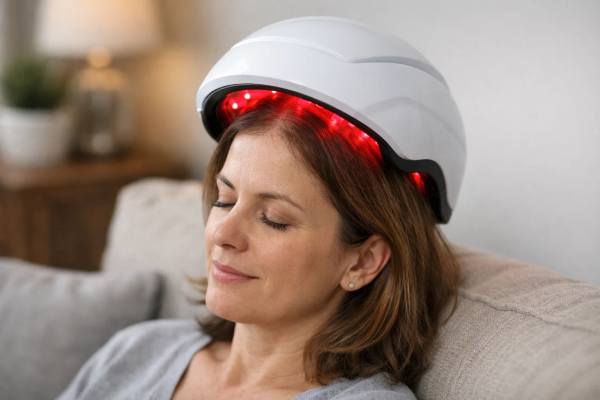
Low-level laser therapy, often grouped under red light therapy or photobiomodulation, sits in an unusual place in hair care. It is not a drug, not a supplement, and not a salon gimmick when the device is well designed. It is a real treatment category with clinical trials behind it, yet it is also one of the easiest areas for consumers to overspend on because the market is crowded with caps, combs, helmets, and bold promises.
The central question is not whether red light can influence hair biology at all. It can. The more useful question is who benefits enough to justify the cost and daily effort. For the right person, a good device can modestly improve hair density, thickness, and shedding over time. For the wrong person, it becomes an expensive routine layered onto a form of hair loss it was never likely to fix.
This guide covers what the evidence really says, which devices make the most sense, how to use them well, and where the limits are.
Quick Facts
- Low-level laser therapy has the best evidence for mild to moderate androgenetic alopecia in men and women.
- Results are usually modest and gradual, with visible change more likely after several months of steady use.
- Hands-free cap and helmet devices are often the most practical choice because adherence matters as much as specifications.
- Red light therapy is not a strong first-line answer for patchy autoimmune hair loss, scarring alopecia, or sudden diffuse shedding from an internal trigger.
- Choose an FDA-cleared device for pattern hair loss and follow its schedule consistently for at least 4 to 6 months before judging it.
Table of Contents
- What the Evidence Really Shows
- How Red Light May Help Follicles
- Who Is Most Likely to Benefit
- Best Device Types and Buying Criteria
- How to Use It for Better Results
- Safety, Limits, and When to Skip It
What the Evidence Really Shows
The evidence for low-level laser therapy is better than many people assume, but not as dramatic as marketing makes it sound. The strongest data are in androgenetic alopecia, also called male and female pattern hair loss. In that setting, randomized sham-controlled trials and systematic reviews show that home-use red light devices can improve hair density compared with sham treatment. That matters because sham-controlled device studies are harder to fake with wishful thinking than open-label before-and-after photos.
The effect, however, is usually modest rather than transformative. A realistic expectation is improved density, fuller coverage, and sometimes less visible scalp over time, not a full return to teenage hair. This is especially true when follicles are miniaturized but still alive. Red light works better on hair that is thinning than on scalp that has been shiny and bare for years.
The evidence is also uneven across hair-loss types. Pattern loss has the best support. Other categories, including alopecia areata, telogen effluvium, chemotherapy-related hair loss, and scarring alopecias, have far less data. That does not prove red light never helps in those settings. It means the evidence is too thin to treat them as equally established uses.
A second nuance matters: device trials vary a lot. They use different wavelengths, session lengths, treatment frequencies, diode layouts, and patient populations. That is one reason the literature supports the treatment class without proving that every device on the market performs the same way. Good evidence for one FDA-cleared cap should not be stretched into blind trust in every red-light hat sold online.
In practical terms, the literature supports four grounded conclusions:
- Low-level laser therapy is a reasonable non-drug option for pattern hair loss.
- It often works best as an adjunct, not necessarily as the only treatment.
- It requires consistent use for months, not days.
- The benefit is usually more visible in early thinning than in advanced loss.
This is also why it is often discussed alongside broader male pattern baldness treatment options rather than as a replacement for everything else. Compared with well-established medical treatments, red light is generally gentler and easier to tolerate, but usually less proven than the top drug options in real-world practice.
The bottom line is simple: low-level laser therapy is not hype, but it is not magic. It is best viewed as a clinically plausible, moderately effective tool for the right diagnosis, the right stage of hair loss, and the right user.
How Red Light May Help Follicles
Low-level laser therapy is often described as photobiomodulation, which sounds technical but points to a fairly practical idea: specific wavelengths of light can influence cell behavior without burning or injuring tissue. In hair care, the most discussed wavelengths fall in the red to near-infrared range, with many home-use hair devices clustering around the mid-600 nanometer range.
Hair follicles are metabolically busy structures. They cycle through growth, transition, rest, and shedding. A thinning follicle is not simply “off.” It is often still active, but producing a shorter, finer, weaker shaft. The theory behind red light is that it may help these struggling follicles operate more efficiently by nudging cellular energy production, blood flow signaling, and local inflammatory balance in a healthier direction.
Several mechanisms are commonly proposed. Red light may influence mitochondrial function, especially through interactions involving cytochrome c oxidase, which can alter cellular energy availability. It may also help shift follicles back toward anagen, the active growth phase, and support longer time spent there. Some studies suggest reduced perifollicular inflammation and improved signaling in the follicle environment. None of those mechanisms fully explain everything, but together they make the treatment biologically plausible.
That said, “plausible” is not the same as “fully solved.” The science is still messy in three important ways:
- We do not have a single perfect dose.
- More power or more diodes does not always mean better results.
- Laser and LED systems are often grouped together even though they are not identical technologies.
This last point confuses many buyers. Some devices use laser diodes only. Some use LEDs only. Some use both. In practice, both laser and LED hair devices are often sold under the same red-light umbrella, and the clinical literature frequently discusses them together. For a consumer, the bigger issue is usually whether the device has credible design, consistent scalp coverage, and evidence in pattern hair loss, not whether the marketing language sounds more futuristic.
Another useful perspective is to place red light inside the broader hair growth cycle. Hair thickening is slow because follicles do not all move in sync. Even if a treatment starts helping the scalp environment early, the visible payoff takes time. A follicle needs to re-enter growth, build a better shaft, and extend that shaft enough for you to notice the change in the mirror.
So, how does red light help? The most honest answer is this: it appears to create a more favorable environment for miniaturized follicles to function better. That is not as flashy as “wakes up dormant follicles,” but it is closer to what the evidence actually supports.
Who Is Most Likely to Benefit
The best candidate for low-level laser therapy is someone with mild to moderate androgenetic alopecia, not someone with every possible form of thinning. That typically means a person noticing widening at the part, reduced density at the crown, more scalp show-through under bright light, or gradual miniaturization at the frontal scalp or temples. In simple terms, there is still hair present, but it is weaker and less dense than before.
This is important because device therapy depends on follicles still being there to respond. Red light cannot rebuild a follicle that has long since stopped functioning. It tends to work better when thinning is active but not end-stage.
Good candidates often share a few traits:
- They have early or moderate pattern loss rather than long-standing bare scalp.
- They want a non-drug option or an add-on to medication.
- They can stick to a routine for several months.
- They understand that the goal is improvement, not a perfect reset.
Women often ask whether red light is only for male-pattern baldness. It is not. The better trials include both men and women, and home devices are commonly marketed for both, usually within mild to moderate pattern loss ranges. That makes it a useful option for women who want a non-hormonal device-based approach or who prefer not to start with oral medication.
Who is less likely to benefit? Anyone whose hair loss story points away from pattern thinning. If shedding began suddenly after illness, surgery, rapid weight loss, a new medication, or childbirth, the story may fit telogen effluvium better than androgenetic alopecia. If the loss is patchy, smooth, and abrupt, think more about autoimmune causes. If there is scale, burning, soreness, pustules, or scarring, the scalp itself needs attention first. In those cases, a laser cap can become a detour.
This is why diagnosis matters before purchase. Many people who say “hair loss” are really describing different problems:
- Fewer hairs from the root.
- Hair breakage from the mid-length.
- A widening part from pattern loss.
- Sudden shedding from a body stressor.
- Inflammation-driven thinning from scalp disease.
Those are not the same situation. If you are unsure which one you have, review the differences between hair shedding and true hair loss patterns before investing in a device.
The best red-light outcomes usually come from people who match the evidence base: early to moderate pattern hair loss, realistic expectations, and strong adherence. The farther your case sits from that profile, the more cautious you should be about spending several hundred dollars on home equipment.
Best Device Types and Buying Criteria
When people search for the best red-light devices for hair growth, they often expect a simple brand ranking. The problem is that those rankings age quickly, and device marketing moves faster than good comparative science. A more durable answer is to focus on the features that actually matter.
For most people, the best overall format is a hands-free cap or helmet. The reason is not glamour. It is adherence. A treatment only helps if you keep using it, and wearable devices make that easier than hand-held tools. Caps and helmets also tend to deliver more uniform scalp coverage, which matters when thinning is spread across the crown, mid-scalp, and frontal region.
A comb or brush device can still be a good choice, but it is usually best for a narrower use case:
- Lower upfront budget.
- Smaller target area.
- Users willing to spend more active time per session.
- Dense hair that benefits from manual parting during treatment.
The downside is obvious: combs demand attention. That lowers adherence, and poor adherence can erase whatever theoretical device advantage existed on paper.
The best buying criteria are more practical than most shoppers expect:
- FDA-cleared for androgenetic alopecia
This is the first filter. Clearance does not guarantee superb results, but it is a stronger signal than vague wellness claims. - A treatment schedule you can live with
A 12-minute session you will actually do beats a 30-minute session you skip. - Good scalp coverage
A better device treats the areas you need, not just the center of the scalp. - Clear wavelength and usage details
The most studied home-use hair devices often work in the red range around 650 to 655 nm, though designs vary. - Return policy, warranty, and build quality
These matter because hair treatment is a long game and electronics fail.
One point is worth stressing: more diodes do not automatically equal better results. Diode count is often used as a marketing shortcut, but without context it tells you little. Coverage pattern, energy delivery, consistency, and device design matter more than a headline number.
For most users, a simple decision guide works well:
- Choose a cap or helmet if convenience and consistency are the top priority.
- Choose a comb if you want a lower-cost entry point and do not mind active use.
- Skip clinic-only packages unless you have already decided the repeated visits fit your budget and routine.
If you are also comparing other procedural options, it helps to understand where devices sit relative to PRP, minoxidil, and finasteride. Red light is often easier to tolerate than drug therapy and less invasive than injections, but it is not automatically stronger.
The best device is usually not the flashiest one. It is the one with credible clearance, sensible scalp coverage, and a routine you will still follow in month five.
How to Use It for Better Results
The most common reason people think red-light therapy “does not work” is that they use it inconsistently, stop too early, or expect a speed of change that hair biology cannot deliver. This is a treatment where method matters.
Most evidence-backed home routines fall into a familiar range: about 15 to 20 minutes per session, several times per week, for at least 16 to 26 weeks. Some devices use shorter daily schedules, while others build in sessions every other day. The right schedule is the one on the device you bought, not a generic rule pulled from another brand. Consistency matters more than improvisation.
A practical way to use it well looks like this:
- Start with clean, dry scalp skin.
- Place the device so it sits close to the scalp, not hovering over thick lifted hair.
- Follow the exact session schedule in the device instructions.
- Take baseline photos in the same lighting before you begin.
- Reassess at 4, 6, and 9 months rather than every few days.
Photos matter because mirrors are unreliable. Hair looks different depending on wash day, angle, styling, and overhead light. Consistent photos will tell you more than memory.
Red light is often used alone, but it may fit even better as part of a combined plan. For many people with pattern hair loss, pairing it with topical minoxidil makes more sense than choosing one and refusing the other. The logic is strong: the treatments work through different pathways, and red light is usually tolerated well enough to layer into a routine. That said, combination therapy does not guarantee a dramatic additive effect in every study. Think of it as a sensible stack, not a guaranteed shortcut.
A few details improve real-world results:
- Give it at least 4 to 6 months before calling it a failure.
- Expect continued use for maintenance if it helps.
- Do not buy a device and then use it only when you remember.
- Do not assume more sessions than instructed will force faster growth.
Another point people miss is that treatment works best when the scalp environment is not fighting back. Heavy scale, active dermatitis, painful inflammation, or product buildup can interfere with comfort and adherence. Device therapy works more smoothly when the scalp is calm.
Use red light the way you would use a fitness plan: regular, boring, documented, and sustained. That approach sounds unexciting, but it is exactly what makes the difference between a promising device and an unused gadget in a drawer.
Safety, Limits, and When to Skip It
Low-level laser therapy is generally well tolerated, and that is one of its biggest advantages. In trials, serious adverse effects are uncommon. When side effects do show up, they are usually mild and temporary: scalp warmth, slight irritation, tingling, dryness, or brief redness. For many users, that makes red light easier to stay with than treatments that irritate the scalp more aggressively.
Still, “safe” is not the same as “appropriate for everyone.” There are clear limits to what this therapy can do, and those limits matter just as much as the safety profile.
First, low-level laser therapy is not the best tool for every diagnosis. It should not be your first answer when hair loss is sudden, patchy, painful, heavily inflamed, or associated with scarring. It is also a poor substitute for medical evaluation when the hair loss story points to thyroid disease, iron deficiency, autoimmune disease, a medication reaction, or a scalp disorder.
Second, device quality is a real issue. The market includes serious FDA-cleared devices and also loosely marketed red-light products that borrow the language of photobiomodulation without the same standard of evidence. That means the main risk is not usually physical harm. It is wasted money and delayed diagnosis.
Use caution and get medical input first if any of these apply:
- You are pregnant or breastfeeding and want guidance on the overall hair-loss plan.
- You have a history of scalp skin cancer or suspicious scalp lesions.
- You use strongly photosensitizing medications.
- Your scalp is very tender, inflamed, infected, or actively broken out.
- You are losing hair from the brows, lashes, or body as well.
It is also important to know when to stop self-treating and escalate. If you have used a credible device exactly as directed for 6 months and have no clear benefit, it may be time to rethink the diagnosis or treatment mix. In that situation, more patience is not always the answer. Better diagnosis is.
A device should also fit the stage of your hair loss. If the scalp has been bare for a long time, a laser cap is unlikely to outperform realistic alternatives such as medical therapy for remaining hair, cosmetic camouflage, or consultation about restoration options. The article on when to see a dermatologist for hair loss is especially relevant if your pattern is changing quickly or not fitting a typical course.
The fairest way to frame red light is this: it is a low-risk, moderate-upside tool with real but limited evidence. Its best use is in a careful plan, not in desperation spending. When it fits, it can be worthwhile. When it does not, the smartest move is to stop forcing the wrong treatment onto the wrong problem.
References
- Low-Level Laser and LED Therapy in Alopecia: A Systematic Review and Meta-Analysis 2025 (Systematic Review and Meta-Analysis)
- Physical Treatments and Therapies for Androgenetic Alopecia 2024 (Review)
- A Systematic Review and Meta-analysis of Randomized Controlled Trials of United States Food and Drug Administration-Approved, Home-use, Low-Level Light/Laser Therapy Devices for Pattern Hair Loss: Device Design and Technology 2021 (Systematic Review and Meta-Analysis)
- Low-level light therapy using a helmet-type device for the treatment of androgenetic alopecia: A 16-week, multicenter, randomized, double-blind, sham device-controlled trial 2020 (RCT)
- Efficacy of Low-Level Laser Therapy in Androgenetic Alopecia – A Randomized Controlled Trial 2023 (RCT)
Disclaimer
This article is for educational purposes only and is not medical advice, diagnosis, or treatment. Hair loss has many causes, and low-level laser therapy is most appropriate for some forms of pattern hair loss, not all thinning or shedding. Device choice, treatment frequency, and whether red light should be used alone or alongside medication should be tailored to your diagnosis, scalp health, medical history, and goals. Seek care from a qualified clinician if hair loss is sudden, patchy, painful, inflammatory, scarring, or not improving with appropriate treatment.
If this article was useful, please share it on Facebook, X (formerly Twitter), or your preferred platform to help more readers find clear, evidence-based guidance.