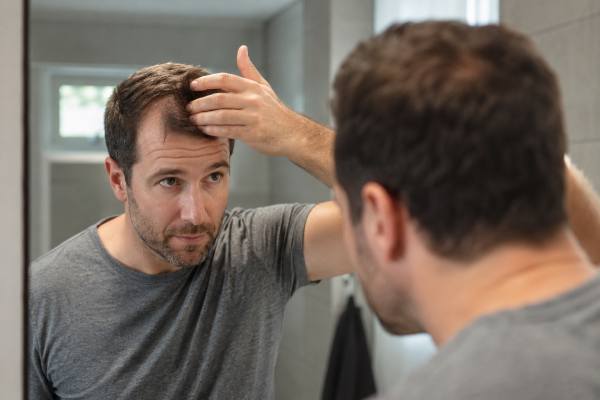
Minoxidil is one of the most common over-the-counter treatments for male pattern hair loss. It does not change testosterone, block DHT, or “cure” baldness. Instead, it helps some shrinking hair follicles stay active longer, which can slow shedding and improve density over time. The catch is that it works slowly, must reach the scalp rather than the hair, and has to be continued to maintain results.
Most men use 5% minoxidil as a foam or liquid. Both can work, but they feel different, dry differently, and may irritate the scalp in different ways. Early shedding, uneven regrowth, and frustration after a few weeks are common reasons men quit too soon. A realistic plan gives minoxidil at least four months, judges results with photos, and treats side effects early instead of guessing.
Table of Contents
- How Minoxidil Works for Male Pattern Hair Loss
- Foam vs Liquid Minoxidil: Which Is Better?
- How to Apply Minoxidil Correctly
- Minoxidil Results Timeline: What to Expect Month by Month
- Side Effects, Shedding, and Safety Concerns
- Why Minoxidil May Not Work for Some Men
- Combining Minoxidil With Other Hair Loss Treatments
- When to See a Doctor About Hair Loss
How Minoxidil Works for Male Pattern Hair Loss
Minoxidil helps hair follicles stay in the growth phase longer, but it does not fix every cause of hair loss. It works best for androgenetic alopecia, also called male pattern hair loss. That usually means gradual thinning at the crown, widening at the top of the scalp, or a pattern that runs in the family.
Hair grows in cycles. A follicle spends time growing, resting, shedding, and then starting again. In male pattern hair loss, sensitive follicles slowly shrink under the influence of genetics and hormones, especially dihydrotestosterone, often called DHT. The hairs become thinner, shorter, and less pigmented until the area looks sparse.
Minoxidil does not block DHT. Its exact hair-growth effect is not fully explained, but it appears to improve follicle activity, shorten the resting phase, and help some follicles produce thicker visible hairs. That is why it can improve coverage without changing testosterone levels.
This distinction matters. A man with early crown thinning may respond well because many follicles are still alive but miniaturized. A man with a smooth bald area that has been shiny and bare for years has fewer active follicles left, so minoxidil has less to work with.
Minoxidil is most often used for the top of the scalp and crown. Many men also try it along the temples or hairline, but results there are less predictable. For a broader look at thinning patterns, Norwood stages, and when treatment is worth starting, see male pattern hair loss stages and treatment timing.
It is also important to separate male pattern loss from other problems. Sudden patchy hair loss, scaling, pain, pus bumps, or rapid shedding after illness may need a different diagnosis. Minoxidil may not help much if the real cause is ringworm, scarring alopecia, thyroid disease, iron deficiency, medication-related shedding, or tight hairstyles that pull on the scalp.
Foam vs Liquid Minoxidil: Which Is Better?
Foam and liquid minoxidil use the same active ingredient, but the vehicle changes how the product feels and how likely it is to bother your scalp. For many men, the better choice is the one they can use consistently.
| Feature | 5% Foam | 5% Liquid Solution |
|---|---|---|
| Texture | Light mousse-like foam | Watery or slightly oily liquid |
| Typical dose | Half a capful applied to thinning areas | Usually 1 mL applied with a dropper |
| Drying | Often dries faster | May take longer and leave residue |
| Scalp irritation | Often better tolerated if liquid irritates | More likely to sting or itch in some men |
| Ease with longer hair | Can get caught in hair if not parted well | Dropper can reach the scalp more directly |
| Best fit | Men who dislike greasy residue or have sensitive scalps | Men who want precise application or have dense hair |
Liquid minoxidil often contains propylene glycol, an ingredient that helps dissolve and deliver the medication. It can also cause dryness, itching, flaking, or burning in some users. Foam is usually propylene glycol-free, which is why men with irritation from liquid often switch to foam instead of quitting.
Foam has its own annoyances. It can melt on warm fingers, spread into the hair instead of the scalp, or feel harder to apply through longer hair. Chilling your fingers briefly with cold water, parting the hair, and applying small amounts at a time can help.
The liquid dropper gives more control over small areas. Men treating the crown may find it simple. Men applying near the temples need to be careful because runoff onto the forehead can increase the chance of unwanted facial hair.
A higher concentration is not always better. Standard men’s products are usually 5%. Using more than directed, applying it more often, or mixing multiple minoxidil products can increase irritation without speeding up growth.
How to Apply Minoxidil Correctly
Minoxidil fails most often because it lands on the hair instead of the scalp. The target is the skin where the thinning follicles sit.
Apply it when the scalp is dry or mostly dry. Wet skin can change how the product spreads and may make dripping more likely. Part the hair with your fingers or a comb, place the product on the thinning area, then spread it lightly. You do not need to scrub hard.
For foam, dispense about half a capful, then apply it in small dabs across the thinning zone. For liquid, measure the labeled amount, often 1 mL, and use the dropper to place small drops directly on the scalp.
A simple routine looks like this:
- Part the hair to expose the thinning scalp.
- Apply the labeled amount to the affected area.
- Spread it gently with fingertips.
- Wash your hands well.
- Let it dry before applying styling products or going to bed.
Many men use minoxidil twice daily because that is how many 5% men’s labels are written. Some dermatologists recommend once-daily use in selected cases to improve adherence or reduce irritation, but men following an over-the-counter label should not exceed the recommended use.
Give the product time to stay on the scalp. Washing it off too soon can reduce exposure. Many labels advise allowing several hours before washing or swimming. Applying it right before a sweaty workout can also waste product and make it run onto the face.
Styling products can be used, but apply minoxidil first and let it dry. If gel, wax, or hair fibers go on first, they may block contact with the scalp. For men using concealers, the easiest routine is often minoxidil on clean dry scalp, dry time, then styling or fibers.
Do not apply minoxidil to broken, infected, sunburned, or painful skin. Damaged skin may absorb more medication and can sting badly. Treat the scalp problem first.
Chemical hair treatments need extra care. Hair dye, relaxers, and perms can irritate the scalp. Many men pause minoxidil around the day of a chemical treatment and restart when the scalp feels normal. There is no need to “make up” missed doses by doubling later.
Minoxidil Results Timeline: What to Expect Month by Month
Minoxidil results are slow because hair grows slowly. Judging it after two or three weeks usually leads to the wrong conclusion.
| Time using minoxidil | What may happen | How to judge it |
|---|---|---|
| Weeks 1–4 | Little visible change; possible itching or dryness | Focus on correct application and tolerability |
| Weeks 2–8 | Temporary shedding can occur | Do not stop unless shedding is severe, patchy, or accompanied by scalp symptoms |
| Months 3–4 | Early fine regrowth or reduced shedding may appear | Compare photos under the same lighting |
| Months 6–9 | Density may look better if responding | Look at crown coverage, part width, and styling ease |
| Months 12+ | Results are easier to judge; maintenance becomes the goal | Continue if benefit is clear and side effects are manageable |
Early shedding scares many men. It can happen when resting hairs are pushed out as follicles shift into a new growth cycle. The shed hairs were often already near the end of their cycle. This can look worse before it looks better.
Temporary shedding is usually diffuse in the treated area and settles within weeks. Shedding that continues, comes out in clumps, leaves round patches, or comes with scaling, pain, redness, or pus bumps needs medical evaluation.
The first visible improvement may be subtle. New hairs can look fine, short, or lighter at first. Some men notice that less scalp shows under bathroom lighting. Others notice their hair is easier to style before they see obvious regrowth.
Take baseline photos before starting. Use the same room, same light, same hairstyle, and same angles: front hairline, temples, top-down crown, and side view. Monthly photos are more useful than daily mirror checks.
If there is no visible benefit after four to six months, check technique before declaring failure. Was it applied to the scalp? Was it used most days? Was the thinning area too advanced? Was the diagnosis correct? If the answer is unclear, a dermatologist can examine the scalp with magnification.
Stopping minoxidil usually leads to loss of the hairs it helped maintain. This does not mean the product “made hair loss worse.” It means the follicles return to their untreated pattern over time. Men who stop often notice shedding several months later.
Side Effects, Shedding, and Safety Concerns
Most minoxidil side effects are local scalp problems: itching, dryness, redness, flaking, burning, or irritation. These are more common with liquid than foam for some men, especially if the liquid contains propylene glycol.
Mild dryness can sometimes be managed with a gentler shampoo, less aggressive rubbing, or switching from liquid to foam. Persistent redness, severe itch, cracking, rash, or swelling means the scalp is not tolerating the product well.
Unwanted hair growth can happen if minoxidil repeatedly runs onto the forehead, temples, cheeks, or pillow. This risk is lower when the product is kept on the scalp, allowed to dry before bed, and washed off the hands after use. If unwanted facial hair appears, stop applying it outside the target area and consider medical advice.
Minoxidil can irritate the eyes. If it gets into the eyes, rinse with cool water. The foam is also flammable before it dries, so avoid smoking, flames, or heat styling immediately after applying it.
Systemic side effects are uncommon with topical use, but they matter. Stop using minoxidil and seek medical advice if you develop chest pain, fast heartbeat, faintness, dizziness, sudden unexplained weight gain, or swelling in the hands or feet. Men with heart disease should ask a clinician before using it.
Do not use minoxidil on children or pets, and keep containers out of reach. Accidental ingestion can be dangerous. Also avoid skin-to-skin transfer to infants from freshly treated areas.
Scalp acne or folliculitis can also show up during use. That may be from the product vehicle, sweat, occlusion from hats, or unrelated scalp inflammation. If bumps are painful, spreading, or pus-filled, stop guessing and get the scalp checked. Men who deal with acne triggered by sweat, shaving, or skin products may also find it helpful to review adult acne treatment options for men.
Why Minoxidil May Not Work for Some Men
Minoxidil does not work for every man. A poor response does not always mean the product is useless; sometimes the cause is timing, technique, or the wrong diagnosis.
Advanced bald areas respond less well. If the scalp has been bare for years, there may be too few active follicles left. Minoxidil can improve miniaturized hairs, but it cannot reliably recreate dense hair where follicles are no longer functioning.
Hairline results are also less predictable than crown results. Some men see small gains around the temples, but many see only stabilization. If the main concern is a receding hairline, expectations should be modest. For early temple thinning, compare options in receding hairline causes and treatments.
Inconsistent use is another major reason for failure. Missing an occasional dose is not a disaster. Missing several days every week makes results harder to achieve. If twice-daily use is not realistic, ask a dermatologist whether a simplified schedule still makes sense.
Some men apply it to the hair, not the scalp. The hair shaft is dead material. The follicle is in the skin. If most of the product dries in the hair, the dose reaching the follicle may be too low.
Other causes of shedding can hide a response. Stress, major illness, rapid weight loss, crash dieting, thyroid disease, iron deficiency, and some medications can cause diffuse shedding. In that situation, minoxidil may be working on androgenetic alopecia while another problem continues to push hairs into shedding.
Scalp disease can also interfere. Thick dandruff, seborrheic dermatitis, psoriasis, fungal infection, or scarring inflammation may need treatment first. Applying minoxidil over an inflamed scalp can worsen irritation and make adherence difficult.
The most useful question is not “Did I grow all my hair back?” It is “Did shedding slow, did coverage improve, or did the thinning stabilize compared with where it was heading?” Stabilization can be a meaningful result, especially in younger men with active loss.
Combining Minoxidil With Other Hair Loss Treatments
Minoxidil is often paired with treatments that work through different pathways. The most common medical combination for men is minoxidil plus finasteride, because minoxidil supports growth while finasteride lowers DHT activity in the scalp.
Finasteride can be more effective for slowing male pattern loss, but it has a different side effect profile and requires more thought about sexual side effects, mood changes, fertility plans, and long-term use. Men comparing options can read more about finasteride benefits and safety for hair loss.
Topical finasteride is another option some clinicians use to reduce scalp DHT exposure while trying to limit systemic effects. It is not the same as minoxidil and should not be mixed casually at home unless a clinician or pharmacy has provided clear instructions. For more on this route, see topical finasteride benefits and risks.
Dutasteride is a stronger DHT-lowering medication than finasteride, but it is not the usual first over-the-counter step and is used with medical supervision. It may be discussed when hair loss is aggressive or when standard therapy is not enough. A deeper comparison is covered in dutasteride for hair loss.
Oral minoxidil has become more widely discussed, but it is not the same as topical minoxidil. It is prescription-only for hair loss use, is off-label for this purpose in many settings, and can have systemic side effects such as swelling, changes in heart rate, dizziness, or unwanted body hair. Men curious about tablets should review oral minoxidil benefits and heart-related risks before asking a clinician whether it fits their health history.
Microneedling, platelet-rich plasma, low-level laser devices, and hair transplantation may also be considered. Their cost, evidence, and suitability vary. A hair transplant works best when hair loss is stable enough and there is enough donor hair. It does not stop future thinning, so many surgeons still recommend medical therapy before and after surgery. For the surgical side, see hair transplant cost factors and recovery.
Avoid stacking too many treatments at once without a plan. Starting three new products in the same week makes it hard to know what helped or what caused irritation. A cleaner approach is to start one main treatment, track photos, then add another if needed.
When to See a Doctor About Hair Loss
Gradual crown thinning with a family history often fits male pattern hair loss, but some signs should not be treated with over-the-counter minoxidil alone.
See a doctor or dermatologist if hair loss is sudden, patchy, painful, scaly, crusted, or associated with redness. Also get checked if there is no family history, if the pattern seems unusual, or if shedding began after a new medication, major illness, rapid weight loss, or severe stress.
Medical evaluation may include a scalp exam, pull test, dermoscopy, or blood tests. Common labs may look for thyroid problems, low iron stores, vitamin deficiencies, inflammation, or hormone clues when symptoms point that way. Not every man needs a large lab panel, but testing can prevent months of using the wrong treatment.
Men should also get help if hair loss is affecting mood, dating confidence, work confidence, or social life. Hair loss is common, but that does not make the distress imaginary. A calm conversation with a clinician can turn scattered product shopping into a clear plan.
Bring details to the visit: when thinning started, where it began, family history, current medications, supplements, recent illness, weight changes, scalp symptoms, and photos from earlier years if available. Product names and doses matter, especially if you already tried minoxidil, finasteride, steroids, testosterone, or supplements marketed for hair growth.
A dermatologist can also tell whether you are a good candidate for prescription therapy, procedures, or transplant referral. Men with sexual side effects, fertility plans, prostate medication use, heart disease, or blood pressure issues should be especially careful with self-directed hair-loss treatment.
References
- DailyMed – MINOXIDIL 5% (FOR MEN)- minoxidil aerosol, foam 2026 (Official Label)
- Minoxidil: a comprehensive review 2022 (Review)
- Treatment of Androgenetic Alopecia: Current Guidance and Unmet Needs 2023 (Review)
- Oral Minoxidil vs Topical Minoxidil for Male Androgenetic Alopecia: A Randomized Clinical Trial 2024 (RCT)
- Relative Efficacy of Minoxidil and the 5-α Reductase Inhibitors in Androgenetic Alopecia Treatment of Male Patients: A Network Meta-analysis 2022 (Systematic Review)
- Male Androgenetic Alopecia 2023 (Review)
Disclaimer
This article is educational and does not replace care from a qualified healthcare professional. Hair loss can have causes other than male pattern baldness, and scalp irritation, sudden shedding, chest symptoms, dizziness, swelling, or unexplained weight gain should be discussed with a clinician. Always follow the product label or the instructions given by your doctor or dermatologist.