
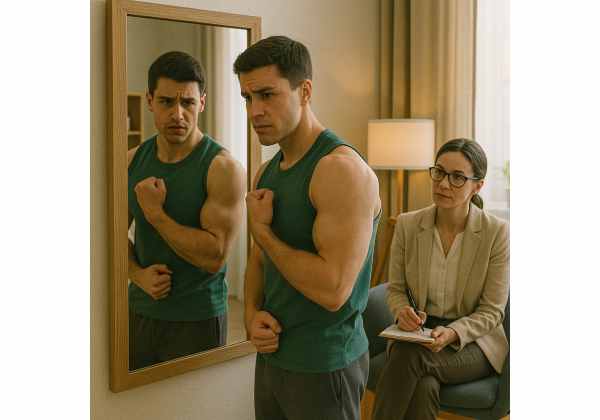
Muscle dysmorphia is a mental health condition in which a person becomes intensely preoccupied with the idea that their body is too small, not muscular enough, or not lean enough, even when others may see them as muscular or fit. It is more than wanting to exercise, improve strength, or look a certain way. The concern becomes persistent, distressing, and difficult to control, often leading to compulsive checking, rigid exercise routines, restrictive eating, avoidance of social situations, or unsafe use of substances meant to change the body.
Muscle dysmorphia is usually understood as a form or specifier of body dysmorphic disorder, although it also overlaps with eating disorders, obsessive-compulsive symptoms, exercise dependence, and performance-enhancing substance use. That overlap can make it easy to miss, especially because many behaviors associated with the condition may look “healthy” or disciplined from the outside.
What matters most to recognize
- Muscle dysmorphia centers on a painful belief that one’s body is insufficiently muscular, small, weak, or not lean enough.
- Common signs include compulsive lifting, mirror checking, body comparing, strict dieting, reassurance seeking, and distress when workouts or food rules are disrupted.
- It can be confused with ordinary fitness goals, competitive bodybuilding, eating disorders, obsessive-compulsive disorder, or general body dissatisfaction.
- The condition can affect men, women, adolescents, adults, athletes, and gender-diverse people, though it is especially studied in boys and men.
- Professional evaluation may matter when body concerns cause distress, social avoidance, impaired school or work functioning, unsafe substance use, self-harm thoughts, or inability to reduce compulsive behaviors.
Table of Contents
- What Muscle Dysmorphia Means
- Symptoms and Visible Signs
- Fitness Goals vs Muscle Dysmorphia
- Causes and Underlying Patterns
- Risk Factors and Vulnerable Groups
- Complications and Health Effects
- Diagnostic Context and Evaluation
What Muscle Dysmorphia Means
Muscle dysmorphia is best understood as a severe, distressing preoccupation with perceived lack of muscularity or body size. The central problem is not exercise itself, but the way appearance concerns begin to dominate attention, choices, identity, and daily functioning.
A person with muscle dysmorphia may believe they look too small, underdeveloped, weak, soft, or inadequately defined. This belief can persist even when the person has substantial muscle mass or receives reassurance from others. The distress often feels urgent and convincing, not like a passing insecurity. Some people recognize that their concerns may be exaggerated, while others feel completely certain that their body is unacceptable.
In current diagnostic frameworks, muscle dysmorphia is commonly described in relation to body dysmorphic disorder. Body dysmorphic disorder involves preoccupation with perceived flaws in appearance that are not noticeable or appear slight to others, along with repetitive behaviors or mental acts such as checking, comparing, grooming, reassurance seeking, or avoidance. In the muscle dysmorphia form, the perceived flaw is mainly the belief that the body build is too small or insufficiently muscular.
This distinction matters because muscle dysmorphia is not simply vanity, athletic ambition, or a preference for a muscular body. Many people pursue strength training, bodybuilding, or physique goals without having a mental health disorder. In muscle dysmorphia, the pursuit becomes distress-driven and hard to interrupt. The person may feel unable to skip a workout, eat flexibly, wear certain clothes, attend social events, or tolerate seeing their body without intense anxiety or shame.
Muscle dysmorphia can also involve a mismatch between outward appearance and internal experience. Someone may appear disciplined, athletic, or confident, yet feel deeply distressed, defective, or trapped by routines they cannot comfortably stop. This is one reason the condition can be overlooked by family members, coaches, clinicians, and even the person experiencing it.
It is also not limited to one body type. A person may be muscular, lean, average-sized, or in a larger body and still experience muscle dysmorphia. The defining feature is the persistent preoccupation and its consequences, not the person’s actual appearance.
Muscle dysmorphia is sometimes informally called “bigorexia” or “reverse anorexia,” but those terms can be misleading. They may suggest that the condition is simply the opposite of anorexia nervosa or only about wanting to be bigger. In reality, many people with muscle dysmorphia are preoccupied with both size and leanness. They may want larger muscles while also fearing body fat, which can drive rigid eating, excessive training, and repeated attempts to “bulk,” “cut,” or refine the body.
For readers trying to understand where muscle dysmorphia fits among mental health conditions, the broader distinction between screening and diagnosis in mental health is useful: questionnaires can identify concerning symptoms, but a diagnosis depends on a full clinical picture, including distress, impairment, medical context, and whether another condition better explains the symptoms.
Symptoms and Visible Signs
The core symptoms of muscle dysmorphia are persistent muscularity-related preoccupation, repetitive checking or comparison behaviors, and distress or impairment caused by those concerns. The signs may be private, behavioral, emotional, physical, or social.
A person may spend large amounts of time thinking about muscle size, symmetry, definition, body fat, strength, or perceived flaws. These thoughts can interrupt school, work, relationships, sleep, meals, and ordinary routines. The person may repeatedly compare themselves with athletes, influencers, gym peers, actors, or older photos of their own body.
Common symptoms and signs include:
- Frequent mirror checking, body measuring, posing, flexing, or photographing the body.
- Avoiding mirrors altogether when the person fears feeling distressed by what they see.
- Repeatedly asking others whether they look small, weak, fat, lean, muscular, or changed.
- Feeling anxious, guilty, irritable, or “wrong” after missing a workout.
- Training despite injury, illness, exhaustion, or important obligations.
- Strict food rules focused on muscle gain, leanness, protein intake, calorie targets, or body fat reduction.
- Avoiding social meals, travel, dating, swimming, changing rooms, or events that interfere with routines.
- Wearing baggy clothing to hide the body or tight clothing to check whether the body looks muscular enough.
- Spending significant time researching supplements, workouts, hormones, physiques, or body transformation content.
- Feeling that no amount of progress is enough, even after measurable changes in strength or size.
Some symptoms look like ordinary fitness behavior until the distress and rigidity become clear. For example, preparing meals, tracking workouts, or following a training plan are not automatically signs of a disorder. The concern rises when these behaviors become compulsory, emotionally punishing, medically risky, or more important than health, relationships, education, work, or personal values.
Emotional signs can be just as important as visible habits. Muscle dysmorphia often includes shame, anxiety, low mood, irritability, perfectionism, and fear of being judged. A person may feel exposed in normal clothing, uncomfortable in photos, or distressed by comments about their body, even comments intended as compliments. Reassurance may help briefly, but the doubt usually returns.
Cognitive symptoms may include distorted body perception, all-or-nothing thinking, and persistent mental comparison. A person might think, “I look tiny,” “I cannot be seen like this,” “I failed because I missed one session,” or “People will think I am weak.” These thoughts can feel automatic and difficult to challenge.
The condition may also involve secrecy. Someone may hide how much they exercise, how distressed they feel, how rigid their eating has become, or whether they use substances to change their body. They may avoid conversations about their routines because they fear criticism, pressure to stop, or losing control over the behaviors that feel necessary.
Because symptoms can overlap with anxiety, depression, obsessive-compulsive symptoms, and eating disorder symptoms, evaluation often considers several possibilities. When eating patterns, body shape fears, or compulsive exercise are prominent, eating disorder screening may be part of the diagnostic picture, especially when restriction, binge eating, purging, or significant weight change is present.
Fitness Goals vs Muscle Dysmorphia
The difference between healthy fitness goals and muscle dysmorphia is not the presence of exercise, discipline, or interest in appearance. The difference is whether body concerns become rigid, distressing, inaccurate, and impairing.
Many people train seriously, follow nutrition plans, compete in sports, or care about appearance without having muscle dysmorphia. A healthy fitness goal usually remains flexible enough to coexist with rest, relationships, illness, changing life demands, and a realistic view of the body. Muscle dysmorphia tends to narrow life around the perceived need to become bigger, leaner, or more defined.
| Area | Health-focused fitness | Possible muscle dysmorphia |
|---|---|---|
| Body thoughts | Occasional dissatisfaction or goal-setting | Persistent preoccupation with being too small, weak, or not lean enough |
| Exercise | Structured but adjustable | Compulsive, distress-driven, or continued despite injury and major conflict |
| Eating | Supports energy, health, and performance | Rigid rules, fear, guilt, or avoidance when food does not fit the plan |
| Self-worth | Appearance may matter, but is not the whole identity | Self-worth heavily depends on muscle size, leanness, or physique control |
| Functioning | Fitness supports life | Life is restricted by training, checking, avoidance, or body distress |
The distinction can be especially difficult in bodybuilding, physique sports, wrestling, football, weightlifting, gymnastics, dance, military settings, and other environments where body composition or performance is emphasized. In these settings, strict routines may be normalized. A person may receive praise for behaviors that are internally driven by shame, fear, or distorted self-perception.
Muscle dysmorphia also overlaps with eating disorders, but it is not identical to them. Some eating disorders center mainly on fear of weight gain, pursuit of thinness, binge eating, purging, or restriction. Muscle dysmorphia centers on perceived insufficient muscularity, although fear of fat gain and rigid food rules may be present. A person may pursue both muscularity and extreme leanness, which can blur the boundary between body dysmorphic disorder and muscularity-oriented disordered eating.
It can also overlap with obsessive-compulsive disorder. Both can involve intrusive thoughts and repetitive behaviors that reduce anxiety temporarily. In muscle dysmorphia, however, the repeated behaviors are organized around appearance, muscularity, or body checking. If broader obsessions and compulsions are present, OCD screening may help clarify whether symptoms extend beyond body image concerns.
Ordinary body dissatisfaction is also different. Many people dislike some part of their body at times. Muscle dysmorphia involves a stronger and more impairing pattern: the concern is persistent, difficult to dismiss, and linked to repetitive behaviors, avoidance, or significant distress. The person may lose hours each day to checking, training, comparing, planning, or worrying.
A useful practical question is not “Does this person work out a lot?” but “What happens emotionally and functionally when they cannot pursue the body goal?” If missing one workout leads to panic, self-hatred, social withdrawal, or compensatory exercise; if meals feel unsafe unless tightly controlled; or if the person’s world becomes smaller because of body concerns, the pattern is more concerning than ordinary fitness motivation.
Causes and Underlying Patterns
Muscle dysmorphia does not have one single cause. It usually develops through a combination of biological vulnerability, temperament, body image experiences, social reinforcement, and environments that reward muscularity or leanness.
One major pathway involves body image distortion. The person may look at their body and focus intensely on perceived inadequacies, while discounting evidence of strength, size, or fitness. Attention becomes selective: small changes in lighting, pump, body fat, scale weight, clothing fit, or social comparison may feel like proof that the body is unacceptable. Over time, the person may rely more on checking rituals than on a stable sense of their body.
Another pathway involves reinforcement. Training, dieting, checking, or reassurance may briefly reduce anxiety. The relief can make the behavior more likely to happen again. For example, a person who feels panicked about looking small may lift for two extra hours and feel temporarily calmer. The next time the fear appears, the mind treats the extra training as necessary. This cycle can make compulsive behaviors stronger, even when they harm health or daily life.
Social and cultural pressures also matter. Muscular, lean bodies are heavily promoted in advertising, sports, film, gaming, dating apps, and social media. Fitness content can be useful, but it can also intensify comparison, especially when images are edited, enhanced, selectively posed, or linked to supplement marketing. A person may begin comparing their ordinary body, in ordinary lighting, to curated images made under ideal conditions.
Certain beliefs can increase vulnerability. These may include:
- “Being muscular is the only way to be respected.”
- “If I am not lean, I have failed.”
- “My body determines my worth.”
- “People notice every flaw I notice.”
- “Rest means weakness.”
- “I will finally feel okay when I reach the next body goal.”
Temperament and emotional patterns may also contribute. Perfectionism, anxiety sensitivity, low self-esteem, shame, difficulty tolerating uncertainty, and high need for control can all make appearance concerns more sticky. Muscle dysmorphia may become a way to manage broader feelings of inadequacy, stress, trauma, social rejection, or fear of not meeting gender expectations.
Trauma and bullying can play a role for some people. A history of being teased, humiliated, physically threatened, rejected, or judged for body size may make muscularity feel like safety. The body goal may become tied to protection, identity, or the hope of never feeling powerless again. This does not mean everyone with muscle dysmorphia has trauma, but for some, the body concern carries emotional meaning beyond appearance.
There may also be overlap with depressive and anxiety symptoms. Low mood can make the person feel defective or hopeless, while anxiety can intensify checking and avoidance. For some people, body concerns become part of a wider pattern of rumination and self-monitoring. Articles on rumination and repetitive worry can help explain how distressing thoughts can loop, although muscle dysmorphia requires its own clinical context.
Importantly, muscle dysmorphia can be maintained by apparent success. Compliments, increased attention, athletic recognition, or visible muscle gain may reinforce the pursuit while failing to resolve the underlying preoccupation. The person may think, “I just need a little more,” but each milestone moves the standard rather than ending the distress.
Risk Factors and Vulnerable Groups
Muscle dysmorphia can affect anyone, but risk is higher when personal vulnerability meets strong pressure to change, display, compare, or control the body. The condition has been studied most often in boys and men, but it is not exclusive to them.
Adolescence and young adulthood are important periods because body image, identity, peer status, sports involvement, dating, and social comparison are often changing at the same time. Puberty can bring rapid body changes that feel difficult to control. For some young people, the desire to become bigger, leaner, or more muscular becomes tied to belonging, confidence, masculinity, attractiveness, or safety.
Groups that may face higher risk or need careful attention include:
- Adolescent boys and young men exposed to intense muscularity ideals.
- Bodybuilders, physique competitors, strength athletes, and some team-sport athletes.
- People in environments where size, leanness, weight class, or appearance is strongly evaluated.
- People with a history of bullying, weight stigma, body shaming, or appearance-based teasing.
- People with anxiety, depression, obsessive-compulsive symptoms, eating disorder symptoms, or low self-esteem.
- People using anabolic-androgenic steroids, “cutting” agents, fat-loss products, or multiple muscle-building supplements.
- Transgender men and some gender-diverse people, especially when body shape, muscularity, or gender expression is linked to distress or safety.
- People who spend substantial time viewing appearance-focused fitness, transformation, or comparison-based social media.
Gender deserves careful wording. Muscle dysmorphia is often associated with males because many cultures place strong value on male muscularity and because research has historically focused on boys and men. However, women and gender-diverse people can also experience muscularity-focused body dysmorphic symptoms. In some individuals, the concern may be less about “getting huge” and more about appearing toned, lean, strong, defined, symmetrical, or not soft.
Athletic and gym environments can be protective for many people, but they can also hide symptoms. A person surrounded by intense training routines may not recognize when their behavior has become compulsive. Coaches, trainers, peers, and family may praise dedication while missing distress, injury, secrecy, or social withdrawal.
Social media is another risk amplifier, especially when feeds are dominated by physique comparison, supplement promotion, “what I eat in a day” content, transformation photos, edited images, or rigid body ideals. The problem is not simply using social media, but repeated exposure to images and messages that make the person feel inadequate and driven to monitor the body. The relationship between social media, comparison, and body image can be especially relevant when appearance checks become part of daily online behavior.
Substance use is a particularly important risk marker. Some people with muscle dysmorphia use legal supplements, high-stimulant products, unregulated compounds, anabolic-androgenic steroids, or other performance- and appearance-enhancing substances. Use may begin as experimentation and become part of a larger pattern of body control. The risk increases when a person feels unable to stop despite side effects, secrecy, financial cost, mood changes, or medical concerns.
Risk factors do not prove that someone has muscle dysmorphia. They indicate that clinicians, families, coaches, and the person themselves may need to look beyond surface behavior and ask whether the body pursuit is flexible, health-supporting, and values-aligned, or rigid, distressing, and impairing.
Complications and Health Effects
Muscle dysmorphia can affect mental health, physical health, relationships, school, work, finances, and identity. The complications often come from the combination of distressing body beliefs and repeated attempts to reduce that distress through increasingly rigid behaviors.
Psychological complications may include anxiety, depression, shame, irritability, low self-worth, social withdrawal, and impaired concentration. The person may struggle to think about anything except body size, training, meals, or perceived flaws. Compliments may not feel believable. Progress may feel temporary. A small change in weight, lighting, muscle fullness, or routine can trigger intense distress.
Social complications are common. A person may avoid parties, restaurants, vacations, dating, family meals, beach trips, locker rooms, or clothing that reveals the body. They may leave events early to train, bring rigid meals everywhere, or feel unable to participate if food and exercise cannot be controlled. Over time, relationships can become strained because others may feel shut out, confused, or criticized.
Physical complications depend on the behaviors involved. Excessive training can contribute to overuse injuries, chronic pain, tendon problems, fatigue, poor sleep, and reduced recovery. Training through injury may worsen damage and prolong symptoms. Rigid eating can lead to inadequate energy intake, digestive distress, nutrient gaps, hormonal disruption, dizziness, irritability, and impaired athletic performance, even when the diet appears “clean” or high in protein.
Substance-related complications can be serious. Anabolic-androgenic steroid use and some unregulated performance-enhancing products can affect mood, acne, hair loss, blood pressure, cholesterol, liver function, fertility, sexual function, and cardiovascular health. Stimulant-heavy products or combinations of supplements may add risks, especially when used in high doses or alongside dehydration, dieting, or intense exercise. The key concern is not that every supplement is harmful, but that escalating use, secrecy, unsafe sourcing, or inability to stop can signal a higher-risk pattern.
Financial and occupational effects may also appear. The person may spend large amounts of money on gym memberships, coaching, supplements, clothing, food plans, procedures, or substances. School or work may suffer because of fatigue, distraction, missed obligations, or rigid scheduling around training and eating.
Muscle dysmorphia can also complicate medical care. A person may seek help for injuries, hormone effects, fatigue, stomach problems, anxiety, low mood, or sleep issues without mentioning the body preoccupation driving the behaviors. They may feel embarrassed, fear being told to stop training, or believe the concern is not “serious enough” because others admire their discipline.
The most urgent complications involve self-harm, suicidal thoughts, severe depression, dangerous substance use, or rapidly worsening functioning. Body dysmorphic disorder and related appearance-focused conditions can carry significant distress, and muscle dysmorphia should not be dismissed as a lifestyle issue. If a person is thinking about self-harm, feeling unable to stay safe, using unknown or high-risk substances, or experiencing severe mood changes, urgent professional evaluation is appropriate.
The emotional burden can be especially hidden because the person may look outwardly successful. They may be strong, lean, admired, or athletic while privately feeling trapped by fear of losing size, gaining fat, appearing weak, or being exposed as inadequate. That mismatch between external appearance and internal distress is one reason compassionate recognition matters.
Diagnostic Context and Evaluation
Muscle dysmorphia is evaluated by looking at the person’s thoughts, behaviors, distress, impairment, body image beliefs, eating and exercise patterns, substance use, and related mental health symptoms. No single mirror check, gym habit, or questionnaire score is enough by itself.
A mental health evaluation may explore how much time the person spends thinking about muscularity, what behaviors they use to reduce distress, how flexible their routines are, and what happens when routines are interrupted. It may also ask about school, work, relationships, sleep, mood, anxiety, eating patterns, injury history, and use of supplements or performance-enhancing substances.
Clinicians may consider several related or overlapping conditions, including:
- Body dysmorphic disorder.
- Eating disorders or muscularity-oriented disordered eating.
- Obsessive-compulsive disorder.
- Depression or anxiety disorders.
- Substance use disorders, including appearance- and performance-enhancing substance misuse.
- Trauma-related symptoms.
- Exercise dependence or compulsive exercise patterns.
- Medical issues related to overtraining, under-fueling, steroid use, or supplement use.
Assessment tools may be used to organize symptoms, but they do not replace clinical judgment. Questionnaires can ask about drive for size, appearance intolerance, functional impairment, compulsive checking, exercise behavior, or eating disorder symptoms. A clinician may also ask about insight: whether the person recognizes that their beliefs might be exaggerated, partly true, probably true, or completely true. Low insight can make symptoms more difficult to identify because the person may describe their body concern as simple reality rather than distressing perception.
The evaluation should also distinguish muscle dysmorphia from culturally normal appearance concerns and from dedicated training. A competitive athlete may follow a strict plan without having muscle dysmorphia if the plan is purposeful, flexible within context, medically safe, and not driven by distorted body beliefs or severe distress. Conversely, a noncompetitive gym-goer may have significant symptoms if body preoccupation controls daily life.
Professional evaluation may be especially important when any of the following are present:
- Body concerns take up an hour or more per day or feel hard to control.
- The person avoids school, work, dating, meals, photos, social events, or public places because of body concerns.
- Exercise continues despite injury, illness, exhaustion, or major conflict.
- Eating becomes rigid, fearful, secretive, or socially impairing.
- There is use of anabolic steroids, unknown compounds, or escalating supplement combinations.
- Mood, anxiety, anger, sleep, or concentration changes are significant.
- The person feels hopeless, trapped, ashamed, or unable to stay safe.
A broad mental health assessment can help clarify what is driving the symptoms and whether more than one condition is present. For someone unsure what that process involves, an explanation of what happens during a mental health evaluation can make the idea of assessment feel less mysterious.
It is also important to use nonjudgmental language. People with muscle dysmorphia may already feel ashamed or defensive. Framing the concern as distress and impairment, rather than vanity or obsession with looks, makes it easier to discuss honestly. The central question is not whether caring about appearance is wrong; it is whether the body concern has become painful, consuming, and limiting.
References
- Muscle dysmorphia in adolescents and young adults 2026 (Review)
- Muscle-building supplement use is associated with muscle dysmorphia symptomatology among Canadian adolescents and young adults 2025 (Study)
- Prevalence and correlates of muscle dysmorphia in a sample of boys and men in Canada and the United States 2025 (Study)
- Exploring risk factors of drive for muscularity and muscle dysmorphia in male adolescents from a resource-limited setting in Burkina Faso 2023 (Study)
- Body Dysmorphic Disorder 2024 (Review)
- Table 23, DSM-IV to DSM-5 Body Dysmorphic Disorder Comparison 2016 (Diagnostic Reference)
Disclaimer
This article is for general educational purposes only and is not a substitute for professional medical advice, diagnosis, or treatment. Muscle dysmorphia can involve significant distress, unsafe substance use, self-harm thoughts, or serious impairment, and concerns like these should be discussed with a qualified health professional.
Thank you for taking the time to read about a condition that is often hidden behind outward discipline; sharing this article may help someone recognize distress that deserves attention.





