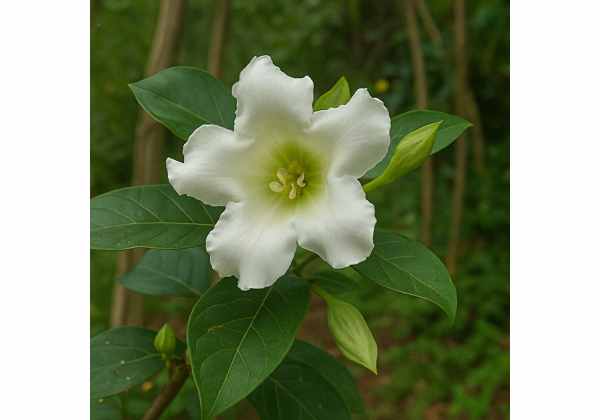
Nepal Trumpet Flower, or Beaumontia murtonii, is a striking tropical climber known for its large cream-white trumpet flowers, glossy foliage, and vigorous growth. It belongs to the Apocynaceae family, a plant group that includes several species with potent latex and cardioactive compounds. That family link matters because this plant draws interest for two very different reasons: ornamental beauty and possible pharmacological activity. Unlike better-known medicinal herbs, however, Nepal Trumpet Flower is not a validated everyday remedy. The published evidence is limited, highly specialized, and focused more on toxicology and laboratory chemistry than on proven human health outcomes.
That makes it a plant best approached with clarity rather than hype. Its most relevant “benefits” are still preliminary and mostly confined to preclinical research on cardenolides and other bioactive constituents. Traditional records also point to toxic latex use rather than routine wellness use. So while the species has genuine scientific interest, especially in relation to natural product discovery, it should not be treated like a casual supplement, tea herb, or home remedy.
Key Facts
- The strongest current value of Nepal Trumpet Flower is as a research plant with cardenolide-rich chemistry, not as a proven self-care herb.
- Laboratory studies suggest some isolated compounds may affect cancer-related signaling pathways, but human benefits are unproven.
- 0 mg orally is the safest unsupervised dose because no validated human dosage exists.
- Pregnant or breastfeeding people, children, and anyone with heart disease should avoid self-experimentation.
Table of Contents
- What Nepal Trumpet Flower Is and How to Recognize It
- Nepal Trumpet Flower Health Benefits and What the Evidence Says
- Key Ingredients and Medicinal Properties
- Traditional Uses and Why This Is Not a Routine Herb
- Dosage, Forms, and Why No Self-Care Dose Exists
- Safety, Side Effects, and Who Should Avoid It
- Should You Use Nepal Trumpet Flower Today
What Nepal Trumpet Flower Is and How to Recognize It
Nepal Trumpet Flower is an evergreen woody climber in the Apocynaceae family. In gardens, it is valued for dramatic clusters of cream to off-white tubular flowers and a lush, tropical look that makes it stand out on pergolas, trellises, and large supports. Botanically, it is a perennial liana rather than a soft-stemmed herb, and that alone helps explain why it does not fit neatly into the usual “medicinal herb” category.
The plant’s common name can be misleading. Despite being called Nepal Trumpet Flower in horticultural circles, the accepted native range of Beaumontia murtonii lies mainly across parts of mainland Southeast Asia and Peninsular Malaysia rather than Nepal itself. That is a useful reminder that common names often reflect trade history or garden habit more than strict geography.
A few features help identify the species:
- It is a climbing plant, not a shrub or ground herb.
- The leaves are large, opposite, and elliptic, with young foliage often hairier than mature leaves.
- The flowers appear in clusters, with long tubular corollas and a pale cream-white color.
- The plant produces milky latex, which is common in the Apocynaceae family and often signals pharmacological activity or toxicity.
- The fruits are elongated and contain hair-tufted seeds, a trait shared by several related climbers.
That latex is not a minor feature. In plant families like Apocynaceae, latex often accompanies bioactive chemistry, including alkaloids, cardenolides, iridoids, or other defense compounds. So even before looking at laboratory studies, the plant belongs to a botanical group that deserves respect.
In practical terms, Nepal Trumpet Flower is best understood as a plant at the border of ornament and pharmacology. It has clear horticultural value, but that does not automatically make it edible, safe, or useful as medicine. In fact, the opposite is often true with Apocynaceae plants: they are visually appealing precisely because they evolved strong chemical defenses.
That distinction matters because searchers often assume that any plant with “flower” in the common name may be mild enough for teas, poultices, or general folk use. Nepal Trumpet Flower should not be placed in that category by default. It is not comparable to culinary blossoms or gentle aromatic herbs. Its botanical identity points toward caution first, especially when latex and cardioactive constituents enter the picture.
The safest starting point is to see Nepal Trumpet Flower as a chemically interesting ornamental climber. That frame protects readers from a common mistake: assuming beauty and traditional naming imply everyday medicinal safety.
Nepal Trumpet Flower Health Benefits and What the Evidence Says
The phrase “health benefits” needs to be handled carefully here. Nepal Trumpet Flower does not have a strong evidence base showing clear human benefits for digestion, immunity, mood, pain, or metabolic health. There are no recognized clinical guidelines for using it, no validated human dosing standards, and no consumer-friendly body of research suggesting it belongs in routine herbal self-care. That is the honest foundation.
What the evidence does suggest is narrower and more interesting in a research sense. Published laboratory studies indicate that extracts and isolated compounds from Beaumontia murtonii contain cardenolides and may influence cancer-related cellular pathways. In one preclinical line of work, compounds isolated from B. murtonii showed inhibition of BMI1 promoter activity, a target relevant to cancer stem cell biology and tumor persistence. That makes the plant potentially important for natural-product research, but it does not mean the plant has proven anticancer effects in humans.
So the most realistic “benefits” are these:
- Research value
The species contains compounds that may help scientists explore cell signaling, cytotoxicity, and structure-activity relationships. That is a legitimate form of medicinal relevance, but it is relevant to drug discovery, not self-prescribing. - Chemotaxonomic value
Because B. murtonii belongs to a chemically rich family, it helps researchers understand how different Apocynaceae species produce and distribute cardioactive compounds. This is scientifically useful even when a plant is not a safe consumer herb. - Ethnobotanical value
The plant also has historical significance in relation to toxic latex use. That is not a wellness benefit, but it does show that people recognized its potency long before laboratory analysis.
What the evidence does not support is just as important:
- It does not support oral use for heart health.
- It does not support home use for pain, inflammation, or infections.
- It does not support tea, tincture, or powder use as a general tonic.
- It does not support cancer self-treatment.
This is where comparison helps. Some plants have active compounds and strong consumer data. Others have active compounds and mostly laboratory data. Nepal Trumpet Flower falls into the second group. Readers who want a clearer example of a plant with better-supported consumer use can compare it with ginger’s better-characterized active compounds, where chemistry and practical use line up much more clearly.
So yes, Nepal Trumpet Flower may have medicinal importance in a research setting. But the practical takeaway for most people is restraint. Its most promising properties are still preliminary, and the gap between lab findings and safe human use remains wide. Calling it a “medicinal flower” without that context would be misleading.
Key Ingredients and Medicinal Properties
The most important compounds associated with Nepal Trumpet Flower are cardenolides, also called cardiac glycosides. These are steroid-like plant metabolites known for strong biological effects, especially through interactions with the sodium-potassium ATPase pump. In plain terms, that means the same class of compounds that attracts pharmaceutical interest can also create serious toxicology concerns.
In Beaumontia murtonii, published studies have identified several cardenolide-type compounds, including digitoxigenin-related glycosides and other structurally related constituents. Later work also isolated known cardenolides and a new compound from methanol-soluble extracts. One of the reported bioactive compounds, wallichoside, was investigated for effects on BMI1-related signaling in cancer models. That is one reason the plant appears in natural-products literature despite not being a common herbal remedy.
From a medicinal-properties perspective, the most relevant points are:
- Cardioactive potential
Cardenolides are not nutritionally passive compounds. They can meaningfully affect cell physiology and cardiac ion regulation. - Cytotoxic and signaling activity
In laboratory systems, some compounds appear capable of influencing cancer-associated pathways and stemness markers. - High pharmacological potency
This is both the main reason for scientific interest and the main reason for consumer caution.
It is important to understand that “active” does not mean “appropriate for self-use.” In fact, with plants like this, high activity often means the opposite. A plant rich in cardenolides may be too potent, too unpredictable, or too poorly studied for safe casual use. That is why medicinal properties have to be divided into two categories:
Properties of research interest
- potential cytotoxicity
- pathway modulation
- structure-based drug discovery relevance
- family-level chemotaxonomic importance
Properties of practical concern
- narrow safety margin
- possible cardiotoxicity
- strong family-level toxicity precedent
- lack of validated oral consumer dosing
This is also why Nepal Trumpet Flower should not be grouped with gentle household botanicals. A better comparison is to cardioactive plants such as foxglove and its cardioactive compounds, where the chemistry is powerful enough to matter medically but too risky for casual unsupervised use.
Another useful point is that consumers often overinterpret in vitro findings. When a study shows that isolated compounds affect tumor cells or signaling pathways in the lab, that does not mean chewing leaves, brewing flowers, or using a homemade extract will produce a safe or helpful result. The form, dose, purity, and target tissue are completely different.
So if someone asks about the key ingredients of Nepal Trumpet Flower, the honest answer is not a trendy antioxidant list. It is a warning-labeled chemical profile centered on cardenolides, supported by specialized phytochemistry, and best handled as a scientific subject rather than an everyday supplement ingredient.
Traditional Uses and Why This Is Not a Routine Herb
Traditional use does not always mean internal medicine. In the case of Nepal Trumpet Flower, the clearest ethnobotanical record points to the plant’s latex being used as an arrow poison. That fact is crucial because it changes the whole way the species should be framed. Many herb articles begin with tea use, tonic use, digestive use, or wound use. Nepal Trumpet Flower does not begin there. Its most clearly recorded traditional relevance is toxic rather than nourishing.
That does not mean the plant had no broader local value. Like many strong climbers in tropical environments, it may also have been noticed for ornamental qualities, fragrance, presence in forest-edge habitats, and possibly restricted local applications that never entered mainstream medical literature. But the available reliable record does not support turning it into a routine folk remedy for modern readers.
This distinction matters for several reasons.
First, plants with toxic latex were often used historically because they were powerful, not because they were mild. Communities sometimes used such plants in hunting, warfare, ritual, or highly specific external practices. Those uses depended on expertise and context. They do not translate into a safe wellness profile.
Second, modern readers are often tempted to over-correct. If they hear that a plant was “used traditionally,” they may assume that a smaller amount must be health-promoting. That logic is not safe here. A plant can be traditionally important and still be a poor candidate for tea, capsules, or home extraction.
Third, Nepal Trumpet Flower lacks the kind of multi-century documented medical use that supports stronger herbal confidence. There is no broad modern tradition of controlled internal use, and no accepted framework for translating older ethnobotanical mentions into contemporary dosing.
A practical way to think about its “uses” today is to separate them:
Reasonable contemporary uses
- botanical study
- ornamental cultivation
- phytochemical research
- ethnobotanical education
Unreasonable contemporary uses
- self-made tinctures
- home cancer remedies
- internal use for heart or circulation
- casual experimentation with latex or leaf extracts
That is why Nepal Trumpet Flower should be placed outside the normal consumer herb lane. Some plants are appropriate for carefully limited topical traditions. Others are suitable in food-like doses. This plant sits closer to the “chemically potent and poorly suited to self-care” end of the spectrum. Readers looking for a better example of a plant where external-only caution plays a large role may compare it with comfrey’s more restricted topical context, though Nepal Trumpet Flower carries a more serious pharmacologic uncertainty.
The best conclusion is simple: Nepal Trumpet Flower has traditional significance, but not in the way most wellness readers expect. Its known historical use points toward potency and danger, not toward a safe routine herbal role.
Dosage, Forms, and Why No Self-Care Dose Exists
There is no validated oral dose for Nepal Trumpet Flower in self-care. That should be the clearest line in the whole article. No established human dosage exists in mg, mL, cups, drops, or capsules for general wellness use. The available literature is not organized around safe consumer dosing. It is organized around plant identification, phytochemistry, and laboratory activity.
That means the usual herb questions have unusually direct answers:
- Tea dose? Not established.
- Tincture dose? Not established.
- Powder dose? Not established.
- Capsule dose? Not established.
- Topical household dose? Not established.
In fact, the most defensible self-care dose is 0 mg orally. That is not a rhetorical flourish. It is the only amount that fits the evidence for unsupervised use, because the plant’s active chemistry raises more safety questions than benefit questions.
People sometimes ask whether laboratory studies can guide dosing. In this case, no. Preclinical papers may report concentrations in micromolar ranges or isolate purified compounds from extracts, but those values do not translate into safe home doses. A purified cardenolide tested in cultured cells is not the same as a homemade extract from leaves, flowers, or latex. The jump from in vitro assay to kitchen use is far too large.
The form problem makes this even harder. Different plant parts can carry different compound profiles, and the concentration of cardioactive glycosides may vary with maturity, processing, season, and extraction method. That variability makes even small consumer experimentation hard to justify.
A useful rule is this:
- If a plant has no human dose data, do not invent one.
- If a plant contains cardioactive compounds, assume the margin for error may be narrow.
- If the most reliable traditional use involves poison, the burden of safety proof becomes even higher.
This is why Nepal Trumpet Flower does not belong in do-it-yourself herbal dosing culture. A plant with no reliable self-care dose and plausible cardenolide content should not be trialed the way someone might trial a gentler digestive herb. Readers who want an example of a plant with clearer extract ranges and more ordinary self-care guidance can compare it with ginger extract and better-documented dosing.
So the dosage section is deliberately short on numbers because honesty requires it. The absence of a dose is itself the guidance. Where evidence is missing and potential toxicity is meaningful, restraint is not a gap in advice. It is the advice.
Safety, Side Effects, and Who Should Avoid It
Safety is the decisive issue with Nepal Trumpet Flower. The species belongs to a family well known for potent latex and cardioactive chemistry, and published studies on Beaumontia murtonii specifically identify cardenolide-type compounds. That means concern is not theoretical. It is rooted in both family pattern and species-level chemistry.
The biggest risk is potential cardiac glycoside toxicity. Compounds in this class can affect heart rhythm, conduction, and ion transport. In safer medical contexts, related molecules require extremely careful dosing because the difference between therapeutic and harmful exposure can be small. In an unregulated plant context, that uncertainty becomes much more serious.
Possible adverse effects from cardioactive glycoside exposure can include:
- nausea and vomiting
- abdominal pain
- weakness or fatigue
- dizziness
- confusion
- visual changes
- bradycardia or irregular heartbeat
- dangerous arrhythmias in severe cases
The plant’s latex creates additional caution. Even when a compound is not intended for ingestion, latex-bearing species can irritate skin, eyes, or mucous membranes, and accidental oral exposure becomes more concerning when the plant already has cardioactive potential.
The people who should clearly avoid self-experimentation include:
- Pregnant or breastfeeding people
- Children and adolescents
- Anyone with heart disease or arrhythmia history
- People taking digoxin or other cardioactive medicines
- People with kidney disease
- People using diuretics or medicines that affect electrolytes
- Anyone with unexplained fainting, palpitations, or conduction problems
Even if a person is healthy, that does not create a safety margin large enough to justify casual use. Plants with cardiac glycosides are not appropriate for “start low and see how you feel” experimentation. That mindset may work with some food-like herbs. It is the wrong mindset here.
There is also a common category error to avoid: assuming that laboratory anticancer interest makes a plant broadly therapeutic. In reality, it often means the plant contains compounds too biologically forceful for unsupervised household use. Many such compounds only become useful after purification, dosing control, formulation work, and extensive toxicology testing.
For perspective, readers who want a gentler example of how herbal safety is usually framed may find a much milder herb safety profile useful. Nepal Trumpet Flower sits far outside that everyday-herb zone.
The safest summary is direct. This is not a casual medicinal plant. It is a chemically interesting species with enough reason for caution that avoidance is usually the most sensible consumer strategy.
Should You Use Nepal Trumpet Flower Today
For most people, Nepal Trumpet Flower is better appreciated than used. It is visually impressive, scientifically interesting, and ethnobotanically notable, but those qualities do not add up to a good self-care herb. In fact, they point in the opposite direction. The strongest evidence around the plant concerns cardenolides, laboratory bioactivity, and toxic potential, not safe consumer outcomes.
So the real decision is not whether the plant is “good” or “bad.” It is whether the available evidence supports routine use. Right now, it does not.
Nepal Trumpet Flower may be worth attention in a few contexts:
- as a botanical specimen in tropical and subtropical gardens
- as a research species for natural-product and cardenolide studies
- as an ethnobotanical example of how traditional plant use may involve poison, potency, and specialized knowledge rather than everyday health tonics
It makes much less sense in these situations:
- as a homemade extract
- as a cancer self-treatment
- as a heart or circulation herb
- as a “rare medicinal flower” purchased online without species verification
- as a novelty supplement for people who assume all plants are safe in small doses
The article title asks about health benefits, uses, dosage, and safety. The most useful final answer is unusually simple:
- Benefits: preliminary and mostly preclinical
- Uses: mainly ornamental, research, and ethnobotanical
- Dosage: no validated self-care dose
- Safety: caution is more evidence-based than use
That may sound less exciting than a typical herb article, but it is far more helpful. A good health article should not turn uncertainty into a sales pitch. With Nepal Trumpet Flower, the most responsible guidance is to name the evidence gap, explain the chemical concern, and keep the reader away from confident but unsupported claims.
So should you use Nepal Trumpet Flower today? In most cases, no. Grow it if you like its flowers and have the right climate. Study it if you are interested in plant chemistry or ethnobotany. But do not confuse laboratory promise with safe personal use. The plant has value, yet that value lies more in knowledge than ingestion.
References
- NParks | Beaumontia murtonii 2026 (Government species profile)
- Identification of BMI1 Promoter Inhibitors from Beaumontia murtonii and Eugenia operculata – PubMed 2017 (Preclinical study)
- Cardiac Glycosides of Beaumontia Brevituba and B. Murtonii – PubMed 1990 (Seminal phytochemistry study)
- Cardiac glycosides toxicity: Mechanisms and mitigation strategies in recent studies – PubMed 2025 (Review)
- Cardenolides from the Apocynaceae family and their anticancer activity – PubMed 2016 (Review)
Disclaimer
This article is for educational purposes only and does not replace medical advice, diagnosis, or treatment. Nepal Trumpet Flower is not a validated home remedy, and its chemistry raises meaningful safety concerns, especially around cardioactive glycosides and latex exposure. Do not ingest the plant, prepare homemade extracts, or use it to self-treat cancer, heart symptoms, pain, or any chronic condition. Anyone who is pregnant, breastfeeding, has heart or kidney disease, or takes prescription medicines should avoid self-experimentation and seek qualified medical guidance for any health concern.
If you found this article useful, consider sharing it on Facebook, X, or your preferred platform.