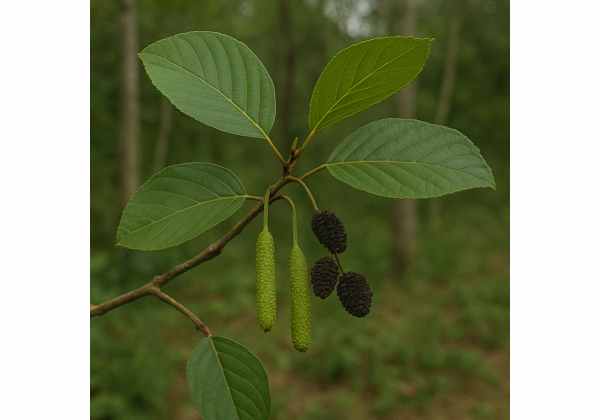
Nepalese alder, or Alnus nepalensis, is a fast-growing Himalayan tree better known in forestry and traditional medicine than in modern wellness marketing. Its bark, leaves, and roots have been used in regional healing systems for stomach complaints, diarrhea, dysentery, cuts, and wound care, while newer laboratory studies have drawn attention to its antioxidant, antibacterial, and anti-inflammatory potential. That combination makes it interesting, but it also calls for restraint. Nepalese alder is not a mainstream supplement with a standardized extract or a clinically established human dose.
What makes the plant notable is its chemistry. Investigators have identified tannins, phenolic compounds, flavonoids, triterpenoids, steroids, and a distinctive group of molecules called diarylheptanoids, including oregonin and related compounds. These may help explain why the plant has a long traditional reputation as an astringent, wound-supportive, and digestive herb.
For most readers, the most helpful question is not whether Nepalese alder is a miracle remedy, but where it may genuinely fit: as a traditional medicinal tree with promising preclinical evidence, selective practical uses, and important safety limits when self-treatment goes too far.
Essential Insights
- Nepalese alder shows the strongest promise for antioxidant support, mild antimicrobial action, and traditional astringent use.
- Its most established folk uses involve diarrhea, stomach discomfort, cuts, and wound care rather than broad disease treatment.
- Animal studies have used about 100 to 200 mg/kg extracts, but no standardized human oral dose has been established.
- Avoid concentrated preparations during pregnancy, breastfeeding, childhood, and for severe digestive illness, infections, or unexplained bleeding.
Table of Contents
- What is Nepalese Alder and how is it used
- Key ingredients and medicinal properties
- Potential health benefits and what evidence shows
- Nepalese Alder in traditional and modern use
- How Nepalese Alder is prepared
- Dosage, timing, and duration
- Safety, side effects, and who should avoid it
What is Nepalese Alder and how is it used
Nepalese alder is a deciduous tree in the birch family, native to the Himalayan belt and neighboring upland regions. It is often recognized for its ecological value before its medicinal one. The tree grows quickly, helps stabilize disturbed slopes, and improves soils through nitrogen-fixing root associations. Yet in several traditional systems, especially in Nepal and parts of India, it is also a practical medicinal resource.
The parts most often linked with herbal use are the bark, roots, and leaves. Traditional records describe the bark and roots being prepared as decoctions for digestive complaints such as diarrhea, dysentery, and stomach ache. Fresh leaves have been used differently: crushed into a paste and placed on cuts or wounds, often with the aim of reducing bleeding and supporting surface healing. This difference between internal and external use is worth noticing. Nepalese alder was not traditionally treated as a single-purpose herb. It was valued for its astringency, tissue-tightening quality, and usefulness in everyday problems.
That astringency is a key to understanding the plant. Herbs high in tannins often earn reputations for “drying,” “tightening,” or “firming” tissues. In practical terms, that can translate to folk use for loose stools, damp skin conditions, or minor bleeding. This places Nepalese alder in a broader family of traditional bark medicines, much like tannin-rich oak bark preparations that are used for digestive and topical support.
Still, Nepalese alder is not a widely standardized modern botanical. Unlike herbs that appear in pharmacopeias with clear extract specifications, this tree remains mostly in the realm of ethnomedicine and early scientific investigation. That means the plant is medically interesting, but it does not yet justify highly confident treatment claims.
A useful modern summary would describe Nepalese alder as a traditional medicinal tree with three overlapping identities:
- A regional digestive astringent
- A topical folk remedy for minor wounds and cuts
- A source of bioactive compounds now being studied in the lab
This perspective keeps expectations realistic. Nepalese alder deserves attention, but it deserves the kind of attention given to a promising traditional plant, not to a proven clinical therapy. That distinction shapes every practical decision that follows, from preparation to dosage to safety.
Key ingredients and medicinal properties
Nepalese alder does not owe its reputation to a single famous active compound. Its medicinal properties seem to come from several overlapping groups of phytochemicals, each contributing a different part of the plant’s overall profile.
The first major group is diarylheptanoids. These compounds are considered characteristic constituents of the Alnus genus and are especially important in Nepalese alder research. Among the better-known examples reported from Alnus nepalensis are oregonin, platyphylloside, and hirsutanonol 5-O-β-D-glucopyranoside, along with related molecules such as alnus dimer and other heptane-chain phenolics. These compounds are important because they have been linked to anti-inflammatory, antioxidant, and antiparasitic activity in experimental work.
The second important group is tannins and other phenolic compounds. These help explain the plant’s traditional astringent uses. Tannins can bind proteins at the tissue surface, producing the tightening sensation common to bark decoctions and wound washes. That makes them relevant to diarrhea support and minor topical applications. The bark also contains significant phenolic content, which likely contributes to free-radical scavenging and antimicrobial action.
The third group includes flavonoids and related polyphenols. These compounds often support antioxidant defense and help explain why plant extracts show activity in common laboratory assays. Though these are not unique to Nepalese alder, they work together with diarylheptanoids and tannins to shape the plant’s profile.
Finally, triterpenoids and steroids have also been reported from the species. These may not be the first compounds people associate with alder, but they add to the chemical diversity of the bark and leaves and may contribute to the plant’s broader biological activity.
From a practical standpoint, Nepalese alder’s main medicinal properties can be described as:
- Astringent, due largely to tannins
- Antioxidant, due to phenolics, flavonoids, and diarylheptanoids
- Anti-inflammatory, especially in preclinical diarylheptanoid studies
- Mildly antimicrobial, based on bark and leaf extract experiments
These categories make sense together. A tannin-rich, phenolic-rich medicinal bark often behaves as a wound-supportive and gut-supportive herb in traditional medicine. If you are familiar with other astringent topical herbs such as witch hazel, the basic logic is similar, although the exact compounds are different.
The key point is that Nepalese alder has a plausible medicinal chemistry. Its traditional uses are not random. They fit with what modern phytochemistry has found. But chemistry alone is not the same as clinical proof, and that is where the next section matters most.
Potential health benefits and what evidence shows
The best way to describe Nepalese alder’s health benefits is to separate traditional usefulness, preclinical promise, and proven human outcomes. The first two categories are meaningful. The third remains limited.
The most credible benefit is digestive astringent support. Traditional use for diarrhea, dysentery, and stomach discomfort fits the plant’s tannin-rich bark and root profile. Astringent herbs can sometimes help by reducing excessive secretion and toning irritated tissues. This does not mean Nepalese alder should be used casually for every digestive upset, but it does explain why it repeatedly appears in ethnomedicinal records.
The second likely benefit is topical wound support. Fresh leaf paste has been used on cuts and wounds as a hemostatic-style remedy, meaning a plant used to help limit minor bleeding and support local healing. This also fits with astringent chemistry. Such use is plausible for minor surface issues, though modern wound care standards should always come first.
The third area is antioxidant activity. Recent laboratory work on bark and leaf extracts found strong phenolic, flavonoid, and tannin content, along with notable radical-scavenging activity. In another study, A. nepalensis performed well among selected Nepalese medicinal plants in antioxidant testing. This suggests the tree is chemically active, not inert.
The fourth area is anti-inflammatory potential. Isolated diarylheptanoids from Nepalese alder reduced inflammatory signaling in macrophage models and improved outcomes in a mouse endotoxic-shock model. This is one of the stronger mechanistic findings for the species, but it remains preclinical. It supports interest, not self-treatment claims.
The fifth and most experimental benefit is antimicrobial and antiparasitic activity. Bark and leaf extracts have shown inhibition against selected bacteria in vitro, and isolated diarylheptanoids have shown antifilarial activity in laboratory and animal settings. These are exciting research findings, but they are far from everyday clinical guidance.
A balanced reading of the evidence looks like this:
- Traditional use supports digestive and wound-related applications.
- Laboratory evidence supports antioxidant, antibacterial, and anti-inflammatory activity.
- Animal research supports anti-inflammatory and antifilarial promise.
- Human clinical dosing and outcome data are still missing.
That final point matters most. Nepalese alder is better thought of as a promising medicinal tree under study than as a finished herbal product. Readers who want strong human evidence for inflammation relief may find more established options in better-studied anti-inflammatory botanicals, while Nepalese alder remains a species where tradition and early science are more developed than clinical practice.
Its benefits, then, are best described as credible but preliminary. That is a worthwhile category. It means the plant deserves respect, curiosity, and caution in equal measure.
Nepalese Alder in traditional and modern use
Nepalese alder is a good example of how traditional medicine and modern research do not always ask the same question. Traditional users asked, “What helps when someone has loose stools, a stomach ache, or a cut?” Modern researchers ask, “Which extract shows antioxidant activity, which fraction lowers inflammatory cytokines, and which isolated compounds deserve deeper study?” Both approaches matter, but they speak different languages.
In traditional practice, Nepalese alder was not used because someone had identified oregonin or characterized a diarylheptanoid fraction. It was used because certain plant parts worked in repeated local experience. Root decoctions were taken for bowel complaints. Leaves were crushed into paste for cuts and wounds. These are practical, direct uses tied to everyday problems.
Modern research keeps some of that traditional logic but translates it into laboratory categories. When researchers measure tannins, phenolics, flavonoids, inhibition zones, nitric oxide suppression, or inflammatory cytokines, they are testing whether the folk reputation has a biochemical basis. In Nepalese alder’s case, the answer seems to be yes, at least in part. The plant repeatedly shows activity worth noting.
That does not mean old and new uses line up perfectly. Traditional medicine often uses whole preparations, such as decoctions or pastes, while modern science may isolate fractions, purify compounds, or even use plant extracts to assist nanoparticle synthesis. Those research methods can reveal important pharmacology, but they also move away from how people actually used the tree.
This difference leads to a useful rule: the stronger the processing, the less you should assume the result reflects ordinary folk use. A bark decoction is one thing. An isolated diarylheptanoid or plant-assisted nanoparticle experiment is something else entirely.
Today, Nepalese alder fits best into three overlapping areas:
- Ethnomedicine, where its traditional uses are still informative
- Phytochemistry, where its diarylheptanoids and tannins make it scientifically interesting
- Early pharmacology, where antioxidant, antimicrobial, and anti-inflammatory effects are still being mapped
That makes Nepalese alder a compelling plant for readers who value both history and evidence. It also makes it a poor candidate for exaggerated consumer claims. Its real value lies in thoughtful interpretation. It behaves like a regional medicinal tree with a credible traditional record and promising experimental support, not like a fully validated over-the-counter remedy.
This is also why comparison with gentler or more standardized herbs can be helpful. For surface soothing and skin-support traditions, some readers may better understand Nepalese alder by comparing its role to other topical folk herbs such as calendula, even though the chemistry is very different. The comparison is functional rather than botanical: both live at the intersection of household remedy and broader herbal practice.
How Nepalese Alder is prepared
Preparation matters because Nepalese alder has not been standardized in the way commercial herbs often are. The form you use changes both the likely effect and the degree of uncertainty.
The most traditional internal form is the decoction. This makes sense for bark and root material, which are dense, fibrous, and better suited to simmering than simple steeping. Decoctions extract tannins and many water-soluble compounds well, which matches the plant’s folk use for digestive complaints. In traditional practice, the goal was usually not a concentrated “extract” in the modern supplement sense, but a strong medicinal liquid made from coarse plant material.
The main traditional external form is the fresh leaf paste. Fresh leaves are crushed or pounded and applied to small cuts or wounds. This is a very different type of preparation from a tea or decoction. It is immediate, local, and topical. Because the fresh plant is involved, cleanliness and correct identification matter greatly.
In a research setting, scientists have used several nontraditional preparations:
- Methanolic leaf extracts
- Ethanolic bark extracts
- Butanol or chloroform fractions
- Isolated diarylheptanoids
- Aqueous bark extract for nanoparticle-related experiments
These are scientifically useful, but they are not interchangeable with home herbal practice. A consumer should not look at a methanolic extract study and assume a kitchen decoction will behave the same way.
For practical readers, the safest preparation hierarchy is simple:
- Traditional topical use is easiest to understand, but still requires cleanliness and caution.
- Traditional decoctions are more understandable than concentrated solvent extracts, but still lack standardized modern dosing.
- Concentrated experimental extracts should be treated as research materials, not self-care recipes.
There is also a sourcing issue. Tree bark and roots are not casual herbs. Harvesting them can damage or kill the tree, so sustainability matters. This is one reason Nepalese alder is not a convenient do-it-yourself herb in the same way that mint or chamomile might be. If bark is harvested, it should come from a reliable and properly identified source rather than from random roadside or polluted environments.
The best practical advice is to keep the plant close to its documented uses. Nepalese alder makes the most sense as a traditional bark-or-leaf medicine used conservatively, not as a heavily concentrated home extract. The farther you move from traditional preparations, the more uncertainty you create.
Dosage, timing, and duration
This is the most important caution in the whole article: there is no established evidence-based human oral dose for Nepalese alder. That should shape every decision about how the plant is discussed and used.
Traditional medicine describes forms of use more clearly than it describes standardized dosage. Root and bark decoctions were taken for digestive complaints, and leaf paste was applied topically for cuts and wounds. But the surviving literature does not provide a modern, clinically validated range such as “take X mg twice daily” for general use. That absence matters.
Where numbers do exist, they mostly come from research models rather than clinical herbal practice. For example, antifilarial animal work used about 100 to 200 mg/kg of crude extract, with some fractions studied around 100 mg/kg. These figures are valuable for research interpretation, but they are not a direct human recommendation. In the same way, in vitro antimicrobial findings reported concentrations in mg/mL or μg/mL, but those are laboratory testing conditions, not consumer doses.
A practical dosage framework therefore has to be conservative:
- Topical traditional use: fresh leaf paste applied locally in small amounts for minor, short-term household use only
- Internal traditional use: bark or root decoction in small, time-limited amounts under experienced guidance rather than self-directed daily use
- Research figures: 100 to 200 mg/kg in animal studies, useful for context but not for self-prescribing
- Modern consumer guidance: no standardized capsule, tincture, or extract dose can currently be recommended with confidence
Timing follows purpose. If Nepalese alder is used traditionally for digestive discomfort, it would usually make sense around the time symptoms appear rather than as a long-term wellness tonic. For topical folk use, it belongs to short-term surface care, not chronic skin self-treatment.
Duration should also stay short. Astringent bark herbs are rarely ideal as indefinite daily remedies. If someone notices no clear benefit within a few days, or if symptoms recur often, the answer is usually not “take more.” It is “reconsider the situation.” Persistent diarrhea, blood in the stool, fever, marked abdominal pain, or infected wounds should move out of herbal self-care and into proper medical assessment.
The honest conclusion is that Nepalese alder has traditional use and interesting research, but not a settled dosing system for modern self-medication. That honesty is not a weakness. It is what makes the guidance trustworthy.
Safety, side effects, and who should avoid it
Nepalese alder may be a traditional plant, but traditional use does not automatically mean proven safety in every form. In fact, the lack of clinical standardization is exactly why safety needs to be handled carefully.
The first concern is gastrointestinal irritation. Bark medicines rich in tannins can be a double-edged sword. In small amounts they may feel useful for loose stools, but in larger or repeated amounts they may cause nausea, stomach irritation, or excessive dryness. Some people may also notice constipation or an unpleasant tightening sensation after strong preparations.
The second concern is misapplied self-treatment. Nepalese alder’s most interesting modern findings include antibacterial, anti-inflammatory, and antifilarial activity, but these are largely laboratory and animal data. That makes the plant scientifically promising, not clinically proven. It should not replace antibiotics, antiparasitic drugs, wound care, or medical evaluation when symptoms are serious.
The third concern is lack of pregnancy and breastfeeding data. Since there are no solid human safety data for concentrated internal use, pregnancy and breastfeeding are times to avoid experimentation. The same is true for children, where dose uncertainty and tolerability are even bigger issues.
The fourth concern is topical cleanliness and wound judgment. A fresh leaf paste may sound gentle, but any plant material placed on broken skin can introduce contamination if it is not clean. Folk practice works best when applied to very minor, clean, superficial issues. Deep wounds, spreading redness, pus, fever, or animal bites need modern care, not household improvisation.
People who should avoid self-directed medicinal use of Nepalese alder include:
- Pregnant or breastfeeding individuals
- Children
- Anyone with severe or persistent diarrhea
- Anyone with blood in the stool or unexplained abdominal pain
- Anyone with infected, deep, or slow-healing wounds
- Anyone wanting to substitute it for standard antiparasitic or antimicrobial treatment
There is also a broader herbal-safety principle at work here. When an herb is primarily supported by ethnomedicine and preclinical studies, it is usually wiser to use it narrowly, briefly, and traditionally rather than broadly and aggressively. For people seeking a gentler, more familiar digestive herb, chamomile is often easier to dose and better studied for routine soothing use, even though it serves a different role.
The best safety summary is straightforward: Nepalese alder appears medicinally active, but its safest place is in cautious, limited, traditional-style use. As soon as symptoms become severe, recurrent, or medically important, the plant should stop being the center of the plan.
References
- The Evaluation of antioxidant, antimicrobial, and lethality Activities of leaf and bark extract of alnus nepalensis D. Don 2025.
- Screening of Antioxidant, Antibacterial, Anti-Adipogenic, and Anti-Inflammatory Activities of Five Selected Medicinal Plants of Nepal 2023.
- Plant-mediated synthesis of zinc oxide (ZnO) nanoparticles using Alnus nepalensis D. Don for biological applications 2024.
- Diarylheptanoids from Alnus nepalensis attenuates LPS-induced inflammation in macrophages and endotoxic shock in mice 2016.
- Simultaneous quantification of diarylheptanoids in Alnus nepalensis using a validated HPTLC method 2014.
Disclaimer
This article is for educational purposes only and does not replace medical advice, diagnosis, or treatment. Nepalese alder has a meaningful traditional record and encouraging preclinical research, but it does not have a well-established human dosing standard or strong clinical trial evidence for routine self-treatment. Anyone who is pregnant, breastfeeding, caring for a child, living with chronic digestive disease, taking prescription medicines, or dealing with possible infection, bleeding, or persistent symptoms should speak with a qualified healthcare professional before using Nepalese alder medicinally.
If you found this article useful, please share it on Facebook, X, or your preferred platform to help more readers discover careful, evidence-aware herbal information.