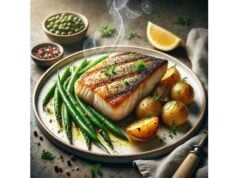
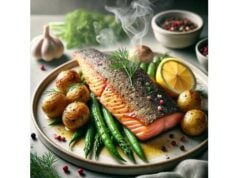
Opah—also called moonfish—is a firm, richly flavored pelagic fish prized by chefs for its versatility. Different muscle groups on a single fish offer steak-like cuts for grilling and sashimi-grade portions for raw applications, so cooks can explore multiple textures from one species. Nutritionally, opah delivers high-quality protein, marine omega-3 fatty acids, and notable selenium with relatively modest sodium. Because it is incidentally caught in well-managed fisheries and handled much like tuna and swordfish, it is widely available as steaks or loins. This guide translates the science and kitchen craft into practical steps: how opah’s nutrients stack up per 100 grams, proven health benefits linked to omega-3s and lean protein, real-world safety considerations like mercury and histamine control, and how to source, store, and cook it for best texture and flavor. You will also find portion guidance, quick comparisons to similar fish, and concise answers to common questions.
Top Highlights
- Typical serving: 115–150 g cooked or raw steak, one to two times weekly within a varied seafood pattern.
- Key benefits: high-quality protein and long-chain omega-3s that support heart health and satiety.
- Safety caveat: mercury varies among large pelagic fish; follow national fish-intake guidance and rotate species.
- Who should limit or avoid: people who are pregnant or breastfeeding and young children should choose lower-mercury seafood more often.
- Handling note: maintain strict cold chain to prevent histamine formation in temperature-abused fish.
Table of Contents
- Detailed Overview
- Nutrition Profile
- Evidence-Based Health Benefits
- Risks, Allergies and Interactions
- Selecting, Quality, Sustainability and Storage
- Preparation, Cooking and Nutrient Retention
- Portions, Comparisons and FAQs
Detailed Overview
Opah (Lampris spp.), also known as moonfish, is a round, laterally compressed ocean fish with rosy-silver skin and white speckling. It inhabits midwater zones and is most often landed as incidental catch in longline fisheries that target species like tuna and swordfish. That incidental status partly explains opah’s restaurant mystique: availability fluctuates, and chefs value its clean, rich taste and firm, succulent texture that holds up under high heat.
One unique biological note sets opah apart from most bony fish. It is regionally endothermic—able to keep its body warmer than the surrounding water thanks to counter-current heat exchange and constant fin movement. This adaptation lets opah forage comfortably in colder, deeper layers while sustaining speed and performance. For cooks, that physiology translates into unusually dense muscle structure with large, well-defined flakes and a satisfying “steak” bite.
Culinarily, opah behaves like a cross between tuna and swordfish, yet it is milder than both when handled carefully. The fish offers multiple usable cuts from one carcass: a loin suitable for steaks and grilling, a tender belly for searing or confit, and often sashimi-grade sections for raw applications. The meat ranges from orange-red to pink when raw and turns pearly white when cooked. A light brine or citrus-based cure before cooking can firm the surface and season it evenly without masking the fish’s natural sweetness.
Nutritionally, opah is a high-protein, moderate-fat fish. It contains marine omega-3s (EPA and DHA) in meaningful amounts, plus selenium—a trace mineral that supports antioxidant defenses. Like other large pelagics, mercury levels can be higher than in small schooling fish, so it is best enjoyed within a rotation that leans more heavily on lower-mercury choices for frequent meals.
In the marketplace, opah is commonly sold as thick steaks or boneless loins. Fresh fish should smell clean and oceanic, with moist, translucent flesh and no browning. Frozen options can be excellent when processed at sea. Because histamine can form if any scombroid or scombroid-like fish is temperature abused, insist on a solid cold chain and thaw slowly in the refrigerator to protect quality and safety.
Nutrition Profile
Notes on data and conversions: The tables below present nutrients per 100 g raw opah to standardize comparisons. Values are derived from authoritative seafood nutrition listings for a 4 oz (113 g) serving and scaled to 100 g. Natural variability occurs by cut, season, and handling. Percent Daily Value (%DV) uses current adult reference intakes where applicable.
Macros and Electrolytes (per 100 g, raw)
| Nutrient | Amount | %DV |
|---|---|---|
| Energy | 150 kcal | — |
| Protein | 21.2 g | — |
| Total fat | 7.1 g | 9% (78 g DV) |
| Saturated fat | 2.2 g | 11% (20 g DV) |
| Carbohydrate | 0 g | 0% |
| Total sugars | 0 g | — |
| Dietary fiber | 0 g | — |
| Sodium | 71 mg | 3% (2,300 mg DV) |
| Water | ~70–72 g | — |
Interpretation: Opah is a high-protein, moderate-fat fish with no carbohydrate. Its fat profile includes long-chain omega-3s, which contribute to heart-protective effects.
Fats and Fatty Acids (per 100 g, raw)
| Lipid | Amount | %DV |
|---|---|---|
| Omega-3 (EPA+DHA) | ~1.6 g | — |
| Cholesterol | 53 mg | — |
Notes: Omega-3 values vary by cut (belly contains more than loin). There is no established %DV for EPA and DHA; many health organizations encourage regular intake through fish.
Protein and Amino Acids
- Protein quality: Complete amino acid profile typical of marine fish, high biological value.
- Use case: Reliable lean protein that supports muscle maintenance and post-meal satiety at modest calorie cost.
Vitamins (typical qualitative levels)
- Niacin (Vitamin B3): present at useful levels associated with energy metabolism.
- Vitamin B6 and Vitamin B12: commonly present in marine fish; amounts vary by cut and freshness.
- Vitamin D: variable and generally modest in pelagic species unless fortified; do not rely on opah as a primary source.
Minerals (per 100 g, raw)
| Mineral | Amount | %DV |
|---|---|---|
| Selenium | 43 µg | 78% (55 µg DV) |
| Phosphorus | present (variable) | — |
| Potassium | present (variable) | — |
Why selenium matters: Selenium supports antioxidant enzymes and may help counterbalance mercury exposure within a diverse seafood pattern.
Bioactives and Other Components
- Marine omega-3s (EPA and DHA): long-chain fats linked with cardiometabolic and neurocognitive benefits.
- Imidazole dipeptides (for example, balenine): naturally occurring compounds in some fish muscles; research is emerging on kinetics and possible exercise-related roles.
- Creatine and taurine: present in many fish muscles and contribute to cellular energy handling and osmoregulation.
Allergens and Intolerance Markers
- Opah is a finfish; individuals with finfish allergy should avoid it. Cross-contact with shellfish can occur in mixed processing environments.
Contaminants and Residues (context for consumers)
- Mercury: levels in large pelagics vary; include opah occasionally within a rotation emphasizing lower-mercury species if you eat fish multiple times per week.
- Histamine risk in temperature-abused fish: strict cold chain from vessel to plate is the key control step.
- Microplastics and environmental residues: exposure through seafood is under active study; current household risk management focuses on sourcing and moderation.
Footnote on rounding and scaling: Numbers are rounded to sensible precision for consumer use. Per-cut differences exist; belly and collar sections tend to carry slightly higher fat and omega-3 than lean loins.
Evidence-Based Health Benefits
1) Cardiovascular support from marine omega-3s
EPA and DHA are the hallmark nutrients in oily and moderately fatty fish. A practical intake pattern—fish once or twice weekly that includes species like opah—supports triglyceride reduction and may improve other lipid markers in the context of balanced eating. Opah’s approximate 1.6 g of EPA and DHA per 100 g (more in belly cuts) makes it a meaningful contributor when you aim for the widely recommended “fish twice per week” pattern. The protein in opah helps replace higher-saturated-fat meats, further improving the overall fatty acid profile of your meals.
2) High-quality protein for satiety and muscle maintenance
At about 21 g protein per 100 g raw weight, opah provides complete amino acids needed for muscle repair and day-to-day turnover. Compared with many red meats, it delivers this protein with lower saturated fat. In mixed meals, a 120–150 g portion offers 25–32 g protein, which is a practical target for main meals supporting appetite control and lean-mass goals.
3) Selenium as an antioxidant cofactor
Opah supplies selenium at a level that can approach three-quarters of the daily value in a 100 g serving. Selenium aids glutathione peroxidase activity and supports immune and thyroid function. In the context of seafood, selenium presence is a nutritional upside worth including in a rotation with small, lower-mercury species.
4) Culinary versatility that nudges healthier patterns
A food’s “benefit” often flows from how it reshapes your plate. Opah’s firm texture makes it satisfying when grilled or pan-roasted with minimal added fat. The same fish can be prepared as crudo or poke, encouraging lighter dressings built around citrus, herbs, and vegetables. That versatility helps you sustain a seafood-rich pattern without boredom or reliance on heavy sauces.
5) Practical omega-3 delivery for seafood eaters who dislike “fishy” flavors
Many diners who avoid strong-flavored species enjoy opah’s clean, slightly sweet flavor. When cooked to medium and rested, it yields large, juicy flakes without dryness, making it a good on-ramp to higher-omega-3 choices.
What this does not mean
- Opah is not a cure-all; benefits accrue within an overall pattern that includes plants, whole grains, and other lean proteins.
- It is not a low-mercury fish by default; treat it as an occasional choice if you eat seafood very frequently, and follow national guidance for sensitive groups.
- It is not a guaranteed source of vitamin D; amounts vary and are sometimes low.
Practical takeaways
- For most adults, one 115–150 g serving once or twice per week fits well in the “two seafood meals per week” pattern.
- Pair opah with fiber-rich sides (beans, vegetables, whole grains) to further improve cardiometabolic markers over time.
- Swap opah for high-saturated-fat meats in menus where grilling or pan-searing would otherwise call for beef or pork.
Risks, Allergies and Interactions
Mercury and portion planning
Large, long-lived predators tend to accumulate more methylmercury. While opah is not among the very highest-mercury species, its levels can be higher than small schooling fish. The simplest approach is to enjoy opah as one of several rotating seafood choices and to follow national fish-intake advice that focuses on variety and frequency. Sensitive groups—those who are pregnant or breastfeeding and young children—should rely mostly on lower-mercury species and limit or avoid higher-mercury choices.
Histamine (scombrotoxin) formation in temperature-abused fish
When certain fish families are not kept cold after harvest, bacteria can convert free histidine in muscle to histamine, which is not destroyed by cooking. While tuna, mackerel, and a few others are the classic culprits, temperature abuse of any susceptible species is risky. The practical control is a strict cold chain: purchase from reputable sellers, keep steaks on ice, and refrigerate promptly after cooking. If flesh smells unusually sour, ammonia-like, or “cheesy,” do not taste—discard.
Allergens
Opah is a finfish. Individuals with finfish allergy should avoid it unless cleared by an allergist. Cross-contact with shellfish is possible at mixed seafood counters or plants.
Parasites
Like most wild fish intended for raw consumption, opah used for sashimi should be properly frozen to kill parasites in accordance with food safety codes. Ask for “sashimi-grade” or “previously frozen for raw use” when planning raw preparations at home.
Drug interactions and special diets
- There are no common drug interactions unique to opah itself.
- Those monitoring sodium or cholesterol will find opah fits easily into heart-healthy patterns when cooked with minimal added salt and saturated fat.
- People on very low-mercury diets should keep opah to occasional use and choose small, lower-mercury fish most often.
Storage-related risks
Histamine can develop if steaks are left warm. Keep the fish at 0–2°C during storage and transport. Separate cutting boards for raw fish and ready-to-eat foods to avoid cross-contamination.
Bottom line on safety
Source carefully, keep it cold, and pace portions. For sensitive groups, emphasize low-mercury fish most of the time and treat opah as an occasional choice within the wider seafood rotation.
Selecting, Quality, Sustainability and Storage
How to choose opah at the counter
- Appearance: steaks or loins should be moist and glossy, with translucent orange-pink to rose flesh and no browning or gaping.
- Aroma: clean, oceanic; avoid sour or ammonia notes.
- Cut specifics: belly portions carry more fat and omega-3s and are excellent for searing or slow-poaching; center-cut loins are ideal for grilling or roasting; thinner tail-end pieces suit stir-fries or kebabs.
- Fresh versus frozen: frozen-at-sea product can be superb because rapid onboard freezing locks texture. For raw dishes, many professionals prefer previously frozen fish for safety and consistency.
Label cues and questions to ask
- Country or region of capture and harvest gear (longline is common).
- Whether the fish was frozen at sea or blast frozen before distribution.
- Handling practices upon landing (icing or superchilling).
- “Previously frozen” labeling if planning crudo, poke, or sashimi at home.
Sustainability snapshot
- Management: opah is incidentally caught in U.S.-managed fisheries with bycatch and gear rules.
- Habitat impacts: gear used rarely touches the seafloor.
- Seasonality: availability often peaks spring through late summer in some regions, but landings are year-round.
- Smart rotation: alternating opah with small, fast-growing species distributes demand and supports resilient seafood choices.
Storage and shelf life
- Fresh steaks/loins: store at 0–2°C on a rack over ice; cook within 24–48 hours of purchase for peak quality.
- Thawing: defrost in the refrigerator 12–24 hours on a tray; pat dry before cooking. Avoid countertop thawing.
- Leftovers: chill promptly and consume within 1–2 days. If shredding for salads, moisten with citrus or yogurt-based dressings to protect texture.
Home quality tests
- Press gently: the flesh should spring back and not weep.
- Surface color: even and luminous, no grey edges.
- Smell: neutral-sea breeze rather than fishy.
Price-smart tips
- Buy larger steaks and cut your own portions.
- Choose mixed-cut packs (belly and loin) to explore textures while often paying less per kilogram than for uniform center cuts.
- When in doubt about freshness, ask for smell check permission; reputable fishmongers will accommodate.
Preparation, Cooking and Nutrient Retention
Baseline prep
- Pat steaks very dry. Lightly season with salt just before cooking, or dry-brine 20–30 minutes in the refrigerator for even seasoning.
- Brush or spray with a thin film of oil that tolerates high heat.
- For raw dishes, slice against the grain and keep pieces chilled on crushed ice until service.
High-heat methods for a steak-like result
- Grill (direct heat): cook 2–3 cm thick steaks over medium-high heat 2–3 minutes per side to medium; rest 2 minutes.
- Cast-iron sear: preheat pan until just smoking; sear 1.5–2 minutes per side. Baste with a knob of butter, garlic, and herbs off heat for aroma without greasy finish.
- Broil: place rack 20 cm from element; broil until lightly browned on top and barely translucent in the center.
Gentle methods for juiciness and omega-3 preservation
- Poach: simmer aromatics, then hold liquid just below a simmer (80–85°C). Add salted steaks and cook to medium-rare translucency.
- Confit: submerge belly slices in neutral oil at low temperature (75–85°C) until barely set; chill and flake for salads.
- Steam: place on a rack over boiling water with ginger and scallion; cook until just opaque.
Raw and lightly cured uses
- Crudo: dress thin slices with lemon, olive oil, sea salt, shaved fennel, and chili.
- Poke: cube loin meat, then toss with low-sodium soy, sesame, scallion, and cucumber. Add seaweed and citrus for brightness.
- Ceviche: if desired, combine with citrus and salt; keep fish pre-frozen for safety and chill thoroughly during preparation.
Retention tips
- Avoid overcooking; opah goes from succulent to dry quickly. Pull at medium to preserve juiciness and delicate omega-3s.
- Add acidic ingredients toward the end to prevent surface whitening and moisture loss.
- For leftovers, flake into salads or tacos rather than reheating steaks to well-done.
Flavor pairings
- Citrus (lemon, orange, yuzu), capers, olives.
- Herbs like dill, tarragon, basil, shiso.
- Spice accents: Aleppo pepper, toasted coriander, or a touch of smoked paprika.
- Sauces: salsa verde, miso-lemon vinaigrette, yogurt-tahini with herbs.
Food safety reminders
- Keep fish below 4°C from purchase to cooking.
- Use separate boards and knives for raw fish and garnishes.
- For raw service, prefer previously frozen fish and slice just before plating.
Portions, Comparisons and FAQs
How much is a serving of opah?
- A practical adult portion is 115–150 g (about a palm-sized steak). That yields roughly 25–32 g protein with 8–11 g fat, depending on cut.
How often can I eat it?
- Most adults who enjoy a varied seafood pattern can include opah once or twice weekly as part of the “two seafood meals per week” approach. If you eat fish more often, rotate toward lower-mercury species for the majority of meals.
Opah versus similar fish
- Swordfish: similar steak preparation but swordfish tends to be drier if overcooked and often carries higher mercury exposure; opah can be a juicier, milder alternative.
- Tuna (bigeye or yellowfin): tuna is leaner; opah’s moderate fat and larger flake give a richer mouthfeel.
- Mahi-mahi: lean and mild, great for frequent rotation; opah tastes richer and performs better at higher heat.
- Salmon: higher overall omega-3s; opah offers a firmer, whiter cooked flesh with a different flavor profile.
Is opah good for weight management?
- Yes, when portions are sensible and cooking uses minimal added fat. It provides high satiety per calorie and pairs well with vegetables and whole grains.
Can I serve opah raw at home?
- Yes, provided the fish has been properly frozen for parasite control and handled cold. Ask for sashimi-grade or previously frozen fish and keep it chilled until plating.
Does opah contain vitamin D?
- Levels are variable and often modest. Do not rely on opah as a primary vitamin D source; use fortified foods or other fish known for higher vitamin D if needed.
What about microplastics or environmental residues?
- Research is ongoing across many seafood types. Sensible risk management focuses on buying from transparent, reputable suppliers and maintaining a diverse, rotating seafood diet rather than relying on one species.
Any specific tips for athletes?
- A 150 g serving supplies 30 g of complete protein for recovery meals. Pair with carbohydrate sources (rice, potatoes, or whole grains) and a vegetable for glycogen replenishment and micronutrients.
Can I freeze cooked opah?
- Yes. Chill quickly, wrap tightly, and freeze up to one month. Thaw overnight and use flaked in salads or mixed dishes rather than reheating as a steak.
References
- Opah: Seafood | NOAA Fisheries 2025 (Consumer Profile)
- Advice about Eating Fish | FDA 2024 (Guidance)
- CPG Sec 540.525 Scombrotoxin (Histamine)-forming Fish and Fishery Products – Decomposition and Histamine (CPG 7108.24) | FDA 2024 (Guidance)
- Acute balenine supplementation in humans as a natural carnosinase-resistant alternative to carnosine 2023 (RCT)
- Whole-body endothermy in a mesopelagic fish, the opah, Lampris guttatus 2015 (Seminal Study)
Disclaimer
This article is for general education and does not replace personalized medical advice. Seafood nutrient and contaminant levels vary by species, harvest area, size, and handling. If you are pregnant or breastfeeding, planning pregnancy, or preparing fish for young children, follow national fish-intake guidance that emphasizes lower-mercury species. For raw preparations, use properly frozen fish from reputable suppliers. If you have food allergies or specific medical conditions, consult a qualified health professional about seafood choices and portion frequency.
If this guide helped you, please consider sharing it on Facebook, X, or any platform you prefer. Your support helps us continue creating clear, practical nutrition resources.