
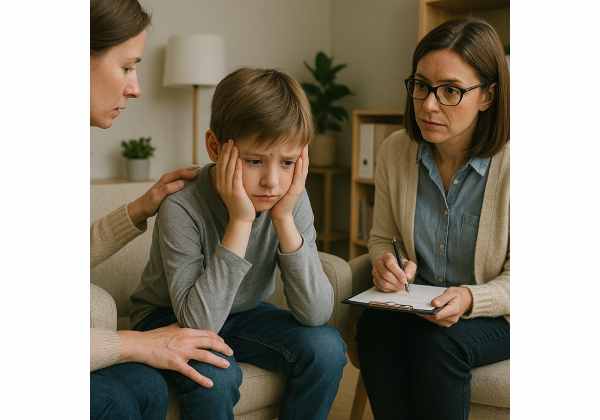
Some children worry more intensely, more often, and about more areas of life than their peers. When this pattern becomes persistent, difficult to control, and disruptive to school, family life, sleep, friendships, or health, it may reflect more than a cautious temperament or a stressful phase.
Overanxious disorder of childhood is an older diagnostic term that described children with excessive, long-lasting worry, reassurance seeking, self-consciousness, tension, and physical complaints. It is no longer used as a separate diagnosis in current DSM classifications, but the pattern it described remains clinically important. Today, many children who once might have been described this way are evaluated for generalized anxiety disorder, social anxiety disorder, separation anxiety disorder, panic symptoms, obsessive-compulsive disorder, trauma-related symptoms, depression, ADHD, autism-related distress, learning problems, or medical contributors.
What matters most is not the label alone, but the child’s overall pattern: what they worry about, how long it has been happening, how much distress it causes, what they avoid, and how much it interferes with ordinary development.
What to recognize early:
- Overanxious disorder of childhood is mainly a historical term; similar symptoms are now usually considered within current childhood anxiety diagnoses.
- The core pattern is excessive, persistent worry across many situations, often with reassurance seeking, perfectionism, tension, irritability, sleep problems, or stomachaches.
- It can be confused with normal childhood worries, ADHD, learning difficulties, OCD, social anxiety, trauma reactions, depression, autism-related distress, or medical problems.
- Professional evaluation matters when worry is persistent, hard to control, out of proportion, or interferes with school, relationships, sleep, eating, health, or family routines.
- Urgent evaluation is important if anxiety appears with suicidal thoughts, self-harm, hallucinations, severe agitation, inability to function, abuse concerns, or sudden neurological symptoms.
Table of Contents
- What Overanxious Disorder Means Today
- Symptoms and Signs in Children
- Normal Worry vs Clinical Anxiety
- Causes and Risk Factors
- Conditions That Can Look Similar
- Diagnostic Context and Evaluation
- Effects and Complications
- When Urgent Evaluation Matters
What Overanxious Disorder Means Today
Overanxious disorder of childhood is best understood as an older diagnostic description for children whose worry was broad, persistent, and impairing. In current DSM-based practice, it is not usually diagnosed as a stand-alone condition; similar symptom patterns are more often evaluated under generalized anxiety disorder or another anxiety-related diagnosis.
Historically, the term described children who seemed worried about many parts of life rather than one specific fear. A child might worry about schoolwork, being late, disappointing parents, family safety, health, world events, mistakes, peer approval, or whether something bad might happen. These worries were not simply occasional concerns. They tended to persist for months, feel hard for the child to control, and show up as emotional distress, physical tension, reassurance seeking, avoidance, or problems with daily functioning.
The shift away from the term does not mean the symptoms are unimportant. It means diagnostic systems changed. Clinicians now try to identify the most accurate current diagnosis by looking at the child’s full symptom pattern. For example:
- Worry about many ordinary events may fit generalized anxiety disorder.
- Fear of being judged, embarrassed, watched, or rejected may fit social anxiety disorder.
- Distress about being away from caregivers may fit separation anxiety disorder.
- Repeated intrusive thoughts and rituals may suggest obsessive-compulsive disorder rather than ordinary worry.
- Anxiety after frightening or overwhelming events may suggest trauma-related symptoms.
- School distress may reflect anxiety, bullying, learning difficulties, ADHD, depression, autism-related overload, or several factors together.
This diagnostic context is important for parents and caregivers because “overanxious” is sometimes used informally to describe a child’s temperament. A cautious, sensitive, or high-achieving child is not automatically disordered. Clinical concern rises when anxiety is persistent, disproportionate to the situation, difficult to soothe, and clearly interfering with the child’s ability to do age-appropriate things.
The term can still be useful as a plain-language clue. It captures a recognizable pattern: a child who seems chronically worried, tense, self-doubting, and dependent on reassurance. But modern evaluation usually goes further than that. It asks what kind of anxiety is present, what else may be contributing, and whether the child’s symptoms meet criteria for a current mental health condition.
Symptoms and Signs in Children
The main sign is persistent, excessive worry that spreads across several areas of a child’s life. Children may not always say “I feel anxious,” so the pattern often appears through behavior, body complaints, sleep disruption, irritability, or repeated requests for reassurance.
Common worry themes
Children with this pattern may worry about ordinary issues in a way that feels unusually intense or repetitive. Common themes include:
- School performance, grades, homework, tests, or making mistakes
- Being late, forgetting something, breaking a rule, or disappointing adults
- Health, illness, injuries, death, or safety of family members
- Social approval, being disliked, being laughed at, or saying something wrong
- Future events, schedules, weather, news, money, or family stress
- Moral concerns, such as whether they did something “bad” or unfair
- Competence, such as “What if I can’t do it?” or “What if I fail?”
Some children ask the same question many times even after receiving a clear answer. Others seem unable to accept reassurance for long. They may need repeated confirmation that homework is correct, parents are safe, plans will not change, or nothing bad will happen. The relief may last only briefly before the worry returns.
Emotional and behavioral signs
A child may seem tense, watchful, perfectionistic, easily upset, or unusually hard on themselves. Some become tearful or clingy. Others look angry, oppositional, or controlling because anxiety is coming out as irritability rather than visible fear.
Signs adults may notice include:
- Avoiding school, activities, sleepovers, parties, sports, or new situations
- Procrastinating because starting feels risky or overwhelming
- Taking excessive time to complete assignments due to checking or fear of mistakes
- Becoming distressed when routines change
- Asking adults to speak, decide, check, or reassure on their behalf
- Meltdowns before transitions, tests, medical visits, separations, or performances
- Difficulty relaxing even during free time
Anxious children can also look highly responsible. They may be described as mature, careful, polite, or “easy” because they work hard to avoid mistakes. This can hide how much distress they are carrying internally.
Physical and sleep-related signs
Anxiety often shows up in the body. Children may report stomachaches, nausea, headaches, chest tightness, muscle tension, shakiness, dizziness, sweating, shortness of breath, fatigue, or a racing heart. These symptoms can be real and uncomfortable even when no dangerous medical condition is found.
Sleep can also be affected. A child may have trouble falling asleep, wake during the night, ask for repeated reassurance at bedtime, fear being alone, or wake tired because their mind stayed active for hours. Over time, poor sleep can worsen irritability, attention, emotional regulation, and school functioning.
Normal Worry vs Clinical Anxiety
The difference between normal worry and clinically significant anxiety is usually found in duration, intensity, control, and impairment. Many children have fears and worries; concern grows when worry is persistent, out of proportion, hard to interrupt, and limits ordinary life.
Children naturally pass through developmental fears. Preschool children may worry about separation, darkness, or imaginary dangers. School-age children may worry about grades, rules, storms, injury, or friendships. Teenagers may worry about identity, relationships, performance, appearance, and the future. These concerns may be uncomfortable without being a disorder.
Clinical anxiety is more likely when the worry does not settle, spreads into many situations, or causes the child to avoid normal activities. The child’s age also matters. A fear that is expected at age 4 may be more concerning if it remains just as intense at age 11 and prevents independence.
| Feature | More typical childhood worry | More concerning anxiety pattern |
|---|---|---|
| Duration | Comes and goes around specific events | Persists for weeks or months and keeps returning |
| Intensity | Feels uncomfortable but manageable | Feels overwhelming, urgent, or hard to soothe |
| Control | Child can shift attention with support | Child feels stuck in repeated worry or reassurance seeking |
| Functioning | Child still attends school, plays, sleeps, and participates | Worry interferes with school, sleep, friendships, meals, activities, or family routines |
| Body symptoms | Mild symptoms around stressful moments | Frequent stomachaches, headaches, tension, nausea, fatigue, or panic-like symptoms |
| Avoidance | Brief hesitation before trying | Avoids or refuses expected activities because anxiety feels too strong |
A key practical question is whether anxiety is narrowing the child’s world. Occasional worry before a test is expected. Repeatedly missing school, spending hours checking assignments, refusing social events, or needing constant reassurance that family members are safe suggests a more impairing pattern.
It is also important not to dismiss quiet suffering. Some children comply outwardly while feeling distressed inside. Others function well at school and then fall apart at home because they have been suppressing anxiety all day. A child’s grades alone do not show whether anxiety is clinically significant.
Causes and Risk Factors
There is rarely one single cause. Persistent childhood anxiety usually develops from a mix of temperament, genetics, brain and stress-system sensitivity, family patterns, life experiences, medical factors, and social environment.
Some children are temperamentally more cautious, sensitive to uncertainty, or reactive to threat. They may notice danger signals quickly, dislike unpredictability, or need more time to adjust to new situations. This temperament is not a flaw. In some settings it can support carefulness and empathy. But when combined with stress, high expectations, repeated uncertainty, or limited coping opportunities, it can increase vulnerability to anxiety.
Family history also matters. Children with close relatives who have anxiety or mood disorders may have a higher risk, partly because of inherited vulnerability and partly because children learn how adults respond to uncertainty, danger, mistakes, and distress. This does not mean parents cause the condition. It means anxiety can run through families through many pathways.
Risk factors can include:
- A personal or family history of anxiety, depression, OCD, panic symptoms, or trauma
- Behavioral inhibition, shyness, high sensitivity, or intense fear of mistakes
- Chronic stress at home, school, or in the community
- Bullying, rejection, discrimination, violence exposure, or unstable relationships
- Adverse childhood experiences, which may be explored through tools such as adverse childhood experiences screening in appropriate clinical settings-experiences-assessed-results/”>adverse childhood experiences screening in appropriate clinical settings
- Learning difficulties, speech and language problems, ADHD, autism, or sensory overload
- Chronic illness, pain, sleep problems, or repeated frightening medical experiences
- Major transitions, such as divorce, bereavement, relocation, school change, or family illness
- Excessive pressure around performance, appearance, behavior, or achievement
Protective factors also matter. Stable relationships, predictable routines, supportive school environments, safe communities, emotional validation, and opportunities for age-appropriate independence can reduce the burden of anxiety even when a child has risk factors.
The causes are not always obvious from the outside. A child may seem anxious “for no reason,” especially if the main driver is temperament, internal worry, or subtle stressors that adults do not immediately see. A careful evaluation looks beyond the surface and considers the child’s development, family context, school experience, health, sleep, and co-occurring symptoms.
Conditions That Can Look Similar
Many conditions can resemble overanxious disorder of childhood because worry, avoidance, irritability, stomachaches, poor concentration, and sleep problems are not specific to one diagnosis. The distinction depends on the child’s main fear, triggers, behaviors, developmental history, and co-occurring symptoms.
Generalized anxiety disorder is often the closest modern match when worry is broad and persistent. The child worries about many everyday events, finds worry hard to control, and may have restlessness, fatigue, concentration problems, irritability, muscle tension, or sleep disturbance.
Social anxiety disorder may be more accurate when the central fear is negative evaluation. A child may avoid speaking in class, eating around others, performances, parties, phone calls, or unfamiliar peers because they fear embarrassment or judgment. Screening may explore these patterns more specifically, as in social anxiety screening.
Separation anxiety disorder is more likely when distress centers on being away from caregivers or home. A child may fear that something terrible will happen to a parent, resist school or sleepovers, or need to sleep near an attachment figure.
ADHD can be mistaken for anxiety, and anxiety can be mistaken for ADHD. A worried child may seem distracted because their mind is occupied by “what if” thoughts. A child with ADHD may become anxious because they repeatedly lose items, forget assignments, receive criticism, or feel unable to keep up. Understanding anxiety and ADHD differences can be important when concentration is a major concern.
OCD can look like anxiety because both involve distressing thoughts. The difference is that OCD usually involves intrusive obsessions and compulsions, such as checking, counting, repeating, confessing, or seeking certainty in ritualized ways. A child who repeatedly asks for reassurance may have generalized worry, OCD, or both, depending on the pattern. Clinicians may compare features of OCD and anxiety when intrusive thoughts or rituals are present.
Trauma-related symptoms may also look like chronic anxiety. A child may be tense, avoidant, irritable, watchful, easily startled, or physically distressed after frightening experiences. When anxiety appears after abuse, violence, accidents, medical trauma, loss, or other overwhelming events, trauma screening and careful history are important.
Depression can bring irritability, fatigue, poor concentration, sleep changes, stomachaches, withdrawal, and school decline. Some children with depression also worry excessively. Others appear anxious because they feel guilty, hopeless, or unable to cope.
Medical conditions can mimic or worsen anxiety-like symptoms. Thyroid problems, asthma, arrhythmias, anemia, medication side effects, substance exposure, sleep disorders, seizures, migraine, gastrointestinal disorders, and chronic pain can all affect mood, energy, breathing, heart sensations, concentration, or sleep. Broader evaluation may consider medical conditions that mimic anxiety and depression when symptoms are sudden, physical, severe, or unusual.
Diagnostic Context and Evaluation
Evaluation focuses on whether the child’s anxiety is persistent, excessive, developmentally unusual, and impairing. Because “overanxious disorder” is not usually a current stand-alone diagnosis, clinicians typically assess the child’s symptoms against modern anxiety and related mental health categories.
A careful assessment usually includes information from more than one source. Children may describe internal worry that adults cannot see, while parents and teachers may notice avoidance, reassurance seeking, perfectionism, stomachaches, irritability, school refusal, or changes in functioning. In younger children, direct observation and parent report may carry more weight. In adolescents, private time with the clinician can help reveal worries, stressors, substance use, trauma exposure, depression, self-harm thoughts, or safety concerns.
An anxiety-focused evaluation may consider:
- What the child worries about most
- How long the worry has been present
- Whether the worry occurs more days than not
- Whether the child can control or interrupt the worry
- Physical symptoms, sleep problems, fatigue, irritability, or concentration changes
- Avoided places, tasks, people, activities, or situations
- School attendance, grades, peer relationships, family routines, and independence
- Family history of anxiety, depression, OCD, ADHD, autism, substance use, or trauma
- Medical history, medications, sleep, pain, appetite, and developmental history
- Safety concerns, including self-harm thoughts, suicidal thoughts, abuse, or severe functional decline
Screening tools may be used to organize information, but they do not diagnose a child by themselves. A high score can signal that further assessment is needed; a low score does not always rule out anxiety if the child is minimizing symptoms or if the tool does not capture the main problem. This is why the difference between screening and diagnosis in mental health matters.
Common anxiety screening approaches may include parent-report and child-report questionnaires, broad mental health screens, school input, and structured clinical interviews. Tools discussed in anxiety screening can help identify patterns, but the final interpretation depends on clinical context.
A clinician may also look for impairment, not just symptoms. A child who worries but still sleeps, attends school, enjoys activities, maintains friendships, and recovers from stress may not meet the threshold for a disorder. A child with fewer visible symptoms but major avoidance, distress, or family disruption may need more serious attention.
The evaluation should also be developmentally sensitive. A 6-year-old may express anxiety through clinging, stomachaches, tantrums, or refusing school. A 13-year-old may describe racing thoughts, perfectionism, fear of judgment, panic-like sensations, or exhaustion from masking distress. The same underlying anxiety pattern can look different across age, language ability, temperament, culture, and family expectations.
Effects and Complications
Persistent childhood anxiety can affect far more than mood. When worry becomes a daily organizing force, it can shape learning, sleep, family routines, friendships, independence, physical comfort, and a child’s developing sense of competence.
School is often one of the first places where complications appear. An anxious child may take longer to start or finish work, avoid asking questions, panic before tests, miss school because of stomachaches, or refuse assignments that might expose mistakes. Some children overprepare and achieve high grades, but at the cost of sleep, distress, and exhaustion. Others underperform because anxiety interferes with attention, working memory, and confidence.
Social development can also narrow. A child may decline invitations, avoid sports or clubs, stay close to adults, struggle with group work, or fear ordinary peer conflict. Over time, avoidance can reduce practice with social problem-solving and independence. The child may feel lonely even if they want connection.
Family life may become organized around reassurance and avoidance. Parents may answer repeated questions, check homework many times, change plans to prevent distress, speak for the child, or remove anxiety triggers. These patterns are understandable, especially when a child is suffering, but they can gradually make anxiety more central to household routines.
Physical complications may include poor sleep, fatigue, muscle tension, headaches, nausea, appetite changes, abdominal pain, and frequent visits for unexplained symptoms. These symptoms should not be dismissed as “just anxiety.” They are real experiences and sometimes need medical evaluation, especially if they are new, severe, progressive, or accompanied by red flags.
Emotional complications can include low self-esteem, irritability, shame, perfectionism, hopelessness, depression, or anger at being unable to stop worrying. Some children begin to see themselves as weak, difficult, or broken. Others become so used to anxiety that they do not realize how much it limits them.
Possible longer-term concerns include:
- Ongoing anxiety into adolescence or adulthood
- Development of another anxiety disorder
- Depressive symptoms, especially if the child feels trapped or isolated
- School avoidance or academic decline
- Social withdrawal and reduced independence
- Increased family stress
- Greater risk of unhealthy coping behaviors in adolescence
- More frequent physical complaints and health-related worry
These complications are not inevitable. They are reasons to take persistent anxiety seriously, especially when symptoms are affecting multiple areas of life.
When Urgent Evaluation Matters
Most childhood anxiety concerns can be assessed in a routine professional setting, but some symptoms require urgent attention. Immediate evaluation matters when anxiety appears alongside safety risks, severe functional collapse, possible abuse, psychosis, or sudden medical or neurological symptoms.
Seek urgent help if a child or adolescent has:
- Suicidal thoughts, self-harm, or talk of wanting to die
- Threats to harm others or behavior that feels unsafe
- Hallucinations, delusions, extreme confusion, or severe disorganized behavior
- Sudden inability to speak, walk, stay awake, recognize people, or function normally
- Severe agitation, panic, or distress that cannot be calmed and feels unsafe
- Refusal or inability to eat or drink enough to stay medically safe
- Anxiety related to possible abuse, violence, coercion, or exploitation
- Chest pain, fainting, severe breathing difficulty, seizure-like symptoms, or sudden neurological changes
- Rapid worsening after medication changes, substance use, intoxication, or withdrawal
- School refusal or withdrawal so severe that the child cannot participate in basic daily life
For severe or uncertain situations, guidance such as when to go to the ER for mental health or neurological symptoms may help families think through urgency. When in doubt, it is safer to involve a qualified professional, emergency service, crisis line, pediatrician, or local urgent care pathway.
Urgent evaluation is not about labeling a child as dangerous or permanently ill. It is about protecting safety, identifying serious causes, and making sure the child is assessed at the right level of care. Anxiety can be distressing on its own, but the presence of self-harm thoughts, psychotic symptoms, severe impairment, abuse concerns, or acute physical symptoms changes the risk picture.
References
- Generalized Anxiety Disorder in Children and Adolescents 2001 (Review)
- Anxiety in children and youth: Part 1 – Diagnosis 2022 (Position Statement)
- Anxiety disorders in children and adolescents: A summary and overview of the literature 2023 (Review)
- Anxiety in Children and Adolescents: Screening 2022 (Recommendation Statement)
- Screening for Anxiety in Children and Adolescents: Evidence Report and Systematic Review for the US Preventive Services Task Force 2022 (Systematic Review)
Disclaimer
This article is for general educational purposes only and is not a substitute for professional medical advice, diagnosis, or treatment. A child with persistent anxiety, major impairment, self-harm thoughts, sudden physical symptoms, or safety concerns should be evaluated by a qualified health professional.
Thank you for taking the time to read this resource; sharing it may help another parent, caregiver, or educator recognize when a child’s worry deserves careful attention.





