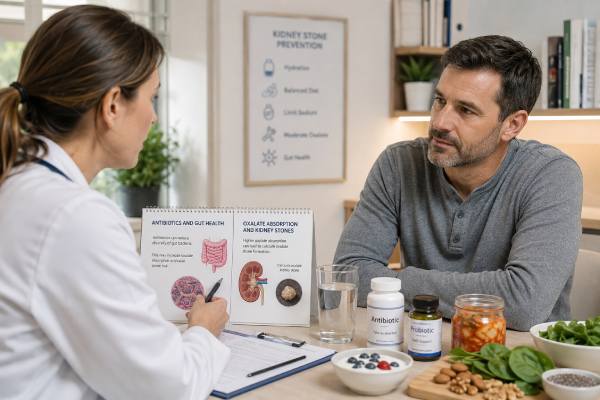
Antibiotics treat bacterial infections, but they also disturb the gut bacteria that help process food byproducts. One of those byproducts is oxalate, a natural compound found in foods such as spinach, almonds, beets, rhubarb, cocoa, and many teas. When too much oxalate reaches the urine, it binds with calcium and forms calcium oxalate crystals, the starting point for the most common type of kidney stone.
The link is not as simple as “antibiotics cause kidney stones.” The real issue is that antibiotics change the gut environment. In some people, that change reduces oxalate-degrading bacteria, increases oxalate absorption, and shifts the urine toward stone formation. This matters most for people who already form calcium oxalate stones, have high urine oxalate, take frequent antibiotics, have chronic diarrhea, or have had bowel surgery.
Understanding the gut-oxalate connection gives you practical levers: use antibiotics only when they are truly needed, pair oxalate-rich foods with calcium, keep urine diluted, avoid unnecessary low-calcium dieting, and get proper urine testing after a stone.
Table of Contents
- How Oxalate Becomes a Kidney Stone
- Why the Gut Microbiome Matters
- How Antibiotics Change Stone Risk
- Who Should Be Extra Careful
- What to Do After Antibiotics
- Diet Steps That Lower Oxalate Absorption
- Probiotics and Oxalobacter Claims
- When to Test and When to Get Help
How Oxalate Becomes a Kidney Stone
Oxalate becomes a kidney stone problem when too much of it ends up in the urine at the same time as calcium. Calcium and oxalate naturally attract each other. When urine is concentrated, they join more easily, form tiny crystals, and grow into stones when the urine lacks enough protective factors such as citrate and adequate volume.
Calcium oxalate stones are common because both calcium and oxalate are normal parts of body chemistry. Oxalate comes from two main places. Some comes from food. Some is made inside the body as a waste product of normal metabolism. You cannot remove oxalate completely, and trying to do so usually leads to an unbalanced diet. The useful goal is to keep urine oxalate low enough, urine volume high enough, and calcium handling stable enough that crystals do not grow.
The gut plays a large role because food oxalate must pass through the digestive tract before it reaches the bloodstream and urine. When oxalate stays bound inside the intestines, it leaves in stool. When it stays free, more of it gets absorbed into the blood, filtered by the kidneys, and concentrated in urine.
A common mistake is cutting calcium too aggressively. Low-calcium eating leaves more oxalate unbound in the gut, which raises absorption. This is why many stone prevention plans include normal dietary calcium with meals rather than calcium avoidance. A person who eats spinach with no calcium source absorbs more oxalate than a person who eats a smaller spinach portion with yogurt, milk, calcium-set tofu, or another calcium-containing food.
For a fuller background on stone type, diet, and prevention, see calcium oxalate stone prevention. The key point here is simple: the gut decides how much dietary oxalate gets a chance to reach the kidneys.
Why the Gut Microbiome Matters
The gut microbiome is the community of bacteria, fungi, and other microbes living in the intestines. It helps break down parts of food that human enzymes do not fully digest. It also affects bile acids, gut lining health, stool pattern, immune signaling, and the chemical environment inside the colon.
For oxalate, the best-known bacterium is Oxalobacter formigenes. It uses oxalate as a fuel source. When it is present and active, it helps break down oxalate in the gut. Some other bacteria, including certain Lactobacillus and Bifidobacterium strains, also show oxalate-degrading ability in laboratory or small human studies, but their effects are less consistent.
Oxalobacter gets attention because it is highly specialized. It is not just “a good gut bug.” It is an oxalate-using organism. People who carry it often have different oxalate handling than people who do not. But the story is not only about one microbe. Stone formers often show broader differences in gut microbial diversity, metabolic pathways, and inflammatory signals. That means a person without Oxalobacter is not automatically destined to form stones, and a person with it is not fully protected.
The gut decides whether oxalate stays trapped or gets absorbed
Inside the intestines, oxalate has two main paths. It binds to minerals and leaves in stool, or it stays soluble and gets absorbed. Calcium is the most important mineral in this process. When calcium is present in the same meal as oxalate, the two bind in the gut before oxalate reaches the bloodstream.
Fat digestion also matters. In people with fat malabsorption, unabsorbed fat binds calcium. That leaves less calcium available to bind oxalate. More free oxalate then crosses the gut lining. This is why high urine oxalate is common after some bariatric surgeries, in inflammatory bowel disease with chronic diarrhea, and in other bowel conditions that interfere with normal fat absorption.
Loose stools speed up transit and change the gut environment. Recurrent diarrhea also lowers fluid status, which concentrates the urine. That creates a double hit: more oxalate absorption and less urine dilution.
Stone risk rises when several small shifts happen together
A kidney stone usually forms because several risks line up. A high-oxalate smoothie, a few days of low fluid intake, salty meals, low dietary calcium, and recent antibiotic use each add pressure. Alone, one factor might not create a stone. Together, they push urine chemistry toward crystallization.
This is why practical prevention beats extreme restriction. You do not need a sterile, perfect diet. You need steady habits that keep oxalate absorption and urine concentration under control most days.
How Antibiotics Change Stone Risk
Antibiotics do not only target the infection being treated. They also expose gut bacteria to a drug that changes which organisms survive, recover, or disappear. After a course of antibiotics, the gut microbiome often rebuilds, but it does not always return to the exact same pattern. Some bacteria recover quickly. Others take longer. Some remain reduced, especially after repeated courses.
This matters for stone risk because oxalate-degrading bacteria are part of a living ecosystem. Antibiotics reduce certain organisms directly and disturb the surrounding community that helps them thrive. If the gut loses microbes that break down oxalate or support normal oxalate transport, more oxalate is available for absorption.
Large observational research has linked several oral antibiotic classes with later kidney stone diagnosis, especially when exposure was recent and when antibiotics were used at younger ages. The classes most often discussed include sulfonamides, cephalosporins, fluoroquinolones, nitrofurantoin or methenamine combinations in older datasets, and broad-spectrum penicillins. Observational studies cannot prove that the antibiotic itself caused every stone. People who receive antibiotics also have infections and medical conditions that affect risk. Still, the pattern is strong enough to support careful antibiotic use.
Recent and repeated exposure deserves attention
The timing makes biological sense. Stones grow over weeks to months. A course of antibiotics that changes the gut environment in the months before a stone attack fits that timeline. The concern is stronger for people who receive repeated antibiotic courses for sinus infections, urinary symptoms, acne, dental problems, respiratory infections, or recurrent UTIs.
This does not mean you should refuse antibiotics when they are needed. Untreated bacterial infections cause real harm. A kidney infection, pneumonia, strep throat, certain skin infections, and some UTIs need appropriate treatment. The smarter approach is to avoid unnecessary antibiotics, not to avoid necessary care.
Good antibiotic stewardship means asking clear questions:
- Is this definitely bacterial, or is it likely viral?
- Is a test needed before treatment, such as a urine culture or throat swab?
- Is this the narrowest antibiotic that works for this infection?
- How long should I take it?
- What symptoms mean I should call back instead of starting another course?
People with recurrent urinary symptoms should be especially careful. Burning, urgency, pelvic discomfort, and cloudy urine are not always bacterial infection. Treating noninfectious bladder irritation with repeated antibiotics adds gut disruption without solving the real problem. If urinary symptoms keep returning after treatment, UTI symptoms after antibiotics need a more careful look at culture results, resistance, reinfection, and non-UTI causes.
Oxalobacter is part of the story, not the whole story
It is tempting to reduce the whole topic to one sentence: antibiotics kill Oxalobacter, and that raises stones. That is too narrow. Some antibiotics linked with stone risk do not clearly target Oxalobacter in the same way. This suggests other gut bacteria and metabolic functions also matter.
The gut community affects oxalate degradation, gut barrier function, bile acid handling, inflammation, and possibly how oxalate moves across the intestinal wall. A disrupted microbiome creates several possible routes toward higher urinary oxalate. Oxalobacter remains important, but it is not the only switch.
Who Should Be Extra Careful
The antibiotic-oxalate link matters most when a person already has other reasons to absorb or excrete more oxalate. A single antibiotic course in an otherwise low-risk person usually does not call for panic. The risk becomes more relevant when antibiotics stack on top of stone history, gut disease, dehydration, high oxalate intake, or abnormal urine chemistry.
People with recurrent calcium oxalate stones should treat antibiotic exposure as one piece of their prevention plan. That means tracking antibiotic courses, noting timing before stone episodes, and reviewing urine oxalate on a 24-hour urine test. The pattern is more useful than memory. “I had three antibiotic courses in the past year” gives a clinician more to work with than “I get antibiotics sometimes.”
People with bowel conditions need extra attention because their baseline oxalate absorption is often higher. Crohn’s disease, ulcerative colitis with diarrhea, celiac disease that is not well controlled, chronic pancreatitis, bile acid diarrhea, short bowel syndrome, and Roux-en-Y gastric bypass all raise concern. In these situations, oxalate absorption rises because calcium binding, fat absorption, stool pattern, and gut lining function are altered.
Children and teenagers with stones also deserve careful evaluation. Kidney stones in younger people are less likely to be random. Family history, diet, hydration, metabolic causes, bowel issues, and antibiotic exposure all deserve review. Prevention matters because a first stone at a young age leaves more years for recurrence.
Higher-risk situations to flag
| Situation | Why it matters | Practical next step |
|---|---|---|
| Recurrent calcium oxalate stones | Urine chemistry is already prone to crystal formation. | Ask about a 24-hour urine test and stone analysis. |
| Frequent antibiotic courses | Repeated microbiome disruption gives less time for recovery. | Review whether each infection needs testing or narrower treatment. |
| Chronic diarrhea or fat malabsorption | More free oxalate gets absorbed from the gut. | Discuss enteric hyperoxaluria with a clinician or dietitian. |
| Bariatric surgery, especially Roux-en-Y gastric bypass | Oxalate absorption often rises after altered fat handling. | Use meal-based calcium and urine monitoring. |
| Low-calcium dieting | Less calcium is available to bind oxalate in meals. | Restore appropriate dietary calcium unless told otherwise. |
This does not mean every high-risk person needs the same diet or medication. It means prevention should be guided by measured urine results instead of guesswork.
What to Do After Antibiotics
After a necessary antibiotic course, focus on the stone risks you can control immediately: urine concentration, meal composition, sodium intake, bowel regularity, and follow-up testing if you are a recurrent stone former. You do not need a harsh detox, supplement stack, or extreme low-oxalate cleanse.
The first step is hydration. Stones form more easily in concentrated urine. Aim for pale-yellow urine through most of the day unless your clinician has given you a fluid limit for heart, kidney, or liver disease. People with a stone history are often advised to produce high urine volume, not merely drink a certain number of glasses. Hot weather, exercise, fever, diarrhea, and travel increase fluid needs.
The second step is normal eating with calcium included at meals. If you eat oxalate-rich foods, pair them with calcium-containing foods rather than eating them alone. Calcium works best for oxalate binding when it is in the gut at the same time as oxalate. Taking calcium at bedtime does not bind the spinach salad you ate at lunch.
The third step is sodium reduction. High sodium intake increases calcium loss into urine. More urine calcium means more material available to bind with oxalate. Restaurant meals, deli meats, canned soups, frozen dinners, salty snacks, fast food, and many sauces create far more sodium exposure than a home salt shaker alone.
For a broader prevention plan, kidney stone prevention steps usually combine fluid, sodium control, appropriate calcium, citrate support, and targeted treatment based on urine results.
A practical 2-week reset after antibiotics
Use this as a simple routine after finishing antibiotics, especially if you form calcium oxalate stones:
- Spread fluids across the day instead of drinking most of them at night.
- Include calcium with meals that contain nuts, spinach, beets, chocolate, soy, or high-oxalate grains.
- Keep salty packaged meals and restaurant food limited while your routine gets back to normal.
- Restart your usual fiber pattern with foods such as oats, beans in tolerated portions, fruit, vegetables, and whole grains.
- Call your clinician if diarrhea persists, because ongoing diarrhea raises both dehydration and oxalate absorption risk.
Do not start leftover antibiotics, borrow antibiotics, or stop a prescribed course early without medical advice. Both habits create problems: undertreated infection on one side and unnecessary microbiome disruption on the other.
Diet Steps That Lower Oxalate Absorption
The best oxalate strategy is targeted, not extreme. Many people hear “oxalate” and remove long lists of healthy foods. That approach often backfires. It lowers diet quality, reduces calcium intake, and makes meals harder to sustain. A better plan focuses on the highest-oxalate foods, meal pairing, portions, and urine testing.
Spinach is the classic example. It is far higher in oxalate than many other leafy greens. A daily spinach smoothie with almond milk, almond butter, cocoa, and no calcium-rich food creates a concentrated oxalate load. Swapping spinach for kale or romaine, using dairy milk or calcium-fortified milk, reducing almond-heavy ingredients, and drinking enough fluid changes the risk without making the diet feel medicalized.
Nuts are another common issue. Almonds, cashews, and peanuts add oxalate, and portions often creep up. A small handful is different from eating almond flour crackers, almond butter, almond milk, and almond-based snacks throughout the day. The cumulative pattern matters more than one serving.
Use calcium with meals, not calcium avoidance
Most calcium oxalate stone formers should not default to a low-calcium diet. Food calcium helps trap oxalate in the gut. Good options include milk, yogurt, kefir, calcium-fortified plant milks, calcium-set tofu, and some cheeses. People who avoid dairy should check labels because not all plant milks are calcium fortified.
Calcium supplements are more individualized. Some people need them, especially after bariatric surgery or with low dietary intake, but timing matters. Calcium taken with meals has a different purpose than calcium taken away from food. Supplements also need review if you have kidney disease, high blood calcium, certain endocrine problems, or a history of calcium phosphate stones.
For a deeper meal-timing explanation, see calcium with meals for oxalates.
Keep high-oxalate foods in perspective
A low-oxalate diet is not a universal kidney stone diet. It is most useful when urine testing shows high oxalate or when a person has enteric hyperoxaluria from bowel disease, bariatric surgery, or chronic malabsorption. For other stone formers, sodium, low urine volume, low citrate, high animal protein intake, or high urine calcium might be the bigger driver.
Use this practical hierarchy:
- First, drink enough fluid to keep urine diluted.
- Second, keep calcium intake appropriate and timed with meals.
- Third, reduce the biggest oxalate loads rather than chasing tiny amounts in every food.
- Fourth, lower sodium because it raises urine calcium.
- Fifth, use 24-hour urine results to decide whether stricter oxalate control is needed.
People who truly need oxalate restriction should focus on high-impact swaps. Choose kale, arugula, romaine, cabbage, or bok choy instead of spinach. Choose pumpkin seeds or sunflower seeds in modest portions instead of large almond servings. Keep chocolate and cocoa as occasional foods rather than daily staples. Use tea portions wisely, especially strong black tea. A structured low-oxalate diet works best when it is personalized instead of copied from a long internet list.
Probiotics and Oxalobacter Claims
Probiotics are appealing because the problem involves gut bacteria. The logic sounds clean: replace the missing oxalate-degrading bacteria and lower stone risk. The current evidence is not that simple.
Generic probiotic products are not proven stone-prevention treatments. Most store-bought probiotics contain Lactobacillus, Bifidobacterium, Saccharomyces, or mixed blends chosen for digestive or general wellness claims, not for reliable oxalate lowering. Even when a strain breaks down oxalate in a lab, it still has to survive stomach acid, colonize or stay active in the gut, compete with existing microbes, and produce a measurable drop in urine oxalate. Many products do not meet that bar.
Oxalobacter formigenes is more directly relevant, but it is not a standard over-the-counter probiotic. It is oxygen-sensitive, difficult to formulate, and vulnerable to disruption. Research using live Oxalobacter preparations is promising in specific settings, but it has not turned into a routine, widely available, guideline-standard prevention tool for everyday stone formers.
This is why probiotic marketing needs skepticism. A label that says “supports urinary health” or “contains oxalate-degrading strains” does not prove that the product prevents stones. The outcome that matters is not whether bacteria appear in stool for a short time. The outcome is lower urine oxalate, fewer crystals, and fewer stone events over meaningful follow-up.
That does not mean gut care is useless. It means the most reliable gut-focused steps are still food and medical basics: avoid unnecessary antibiotics, treat chronic diarrhea, eat enough calcium with meals, maintain fiber if tolerated, and correct malabsorption problems. Fermented foods such as yogurt or kefir fit well for some people because they provide calcium and live cultures, but their stone benefit comes more reliably from meal composition than from a guaranteed oxalate-probiotic effect.
For a closer look at supplement claims, probiotics for oxalate stones explains why the evidence is interesting but not ready for broad promises.
When to Test and When to Get Help
Guessing is a poor strategy after a kidney stone. Two people with calcium oxalate stones can have different urine problems. One has high oxalate. Another has low citrate. Another has high urine calcium from sodium intake or another medical driver. Another simply makes too little urine during work shifts. The prevention plan should match the pattern.
A stone analysis is the first useful test when a stone is captured or removed. It confirms whether the stone is calcium oxalate, calcium phosphate, uric acid, struvite, cystine, or mixed. Do not assume every stone is oxalate based on symptoms. Different stones need different prevention.
A 24-hour urine test is the main tool for understanding stone chemistry. It usually measures urine volume, calcium, oxalate, citrate, uric acid, sodium, pH, and other factors. For this article’s topic, urine oxalate is especially important. If it is high, the next question is why: high-oxalate diet, low calcium intake, bowel disease, bariatric surgery, high vitamin C intake, genetic causes, or a combination.
People with recurrent stones, a first stone at a young age, one kidney, chronic kidney disease, bowel disease, bariatric surgery, frequent UTIs, or repeated antibiotic exposure should ask about testing rather than relying on general advice. Testing also helps prevent overcorrection. A person with low urine citrate needs a different emphasis than a person with high urine oxalate and chronic diarrhea.
See 24-hour urine testing for kidney stones for what the test measures and how to prepare.
Call promptly for red flags
Stone prevention is not the priority during a possible emergency. Seek urgent care for fever with flank pain, chills, vomiting that prevents fluids, severe uncontrolled pain, pregnancy with suspected stone symptoms, a known single kidney, inability to urinate, or signs of kidney infection. A blocked infected kidney is dangerous and needs fast treatment.
Also contact a clinician if diarrhea continues after antibiotics, especially if it is watery, frequent, bloody, or paired with fever or worsening abdominal pain. Persistent diarrhea increases dehydration and oxalate absorption, and some antibiotic-associated infections need specific treatment.
For nonurgent prevention, bring a concise timeline to your appointment: stone dates, antibiotic courses, bowel symptoms, typical high-oxalate foods, supplements, vitamin C dose, calcium intake, and fluid routine. That information helps connect gut events with urine chemistry and stone timing.
References
- Oral Antibiotic Exposure and Kidney Stone Disease 2018 (Observational Study)
- Effect of antibiotic treatment on Oxalobacter formigenes colonization of the gut microbiome and urinary oxalate excretion 2021 (Clinical Study)
- Gut microbiota in patients with kidney stones: a systematic review and meta-analysis 2023 (Systematic Review and Meta-analysis)
- Kidney Stone Pathophysiology, Evaluation and Management: Core Curriculum 2023 2023 (Review)
- Mechanism of Nephrolithiasis: Does the Microbiome Play a Role? 2024 (Review)
- Inducing Oxalobacter formigenes Colonization Reduces Urinary Oxalate Excretion in Healthy Adults 2025 (Clinical Study)
Disclaimer
This article is for education about oxalate, gut health, antibiotics, and kidney stone prevention. It does not diagnose the cause of a stone or replace care from a clinician, urologist, nephrologist, or registered dietitian. Do not stop, skip, or change prescribed antibiotics without medical advice, and seek urgent care for fever, severe flank pain, vomiting, pregnancy with stone symptoms, or trouble urinating.