
Fringetree: Prebiotic-like Bitter for Bile Flow, How to Use It, Dosage, and Side Effects
Fringetree (Chionanthus virginicus), also called white fringetree, is a North American shrub whose root and bark have a long record in folk and eclectic...
Fructans: Prebiotic Benefits, Food Sources, Dosage, and Safety Explained
Fructans—best known as inulin and fructo-oligosaccharides (FOS)—are fermentable fibers found in plants like chicory root, onions, garlic, leeks, asparagus, wheat, and Jerusalem artichoke. They...
Fructobacillus spp.: What It Is, Potential Benefits, and Risks
Fructobacillus are a small, unusual group of lactic acid bacteria adapted to fructose-rich places like flowers, fruits, honey, and the guts of nectar-feeding insects....
Fructo-oligosaccharides Guide: Benefits, How They Work, Dosage, and Safety
Fructo-oligosaccharides (FOS) are short chains of fructose found naturally in onions, garlic, chicory root, and other plants, and widely added to foods as a...
Fructose: What It Is, How It Works, Best Intake Levels, and Health Effects
Fructose is a simple sugar that occurs naturally in fruit, honey, and some vegetables, and also appears in many packaged foods as part of...
Fuchsia: Properties, Uses, Dosage, and Side Effects

Fuchsia is best known as a showy ornamental, but its flowers and purple berries are edible and have a long—if quiet—history in kitchens and...
Fucoidan: What It Is, How It Works, and Who Should Avoid It
Fucoidan is a sulfated polysaccharide concentrated in brown seaweeds like Undaria pinnatifida (wakame) and Fucus vesiculosus. It has drawn attention for immune support, gut...
Fucoxanthin: Evidence, Dosage, and Safety
Fucoxanthin is a marine carotenoid concentrated in brown seaweeds and certain microalgae. Over the last decade, it has drawn attention for potential benefits in...
Fucus vesiculosus extract : Benefits, Properties, Uses, Dosage, and Side Effects Explained
Fucus vesiculosus—often called bladderwrack—is a brown seaweed traditionally used for thyroid and digestive support and now widely sold as standardized extracts. Modern research focuses...
Fulvic Acid: Proven Benefits, How to Use, Dosage, and Side Effects
Fulvic acid is a naturally occurring compound formed as plants and microbes break down organic matter in soil and sediment. In supplements, it most...
Fumarate : Benefits, Properties, Uses, Dosage, and Side Effects Explained
Fumarate shows up in health research, food labels, and prescription medicines—but it does not always mean the same thing. In biochemistry, fumarate is a...
Fumaria officinalis Benefits for Digestion and Skin: Doses and Risks
Fumaria officinalis—often called common fumitory or “earth smoke”—is a small European herb traditionally taken before meals to ease feelings of fullness, slow digestion, and...
Fumaric Acid: What It Is, Real Benefits, Dosage, and Safety
Fumaric acid is a naturally occurring organic acid that your body already makes as part of the Krebs (citric acid) cycle. In foods, it...
Fumitory Extract: Traditional Uses, Evidence, Dosage, and Risks
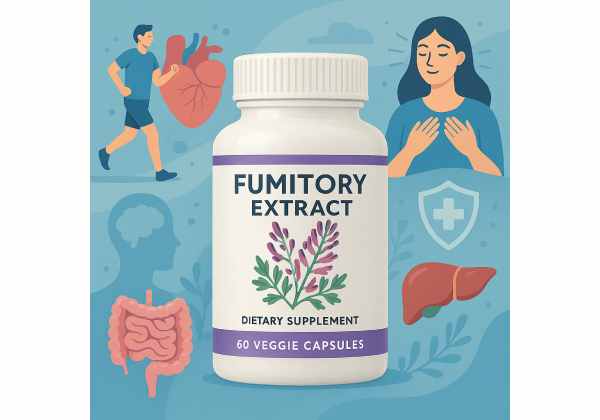
Fumitory extract comes from the aerial parts of Fumaria officinalis, a small European herb long used for digestive discomfort, a sense of fullness after...
Fungal acid protease: Benefits and real-world uses with dosing and safety
Fungal acid protease is a protein-digesting enzyme typically produced by safe, well-characterized strains of fungi such as Aspergillus niger and Aspergillus oryzae. In supplements,...
Fungal amylase: How It Works, Real Benefits, and Safe Dosage
Fungal amylase is a starch-digesting enzyme produced by safe, food-grade fungi—most commonly Aspergillus oryzae or Aspergillus niger. In foods, it helps bakers, brewers, and...