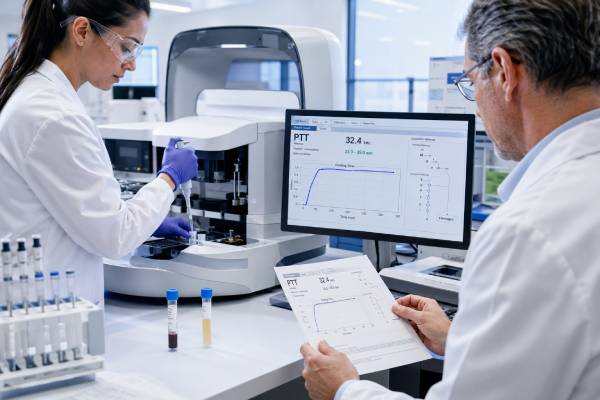
Partial thromboplastin time, usually called PTT, is a blood test that measures how many seconds your blood plasma takes to form a clot after specific clotting reagents are added. In everyday lab reports, PTT and activated partial thromboplastin time, or aPTT, are often used almost interchangeably because most modern testing uses an activator. The test mainly checks the intrinsic and common clotting pathways, which include clotting factors VIII, IX, XI, XII, X, V, II, and fibrinogen.
A normal PTT result usually means these clotting steps are working well enough to form a clot in the expected time. A high PTT means clotting is slower than expected and often needs follow-up, especially if there is bleeding, heparin treatment, an upcoming procedure, or another abnormal clotting test. A low PTT is less common and usually receives attention when there are clotting-risk concerns or signs of inflammation.
- Typical PTT normal range: about 25–35 seconds, but the correct range is the reference interval printed on your own lab report.
- High PTT: blood takes longer than expected to clot and is linked with heparin, factor deficiencies, inhibitors, lupus anticoagulant, liver disease, severe vitamin K deficiency, or DIC.
- Low PTT: blood clots faster than expected and is less commonly used for diagnosis; it sometimes appears with inflammation, high factor VIII, early DIC, pregnancy, or specimen issues.
- PTT and PT are different: PTT checks the intrinsic and common pathways, while PT/INR checks the extrinsic and common pathways.
- Heparin monitoring changes the target: people on unfractionated heparin often have a deliberately prolonged PTT, with a therapeutic range set by the treating facility.
- Urgent follow-up matters: abnormal PTT with heavy bleeding, black stools, severe headache, chest pain, shortness of breath, leg swelling, or planned surgery needs prompt medical guidance.
Table of Contents
- What PTT Measures
- PTT Normal Range
- What a Normal PTT Result Means
- High PTT Meaning and Common Causes
- Low PTT Meaning and Common Causes
- How PTT Is Interpreted With PT, INR, Platelets, and Fibrinogen
- PTT, Heparin, and Medication Effects
- Sample Quality, Preparation, and Follow-Up
What PTT Measures
PTT measures clotting speed in the liquid part of blood, not platelet count and not bleeding time from a cut. The laboratory separates plasma from a blood sample and adds substances that trigger part of the clotting system. The result is reported as seconds until clot formation.
The test focuses on two connected parts of the clotting cascade:
- Intrinsic pathway: factors XII, XI, IX, and VIII
- Common pathway: factors X, V, II, and fibrinogen
These clotting factors are proteins that work in sequence. If one factor is missing, low, blocked by an inhibitor, or affected by medication, clot formation in the test tube takes longer.
PTT is commonly ordered to evaluate unexplained bleeding, easy bruising, suspected clotting factor problems, lupus anticoagulant patterns, severe liver disease, disseminated intravascular coagulation (DIC), and unfractionated heparin treatment. It is also part of many broader clotting evaluations, especially when a clinician orders a coagulation panel.
PTT does not measure every part of hemostasis. Hemostasis is the full process that stops bleeding, including blood vessel narrowing, platelet plug formation, clotting factor activation, and clot stabilization. A person can have a normal PTT and still have a platelet disorder, mild von Willebrand disease, factor XIII deficiency, a blood vessel problem, or a bleeding tendency from medication.
PTT vs aPTT
PTT traditionally refers to partial thromboplastin time. aPTT means activated partial thromboplastin time. In modern practice, many laboratories perform the activated version because it gives more consistent and faster clotting times. Many clinicians still say “PTT” when they mean “aPTT.”
The distinction matters most when comparing results from different laboratories, older records, or research papers. For practical interpretation, use the exact test name and reference interval on the report. If the report says aPTT, do not compare it directly with an older PTT result unless the laboratory method and reference range match.
PTT Normal Range
A typical adult PTT normal range is about 25–35 seconds. Some laboratories use ranges closer to 25–40 seconds or 30–40 seconds, depending on the analyzer, reagent, activator, patient population, and how the laboratory established its reference interval.
The most important rule is simple: your lab’s reference range is the range that applies to your result. A result of 36 seconds is slightly high in a lab with an upper limit of 35 seconds, but normal in a lab with an upper limit of 40 seconds.
| PTT result pattern | Typical interpretation | Common next consideration |
|---|---|---|
| Within the lab range | Clotting through the tested pathways is generally adequate | Interpret with symptoms, PT/INR, platelet count, and medication history |
| Mildly prolonged | Clotting is slightly slower than expected | Repeat test, medication review, sample-quality check, mixing study, or factor testing if clinically relevant |
| Clearly prolonged | Higher chance of heparin effect, factor deficiency, inhibitor, lupus anticoagulant, liver disease, DIC, or anticoagulant interference | Prompt clinical review, especially before procedures or with bleeding |
| Shortened | Clotting occurs faster than expected in the test tube | Often less specific; consider inflammation, high factor VIII, early DIC, pregnancy, or specimen issues |
Why the range differs between labs
PTT is sensitive to the testing system. Reagents differ in phospholipid content, activator type, and sensitivity to factor deficiencies, lupus anticoagulant, heparin, and direct oral anticoagulants. Instruments also detect clot formation differently.
This is why a PTT result should not be judged only against an internet range. The same blood sample can produce different seconds on different systems. Laboratories reduce this problem by establishing local reference intervals and by validating their methods.
Adult, child, and pregnancy ranges
Adults usually use the reference interval printed by the testing laboratory. Children and newborns often need age-specific interpretation because the clotting system changes during development. Pregnancy also changes clotting biology, often making the blood more prone to clotting as part of normal preparation for delivery.
A mildly different PTT during pregnancy, infancy, or acute illness needs context. The same number has different meaning in a healthy outpatient, a hospitalized person on anticoagulants, a newborn, and a pregnant person being evaluated for complications.
What a Normal PTT Result Means
A normal PTT usually means the tested clotting factors are present and functioning well enough for the plasma to clot within the expected time. It is reassuring when there is no bleeding history, no anticoagulant exposure, and other clotting tests are also normal.
A normal result does not rule out every bleeding disorder. PTT becomes abnormal only when the test system is sensitive enough to detect the problem and the factor level has dropped enough to slow clotting. Mild factor deficiencies, mild forms of von Willebrand disease testing, platelet function problems, factor XIII deficiency, and medication-related platelet effects can still exist with a normal PTT.
A normal PTT also does not prove that a person has no clot risk. Many clotting-risk conditions involve platelets, inflammation, blood vessel injury, inherited thrombophilias, cancer, immobility, estrogen therapy, pregnancy, or prior clot history. PTT is one tool, not a full clot-risk screen.
Normal PTT with bleeding symptoms
When bleeding symptoms exist despite a normal PTT, clinicians often look beyond the intrinsic clotting pathway. Important clues include:
- Frequent nosebleeds lasting longer than 10 minutes
- Heavy menstrual bleeding or iron deficiency from blood loss
- Easy bruising without clear injury
- Bleeding after dental work, surgery, childbirth, or injury
- Family history of bleeding problems
- Use of aspirin, NSAIDs, anticoagulants, supplements, or alcohol
Follow-up tests often include CBC with platelet count, PT/INR, fibrinogen, von Willebrand factor antigen and activity, factor VIII activity, platelet function testing, and sometimes factor XIII testing. A platelet count helps separate clotting factor problems from low-platelet causes of bruising or bleeding.
Normal PTT before surgery
A normal PTT before surgery is helpful, but bleeding history often matters more than screening alone. A person with repeated procedure-related bleeding needs evaluation even with normal screening tests. A person with no bleeding history, no anticoagulant use, and normal exam findings often has low risk from a clotting-factor standpoint.
Before any planned procedure, the key question is not only “Is PTT normal?” but also “Has this person ever bled unusually after a similar challenge?” Surgery, tooth extraction, childbirth, injury, and prior biopsies provide useful real-world stress tests of the clotting system.
High PTT Meaning and Common Causes
A high PTT means the blood sample took longer than expected to clot. The result is also called a prolonged PTT. The seriousness ranges from a harmless lab artifact to a major bleeding risk, so the next step depends on symptoms, medications, degree of elevation, and whether PT/INR is also abnormal.
Common reasons for prolonged PTT include:
- Unfractionated heparin
- Hemophilia A or B
- Factor XI deficiency
- Severe von Willebrand disease with low factor VIII
- Factor XII deficiency or contact factor deficiencies
- Lupus anticoagulant
- Specific factor inhibitors, such as acquired factor VIII inhibitor
- Severe liver disease
- Severe vitamin K deficiency
- DIC
- Direct thrombin inhibitors and some direct oral anticoagulants
- Underfilled citrate tube, clot in the sample, or other collection problem
A separate article on high PTT causes covers prolonged results in more detail.
Factor deficiencies that prolong PTT
PTT becomes prolonged when one or more tested clotting factors are low enough to slow the reaction. Factor VIII deficiency causes hemophilia A. Factor IX deficiency causes hemophilia B. Factor XI deficiency is sometimes called hemophilia C and has a variable bleeding pattern.
Factor XII deficiency, prekallikrein deficiency, and high-molecular-weight kininogen deficiency can cause a very prolonged PTT without the same bleeding risk seen with factor VIII, IX, or XI deficiency. This surprises many readers because the test looks abnormal, but the body’s bleeding risk does not always match the test-tube result.
That difference is a major reason clinicians do follow-up testing rather than treating the number alone.
Lupus anticoagulant: a prolonged test with clotting risk
Lupus anticoagulant can prolong PTT in the laboratory because it interferes with phospholipids used in the test. In the body, however, lupus anticoagulant is linked with increased clotting risk, not simple “thin blood.”
This pattern matters when someone has a prolonged PTT plus a history of blood clots, pregnancy losses, autoimmune disease, or antiphospholipid antibodies. Follow-up often includes lupus anticoagulant-sensitive assays, dilute Russell viper venom time, anticardiolipin antibodies, and anti-beta-2 glycoprotein I antibodies. A lupus anticoagulant test is more specific than a routine PTT for this purpose.
Mixing studies help separate deficiency from inhibitor
A mixing study is a follow-up test for prolonged PTT. The lab mixes the patient’s plasma with normal pooled plasma and repeats the clotting test.
- Correction toward normal suggests a factor deficiency because the normal plasma supplies the missing factor.
- Failure to correct suggests an inhibitor, such as lupus anticoagulant, heparin, or a specific clotting factor inhibitor.
- Time-dependent failure to correct can occur with some specific factor inhibitors, especially acquired factor VIII inhibitors.
This test does not give the final diagnosis by itself, but it points the workup in the right direction. A mixing study is especially useful when PTT is prolonged and the cause is not obvious from medications or clinical history.
When high PTT is more concerning
High PTT needs faster attention when it appears with active bleeding, a large unexplained bruise, sudden severe headache, blood in urine or stool, vomiting blood, heavy menstrual bleeding with dizziness, anemia, recent surgery, trauma, pregnancy complications, or an upcoming procedure.
It also deserves prompt review when PT/INR, fibrinogen, platelet count, liver tests, or D-dimer are abnormal at the same time. Multiple abnormal clotting results raise concern for broader problems such as severe liver dysfunction, DIC, massive transfusion effects, severe vitamin K deficiency, or anticoagulant exposure.
Low PTT Meaning and Common Causes
A low PTT means the blood sample clotted faster than the lab’s reference interval. This finding is usually less specific than a prolonged PTT. Many low or shortened results come from temporary biology, inflammation, stress, pregnancy, high clotting factor levels, or collection issues.
Possible causes of shortened PTT include:
- High factor VIII activity
- Inflammation or acute illness
- Early stages of DIC before clotting factors are consumed
- Pregnancy or estrogen exposure
- Cancer or other prothrombotic states
- Difficult draw or partial activation of clotting during collection
- Sample handling problems
A separate page on low PTT causes explains when a shortened result has clinical importance.
A mildly low PTT in an otherwise well person often leads to repeat testing rather than immediate diagnosis. A clearly shortened PTT becomes more meaningful when the person also has blood clot symptoms, prior venous thromboembolism, recurrent pregnancy complications, cancer, inflammatory disease, or strong clotting-risk factors.
Symptoms that point toward clotting rather than bleeding
A low PTT does not diagnose a clot, but symptoms of a clot need urgent assessment. Warning signs include one-sided leg swelling or pain, sudden shortness of breath, chest pain that worsens with breathing, coughing blood, sudden weakness on one side of the body, speech trouble, vision loss, or severe unusual headache.
These symptoms require emergency care regardless of whether PTT is normal, high, or low. Many dangerous clots occur with normal routine clotting tests.
How PTT Is Interpreted With PT, INR, Platelets, and Fibrinogen
PTT becomes much more useful when interpreted with related tests. Clinicians rarely use it alone when evaluating bleeding or clotting problems.
| PT/INR | PTT | Possible pattern |
|---|---|---|
| Normal | High | Hemophilia A or B, factor XI deficiency, factor XII deficiency, lupus anticoagulant, heparin effect, acquired factor inhibitor |
| High | Normal | Factor VII problem, early vitamin K deficiency, warfarin effect, some liver patterns |
| High | High | Severe liver disease, DIC, severe vitamin K deficiency, common pathway factor deficiency, fibrinogen problem, multiple anticoagulant effects |
| Normal | Normal | Often normal screening; mild von Willebrand disease, platelet problems, factor XIII deficiency, and vascular causes still remain possible |
PT/INR is especially important because it checks a different entry point into the clotting cascade. If both PT/INR and PTT are prolonged, the issue often affects the common pathway, multiple clotting factors, liver synthesis, vitamin K-dependent factors, fibrinogen, or systemic consumption. A prothrombin time test helps clarify whether the abnormality is isolated to PTT or part of a wider clotting problem.
Platelet count adds another layer. Platelets form the early plug at an injury site. A person with low platelets can bleed despite a normal PTT because the clotting factors are not the main issue. A person with normal platelets and prolonged PTT needs a different workup.
Fibrinogen is also important because it becomes fibrin, the structural mesh of the clot. Low fibrinogen or dysfunctional fibrinogen can prolong clotting tests and contribute to bleeding. A fibrinogen blood test is often ordered when both PT and PTT are abnormal or when DIC is a concern.
D-dimer helps evaluate clot breakdown, not clotting time. It rises when the body forms and breaks down fibrin. A high D-dimer is not specific, but it becomes important in suspected pulmonary embolism, deep vein thrombosis, DIC, or severe inflammation.
PTT, Heparin, and Medication Effects
PTT is widely used to monitor unfractionated heparin, a fast-acting anticoagulant used in hospitals to treat or prevent blood clots. In that setting, a prolonged PTT is expected. The goal is not a “normal” PTT; the goal is a therapeutic range that balances clot prevention with bleeding risk.
Many hospitals set a heparin PTT target based on their own reagent and calibration. A common older rule is about 1.5–2.5 times the control value, but modern protocols often use institution-specific ranges and sometimes compare PTT with anti-Xa levels. This matters because two hospitals can report different therapeutic PTT ranges for the same heparin effect.
The anti-Xa test directly estimates heparin or factor Xa inhibitor activity in certain contexts and is often used when PTT is unreliable, such as in inflammation, lupus anticoagulant, high factor VIII, or critical illness.
Medications that affect PTT
Several medications influence PTT interpretation:
- Unfractionated heparin: commonly prolongs PTT and is often monitored with PTT or anti-Xa.
- Low-molecular-weight heparin: usually has less predictable effect on PTT and is usually monitored with anti-Xa only in selected situations.
- Direct thrombin inhibitors: argatroban and dabigatran can prolong PTT.
- Direct factor Xa inhibitors: rivaroxaban, apixaban, and edoxaban can affect PTT variably, but a normal PTT does not rule out drug effect.
- Warfarin: mainly prolongs PT/INR, but high-intensity anticoagulation can also affect PTT.
- Aspirin and NSAIDs: usually do not prolong PTT because they affect platelet function rather than clotting factor timing.
Always tell the ordering clinician and lab about anticoagulants, recent heparin flushes, supplements, and recent factor replacement therapy. A blood sample drawn from a heparinized line can falsely prolong PTT if the line is not handled correctly.
Sample Quality, Preparation, and Follow-Up
PTT is sensitive to collection and handling. A result that does not match the clinical picture often needs repeat testing before deeper conclusions are made.
The sample is usually collected into a light-blue-top tube containing sodium citrate. Citrate binds calcium and keeps blood from clotting in the tube. In the laboratory, calcium is added back as part of the test. The tube must be filled correctly because the blood-to-citrate ratio affects clotting time.
Common pre-analytical issues include:
- Underfilled tube
- Clotted sample
- Hemolysis, icterus, or lipemia interfering with testing
- Delayed processing
- Wrong tube type
- Difficult draw that activates clotting
- Very high hematocrit, which changes the plasma-to-citrate balance
- Blood drawn from a line contaminated with heparin
You usually do not need to fast for PTT. Preparation mainly involves telling the clinician about all prescription medicines, over-the-counter medicines, supplements, anticoagulants, liver disease, recent bleeding, clot history, pregnancy, and upcoming procedures. Do not stop anticoagulants or aspirin unless the prescribing clinician gives clear instructions.
Practical follow-up questions to ask
A PTT result is easier to understand when you ask focused questions:
- Is my result normal for this laboratory’s range?
- Is the test called PTT or aPTT on this report?
- Is PT/INR also abnormal?
- Are platelets, fibrinogen, liver tests, or D-dimer abnormal?
- Could heparin, a blood thinner, or a line draw have affected the result?
- Do I need repeat testing before a procedure?
- Do my symptoms suggest bleeding risk, clotting risk, or neither?
- Would a mixing study, factor assay, lupus anticoagulant test, or anti-Xa test clarify the result?
When to seek urgent care
Seek urgent medical help for abnormal PTT with heavy or uncontrolled bleeding, vomiting blood, black or bloody stools, blood in urine, sudden severe headache, confusion, fainting, chest pain, shortness of breath, coughing blood, one-sided leg swelling, weakness on one side, or speech trouble.
For non-urgent abnormal results, follow-up still matters. A repeated unexplained prolonged PTT before surgery, a new abnormal result while on anticoagulants, or abnormal PTT with a personal or family bleeding history deserves a clear plan before invasive procedures.
References
- Interpretation of Blood Clotting Studies and Values (PT, PTT, aPTT, INR, Anti-Factor Xa, D-Dimer) 2025 (Review)
- Partial Thromboplastin Time 2023 (Review)
- Laboratory Evaluation of Coagulopathies 2024 (Review)
- Collection, Transport, and Processing of Blood Specimens for Testing Plasma-Based Coagulation Assays 2024 (Guideline)
- International Council for Standardisation in Haematology (ICSH) recommendations for collection of blood samples for coagulation testing 2021 (Guideline)
- Isolated Prolongation of Activated Partial Thromboplastin Time: Not Just Bleeding Risk! 2023 (Review)
Disclaimer
This article is educational and does not replace care from a qualified healthcare professional. PTT results need interpretation with your symptoms, medications, medical history, and other blood tests. Contact your clinician promptly if your result is abnormal, you take anticoagulants, you have bleeding or clot symptoms, or you are preparing for surgery.