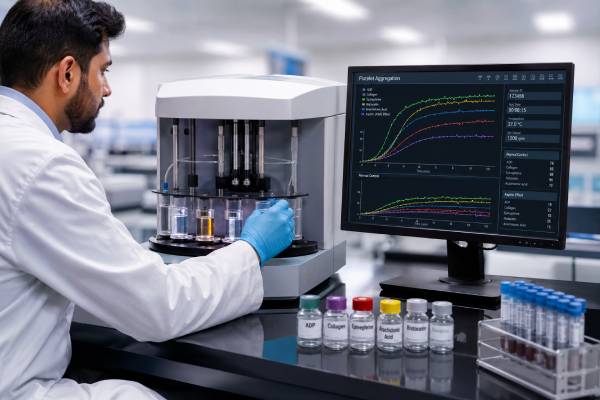
A platelet aggregation test checks how well platelets clump together to help stop bleeding. Platelets are tiny blood cell fragments that rush to an injured blood vessel, stick to the damaged area, signal to other platelets, and form a plug. The test is most useful when a person has easy bruising, frequent nosebleeds, heavy menstrual bleeding, prolonged bleeding after dental work or surgery, or a suspected inherited platelet disorder. It also helps show whether aspirin or another antiplatelet medicine is affecting platelet function.
This test does not simply count platelets. A person can have a normal platelet count but still have platelets that do not work properly. Results need careful interpretation because medicines, sample handling, low platelet count, anemia, and recent illness all influence the result. An abnormal platelet aggregation test usually points to a platelet function problem, but follow-up testing is often needed to find the exact cause.
- A platelet aggregation test measures platelet function, not just platelet number.
- Abnormal results usually mean platelets are not clumping normally in response to one or more activating substances.
- Aspirin usually reduces aggregation to arachidonic acid and sometimes affects collagen or epinephrine responses.
- Normal platelet aggregation does not rule out every bleeding disorder, especially mild von Willebrand disease or mild platelet secretion defects.
- Preparation often includes avoiding aspirin, NSAIDs, and some supplements before testing, but only when the ordering clinician says to stop them.
- Urgent care is needed for heavy bleeding that will not stop, black stools, vomiting blood, severe headache after head injury, or large unexplained bruises.
Table of Contents
- What the Platelet Aggregation Test Measures
- When a Platelet Aggregation Test Is Ordered
- How the Test Is Done and How to Prepare
- How Platelet Aggregation Results Are Reported
- Abnormal Platelet Aggregation Patterns and Causes
- Aspirin Effect, Antiplatelet Drugs, and Medication Interference
- Follow-Up After Abnormal Platelet Aggregation Results
What the Platelet Aggregation Test Measures
A platelet aggregation test measures how strongly platelets clump together after the laboratory adds substances that normally activate them. These substances are called agonists. Common agonists include ADP, collagen, epinephrine, arachidonic acid, and ristocetin. Each one tests a different part of platelet function.
The test helps answer a practical question: when platelets receive a clotting signal, do they respond normally, weakly, or not at all?
Platelets stop bleeding through several steps. First, they stick to the injured blood vessel wall. Then they change shape, release chemical messengers from storage granules, and recruit more platelets. Finally, they bind to each other and build a platelet plug. Clotting proteins then strengthen that plug with fibrin.
A platelet aggregation test focuses mainly on the platelet plug stage. That makes it different from clotting time tests such as PT, INR, and aPTT, which check the clotting factor pathways. A person with abnormal platelet function often has normal PT and aPTT results because those tests do not directly measure platelet clumping. When a broader bleeding evaluation is needed, clinicians often compare aggregation results with a coagulation panel, a complete blood count, and von Willebrand testing.
The test is also different from a platelet count. Platelet count tells how many platelets are present in a measured amount of blood. Platelet aggregation tells how well those platelets respond. Both matter. A low platelet count increases bleeding risk because there are too few platelets to build a stable plug. A normal platelet count with poor aggregation suggests the platelets are present but not working correctly.
The most established version is light transmission aggregometry, often shortened to LTA. In LTA, the lab prepares platelet-rich plasma from the blood sample. Before platelets clump, the sample looks cloudy. As platelets aggregate, the plasma clears and more light passes through. The analyzer records that change as a curve.
Some laboratories use whole-blood impedance aggregometry, lumiaggregometry, flow cytometry, or platelet function analyzer methods. These tests overlap but do not measure exactly the same thing. That is why results from one method should not be treated as interchangeable with results from another.
When a Platelet Aggregation Test Is Ordered
A platelet aggregation test is usually ordered when bleeding symptoms suggest a platelet problem, especially when basic blood tests do not explain the bleeding. It is not a routine screening test for everyone because it is technically demanding, sensitive to medication effects, and usually performed in specialized laboratories.
Doctors commonly consider platelet aggregation testing for symptoms such as:
- Frequent or prolonged nosebleeds
- Easy bruising, especially large bruises after minor bumps
- Bleeding gums without clear dental disease
- Heavy menstrual bleeding from the teenage years onward
- Prolonged bleeding after tooth extraction, childbirth, surgery, or injury
- Small red or purple skin spots caused by bleeding under the skin
- A family history of unusual bleeding
- Bleeding symptoms despite a normal platelet count, PT, and aPTT
The test is especially helpful for suspected inherited platelet function disorders. These include Glanzmann thrombasthenia, Bernard-Soulier syndrome, platelet storage pool disease, P2Y12 receptor defects, thromboxane pathway defects, and several rarer disorders. Some appear in childhood, while mild forms are not recognized until surgery, dental extraction, childbirth, or a major injury exposes the problem.
Platelet aggregation testing also helps evaluate acquired platelet dysfunction. Acquired means the platelet problem developed because of another condition or exposure rather than a lifelong genetic disorder. Common acquired causes include medicines, kidney failure, liver disease, myeloproliferative disorders, myelodysplastic syndromes, alcohol use, severe inflammation, and some blood cancers.
A clinician may order the test before surgery when the person has a meaningful bleeding history. The bleeding history matters more than the test alone. A person who bruises easily from minor bumps but has no surgical, dental, menstrual, or family bleeding history often has a lower chance of a serious platelet disorder than someone with repeated bleeding after procedures.
The test is sometimes used to check aspirin or antiplatelet drug effect. This is usually reserved for selected situations, such as unexplained bleeding while taking aspirin, suspected nonresponse to an antiplatelet medicine, high-risk cardiovascular or neurologic cases, or complex preoperative decisions. It is not the usual way to decide whether the average person should take aspirin.
Platelet aggregation testing is not the first test for every bleeding complaint. A practical starting workup usually includes a CBC with platelet count, blood smear, PT/INR, aPTT, fibrinogen when indicated, kidney and liver assessment when clinically relevant, and von Willebrand testing when the bleeding pattern fits. Heavy menstrual bleeding, nosebleeds, and dental bleeding often overlap with von Willebrand disease, so a von Willebrand disease panel is often part of the evaluation.
How the Test Is Done and How to Prepare
The platelet aggregation test starts with a blood draw from a vein. The blood is collected into a tube that contains an anticoagulant, usually sodium citrate, to keep it from clotting before analysis. The sample must be handled gently because platelets activate easily. Rough handling, delayed processing, clotted tubes, underfilled tubes, and difficult blood draws can distort results.
For light transmission aggregometry, the laboratory spins the blood to prepare platelet-rich plasma and platelet-poor plasma. Platelet-rich plasma contains enough platelets for testing. Platelet-poor plasma acts as the clear reference sample. The analyzer compares the cloudy platelet-rich sample with the clear platelet-poor sample as aggregation occurs.
Timing matters. Many platelet function samples need testing within a few hours of collection. That is one reason the test is often scheduled at a hospital or specialized coagulation laboratory rather than processed like a routine chemistry test. Some labs restrict collection to weekday mornings so the sample reaches the testing bench quickly.
Preparation depends on why the test is being done. If the goal is to diagnose an inherited platelet disorder, the clinician often wants to remove avoidable medication effects first. If the goal is to measure aspirin effect, the person should usually keep taking aspirin as directed so the lab can see the drug effect.
Do not stop aspirin, clopidogrel, warfarin, apixaban, rivaroxaban, heparin, antidepressants, or any prescribed medicine on your own. Stopping the wrong drug can raise the risk of heart attack, stroke, blood clot, seizure, or another serious problem. The ordering clinician should give exact instructions.
Common pre-test issues include:
- Aspirin effect lasts for the life of affected platelets, usually about 7 to 10 days.
- Ibuprofen and naproxen can interfere with platelet function, but their effect is usually shorter than aspirin.
- Some antidepressants, antibiotics, antihistamines, herbal products, fish oil, alcohol, and high-dose vitamin E may affect platelet function in some people.
- Recent infection, inflammation, surgery, pregnancy, or major stress can change platelet reactivity.
- Severe anemia, very low platelet count, or very high platelet count can make results harder to interpret.
The laboratory may reject or qualify a sample if the platelet-rich plasma platelet count is outside its validated range. Many labs prefer platelet-rich plasma in a range roughly around 150 to 400 × 10^9/L for standard LTA. If the count is too low, there may not be enough platelets to create a reliable aggregation curve. If it is very high, the sample may need special handling.
Fasting is not always required, but the lab may ask the patient to avoid fatty meals before the test because lipemic, cloudy plasma affects light-based measurement. The lab may also ask the person to avoid intense exercise, smoking, or alcohol shortly before collection.
How Platelet Aggregation Results Are Reported
Platelet aggregation results are usually reported as aggregation responses to each agonist. The report may include maximum aggregation percentage, slope, lag time, shape change, secretion response, and a written interpretation. The exact format depends on the laboratory and method.
There is no single universal normal range for platelet aggregation. Each laboratory establishes its own reference intervals because results vary by analyzer, agonist concentration, sample handling, platelet count adjustment, and reporting method. A result that appears abnormal in one lab should be interpreted using that lab’s reference range and comments.
A normal result means the platelets aggregated as expected with the agonists tested. It does not prove that every platelet function pathway is normal. Mild secretion defects, intermittent medication effects, mild von Willebrand disease, and some rare disorders can still be missed.
An abnormal result means platelet aggregation was reduced, absent, delayed, or unusually shaped with one or more agonists. The pattern matters more than a single number. For example, absent aggregation with nearly all agonists but preserved ristocetin response suggests a different problem than isolated poor arachidonic acid response.
Common agonists and what they help test
| Agonist | What it helps assess | Common abnormal clue |
|---|---|---|
| ADP | Platelet activation, P2Y12 receptor signaling, secondary wave response | Weak response can suggest P2Y12 pathway problems, clopidogrel effect, or secretion defects |
| Collagen | Platelet response to vessel wall injury and activation pathways | Reduced response can occur with aspirin effect, collagen receptor problems, or secretion defects |
| Epinephrine | Secondary aggregation and platelet activation sensitivity | Absent or weak response is common and not always diagnostic by itself |
| Arachidonic acid | Thromboxane pathway and aspirin-like effects | Markedly reduced response is typical with aspirin or cyclooxygenase inhibition |
| Ristocetin | Interaction between platelets and von Willebrand factor through the GPIb receptor | Abnormal response suggests von Willebrand disease or Bernard-Soulier syndrome pattern |
A well-written report often states whether the pattern is consistent with a drug effect, a possible inherited defect, a secretion defect, a low platelet count effect, or a nonspecific abnormality. Many reports also recommend repeat testing when an unexpected abnormality appears, especially if medication exposure or sample quality was uncertain.
The result should always be compared with symptoms. A mildly abnormal curve in someone with no bleeding history does not carry the same weight as the same curve in someone with repeated surgical bleeding and affected relatives. Likewise, severe bleeding with a normal aggregation test deserves further evaluation rather than dismissal.
Abnormal Platelet Aggregation Patterns and Causes
Abnormal platelet aggregation patterns fall into several broad groups. The pattern gives clues, but it rarely gives the full diagnosis by itself.
Aspirin-like pattern
Aspirin blocks platelet cyclooxygenase-1, which reduces thromboxane A2 production. Thromboxane A2 is a platelet signal that strengthens aggregation. On testing, aspirin commonly causes absent or very low aggregation with arachidonic acid. Collagen and epinephrine responses may also be reduced, while ADP response is often less affected.
This pattern is expected when the person is taking aspirin. It becomes important when the person was supposed to avoid aspirin before diagnostic testing. Hidden aspirin exposure is common because aspirin appears in some cold remedies, pain relievers, combination products, and over-the-counter medicines.
Glanzmann thrombasthenia pattern
Glanzmann thrombasthenia is an inherited platelet disorder involving the GPIIb/IIIa receptor, also called integrin alpha-IIb beta-3. This receptor helps platelets bind fibrinogen and attach to each other. In classic Glanzmann thrombasthenia, aggregation is severely reduced or absent with ADP, collagen, epinephrine, and arachidonic acid. Ristocetin response is usually preserved because ristocetin tests a different platelet receptor pathway.
People with Glanzmann thrombasthenia often have normal platelet counts and normal platelet size. The bleeding pattern is usually mucocutaneous: nosebleeds, gum bleeding, heavy menstrual bleeding, easy bruising, and prolonged bleeding after procedures.
Bernard-Soulier syndrome and von Willebrand patterns
Bernard-Soulier syndrome affects the platelet GPIb-IX-V complex, which helps platelets bind von Willebrand factor at sites of vessel injury. The classic test clue is abnormal ristocetin-induced platelet agglutination. Platelets are often large, and the platelet count may be low.
Von Willebrand disease can also cause an abnormal ristocetin response because von Willebrand factor is needed for that interaction. Follow-up testing distinguishes these conditions. A vWF activity test, vWF antigen level, factor VIII activity, and sometimes specialized subtype testing help clarify the cause.
Storage pool and secretion defects
Platelet storage pool disease and secretion defects affect the platelet granules that release chemical signals. Aggregation may start but fail to build a strong secondary wave, especially with low-dose ADP or epinephrine. Collagen response can be delayed or reduced. Lumiaggregometry, ATP release testing, electron microscopy, or flow cytometry may be needed because standard aggregation alone may miss or understate these defects.
These disorders often cause lifelong easy bruising, nosebleeds, heavy menstrual bleeding, and procedure-related bleeding. Severity varies widely.
P2Y12 receptor pathway problems
The P2Y12 receptor helps platelets respond to ADP. Clopidogrel, prasugrel, and ticagrelor intentionally inhibit this pathway. An inherited P2Y12 receptor defect can create a similar laboratory pattern, with reduced ADP-induced aggregation and impaired secondary aggregation.
The medication history is essential here. A person taking clopidogrel should have reduced ADP response. A person not taking a P2Y12 inhibitor who has a strongly abnormal ADP response may need specialized evaluation.
Nonspecific or acquired platelet dysfunction
Many abnormal aggregation results do not point to one rare inherited disorder. Acquired platelet dysfunction is common in real-world testing. It can occur with kidney failure, liver disease, alcohol exposure, myelodysplastic syndromes, myeloproliferative neoplasms, inflammatory illness, and several medications.
Low platelet count and anemia also affect platelet function testing. This is one reason the aggregation report should be interpreted alongside CBC results, blood smear findings, and clinical history. If platelet size or clumping is suspected, a platelet morphology test can add useful context.
Aspirin Effect, Antiplatelet Drugs, and Medication Interference
Aspirin has one of the clearest effects on platelet aggregation testing. It irreversibly blocks cyclooxygenase-1 in platelets. Since platelets do not have a nucleus, they cannot simply make new cyclooxygenase-1. The body has to produce new platelets to restore normal aspirin-sensitive function. That is why aspirin’s platelet effect lasts about a week even though aspirin itself leaves the bloodstream much sooner.
On a platelet aggregation test, aspirin usually produces a strong reduction in arachidonic acid-induced aggregation. Arachidonic acid is the most direct agonist for showing aspirin-like cyclooxygenase inhibition. Collagen response may be reduced, and epinephrine response may be abnormal. ADP response is often partly preserved because ADP uses a different pathway.
An “aspirin effect” result does not automatically mean aspirin is working well enough to prevent heart attack or stroke in a specific person. Platelet function tests do not perfectly predict clinical outcomes. Different platelet tests often disagree with one another. Results also vary with timing, dose, adherence, enteric-coated aspirin absorption, inflammation, platelet turnover, and lab method.
If aspirin effect is unexpectedly absent, the explanation is often practical rather than genetic. Common reasons include missed doses, recent start of therapy, taking enteric-coated aspirin with poor absorption, wrong medication list, high platelet turnover, drug interactions, or testing too long after aspirin was stopped. True aspirin nonresponse exists, but it should not be assumed from one test alone.
Other antiplatelet medicines create different patterns. Clopidogrel, prasugrel, and ticagrelor reduce ADP pathway responses. GPIIb/IIIa inhibitors produce a broad pattern similar to impaired platelet-to-platelet binding. Nonsteroidal anti-inflammatory drugs such as ibuprofen and naproxen can create aspirin-like effects, but usually for a shorter time. Some selective serotonin reuptake inhibitors affect platelet serotonin handling and can contribute to bleeding tendency, especially when combined with aspirin, NSAIDs, or anticoagulants.
Anticoagulants are different from antiplatelet drugs. Warfarin, heparin, apixaban, rivaroxaban, dabigatran, and edoxaban mainly target the clotting system rather than platelet aggregation. They can still increase bleeding risk, but they are usually monitored with other tests when monitoring is needed. For example, warfarin is linked to INR testing, and heparin monitoring often uses aPTT or anti-Xa testing. Platelet aggregation testing is not a replacement for INR interpretation or anti-Xa monitoring.
Medication review is one of the most important parts of interpreting the test. The report is much more useful when the laboratory knows whether the person took aspirin, NSAIDs, clopidogrel, antidepressants, antihistamines, antibiotics, supplements, alcohol, or other agents in the days before testing.
Follow-Up After Abnormal Platelet Aggregation Results
An abnormal platelet aggregation test is a starting point, not a final diagnosis. The next step depends on the pattern, bleeding history, medication exposure, platelet count, and reason for testing.
A clinician may repeat the test if the abnormality was unexpected, the blood draw was difficult, the sample was delayed, the person had recently taken an interfering medicine, or the symptoms do not match the result. Repeat testing is common because platelet aggregation is sensitive to pre-analytical variables.
Follow-up often includes:
- CBC with platelet count and platelet indices
- Peripheral blood smear to check platelet size, clumping, and other blood cell clues
- PT/INR and aPTT if not already done
- Fibrinogen or thrombin time when the bleeding history suggests a clotting protein issue
- Von Willebrand factor antigen, vWF activity, and factor VIII activity
- Platelet secretion testing or lumiaggregometry
- Flow cytometry for platelet surface glycoproteins
- Genetic testing when an inherited platelet disorder is suspected
- Kidney, liver, thyroid, inflammatory, or bone marrow evaluation when acquired causes fit
A Platelet Function Analyzer test may be used as a screening or supporting test in some settings, but it does not replace full platelet aggregation testing. It is affected by platelet count, hematocrit, von Willebrand factor, and medication exposure. A normal closure time also does not exclude every platelet disorder.
The most important clinical question is whether the person has a bleeding risk that needs a plan. People with confirmed platelet function disorders often need precautions before surgery, dental procedures, childbirth, or invasive testing. Management may include avoiding aspirin and NSAIDs, using tranexamic acid for mucosal bleeding when appropriate, desmopressin for selected disorders, hormonal treatment for heavy menstrual bleeding, iron treatment when deficiency develops, or platelet transfusion for severe bleeding or high-risk surgery. Treatment choice depends on the exact diagnosis.
People taking aspirin or other antiplatelet drugs need a different kind of follow-up. If the test was done to check drug effect, the clinician weighs the result against the reason for the medicine. Someone taking aspirin after a heart attack, stroke, stent, or vascular procedure should not stop it because of bruising or a lab result without medical advice. The clot-prevention benefit may be critical.
Seek urgent medical care for bleeding that is heavy, fast, or unusual for you. Red flags include bleeding that will not stop with firm pressure, vomiting blood, black tarry stools, red urine, severe headache after head injury, sudden weakness or confusion, shortness of breath with bleeding, large rapidly expanding bruises, or extremely heavy menstrual bleeding with dizziness or fainting.
For non-urgent abnormal results, the best next step is usually a focused discussion with the ordering clinician or a hematologist. Bring a medication and supplement list, bleeding history, family history, and any past surgical or dental bleeding details. Exact details often matter more than general statements such as “I bruise easily.”
References
- Light transmission aggregometry for platelet function testing 2024 (Position Statement)
- Diagnosis of Inherited Platelet Disorders: Clinical Evaluation and Functional and Molecular Assays 2025 (Review)
- Advances in Platelet-Dysfunction Diagnostic Technologies 2024 (Review)
- Factors that modulate platelet reactivity as measured by 5 platelet function tests 2024 (Study)
- Platelet Tests 2024 (Official Medical Test Information)
- Platelet Disorders Causes and Risk Factors 2025 (Official Health Information)
Disclaimer
This article is for educational purposes only and does not replace care from a qualified healthcare professional. Platelet aggregation results require clinical interpretation because medicines, sample handling, platelet count, anemia, and medical conditions can change the result. Always follow the instructions of the clinician who ordered the test, especially before stopping aspirin, NSAIDs, anticoagulants, or antiplatelet medicine.