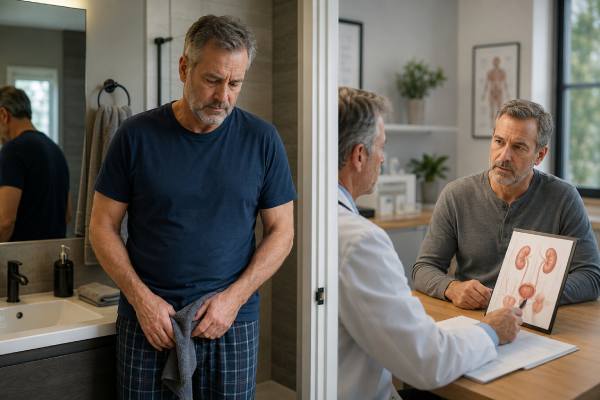
Post-void dribbling is the small leak of urine that comes out after you think you are finished peeing. It may show up as a damp spot in underwear, a few drops after leaving the bathroom, or a need to shake longer than usual. In many men, it happens because urine stays behind in the urethra, especially in the curved part under the scrotum, then leaks out when the body moves.
A few drops once in a while are usually not an emergency. The problem deserves more attention when it is new, getting worse, paired with a weak stream, painful urination, blood, urgency, pelvic pain, or trouble emptying the bladder. Simple habits, urethral milking, and pelvic floor training often help. When they do not, a clinician can check for prostate enlargement, urethral narrowing, infection, medication effects, or bladder problems.
Table of Contents
- What Post-Void Dribbling Means
- Why Urine Gets Trapped After Peeing
- Common Causes in Men
- Fixes to Try After Peeing
- Pelvic Floor Exercises That Help
- When to Get Checked
- What Doctors May Check
- Treatment Options If It Keeps Happening
What Post-Void Dribbling Means
Post-void dribbling means urine leaks shortly after urination has ended. The leak usually happens after zipping up, walking away, sitting down, bending, or changing position. Some men notice only one or two drops. Others need tissue, repeated shaking, or a change of underwear.
Doctors often call this post-micturition dribble. “Micturition” simply means urination. It is considered a post-micturition symptom because it happens after the main urine stream has stopped.
It is different from terminal dribbling. Terminal dribbling is when the urine stream slowly fades into a trickle at the end, while you are still standing at the toilet. Post-void dribbling happens after you believe you are done.
It is also different from urge leakage, where urine escapes because the need to pee becomes sudden and hard to control. Men with urgency, frequent bathroom trips, or leakage before reaching the toilet may be dealing with bladder overactivity or a prostate-related problem. Those symptoms fit better with urgency to pee from overactive bladder or prostate issues than with simple after-dribble alone.
The amount of urine matters less than the pattern. A small leak that happens for years and improves with technique is usually less concerning than a new leak with pain, burning, blood, fever, or a sudden change in urine flow.
Post-void dribbling can affect confidence, clothing choices, travel, exercise, sex, and social comfort. Many men feel embarrassed and do not mention it during checkups. That silence can delay simple treatment. It is a common enough urinary symptom, and a straightforward description is usually enough to start the conversation: “After I finish peeing, a few drops come out when I walk away.”
Why Urine Gets Trapped After Peeing
The usual reason for after-dribble is not that the bladder is still pouring urine out. It is that a small amount of urine remains in the urethra, the tube that carries urine through the penis.
The male urethra is long and curved. One section, called the bulbar urethra, sits deeper in the pelvis near the base of the penis. After urination, pelvic floor muscles normally help squeeze this area so the last urine moves out. If that squeeze is weak, poorly timed, or blocked by tension or anatomy, urine can sit there. When you move, gravity and pressure let it leak.
Think of it like water left in a bent garden hose. The faucet may be off, but water in the curve can still spill when the hose is lifted or stepped on.
The pelvic floor is a group of muscles that supports the bladder, bowel, and sexual organs. In men, these muscles help with bladder control, erections, ejaculation, and the final emptying of the urethra. Problems can happen in two opposite ways:
- Weak pelvic floor muscles may not squeeze out the last drops well.
- Tight or overactive pelvic floor muscles may not relax and coordinate properly during urination.
Both can lead to dribbling, although the fix is not always the same. A man with weak muscles may benefit from strengthening. A man with pelvic tension, pain, constipation, or a stop-start stream may first need relaxation, breathing, and a pelvic floor physical therapist’s guidance.
Age can play a role, but it is not the only factor. Young men can have post-void dribbling from pelvic floor coordination issues, chronic straining, cycling pressure, anxiety-related muscle tension, urethral narrowing, or prostatitis-like pelvic pain. Older men may have the same issues plus prostate enlargement, medication effects, diabetes, or bladder changes.
A useful clue is whether the dribble is isolated. If the stream is strong, there is no pain, and the leak is only a few drops after finishing, trapped urine in the urethra is likely. If the stream is weak, split, painful, urgent, or paired with incomplete emptying, the cause may involve the prostate, urethra, bladder, or infection.
Common Causes in Men
Post-void dribbling can come from one simple issue or from several small problems adding up. The pattern helps narrow it down.
| Pattern | Possible cause | Next step |
|---|---|---|
| A few drops after walking away, otherwise normal urination | Urine trapped in the bulbar urethra | Try urethral milking and pelvic floor training |
| Weak stream, hesitancy, night urination, incomplete emptying | Enlarged prostate or bladder outlet obstruction | Schedule a medical evaluation |
| Split or spraying stream | Urethral narrowing, meatal irritation, skin changes, or dried discharge | Get checked if persistent or recurrent |
| Burning, discharge, pelvic pain, or testicular discomfort | Infection, STI, prostatitis, or pelvic pain syndrome | Testing is usually needed |
| Leakage after prostate surgery | Temporary or lasting sphincter and pelvic floor changes | Ask about pelvic floor rehab and urology follow-up |
Weak pelvic floor function is one of the most common explanations. This may be more likely after years of heavy lifting, chronic coughing, chronic constipation, obesity, long sitting, or surgery around the prostate or pelvis.
Prostate enlargement can also cause dribbling, but it usually brings other symptoms too. Men may notice a slow stream, trouble starting, stop-start flow, getting up at night, or a feeling that the bladder is not empty. Those symptoms overlap with enlarged prostate symptoms and treatment options.
Urethral stricture is a narrowing of the urine tube, often from scar tissue. It can happen after catheter use, urethral injury, some procedures, infections, or inflammation. A stricture may cause weak flow, spraying, a split stream, straining, incomplete emptying, UTIs, or dribbling. Persistent changes in stream shape fit well with split urine stream causes and should not be ignored if they continue.
Pelvic floor tension can create a confusing mix: dribbling, frequent urination, discomfort after ejaculation, perineal pressure, constipation, or a hard-to-relax feeling while peeing. Some men keep doing Kegels when the real problem is muscle tightness, which can make symptoms worse.
Medications can contribute. Decongestants, some antihistamines, antidepressants, bladder medicines, opioids, and drugs with drying or muscle-relaxing effects may change urination. Alcohol and high caffeine intake can worsen urgency and frequency, which may make leakage more noticeable.
Diabetes, nerve conditions, spinal problems, and prior pelvic injuries can affect bladder emptying or sphincter control. These causes are less likely when the only symptom is a few drops after urination, but they matter when dribbling comes with numbness, new erectile changes, leg symptoms, or loss of bladder control.
Fixes to Try After Peeing
The fastest fix is to clear the trapped urine before you leave the toilet. Shaking the penis alone often does not empty the deeper part of the urethra. Urethral milking works better for many men.
Use this sequence:
- Finish urinating without rushing.
- Wait a few seconds and relax your belly, buttocks, and thighs.
- Place two fingers behind the scrotum, near the area between the scrotum and anus.
- Press gently upward and forward along the underside of the penis.
- Move the fingers toward the tip to push remaining urine out.
- Shake or dab the tip once.
- Tighten the pelvic floor once, then relax.
The pressure should be gentle. It should not hurt, bruise, or feel like a hard massage. If pressing behind the scrotum causes pain, burning, or pelvic discomfort, stop and get checked.
Double voiding can help if you also feel that the bladder is not empty. This means urinating, waiting 20 to 30 seconds, relaxing, then trying again. Do not strain hard. Straining can worsen pelvic floor problems, hemorrhoids, and incomplete coordination.
Posture can make a difference. Standing with the feet flat and the body relaxed may help. Some men empty better while sitting, especially if they have pelvic tension, constipation, or a shy-bladder pattern. Sitting is not less masculine; it is simply a position that may help the pelvic floor relax.
A few bathroom habits can reduce leaks:
- Do not rush the final seconds of urination.
- Avoid pushing hard to force out drops.
- Exhale slowly instead of holding your breath.
- Keep the lower belly soft.
- Treat constipation so you are not repeatedly straining.
- Limit large fluid loads right before long drives, workouts, or meetings.
Absorbent pads are not a treatment, but they can protect clothing while you work on the cause. A small male guard or dark underwear may reduce anxiety during travel or work. If you need pads daily because leakage is more than a few drops, or if you leak at other times besides after peeing, get evaluated.
Men often blame “not shaking enough,” but the problem is usually deeper than the tip of the penis. The goal is to empty the urethral curve, not to keep shaking until the skin becomes irritated.
Pelvic Floor Exercises That Help
Pelvic floor exercises can help when post-void dribbling comes from weak or poorly coordinated muscles. The target is not the abdominal muscles, buttocks, or inner thighs. It is the small lift-and-squeeze action around the base of the penis and anus.
A simple way to find the muscle is to imagine stopping gas or lifting the base of the penis upward. Do not practice by repeatedly stopping your urine stream. Doing that often can interfere with normal emptying.
Start with control, not force:
- Sit or lie down with your belly relaxed.
- Gently tighten the pelvic floor as if lifting inward.
- Hold for 2 to 3 seconds.
- Fully relax for 4 to 6 seconds.
- Repeat 8 to 10 times.
- Add 5 quick squeezes at the end.
Do this once or twice a day at first. If symptoms improve and there is no pelvic pain, gradually work toward 10 slow contractions and 10 quick contractions, two or three times daily. More is not always better. Overtraining can cause tightness, aching, urgency, or trouble starting the stream.
Timing matters. For after-dribble, one useful habit is a single pelvic floor contraction after urination, followed by relaxation and urethral milking. The squeeze helps move urine from the deeper urethra; the milking clears what remains.
Results are not instant. Some men notice improvement within a few weeks. Stronger improvement often takes 8 to 12 weeks of regular practice. If nothing changes after two to three months, technique may be off, the pelvic floor may be tight rather than weak, or another urinary issue may be involved.
Stop or reduce Kegels if they cause:
- Pelvic, testicular, penile, or rectal pain
- More urgency or frequency
- Trouble starting urination
- A tighter or more hesitant stream
- Pain with ejaculation
Those signs suggest that relaxation-based pelvic floor therapy may be more appropriate than strengthening. Men with pelvic pain, chronic prostatitis symptoms, or tight pelvic floor symptoms often need breathing, stretching, trigger point work, and down-training rather than repeated squeezing. If pelvic pressure, painful ejaculation, or urinary discomfort are part of the picture, chronic pelvic pain syndrome symptoms may be a better fit than simple weakness.
A pelvic floor physical therapist can check whether you are contracting the right muscles, relaxing fully, and coordinating the squeeze with urination. This is especially useful after prostate surgery, pelvic injury, persistent pain, or failed home exercises.
When to Get Checked
A few drops after peeing can often be handled with technique and pelvic floor work. Medical evaluation is important when dribbling is new, worsening, bothersome, or paired with other urinary changes.
Get checked soon if you have:
- Burning, pain, or fever
- Blood in the urine
- Penile discharge
- New pelvic, testicular, flank, or lower belly pain
- A weak, slow, split, or spraying stream
- Trouble starting to pee
- A feeling that the bladder will not empty
- Recurrent urinary tract infections
- New leakage after prostate, bladder, urethral, or pelvic surgery
- Dribbling with numbness, leg weakness, or back injury symptoms
Blood in urine should always be taken seriously, even if it happens once and then disappears. It can come from infection, stones, prostate issues, vigorous exercise, or other causes, but it needs proper sorting. Men with visible blood should read about blood in urine warning signs and arrange medical care.
Go urgently if you cannot urinate at all, have severe lower abdominal pain with a full-bladder feeling, or develop fever and chills with urinary symptoms. These can signal urinary retention or a serious infection. Sudden inability to pee fits urinary retention in men and should not wait for a routine appointment.
Age changes the level of concern. In men over 40 or 50, dribbling with weak stream, night urination, hesitancy, or incomplete emptying often leads clinicians to check for prostate enlargement and other lower urinary tract issues. In younger men, a persistent weak stream, spraying, or split stream may raise more concern for urethral narrowing, prior injury, inflammation, or pelvic floor dysfunction.
STI testing may be needed if dribbling comes with discharge, burning, new genital sores, testicular pain, rectal symptoms, or exposure risk. Chlamydia, gonorrhea, mycoplasma genitalium, trichomoniasis, and other infections can affect the urethra. Do not assume dribbling alone is an STI, but do not ignore infection symptoms.
Pain is another clue. Simple trapped urine usually causes wetness without significant pain. Dribbling plus pelvic ache, painful ejaculation, or urinary burning points toward inflammation, infection, pelvic floor tension, or prostate-related pain.
What Doctors May Check
A clinician will usually start with questions, a urine test, and a focused exam. The visit is often simpler than men expect.
You may be asked:
- When the dribbling started
- Whether it happens every time or only sometimes
- How much urine leaks
- Whether you feel empty afterward
- Whether the stream is weak, split, spraying, or stop-start
- How often you urinate during the day and night
- Whether there is urgency, burning, blood, discharge, fever, or pain
- Which medications and supplements you take
- Whether you have diabetes, nerve problems, constipation, or prior pelvic surgery
A urinalysis checks for blood, infection markers, glucose, protein, and other clues. If infection is possible, a urine culture or STI tests may be added.
For prostate-related symptoms, a clinician may discuss a digital rectal exam, PSA testing when appropriate, and symptom questionnaires. PSA is not a dribbling test; it is used in prostate risk assessment and must be interpreted based on age, prostate size, infection, recent ejaculation, procedures, and overall risk.
If incomplete emptying is suspected, a post-void residual test may be done. This is usually a quick bladder ultrasound after you urinate. It estimates how much urine remains in the bladder. A high residual suggests the bladder is not emptying well and may change treatment.
Uroflowmetry measures the speed and pattern of the urine stream. You pee into a special device, and it records flow rate. A low flow rate can suggest blockage, weak bladder contraction, or poor coordination.
Cystoscopy may be considered if there is blood, suspected urethral stricture, recurrent infections, prior surgery, or unexplained obstruction symptoms. During cystoscopy, a thin camera looks inside the urethra and bladder. It is not needed for every man with mild after-dribble.
Imaging may be used when stones, kidney problems, significant residual urine, recurrent infection, or other structural issues are suspected.
The goal is not to run every test. The goal is to match testing to the pattern. Isolated after-dribble with a normal stream often starts with conservative treatment. Dribbling plus weak stream, incomplete emptying, blood, pain, or infection signs needs a broader look.
Treatment Options If It Keeps Happening
Treatment depends on the cause. The same symptom can need different approaches in different men.
For isolated post-void dribbling, the usual first steps are:
- Urethral milking after each urination
- Pelvic floor exercises if weakness is likely
- Pelvic floor relaxation if tightness is likely
- Constipation treatment
- Better bathroom timing
- Weight loss if belly pressure is contributing
- Managing chronic cough or heavy straining
If prostate enlargement is part of the pattern, treatment may include watchful waiting, fluid timing, reducing caffeine and alcohol, medication, or procedures. Alpha blockers can relax muscle around the prostate and bladder neck. 5-alpha reductase inhibitors may shrink larger prostates over time. Daily tadalafil can help some men with urinary symptoms and erectile dysfunction. These medicines have possible side effects, including dizziness, ejaculation changes, blood pressure interactions, and sexual side effects, so they should be chosen with a clinician.
Men who wake often to urinate may need a different plan than men who only leak after peeing. Night urination can come from evening fluid intake, sleep apnea, diabetes, leg swelling, bladder overactivity, or prostate issues. Persistent nighttime urination fits nocturia causes and fixes in men and should not automatically be blamed on the prostate.
If urethral stricture is found, treatment may involve dilation, internal urethrotomy, or urethroplasty, depending on the length, location, and recurrence pattern. Repeated temporary fixes may not be the best long-term answer for some strictures, so a reconstructive urologist may be helpful when narrowing returns.
If infection is found, antibiotics or STI treatment should match the test result. Partners may need testing or treatment for certain infections. Avoid leftover antibiotics or online treatment without testing when possible, because symptoms can overlap and resistance patterns matter.
If pelvic floor tension is the main issue, standard Kegels may not help. A pelvic floor physical therapist may use relaxation training, breathing, hip mobility work, manual therapy, bladder retraining, and gradual strengthening only after the muscles can relax.
After prostate surgery, dribbling or urinary leakage may improve over weeks to months, but recovery varies. Pelvic floor rehab, follow-up testing, and time are often part of the plan. Persistent leakage after surgery needs a urology review because stress incontinence, urgency leakage, and post-void dribbling require different treatments.
Common mistakes delay improvement:
- Shaking harder instead of clearing the deeper urethra
- Doing hundreds of Kegels without learning relaxation
- Straining to force out the last drops
- Ignoring a weak or split stream
- Assuming all urinary changes are normal aging
- Using pads without asking why leakage is happening
- Avoiding fluids so much that urine becomes concentrated and irritating
The best sign that home care is enough is steady improvement: fewer leaks, less dampness, normal stream, no pain, and no new symptoms. If the problem stays the same after 8 to 12 weeks of good technique, or if other urinary symptoms appear, it is time for a medical check.
References
- Postmicturition dribble in men with no previous urogenital surgery: Systematic review and meta-analysis of treatment modalities 2024 (Systematic Review)
- A current perspective on post-micturition dribble in males 2019 (Review)
- Pelvic floor exercises for treating post-micturition dribble in men with erectile dysfunction: a randomized controlled trial 2004 (RCT)
- EAU Guidelines on the Management of Non-neurogenic Male LUTS 2026 (Guideline)
- Management of Lower Urinary Tract Symptoms Attributed to Benign Prostatic Hyperplasia: AUA Guideline (2026) Part I: Presentation and Evaluation 2026 (Guideline)
- Enlarged Prostate (Benign Prostatic Hyperplasia) 2024 (Official Health Information)
Disclaimer
This article is for education only and does not replace care from a qualified health professional. Post-void dribbling is often manageable, but urinary symptoms with pain, blood, fever, discharge, weak stream, or trouble emptying need medical evaluation. Seek urgent care if you cannot urinate, have severe lower abdominal pain, or feel very ill with urinary symptoms.