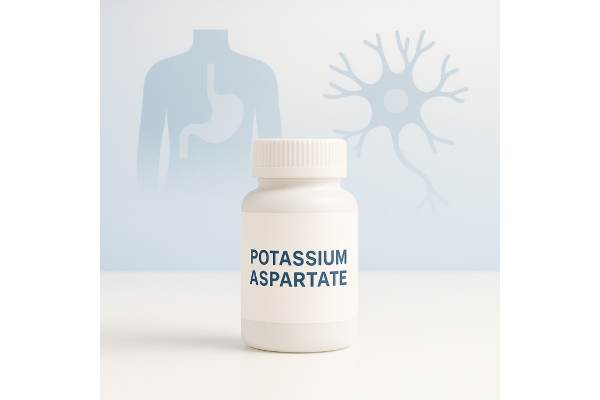
Potassium aspartate is a salt that combines the essential mineral potassium with the amino acid aspartic acid. It is used as an electrolyte supplement to help maintain normal potassium levels, support muscle and nerve function, and assist in conditions where potassium needs are increased. In some clinical settings, potassium aspartate has been explored as an option for mild to moderate hypertension, as an electrolyte replenisher in fatigue, and as part of treatment strategies for high ammonia levels linked to liver problems.
Unlike general “potassium supplements,” which often use potassium chloride or citrate, potassium aspartate may be easier on the stomach and can act as both a potassium source and a metabolic support molecule. Early research also suggests possible protective effects in the brain and heart, although this work is still evolving and does not replace standard medical care.
This guide explains what potassium aspartate is, how it works, where evidence is strongest, how it is typically used in supplements, realistic dosage ranges, and key safety points so you can have an informed discussion with your healthcare professional.
Key insights on potassium aspartate
- Potassium aspartate provides bioavailable potassium plus aspartate, supporting nerve signals, muscle contraction, and overall electrolyte balance.
- Clinical trials suggest potassium aspartate can modestly lower blood pressure in mild to moderate hypertension when used alongside standard care and lifestyle changes.
- Typical supplement doses provide around 99–300 mg elemental potassium per day from potassium aspartate, with higher intakes reserved for supervised medical use.
- People with kidney disease, those on certain blood pressure or heart medications, and anyone at risk of high potassium levels must avoid self-prescribing potassium aspartate.
Table of Contents
- What is potassium aspartate and how it works
- Benefits of potassium aspartate in real-world use
- How to use potassium aspartate day to day
- Potassium aspartate dosage guidelines
- Side effects of potassium aspartate and when to avoid it
- Choosing a potassium aspartate supplement
What is potassium aspartate and how it works
Potassium aspartate is the potassium salt of L-aspartic acid, often labeled as potassium L-aspartate or monopotassium aspartate. It dissociates in water into potassium ions (K⁺) and aspartate anions, both of which are naturally present in the body.
Potassium itself is one of the most important intracellular electrolytes. It helps maintain fluid balance inside cells, supports the electrical activity of the heart, stabilizes nerve impulses, and enables normal muscle contraction. Adequate potassium intake is associated with healthier blood pressure and reduced cardiovascular risk, particularly when dietary sodium is high.
Aspartic acid, the partner in this salt, is a non-essential amino acid involved in the urea cycle, energy production (via the citric acid cycle), and synthesis of nucleotides. In some pharmacology models, aspartate acts as a “carrier” that helps shuttle potassium into cells and supports mitochondrial ATP production. This is one reason potassium aspartate has been studied in fatigue and heart function.
In supplements, potassium aspartate is used mainly as:
- A source of elemental potassium for people with low intake from diet or increased needs.
- A potentially better tolerated alternative to potassium chloride in people who find chloride salts irritating to the stomach.
- A component of combined formulas with magnesium aspartate, aimed at fatigue, muscle performance, or heart rhythm support.
In clinical practice, potassium aspartate also appears in:
- Antihypertensive research, where it has been tested at controlled doses in mild to moderate essential hypertension.
- Hyperammonemia and liver disease settings, usually as part of more complex regimens, to support ammonia detoxification and energy metabolism under specialist supervision.
It is important to distinguish between over-the-counter supplements, which provide modest amounts of potassium, and medical products or intravenous preparations, which deliver much higher doses and must only be used by healthcare professionals.
Benefits of potassium aspartate in real-world use
The potential benefits of potassium aspartate come from two main aspects: its role as a potassium source and the possible additional actions of the aspartate component. Evidence is strongest in electrolyte replacement and blood pressure support, with more exploratory data in fatigue and brain protection.
1. Correcting or preventing low potassium levels
Potassium aspartate is used as an oral supplement for people with low or borderline potassium levels when food alone is insufficient or when loss is increased, for example, due to certain diuretics or gastrointestinal losses. Replenishing potassium can help:
- Reduce muscle cramps, weakness, and fatigue linked to hypokalemia
- Support normal heart rhythm and reduce the risk of certain arrhythmias
- Stabilize blood pressure and fluid balance when potassium intake has been inadequate
In many countries, over-the-counter potassium products are limited to around 99 mg elemental potassium per unit for safety, so higher intakes usually require prescription products or supervised regimens.
2. Supporting blood pressure control
One controlled trial in patients with mild to moderate essential hypertension found that 30 mmol per day of potassium aspartate (roughly 1.2 g elemental potassium) taken orally for four weeks significantly reduced both office and 24-hour blood pressure compared with no supplementation.
Broader meta-analyses of potassium supplementation (mainly potassium chloride or citrate but consistent with potassium as a whole) show modest but meaningful reductions in systolic and diastolic blood pressure and support potassium as an adjunct to lifestyle and medication in hypertension management.
These findings do not mean potassium aspartate replaces antihypertensive drugs, but they suggest that, when used appropriately and safely, it can contribute to overall blood pressure control.
3. Fatigue, performance, and heart function
Older double-blind studies and subsequent summaries report that combinations of magnesium aspartate and potassium aspartate improved feelings of fatigue and exercise tolerance in chronically tired individuals in as little as one to two weeks. Typical doses were around 1 g of each aspartate salt twice daily.
These trials predated modern chronic fatigue syndrome diagnostic criteria and have not been broadly replicated, so the evidence is considered suggestive rather than conclusive. Still, some practitioners use magnesium–potassium aspartate as a short-term trial in selected patients under supervision.
4. Neuroprotective and organ-protective research
Experimental work in animals suggests that potassium aspartate may:
- Reduce brain edema and tissue damage after traumatic brain injury
- Improve ATP levels and Na⁺/K⁺-ATPase activity in injured brain tissue
- Limit apoptotic cell death in models of ischemic stroke
These findings are promising but are far from ready for routine human use. At present, they mainly justify further research and help explain why potassium aspartate appears in some experimental neuroprotective protocols.
5. Cosmetic and topical applications
In cosmetics, potassium aspartate functions as a buffering and conditioning ingredient, helping to stabilize pH and support the skin barrier in creams and hair products. Safety reviews have found it appropriate for topical use in typical concentrations.
How to use potassium aspartate day to day
How you use potassium aspartate depends on your health status, goals, and whether a clinician is directly guiding your regimen. Because potassium can cause serious problems when used improperly, it is important to think in terms of structured, medically aware use rather than casual experimentation.
1. Forms you are likely to see
Common over-the-counter forms include:
- Single-ingredient capsules or tablets labeled “Potassium (as potassium aspartate),” often providing about 99 mg elemental potassium per capsule.
- Combination formulas that pair magnesium aspartate with potassium aspartate, sometimes with taurine or other nutrients for heart and muscle support.
- Powders designed to be mixed with water or juice, usually marketed as electrolyte support.
Prescription or hospital-use products may use potassium aspartate in higher-dose tablets or injectable solutions, but these are strictly medical tools.
2. Typical supplement goals
People who take potassium aspartate supplements outside the hospital usually aim to:
- Maintain or optimize potassium intake when diet is low (for example, low intake of fruits and vegetables).
- Support blood pressure as part of a broader plan that includes reduced sodium, healthier diet, weight management, and regular physical activity.
- Address mild fatigue or muscle cramps, especially when magnesium is supplemented alongside potassium and when lab work or diet review suggests low intake.
These goals should always be discussed with a healthcare professional who can evaluate kidney function, medications, and other risk factors.
3. Timing and pairing with food
Potassium aspartate is generally taken:
- With meals, to improve tolerance and reduce the chance of stomach upset.
- In divided doses if the daily amount is more than one capsule or tablet, for smoother absorption and better comfort.
It is wise to:
- Drink a full glass of water with each dose.
- Avoid taking potassium aspartate on an empty stomach if you are prone to nausea or reflux.
4. Integration with diet and lifestyle
Supplemental potassium should not be seen as a substitute for potassium-rich foods like fruits, vegetables, beans, and dairy. Diet offers a complex mix of nutrients plus fiber and phytochemicals that supplements cannot replicate.
In many cases, your clinician may suggest:
- First increasing dietary potassium, if safe for your kidney and heart status.
- Then considering small supplemental doses of potassium aspartate, especially if you cannot reach targets with food alone or if you use medications that increase potassium loss.
5. When potassium aspartate is not appropriate for self-use
You should not self-start potassium aspartate if:
- You have any history of chronic kidney disease, heart failure, uncontrolled diabetes, or adrenal disorders.
- You take ACE inhibitors, ARBs, potassium-sparing diuretics, NSAIDs chronically, or other drugs that raise potassium.
- You already use other potassium supplements or salt substitutes rich in potassium.
In these situations, even seemingly “small” doses can sometimes push potassium into a dangerous range.
Potassium aspartate dosage guidelines
Because potassium is tightly regulated in the body, safe dosage ranges depend on both how much total potassium you get from all sources and how well your kidneys can excrete the excess. There is no single standardized dose of potassium aspartate suitable for everyone.
The following ranges are general descriptions, not personal medical advice.
1. Dietary reference points for potassium
For context, major guidelines suggest:
- A typical adult needs around 2,600–3,400 mg per day of potassium from all sources, depending on age and sex, with higher intakes often recommended for optimal blood pressure.
- Most people in industrialized countries do not reach these amounts with diet alone and consume too much sodium.
However, these figures refer to total potassium intake from food and supplements combined, not just supplements.
2. Common supplemental amounts of potassium aspartate
In many regions, over-the-counter oral potassium products are restricted to no more than about 99 mg elemental potassium per unit (roughly 2.5 mEq). This limit exists to reduce the risk of serious gastrointestinal or cardiac side effects with unsupervised use.
As a result, typical label directions for potassium aspartate supplements might suggest:
- 1 capsule daily (about 99 mg elemental potassium) for general support
- Up to 2–3 capsules per day, spread across meals, under professional guidance and taking total dietary intake into account
Combination magnesium–potassium aspartate products frequently recommend one capsule up to four times daily, though the exact elemental potassium per capsule varies by brand.
3. Clinical trial dosages
In the antihypertensive trial using potassium aspartate:
- Patients received 30 mmol per day of potassium aspartate, equivalent to around 1,170–1,200 mg elemental potassium per day, for four weeks. This reduced office and 24-hour blood pressure in mild to moderate hypertension.
Such doses are significantly higher than typical over-the-counter use and require monitoring of blood potassium, kidney function, and blood pressure by a clinician.
4. Practical dosing strategy for most adults
If your healthcare professional agrees that a modest potassium aspartate supplement is appropriate and your kidney function is normal, a cautious approach might include:
- Starting at around 99 mg elemental potassium once daily with food
- Reassessing symptoms, blood pressure, or lab values after a few weeks
- Only considering a gradual increase if clinically justified, while avoiding high-dose stacking with other potassium products or salt substitutes
5. Special groups
Extra caution or avoidance is key in:
- Chronic kidney disease (any stage) – impaired excretion increases hyperkalemia risk.
- Older adults, especially with multiple medications – start low and monitor.
- Children and adolescents – should only receive potassium aspartate under pediatric supervision.
- Pregnant or breastfeeding individuals – total potassium needs can change, but safety data for specific salt forms like aspartate are limited; decisions should be medical.
Side effects of potassium aspartate and when to avoid it
Side effects of potassium aspartate are mostly those of potassium itself, although the aspartate component can also influence tolerance and metabolism. Understanding both mild and serious reactions is essential before starting any potassium-containing supplement.
1. Mild and more common side effects
At typical supplemental doses in healthy adults, possible effects include:
- Gastrointestinal discomfort (nausea, abdominal pain, diarrhea)
- A feeling of fullness or irritation in the stomach or esophagus
- Mild changes in bowel habits
Controlled trials of potassium supplementation in hypertension have reported similar rates of mild gastrointestinal symptoms in both potassium and placebo groups, suggesting that many of these effects are tolerable and nonspecific.
Taking potassium aspartate with meals and adequate water can reduce the risk of stomach upset.
2. Hyperkalemia (high potassium) – the main serious risk
The most important safety concern with any potassium supplement is hyperkalemia, which can be life-threatening. Risk is highest in people with reduced kidney function or those taking medications that impair potassium excretion.
Warning signs of significant hyperkalemia can include:
- New or worsening muscle weakness
- Numbness, tingling, or heaviness in limbs
- Irregular heartbeat, palpitations, chest discomfort
- Sudden feelings of lightheadedness or near-fainting
Severe hyperkalemia can cause dangerous cardiac arrhythmias and requires emergency treatment. This is why high-dose potassium therapy must be guided by blood tests and medical supervision.
3. Drug interactions
Potassium aspartate can interact with:
- ACE inhibitors and ARBs, commonly used for blood pressure and heart failure
- Potassium-sparing diuretics (such as spironolactone, eplerenone, amiloride)
- Nonsteroidal anti-inflammatory drugs (NSAIDs) used regularly
- Certain heparin products and other agents that affect renal function or aldosterone levels
When combined with these drugs, even moderate supplemental potassium can cause hyperkalemia. People on such medications should not use potassium aspartate unless their prescriber explicitly recommends and monitors it.
4. Contraindications and high-risk conditions
Avoid unsupervised potassium aspartate use if you have:
- Chronic kidney disease, reduced glomerular filtration rate, or a history of high potassium
- Addison’s disease or other adrenal insufficiency
- Uncontrolled diabetes with acidosis
- Recent major tissue breakdown (such as severe burns or crush injuries)
In these settings, even normal dietary potassium sometimes needs adjustment, and supplements are usually restricted.
5. Allergic or idiosyncratic reactions
True allergy to potassium aspartate is rare but possible, typically presenting with:
- Rash, hives, or itching
- Swelling of lips, tongue, or face
- Difficulty breathing or wheezing
Any of these symptoms require immediate medical attention and permanent discontinuation of the product.
6. Pregnancy, breastfeeding, and children
While potassium is essential in pregnancy and breastfeeding, the safety of specific supplemental forms like potassium aspartate has not been extensively evaluated. Decisions about supplementation in these groups should be individualized, based on lab results, diet, and medications, and made with obstetric or pediatric input.
Choosing a potassium aspartate supplement
If you and your healthcare professional agree that potassium aspartate is appropriate, choosing a high-quality product is the next step. Not all supplements are equal in composition, testing, or labeling clarity.
1. Check the exact ingredient and elemental potassium
The label should clearly list:
- “Potassium (as potassium aspartate)”
- The amount of elemental potassium per serving, usually around 99 mg in single-ingredient products
- The number of servings per day suggested by the manufacturer
Avoid products that hide elemental amounts behind proprietary blends or list only the weight of “potassium aspartate” without clarifying how much potassium that actually provides.
2. Look for third-party testing and good manufacturing practices
Trustworthy brands typically:
- Use third-party laboratories to verify potency, purity, and absence of heavy metals and contaminants
- Follow Good Manufacturing Practices (GMP)
- Provide lot numbers and expiry dates on every bottle
Independent certifications are not perfect guarantees but do raise the overall standard.
3. Decide between single-ingredient and combination formulas
Single-ingredient potassium aspartate is suitable when:
- You primarily need a defined amount of potassium and want precise control of dose.
Combination magnesium–potassium aspartate products may be helpful when:
- You want to support both magnesium and potassium status for muscle function, heart rhythm, or fatigue, and your clinician supports this approach.
However, combinations make it harder to adjust each mineral independently and may not be ideal if you already take other magnesium or potassium products.
4. Consider your full potassium intake and diet
Before adding potassium aspartate, review:
- Your typical intake of fruits, vegetables, beans, and dairy
- Any use of salt substitutes, which often contain large amounts of potassium chloride
- Other multivitamins or electrolyte mixes that may contribute meaningful potassium
This broader view helps avoid accidental “stacking” that could push your total intake into a risky range, especially if kidney function is not perfect.
5. Be skeptical of exaggerated claims
Avoid supplements that:
- Promise to “cure” hypertension, fatigue, or heart disease on their own
- Encourage very high-dose potassium use without lab monitoring
- Downplay the possibility of hyperkalemia or interactions with common medications
Sound products position potassium aspartate as an adjunct within a comprehensive plan that includes medical supervision, diet, exercise, and, when needed, prescription medications.
By combining careful product selection with appropriate medical oversight, potassium aspartate can be used more safely and effectively as part of an integrated strategy for cardiovascular, neuromuscular, and metabolic health.
References
- Potassium – Health Professional Fact Sheet 2022 (Guideline)
- Magnesium aspartate, potassium aspartate, magnesium potassium aspartate, calcium aspartate, zinc aspartate, and copper aspartate as sources for magnesium, potassium, calcium, zinc and copper added for nutritional purposes to food supplements 2008 (Guideline)
- Antihypertensive effect of oral potassium aspartate in patients with mild to moderate hypertension 2005 (RCT)
- Potassium aspartate attenuates brain injury induced by controlled cortical impact in rats through increasing adenosine triphosphate levels, Na+/K+-ATPase activity and reducing brain edema 2016 (Animal Study)
- Oral potassium supplementation for management of essential hypertension: A meta-analysis of randomized controlled trials 2017 (Systematic Review and Meta-analysis)
Disclaimer
This article is for educational purposes only and does not provide medical advice, diagnosis, or treatment. Potassium aspartate and other potassium-containing supplements can cause serious side effects, including dangerous changes in heart rhythm, especially in people with kidney disease, heart disease, diabetes, or those taking certain medications. Never start, stop, or change potassium supplements without consulting a qualified healthcare professional who can interpret your medical history, medications, and laboratory tests. If you experience symptoms such as chest pain, severe weakness, palpitations, or faintness, seek urgent medical attention.
If you found this guide useful, you are kindly invited to share it on Facebook, X (formerly Twitter), or any platform you prefer, and to follow our work on social media. Your thoughtful support through sharing helps our team continue to create careful, evidence-informed content for readers looking for reliable health information.